Star Trek Enterprise (ENT) Season 2 Reviews
Season 1Season 2Season 3Season 4
Carbon CreekMinefieldDead StopA Night in Sickbay
MaraudersThe Seventh
The Communicator
SingularityVanishing PointPrecious CargoThe CatwalkDawn
Stigma
Cease FireFuture Tense
CanamarThe Crossing
JudgmentHorizon
The BreachCogenitorRegenerationFirst FlightBountyThe Expanse
Shockwave II
See ENT season 1
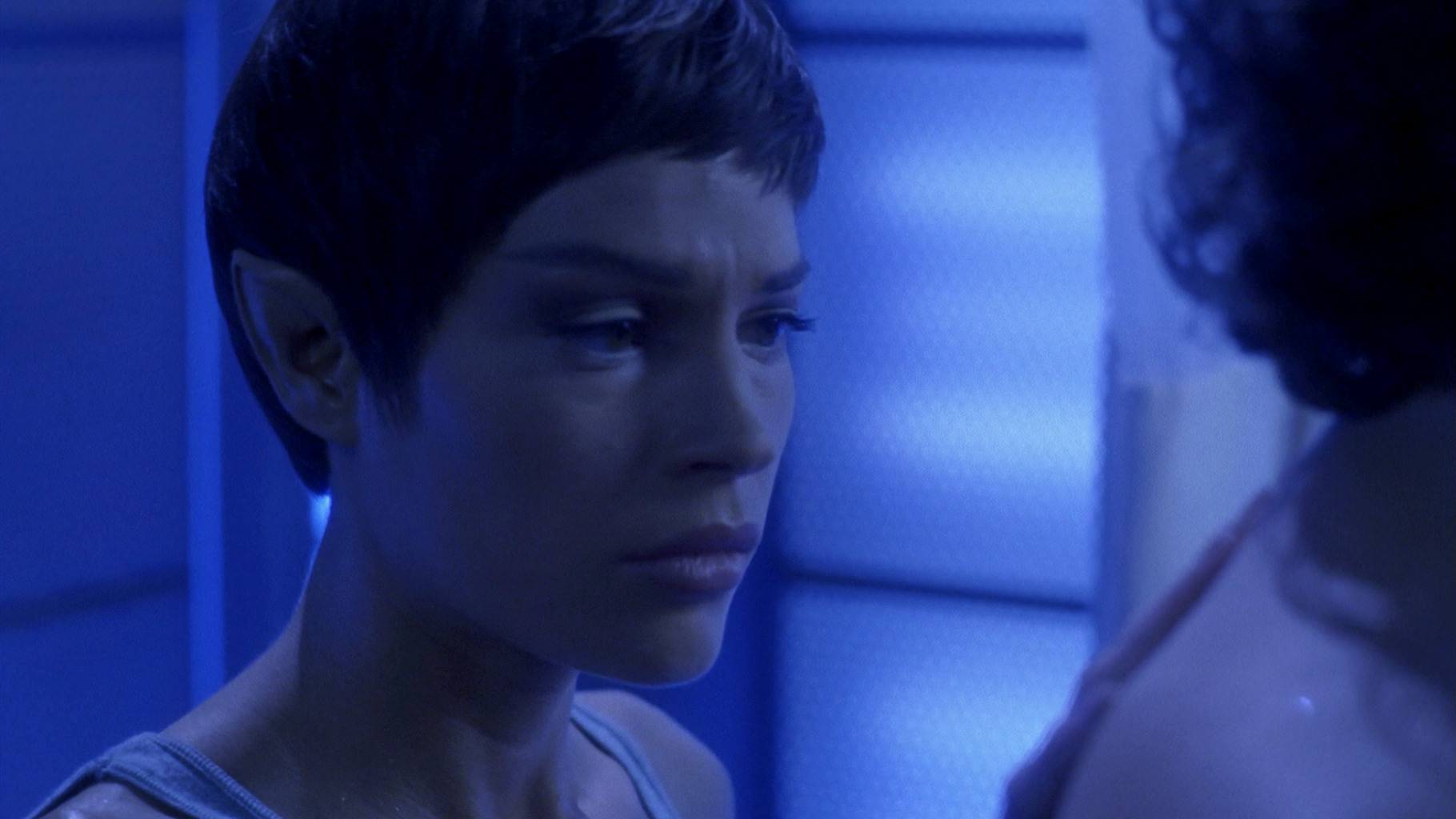
Carbon Creek
Synopsis

April 16th, 2152: During the Captain's dinner on the occasion of T'Pol's one-year anniversary aboard the ship, she tells Archer and Tucker about a historical event that must be regarded as the actual first contact between humans and Vulcans. T'Pol's great-grandmother T'Mir belonged to a crew of a Vulcan vessel that was observing the launch of Sputnik in 1957 when it was forced to crash land near the small town of Carbon Creek. The captain was killed in the impact. When the surviving crew members were running out of food supplies, they had to live among the local population. One of them, Mestral, became fond of Earth's culture - and of a woman called Maggie. He decided to stay on Earth, urging his two crewmates to pretend he was dead when a Vulcan ship arrived to retrieve them three months later.
Review
The history of the first human-Velcron contact needs to be rewritten, but more about that later. My apprehension was that this might develop into a second "11:59", a story that had absolutely nothing to do with the series and its characters and, even worse, was just banal. Well, "Carbon Creek" did not turn out that bad despite its premise. Once I understood how the episode worked, I found it mostly enjoyable. It may be disturbing that, even more than Kate Mulgrew's character in "11:59", T'Mir *is* T'Pol. Maybe her great-grandmother was really like portrayed here, but I think the whole episode rather shows the person that T'Pol imagines her to have been. We may accept that she looks just like T'Pol for that matter. So this may be taken as a character-building episode for T'Pol after all. While we know that the incidence did indeed take place (why else would T'Pol keep an old-fashioned human handbag), every "soft fact" may still be a matter of interpretation. This places the status of this episode somewhere between strict canon and the fairy-tale of "The Haunting of Deck Twelve".
We couldn't expect too much of a historical impact from the premature human-Vulcan first contact. Nevertheless, there should have been more to explore in "Carbon Creek" that was not already widely known. Vulcans stay Vulcans with all their misconceptions and lack of understanding, humans stay humans with their emotional gamut from love to violence. As already mentioned, T'Mir represents T'Pol rather than being an independent character, and the other two Vulcans are just the two opposite roles needed for such a kind of "marooned" story. There is a typically contrived climax when Mestral, against T'Mir's and Stron's advice, uses his particle weapon to free his trapped friends in the coal mine. At this time, it is already quite clear how Mestral feels about humans, and it is simply unnecessary that he still needs to prove that. On the other hand, I like how the Vulcans, unlike it has often been the case lately, stay Vulcans here. Even Mestral, who becomes enchanted with Earth's "primitive" culture in an odd fashion, always keeps up his Vulcan discipline. It only isn't very exciting. Having three Vulcan characters talk to each other all the time can probably never be enthralling. Speaking of characters, none of the regular cast appear in the episode save T'Pol, Archer and Tucker, and the two latter are only good to contribute some trivia and to prevent it from becoming a monologue of T'Pol. Well, I missed the rest of the crew and any real connection to the 22nd century, but after all it was better than the dull obsession with the ancestors everyone suddenly had on Voyager in "11:59".
The homage to TOS: "The City on the Edge of Forever" is quite obvious when the Vulcans find the clothes line and, what a coincidence, a cap for Mestral just like Spock wore one. The gag that T'Mir puts on the dress backward so that we can see her sexy silhouette even twice, is less successful - well, it's a story by B&B. What I like is the allusion to the Vulcan prejudice that American football is a game to the death ("Fusion") when T'Mir listens to the radio broadcast of a sports match and is shocked (American readers should forgive me my European ignorance. Like the Vulcans, I have no idea of what sport!). Also, the scene when T'Mir and Mestral enter the bar is great. Even if their ears were exposed, they couldn't look more alien to the indigenous people. Still, the humor is overall toned down compared to previous episodes with strange encounters. Just think of DS9: "Little Green Men", which was great but also very silly - and impossible to do with Vulcans.
There is at least one impact the "Carbon Creek" incident has on the Enterprise universe. T'Pol does have a good deal of interest in her ancestor's adventure on Earth (otherwise she wouldn't keep the bag, she wouldn't have visited the town and she couldn't tell the story by heart) and maybe in Earth's population too. Having more insight in human behavior than most other Vulcans, even those who have spent some time on Earth too, this may explain her recent support for Archer's actions. A nitpick in this respect: "Broken Bow" told us that T'Pol had hardly left the Vulcan compound, not even for sightseeing. Now she says she has gone to Yellowstone and the Carlsbad Caverns too. In addition, note that there are apparently no interesting places on Earth to go outside the USA, neither for a visit nor for an emergency landing - well, it's a story by B&B.
Finally, technology-wise, it appeased me that it was regarded impossible and remained impossible to construct a subspace transmitter with Earth's technology. Only one week ago every miracle was still achievable with some simple tinkering.
Annotations
- Remarkable quote: "I need to go now. 'I Love Lucy' is on tonight." (Mestral)
- Remarkable facts:
- T'Pol's age is "classified". I doubt that it will be ever mentioned on screen.
- The distress call was picked up by a Tellarite freighter.
- To raise money for Maggie's son Jack to go to the college, T'Mir sells an invention to a patent office - it's Velcro! Are B&B fans of the Velcrons in Sev Trek? Even more remarkably, in the real world Velcro was indeed invented by a man called George de *Mestral*. Wow. Only now I notice that we never had a Vulcan name like that so far.
Rating: 5
Minefield
Synopsis
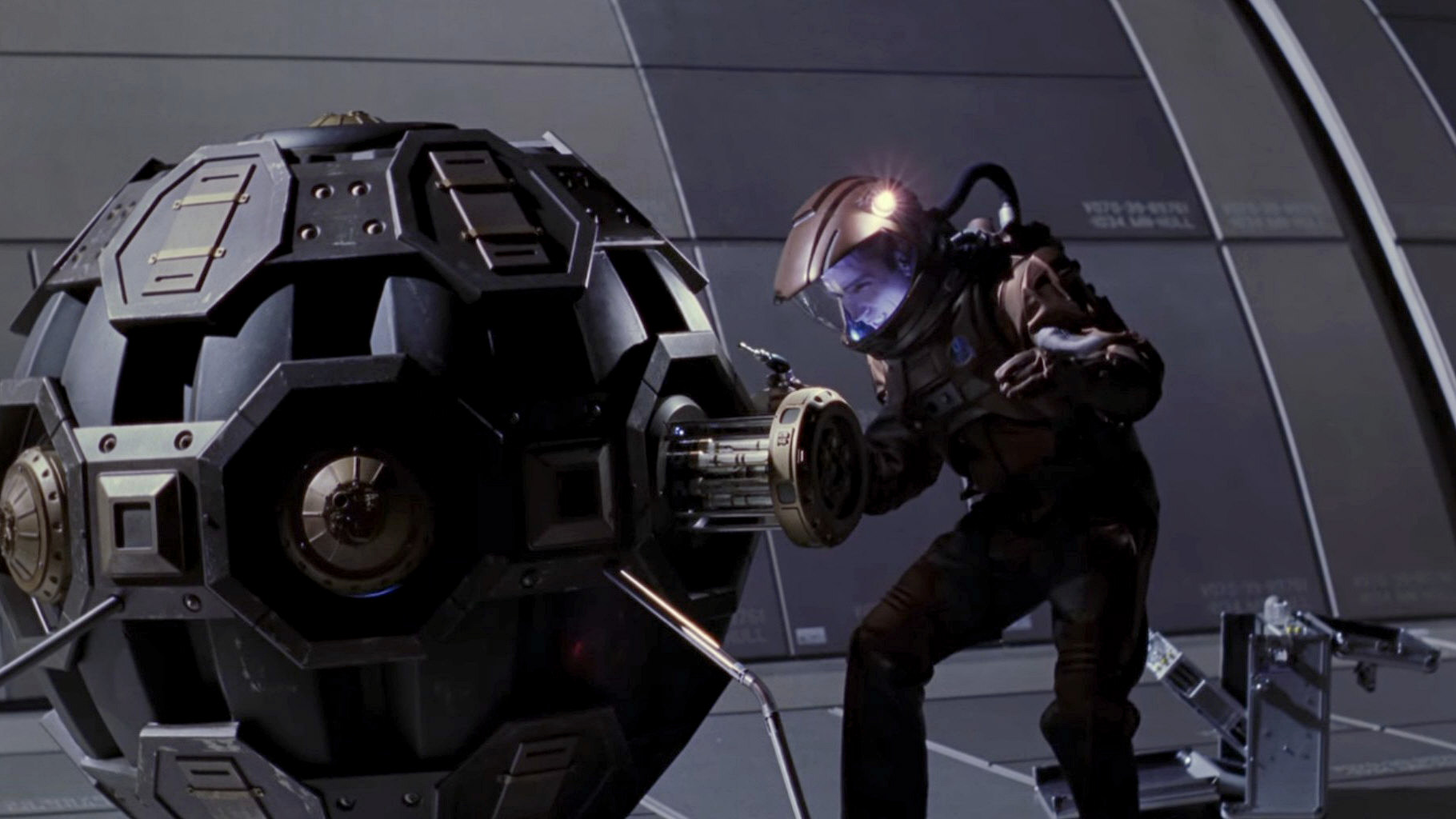
Date not given: When entering orbit of a newly discovered Class-M world, Enterprise is struck and heavily damaged by a cloaked mine. Another mine is stuck to the hull and Reed goes out to disarm it. During his effort a spike stretches out from the mine, penetrates his leg and nails it to the ship's hull plate. Archer comes to help Reed, but he might have to let the hull plate float away together with Reed in order to save the ship. In the meantime, Romulan ships appear at the scene, claiming the planet for the Romulan Empire and demanding Enterprise to leave immediately. With no chance left to disarm the mine, Archer removes the spike in Reed's leg, thereby triggering the detonation mechanism. They protect themselves from the explosion hiding behind shuttle hatches.
Review
Romulans! They did it! No! No! Noooo! But wait - it wasn't that terrible. Actually, it was the most thrilling episode in quite a while, full of action and computer-animated eye-candy. It was an essentially simple ticking-bomb plot. But the scenes involving Reed and Archer as they were having breakfast and later disarming the mine were good writing and acting. It was not trivial. It was not foreseeable.
There is a common consensus that the chemistry between Reed and Tucker in "Shuttlepod One" worked out well, and I agree about that part. But the shuttlepod episode was too painful too watch and yet overall implausible compared to Reed, Archer and the bomb in "Minefield". Maybe Reed exaggerated in his intention to play the hero, but I think it was absolutely in character. Once again, we could learn a good deal about this underused character, this time about his motivation and his goals. For instance, that he didn't join the Royal Navy because of aquaphobia. I am looking forward to future revelations about him. If only the authors wrote something like that for Mayweather too! Well, Mayweather had at least the scene in which he steered the ship manually out of the minefield, using a joystick (with no fan complaints about the device this time).
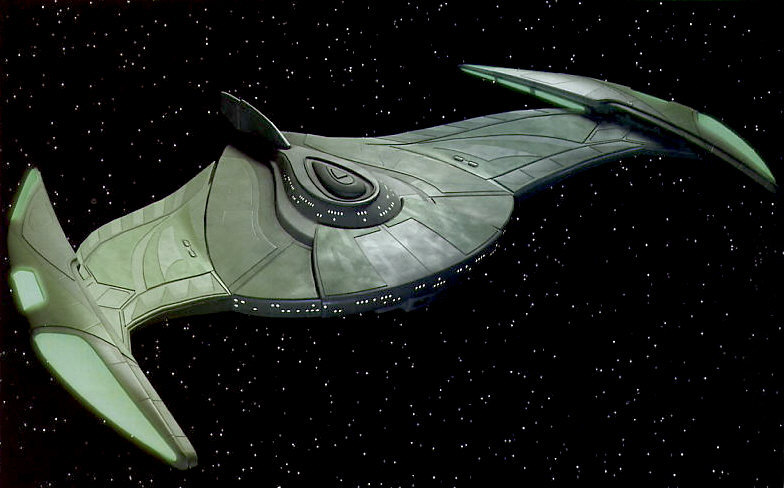
There were quite a few annoyances though. The early Romulan ship is overall a nice homage to the TOS Bird-of-Prey, but why must it have much the same sophisticated nacelles as the (uninspiring) Klingon Raptor class? I see the Romulan ship as a "complementary Akiraprise" because here the nacelles are unbecoming and the rest is fitting... The bird painting on the underside is missing as well. The most blatant continuity problem: the cloaking of the Romulan ships. A century later, cloaking will be something new and surprising to the crew of the Enterprise NCC-1701. Like with other technology of the Enterprise Universe too, it is a cheap excuse that this 22nd century cloaking device is just not meant to be as "advanced" as 100 years later. Why in the world did the Romulan ships need cloaking for this story at all? Of course, the mines were cloaked too, but hiding a complete starship is clearly a more difficult task and they could have saved at least that for the 23rd century. The cloak of the ships was obviously even more advanced as they were not revealed by Daniels's beacon. Moreover, the mines didn't need to be Romulan at all. But no, they couldn't go without the cool effect of having enemy ships pop up everywhere and anytime, as overused as it already is in Enterprise.
In addition, there is a problem and also a missed opportunity concerning the name "Romulan". I was really hoping for Archer to come up with that name in a predestination phenomenon, spontaneously correlating the book title "Romulan Empire" from "Shockwave" with the newly discovered aliens. But Hoshi reads the word "Romulan Star Empire" from communication records, and is corrected by T'Pol that it's supposed to be "Romyulans" (although my recording of her line sounds much like "Romyinens", but that's typical of Jolene Blalock's pronunciation). So the Romulans call themselves Romulans, and so do the Vulcans. There is no explanation why they live on planets with the apparently indigenous names "Romulus" and "Remus" which, what a coincidence, are also names from Earth's mythology. If not from Archer, it would have been so much more plausible if the Romulans had received their human name because their empire was in two star systems that some Latin lover at an astronomical institute on Earth had called "Romulus" and "Remus". Moreover, the awkward introduction of the name brings up bitter memories of the serious "Rigel" blunder in "Broken Bow". The episode that could have been wouldn't have mentioned the name "Romulans" at all and would have just shown a bird-like ship. And at the very end of the episode, we would have been shown its underside, revealing the characteristic Bird-of-Prey marking. Now that would have been cool! The ultimate question, however, is why there had to be Romulans at all in the episode. Considering that Enterprise had run into aliens far more threatening than this rather patient and forgiving species. The Romulans would have deserved to play more than the role of aliens-of-the-week here. Remember "Fight or Flight" or "Silent Enemy", with the latter being the *perfect* but missed occasion to introduce the Romulans as a real menace?
As usual in action episodes, there were several plot holes. The most obvious one: Why didn't they use the transporter to get Archer and Reed away from the mine that was about to explode? There was no explanation as to why it was not possible. Is the device suddenly considered more risky than the immediate vicinity to the explosion of a mine that could tear a ship into pieces? Stupid! Here we have one more Enterprise paradox. After they were eager to utilize the transporter as soon as 2151, at least 50 years too early, the writers recently avoid using it as if there were an explicit directive to do so. Much of the former continuity is already down the drain when they finally make a 180-degree turn, which impairs the remaining credibility even more. Another problem is how Travis, by just moving the ship and opening the hatch, could retrieve Archer and Reed who had been blown in different directions by the mine blast and who, moreover, should have *considerable* relative velocities to the ship. With Reed's tricorder Enterprise is coming dangerously close to Voyager-age miracle scanning devices that can analyze alien technology that has been completely unknown a few seconds ago and can precisely and without any doubt tell which part of the mine is doing what. Finally, no one is killed in the big mine blast. Are the authors trying to make up for all dead crew members in the four previous series by now never killing anyone? Isn't it ironic and paradoxical that Enterprise, set in the "unsafe" 22nd century is the first Trek series to run for one season without any fatality among the crew?
Annotations
- Remarkable quote: "I would consider letting you amputate but if chef got hold of it, he'd be serving 'roast Reed' for Sunday dinner." (Reed)
- Remarkable facts:
- England makes it to the finals of the Football World Cup 2052 (The world cup should take place in 2050, but maybe it's the women's cup?).
- The ubiquitous tool called "hyperspanner" already exists.
- The mine is using tricobalt explosives.
- Malcolm Reed's great uncle, who was aquaphobic too, served as the Chief Engineer of the submarine HMS Clement. When the vessel hit a mine, he stayed in engineering just as long to allow the crew to leave on the escape pods, and he went down with the ship.
Rating: 6
Dead Stop
Synopsis

Date not given: Enterprise docks to an automated repair facility of unknown origin where the recent battle damage as well as Reed's injured leg are being repaired amazingly fast, using advanced replication techniques. Archer's bad feelings about the station prove right when Mayweather is seemingly accidentally killed in an area under reconstruction. But Phlox finds out that it was actually an inanimate copy of Mayweather. The ensign is discovered in the station's core, together with other aliens whose brains are used to supplement the computer power. In order to escape, it is necessary to destroy the station. But as Enterprise has left, it already seems to be rebuilding itself...
Review
Sub-title: "Its origin and purpose, still a total mystery." -- It was probably wise not to mention who built the repair facility and for what purpose except for self-maintenance it offers its services to any passing ship. Maybe the station was sentient, and destroying it was actually an act of murder? But such ethical questions rather belong to TNG instead to the rude 22nd century where the best solution to pressing problems is a volley of spatial torpedoes. Our crew still has to learn a lot, and I will pardon their misbehavior. After all, it marks a difference to the world of Star Trek as it will be in later centuries. Only that it leaves a bit of a bad taste. I also wonder how Archer usually explains such kinds of incidents to Admiral Forrest (and Forrest to the Vulcans).
While it was overall almost as exciting as "Minefield", the plot of "Dead Stop" became thoughtless and predictable at the very moment when Phlox discovered that Mayweather wasn't dead (with a very contrived reasoning). Well, in a way it was reminiscent of the impulsive plot development in TOS, not only because there are some allusions to specific TOS episodes such as "Shore Leave" (Mccoy's feigned death on the automated planet). Like everything that appears to be generous in the Star Trek Universe, the station in "Dead Stop" is hiding the usual dark secret. Even though I anticipated that, I would have expected to see a more classy resolution than the station as a simple "brainsucker". It was just not fitting to see alien bodies (among them a Klingon) hanging in an untidy dungeon, seeing how vastly advanced everything else was. Moreover, we have seen so many plots like that, starting with the infamous "Spock's Brain". What I disliked too was how the vastly advanced technology of the station could be eluded with ease, using a quickly devised plan. And while it was at least a part of the plot here, it seems the authors simply can't go without all the cool 24th century technology. It is not only installed on Enterprise itself as regular equipment, but appears in even more sophisticated forms in the hands of aliens in about every second episode. This week's featured technology was the replicator, in a quality that even the Starfleet of the 24th century can only dream of (Imagine how fast a complete ship could be built!). Where is the necessary limit? The continuity buster of the week, however, is the Rigelian fever. 100 years later, it will be deadly and highly infectious (TOS: "Requiem for Methuselah"), but here it is rather easy to cure and to confine. Of course, we may explain it in a way that it will mutate to a more dangerous variant, but at some point we become tired of twisted thinking and rather admit that once again a homage wound up as a gaping error.
What I found silly and irresponsible was Trip's and Malcolm's attempt to break into the station's core just out of curiosity. When will these guys finally grow up? As I said, our crew are a bunch of space apprentices. It was also disappointing that for once Mayweather, the overpaid extra, played a small role here, only to be "killed" and forced to be passive for the rest of the episode. Why do the authors ignore the potential of his character?
Annotations
- Remarkable facts:
- Dr. Phlox employs Regulan bloodworms to heal injuries, but Lt. Reed is anything but fond of them.
- Once again, there is a mention of Tellarites who are "not the most agreeable species, but they are mostly trustworthy", according to T'Pol. I bet we will see them soon.
- The Tarkaleans (one of the more prominent yet unseen T-Races) are mentioned too, and rather coincidentally than consciously, there is no problem with them being around at this time in this part of the galaxy.
- Remarkable decoration: There is a fascinating piece of decoration in Mayweather's quarters: a miniature of the Nomad probe in its original configuration. This is fitting, as there was another allusion to TOS: "The Changeling", the scene in which Reed was "repaired" by a probe.
- Remarkable quote: "Your inquiry was not recognized." (the station's computer voice)
Rating: 5
A Night in Sickbay
Synopsis

Date not given: On a visit to the Kreetassan homeworld Porthos has picked up a pathogen. The Kreetassans, who are offended because Porthos peed on a sacred tree, refuse to deliver the promised plasma injector and would not help find a cure for the dog. Archer stays up virtually a whole night, worried about his dog and pondering about a possible apology to the Kreetassans. A surgery quickly improvised by Dr. Phlox saves the dog's life. The next day, Archer undergoes a strange apology ritual which pleases the Kreetassans so that they deliver the injector.
Review
Oh my god. Do really I have to review this episode, although it is nothing but a pathetic piece of pulp? Wouldn't it be better to delete all the records and deny its existence? As hard as I may try, there is absolutely nothing enjoyable or otherwise positive in it. Half way through the episode I was already tired of it, but it unfolded a potential to become still worse with every minute.
To start with, everything about "A Night in Sickbay" is extraordinarily trivial. Well, Porthos could die after all, but we know that this wouldn't happen as he sort of belongs to the main cast. Our brave captain has yet again offended someone and is supposed to apologize, so why does this have to take a complete episode this time? Archer's sudden sexual frustration completes the list of plot ingredients. Triviality alone need not be bad. However, three trivial threads in one episode, together with the stupid dialogues, the loads of gratuitous sexual references, the unsuccessful attempts at comedy and the uninspiring role stereotypes make this the probably worst episode of modern Trek.
What was intended to be humorous moments in the episode turned out as awkward as never before in this series and very seldom in Star Trek. Phlox's side note that there are Denobulan animals resembling dogs and "most of them have one head" was still one of the few funnier examples. Even the Kreetassan apology ritual at the end that may have ridiculed an average episode was less embarrassing than most of the rest. Phlox's messy toenails and his long tongue were just too cheap jokes to be worth commented on. The same goes for the second pee joke in three weeks. When Archer and Phlox desperately tried to catch the bat, I was already sorry that I was watching although I had just nothing better to do. Is this Star Trek, or rather a slapstick flick? Archer's illusions and Freudian slips ("I'm doing the breast I can.", "Send me your lips.") sound like they have been penned by teenage fanboys and not like something that I may expect professional authors (namely B&B!) to come up with. The sad climax of bad taste was reached with the dream sequence of Porthos's funeral and Phlox as a priest, followed Archer alone with T'Pol in the decon chamber - I can't remember ever seeing something that cringeworthy on Star Trek. I was watching the episode on a train, and I was actually worried that someone might have thought it was porn.
Most of all I was irritated why Archer was suddenly experiencing sexual attraction to T'Pol just when his dog was ill. If at all, wouldn't he rather feel like that because of boredom and not in a state of emotional stress? Was he troubled about Porthos at all if everything he can think of is sex? The timing makes no sense at all. The characters were out of place and their potential was wasted. Most frustratingly Archer with his wet adolescent dreams and his petty ponderings and Phlox with his barefaced nonchalance. These two kept annoying each other and the viewers.
Something that needs to be mentioned too is the intrusive score of the episode. I usually never spend too much attention to what is played in the background, but this was easily the least fitting music I have ever heard on a Star Trek episode. It was obviously supposed to cheer up the dull story in that the pitch and volume was increased several times. But it was almost always totally inappropriate. There was simply no suspense that could have been emphasized when people were just normally talking. Well, the score kept me from falling asleep after all.
Annotations
- Remarkable scenery: The Kreetassan homeworld belongs to the best CGI scenes created for the series.
Rating: 0
Marauders
Synopsis

Date not given: In a remote alien mining colony Archer, T'Pol and Tucker witness how the colonists are oppressed by Klingon marauders. After fighting them once and losing eight lives, they are now intimidated, but Archer eventually convinces them to take their chance. In order to avoid an open conflict with the Klingons, it is necessary to avoid fatalities among them. Upon their return, the Klingons step into a trap set up by the crew and the settlers. Being overpowered, they are sent back to their ship and told never to come back.
Review
Mark at Trek5.com called this "The Magnificent Seven Lite", but to me it rather seemed like "The A-Team Deluxe". Simple stories need not be the worst ones, and I rather liked the basic idea that is also a homage to TOS: "A Private Little War". The reason why I did not enjoy "Marauders" so much as a whole is because the characters did not touch me, because I failed to see their motivations and because I missed much of the necessary plot logic (especially as this plot was so simple).
On the bright side, there was some emotional involvement from the part of Trip who met the boy whose father - as he would learn later - had been killed by the Klingons. But that was nothing compared to Kirk in the TOS episode. Archer, in contrast, was very arrogant and insensitive here. Tessic had just told the captain of the futile fight against the Klingons and the eight lives they had lost. As a response, Archer knew nothing better than to praise his own courage and dedication. Archer, who has not lost anyone of his crew so far, who has all the fine weapons and other tech, who has a trained crew. T'Pol showed a new side when she turned out a master of self-defense. I liked that aspect which fits with Vulcan philosophy, and it can compensate for the impression of T'Pol's completely inappropriate snow-white and skin-tight desert outfit, which was this episode's concession to the target group (you guess it, written by B&B). Hoshi had a nice scene when she successfully fired at a hovering training target ball, with nice continuity to her less successful first training in "Sleeping Dogs". The Klingons were just dull. Their transporter (yes, they have one!) must have been misaligned and must have left their brains on the ship. The villagers had the "orphan kid pity factor" on their side, but otherwise they did not strike me as very interesting. Maybe it would have been worth showing them as more ambiguous, and not as the lethargic and helpless victims who need "Action Archer" and "Tank T'Pol" to tell them what to do.
What actually bothered me most was the absence of logic in the showdown. So Klingon tactics are "crude", but that of Archer was plain stupid. Why didn't they shoot at the Klingons when these had just beamed down and were all standing together? Why did the crew even expose themselves and the villagers to the extreme danger of a hand-to-hand fight with the Klingons? Don't anyone tell me that a few hours of Vulcan martial arts practice should be sufficient to evade a bat'leth! If it was because they didn't want to kill the Klingons for the sake of peace, I wonder what has happened to the stun setting of the phase pistols. Why all the efforts to move the village, which would have been futile if the Klingons had not followed the villagers to the hills? Much worse, they could have just used their supposed ship weapons to blast away the hills or the village or both, furious as they were. Fortunately, it took the incredibly stupid Klingons several minutes until they could smell the gas and the trap. But who says that they wouldn't return any time, maybe with reinforcements, when they are not expected? They are Klingons, and not Ferengi! Even with Vulcan self-defense techniques and other tricks, the whole plan was ill-conceived and simply irresponsible.
Annotations
- Science & technology:
- The scientific errors of the episode are severe. First of all, it is just wrong that ordinary deuterium should be a "valuable commodity", as Archer put it. Considering that deuterium could be easily extracted from water, air or maybe from interstellar clouds, why go through all the efforts of mining it on a remote planet? And if the miners really find plain deuterium in the soil, why do they have to "refine" it? It is already a gas, there is no point in chemically refining it. And wouldn't burn deuterium in a blue flame?
- This leads me to the ultimate crap-of-the-week, the statement, "deuterium can burn almost as hot as plasma, when it's ignited." I almost fell off the chair. Plasma *is* hot deuterium! Of course, there could be other types of plasma as well, but that would be as senseless as saying, "apples are almost as tasty as fruit." Where is Andre Bormanis when he is needed? He could have simply replaced deuterium with yet another newly invented substance, and I would have had no reason to complain.
- There is also a big problem with sensor capabilities. In the first season, Enterprise was barely capable of detecting an incoming ship as fast as the eye could already see it. Suddenly, the sensors can distinguish Klingon lifesigns (twelve of them) on a suddenly approaching ship (whereas the Klingons obviously detect nothing!). Now that the ship is already better than the NCC-1701-D, I wonder when the technology will reach the Voyager level and be able to distinguish single lifesigns over dozens of light years.
- Remarkable dialogue: "You won't hurt me." - "It's not you I'm worried about." (T'Pol and Mayweather)
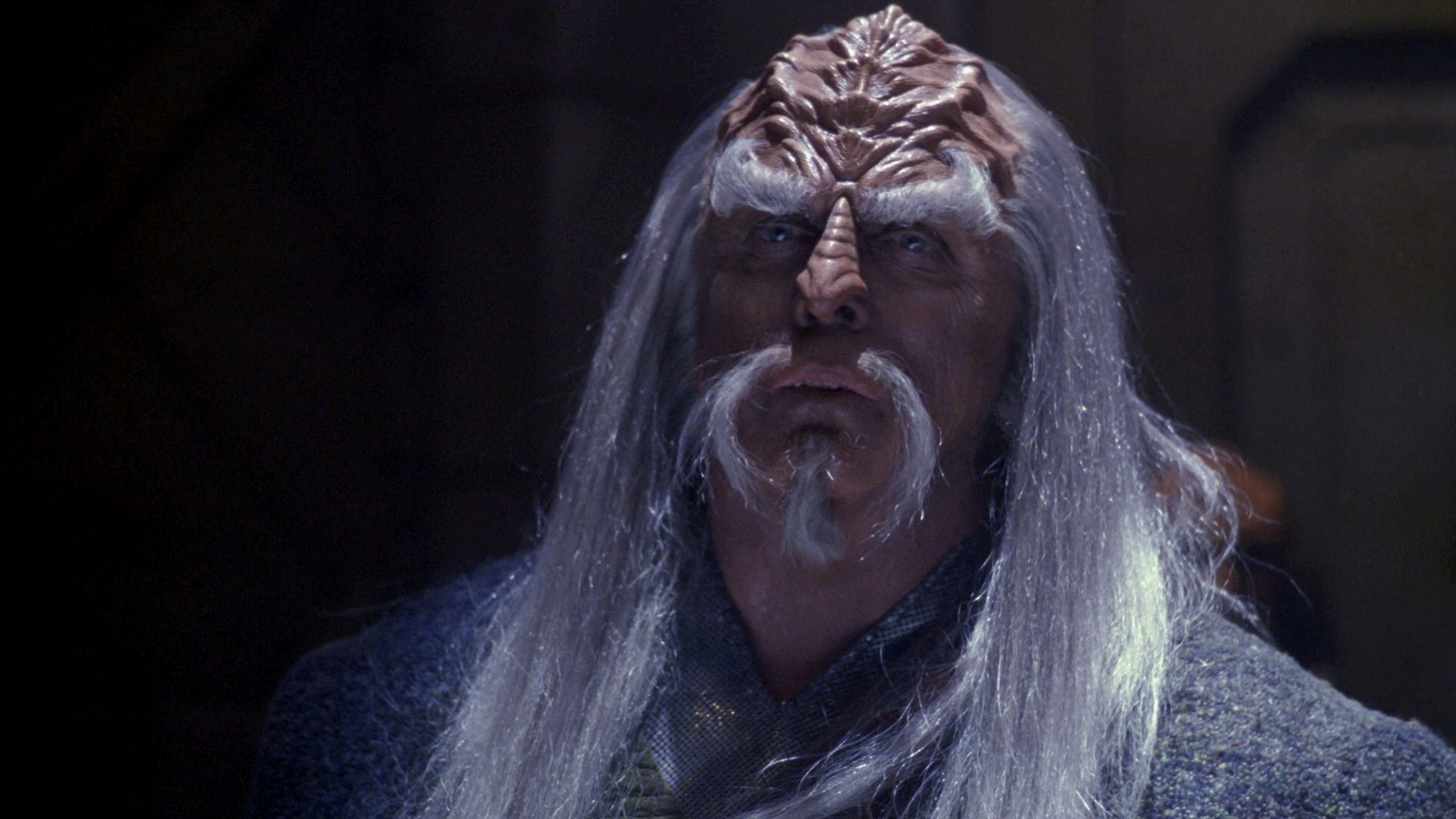
- Remarkable props: We see several alien weapons, including a Jem'Hadar rifle and a Bajoran rifle, all covered with some dirt and rust, so they are not quite as easy to recognize as anachronistic. The Klingons, on the other hand, have very fitting clumsy disruptors that remind me rather of the TOS version than anything else.
Rating: 3
The Seventh
Synopsis

Date not given: T'Pol is in charge of apprehending a renegade Vulcan, Menos, who did not return from a covert mission on an alien planet 30 years ago. Against her orders, she asks Archer to join her. The two find Menos on a trade outpost and arrest him. T'Pol becomes unusually aggressive and demands that Menos confess his supposed crime of smuggling biotoxins, while Archer is sure that the man is not guilty. It turns out that, on her first mission to retrieve the seven defectors, T'Pol killed one of them, Jossen, on Risa. Suffering from emotional stress, she went to P'Jem for a ritual to forget this incident, but the remorse is now resurfacing. After Menos has escaped just another time, the away team discovers the hiding place on his ship and, finally, the biotoxins.
Review
In Star Trek as we (hopefully) still know it, Vulcans were shown as displaying no emotions, as they have learned to successfully yet often painfully repress them. Either way, single exceptions of "illogical Vulcans" in a couple of episodes rather corroborated the prevalence of logic in Vulcan society. Since Enterprise, it seems that every single Vulcan belongs to one the following stereotypical groups. First of all, the faithful followers of logic, narrow-minded and arrogant towards lesser species like humans, Vulcans just as Soval and about all other high-ranking representatives. Secondly, the (apparently) smaller number of those who strive to expand their horizon while adhering to logic, like Ambassador V'Lar and lately T'Pol. Thirdly, the amazingly large group of emotionally unbalanced dissenters, including the folks in "Fusion", Mestral in "Carbon Creek" and now Menos and his comrades. Considering how frequently we meet them (in every tenth episode so far!), they are shown as a very relevant group and not a small minority. Moreover, a large percentage of Vulcans seem to be eager to defect, if they are only given the chance. Are the rest of them prisoners on Vulcan? It almost seems so. It is already critical enough that the Enterprise writers, in an obvious lack of fresh ideas, frequently fall back to the idea of "illogical Vulcans". They are just toying with an important constant of Star Trek that, in their short-sighted notion, is nothing more but a cliché - and they don't seem to be aware that they are destroying it. I could still see a redeeming value in the new revelations about the Vulcan mind and soul. But at some point, I must question whether Vulcans are still credible as aliens at all, considering that they commonly exhibit the full bandwidth of human emotions, and only some rituals keep them from becoming just like us. There appears to be a general misconception that authors write for human actors and thereby unconsciously or unwittingly provide aliens with all the characteristics of humans. Klingons are one of the few lucky alien races that have been allowed to develop a distinctive culture and individual behavior. Unfortunately, Vulcans in Star Trek are slowly being demoted to humans with pointed ears, green blood and dry intonation (and the latter only in states of emotional balance).
Aside from the above, I have rather little to say about the episode itself, which left me very unimpressed. Reviewers that value actor performance and character interaction above all may have had their pleasure with "The Seventh". But in my view the meager idea was simply not worth while getting T'Pol on cordrazine and jeopardizing the whole Vulcan legacy one more time. Jolene Blalock is great as an actress as I may have said before, and she really looks intimidating when T'Pol gets angry. But as stated above, we should not ignore that T'Pol is a Vulcan and should be treated as such by the writers, as tempting it may seem to explore other possibilities. This applies to Menos likewise, who was another convincing character, but not a convincing Vulcan. It occurred to me that there was no necessity to make him and the other six Vulcans at all - bearing in mind that he didn't even look like one! There was no real discussion about the Vulcan way in this episode, and T'Pol may have felt remorse about killing any member of any other species likewise.
I didn't like the technical aspects either. The action sequences were rather crude, the alien outpost reminded me too much of the one we have already seen in "Broken Bow". There is also one obvious technological annoyance: the holographic cloaking. Devices of this kind have become so familiar in Enterprise as even I myself would not have predicted in my worst apprehensions. There was at least one apprehension that did not come true: Although Archer and T'Pol talked about it even twice, there was no decon scene in the end.
Annotations
- Remarkable quote: "I could polish the handrails in engineering." (Tucker, about what he could do during Archer's absence)
Rating: 2
The Communicator
Synopsis

Date not given: After an undercover away mission to a pre-warp planet, Reed notices that he lost his communicator there. When they return to retrieve it, Archer and Reed are captured by the regional military. They are mistaken for spies of the declared enemy, the Alliance. When it is discovered that they are not the same species as the planet's population and photos of their shuttlecraft show up, Archer and Reed pretend that they are genetically altered test pilots of a secret test aircraft of the Alliance. They are just about to be executed when they are rescued with the help of the cloaked Suliban pod ship.
Review
As my reviews indicate, I haven't seen anything that could grasp my interest or give me inspiration lately. Once again, here is one that ranks among the so far least interesting episodes of the series. Only that it was not quite as annoying as "Shadows of P'Jem", not quite as boring as "Oasis" and not quite as mindless as "A Night in Sickbay" that all seemed equally like a waste of time. The beginning of "The Communicator" was still charming when Reed discovered that his communicator was missing. Yet, I wonder why some reviewers compared the episode to TOS: "A Piece of the Action", of whose light-heartedness this episode had absolutely nothing in the following. "The Communicator" is a perfect example how the Enterprise authors are tenacious to provide a certain number of episodes with a certain entertainment factor but without too many ramifications and complications. As such, the episode quickly developed to one of Enterprise's usual beating and shooting orgies and lacked the fine tones that have always been one of Star Trek's virtues. The topic of dealing with pre-warp civilizations was discussed only superficially. There was practically no aspect that wouldn't have been covered much more profoundly in episodes like "Dear Doctor". And the much better episode about an alien prison was "Detained". The same applies to the rather casual interaction between Archer and Reed in this episode with respect to "Minefield". "The Communicator" was not a completely hapless episode, as its simple plot worked out nicely. But with hardly anything unique to it and largely without a sense of humor it will only be remembered for either its good deal of violence or for the sub-plot with the Suliban cloaking and Trip Tucker as The Invisible Man (that accounts for a full point).
The only really new aspect of the episode was summarized by T'Pol in one sentence: "You don't need technology to contaminate a culture." In this regard, I wonder why Archer didn't try to tell the truth. It is easy to anticipate that this incident will give the determination of the military to destroy its enemy a boost. Spreading a rumor can be more detrimental than spreading weapons. Of course, I didn't miss the probably intentional parallel between this planet and the Cold War on mid-20th century Earth. While I agree with the attempt to criticize the paranoia and intolerance in those days on Earth, I wonder why Star Trek frequently creates alien worlds just like in TOS: "A Taste of Armageddon", TNG: "Attached", VOY: "Resistance", among many others, that are in much the same state of their social and political development. This must get boring! Moreover, it is just not fitting to create aliens in the first place, only to give most of them a society and even specific patterns of behavior that are exactly the same as those of humans. Considering how often fans complain about aliens with just a too human look (only with some protruding bones), these are similarities that bother me much more. Like so many times before, there was absolutely nothing alien about this week's aliens. This could have been a time travel episode as well, and they could have worn American or Soviet or Nazi uniforms, but the much better episode of that sort was DS9: "Little Green Man", as silly as it seemed.
Annotations
- Continuity:
- Almost needless to mention lately is that the transporter is not used and not even considered an option at any time. It is just as if the technology didn't exist or as if a spell was on it. It is now obvious that there must be a directive to the authors to silently bury the device. Not, as avid fans have pointed out to me, to "maintain consistency and plausibility" (for which it would be much too late!!!). I speculate that Enterprise is meant to stay down to Earth literally, and the possibility to beam up and down at will would only be counterproductive to isolating our heroes in caves or prisons.
- Concerning the plot logic, only one thing really annoyed me, but this is already a common cliché: Of course, all the devices taken away from Archer and Reed were still in the general's office, and this office was located next to the execution yard, so they could be retrieved much too easily.
- Another question is why the general wanted to execute Archer and Reed so quickly, and did not even attempt to find out the whereabouts of their alleged secret aircraft.
Rating: 1
Singularity
Synopsis

August 14th, 2152: While approaching a black hole in a trinary system, the crew begins to become agitated and obsessed with trivialities instead of caring about their duties. Only T'Pol is unaffected. The reason is radiation coming from within the system. With no more than two hours left until the crew will die, T'Pol's only chance is to navigate the ship through a debris field close to the edge of the black hole. She wakes up Archer, who is hardly able to handle the helm, but with help from Reed's newly installed alert protocol the ship finally breaks free.
Review
Just in case that still proof is needed, this episode strikingly demonstrates that Enterprise authors create many stories entirely from a pool of stereotypes and trivia. First of all, the most overused theme in all of Star Trek and maybe all science fiction on TV, namely "crew acting strangely under alien/radiation influence", is resurrected once again. Knowing TOS: "This Side of Paradise", TOS: "The Naked Time", TNG: "The Naked Now", TNG: "Night Terrors", DS9: "Dramatis Personae", VOY: "Bliss" and finally ENT: "Strange New World", to name only very few episodes along these lines, there is nothing interesting about this idea any longer. No need to mention that, as usual, it happens in a situation that is life-threatening and that, as usual, one crew member is immune and saves the ship. The fine acting (the best I have seen lately) could compensate for the exasperating plot to some extent. Although it was not new either, I liked how everyone of them discovered his or her personal obsession, be it Hoshi as an avid cook or Dr. Phloxenstein who almost performed an unnecessary brain surgery. Well, only that his helpless and accordingly silent victim was no one else but Ensign Mayweather - it's cliché time.
But on a serious note about the characters: In the first part of the episode I was a bit frustrated how adult people could possibly care that much about trivialities, from the Captain's chair over the name of an alert to cooking recipes - but it didn't surprise me. Rather than that, I was surprised that it was *not* meant to be the normal business on the ship and their normal behavior, but that they were acting under the influence of a strange radiation. Such are my expectations after one and a half seasons of Enterprise (and yes, the episode was ironically less predictable just because of that). With "A Night in Sickbay" still in fresh memory, my reaction may be allergic, but I think I can't stand so much humor at a time any more, even if it really isn't that gratuitous here. Well, I don't know if it was really more satisfactory that it was not their own will this time, but because of the bad radiation.
On the bright side, the episode had at least good continuity when Phlox mentioned the incident at the repair station to Mayweather. Also, as simple as the whole plot was constructed, as well did it work out. It was largely free of scientific crap, and was quite exciting or frightening at times. It was just the best that could be made of the thin story. Finally, we get to see another Vulcan nerve pinch (when T'Pol saves Travis from the mad doctor), and the first mention that Hoshi, aside from her looks, is of Japanese descent and not your average all-American crew member.
Annotations
- Remarkable quotes:
- "And Malcolm – don't call it 'battle stations.' Think of something less... aggressive." (Archer)
- "CARROTS!" (Hoshi, to a crewman)
- Remarkable dialogues:
- "It's the *Captain's* chair. It's just as important as your... Reed alert." - "Reed alert. That's not bad..." (Trip and Malcolm)
- "How are you feeling?" - "A little tired, but the headache's gone. What'd you do?" - "Very little. Fortunately." (Phlox and Travis)
Rating: 5
Vanishing Point
Synopsis

Date not given: When a polaric storm approaches the ancient ruins that Tucker and Hoshi are examining, Archer orders the two officers to be beamed up to the ship. Hoshi is to go second. Upon her return she begins to feel dizzy as if her molecules had not been correctly reassembled. After some time she becomes aware that she has become invisible and is declared dead. Hoshi discovers that aliens are apparently planting a bomb to blow up the ship, but her attempts to warn the crew are in vain. Finally, she materializes on the platform and she is told that nothing that happened to her was real. She only spent eight seconds in the pattern buffer.
Review
This episode may be reviewed fast and easily. The best I can say about it is that thanks to the twist at the end it didn't impair continuity too much. Well, Hoshi may have experienced transporter psychosis (TNG: Realm of Fear") long before it should be discovered, but at some point even I am tired of discussing such continuity issues, so never mind. The surprising outcome was also at least a little novelty of the episode. Although I know may fans hate "It was nothing but a dream" episodes, it was absolutely necessary here. Without this outcome it would have scored zero points and even cute Hoshi's being in the focus couldn't have saved it.
Essentially we know the story all too well. With the exception of the last three minutes it was an unabashed rip-off of TNG: "The Next Phase", with some elements clearly taken from TNG: "Remember Me". In this respect it was devoid of any originality, even more so than "Strange New World" or "Oasis". Berman & Braga didn't have a hard time writing this at all, as every single aspect of the story had been shown before: the transporter problem, the astonishment of seeing that she has become transparent, the horror of witnessing how she is declared dead, the attempts of communication, even the aliens who are planting a bomb. At least the latter part of the narrative could have been easily omitted because of its absurdity, but the authors were obviously keen on presenting a carbon copy of the popular TNG episode, where Geordi and Ro Laren experienced exactly the same. It doesn't make much of a difference that Hoshi's adventure was only an illusion, as it's simply not possible to make up with an unexpected ending for an episode that otherwise fails to present anything exciting and new. "The Andorian Incident" suffered from the same dilemma.
It may be unfair to blame Enterprise for the mistakes made in the previous shows with their frequent transporter malfunctions that would better belong in a time when the transporter was still mysterious. I know it's stupid, but I can't help the feeling that Hoshi somehow knew what would happen to Geordi and Laren two hundred years later. The ideas she had in her mind were those of the 24th century with its weird transporter accidents. Only the tale of the famous "Cyrus Ramsey" who vanished after a transporter test in her fantasy gave her story a somewhat more distinctive background. What is left to say is that I really liked that B&B have discovered the potential of Hoshi's character in this episode. It would have been simply awful if it had been just another Archer/T'Pol show (two characters I'm growing tired of). All three points go to Linda Park who palpably portrayed Hoshi's strange experience.
Annotations
- Remarkable title: A vanishing point is a point in which parallel lines converge in a perspective drawing. But the title may also be a pun, referring to Hoshi's vanishing birthmark.
Rating: 3
Precious Cargo
Synopsis

September 12th, 2152: Trip Tucker helps a Retellian freighter with repairs, where he has to free the female passenger in stasis because she is about to suffocate. One of the two Retellians discovers that she is awake, knocks Trip unconscious and leaves with them trapped on his ship. The woman, Kaitaama, is the Kriosian monarch and was held prisoner on the ship. The two manage to release an escape pod and land on a nearby planet. Meanwhile, the other Retellian is interrogated by Archer and T'Pol, who intimidate him by pretending that there are harsh laws on Enterprise. Eventually, a landing party can rescue Trip and Kaitaama.
Review
It is an overall average episode, most of all because we have seen very similar stories so many times before. But fortunately it is not the barefaced rehash of TNG: "The Perfect Mate" that we may have expected after reading the synopsis. Only one week after the rip-off that was "Vanishing Point" that would have been extremely unwise anyway. On the contrary, "Precious Cargo" goes into a completely different direction than the TNG episode, and the similarities are only superficial. In this regard it is odd why of all alien species Kaitaama is Kriosian though - considering that she is *not* an empathic metamorph like Kamala in the TNG episode. Two women transported in stasis, for completely different reasons, but both are accidentally Kriosian - a species that we otherwise never see. It is an extremely contrived coincidence. On the other hand, it is nice that Enterprise doesn't always show us new races, but sometimes remembers that there are plenty of them who should be already around.
It is a very lean and straightforward story without attempts to put in too much conflict potential, too much comedy or too much character development at a time. And most importantly it was entertaining. Both the main plot of Trip & Kaitaama and the secondary plot of "evil Archer" and "Terror T'Pol" work out well. The interaction between Trip and the arrogant monarch works out very well. This reminds me much more of TOS: "Elaan of Troyius" than of the TNG episode. I wonder what happened to Vulcans not being able to lie - or is pretending not regarded as lying? And Archer was so rude and aggressive that he didn't really look like he was playing.
It is a cookie-cutter story, and two of its clichés are slightly annoying. Firstly, the episode continues Enterprise's most typical trend of showing characters in various stages of undress (this time it is Trip once again). Secondly, as we know it from other Star Trek series (especially DS9), there is always a Class-M planet within a few million kilometers if an emergency landing is necessary.
Annotations
- Continuity watch: Trip mentions his "first car", and he explicitly states that it is a "four-wheeled vehicle". This implies that wheeled cars are still commonplace in the mid-22nd century. Considering that we would have to give them at least 50 years to become outdated, it is questionable that Kirk is unfamiliar with them and that Harry Kim doesn't have the slightest idea what a car is.
- Science watch: The escape pod shakes when it crosses the subspace threshold, according to Trip. This is a plausible idea, considering that the pod drops out of the warp field created by the freighter.
- Remarkable dialogue: "Isn't there any sense of humor where you come from?" - "Only among the commoners... Just joking!" (Trip and Kaitaama)
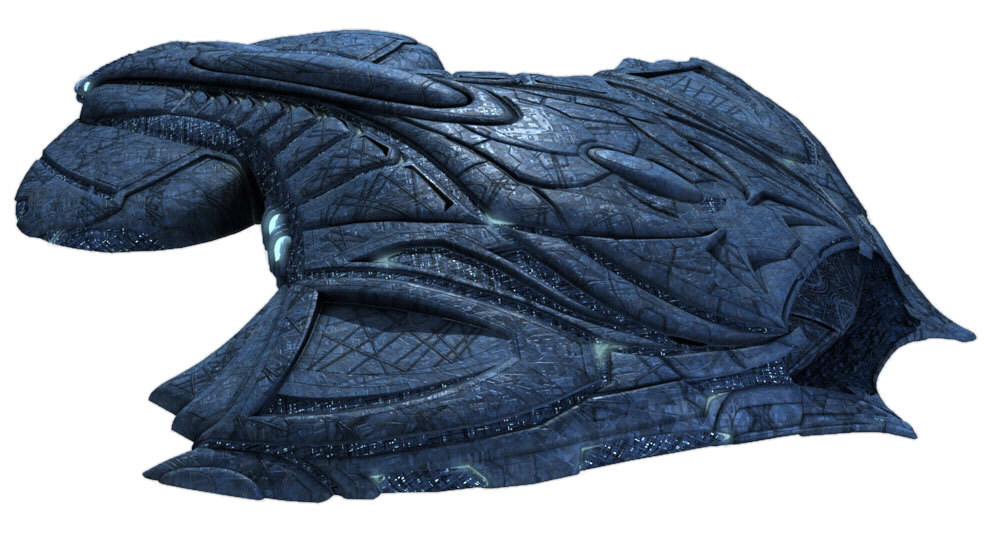
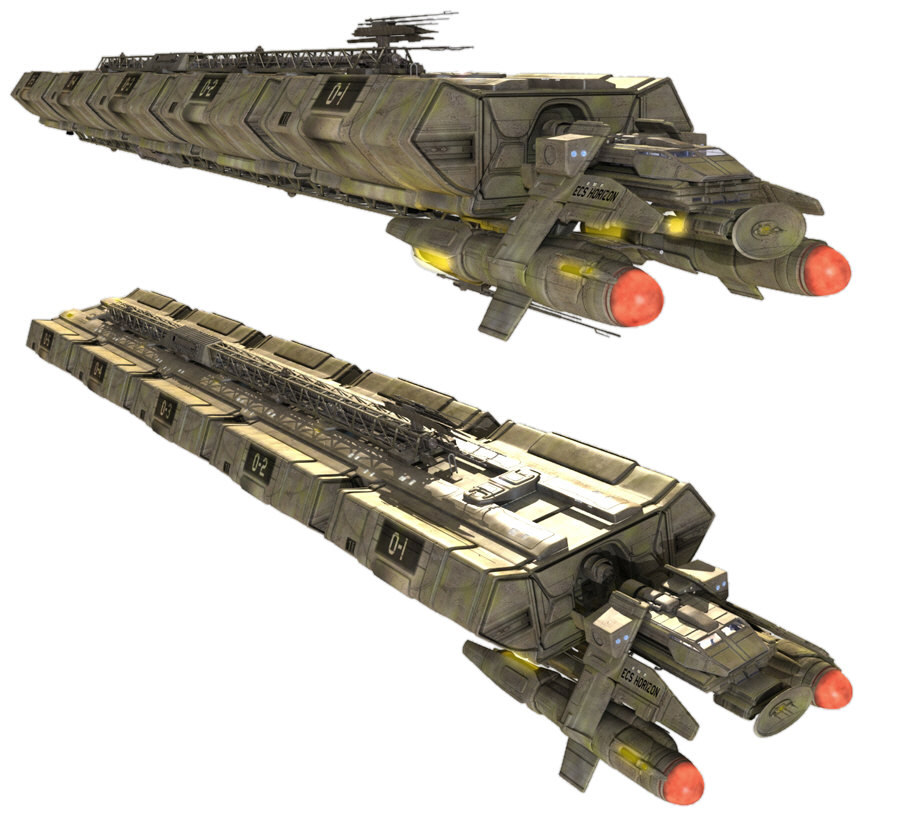
- Remarkable ships: The two alien ships couldn't have been more different. Here the absolutely credible original design of the Retellian freighter with its cargo containers (if the nacelle color were not green, it would have been a perfect candidate for the Earth freighters of the J class). There the Kriosian battlecruiser with its much too easily recognizable design of the overused Akritirian/Ba'neth/Lokirrim ship, completely out of place and time.
Rating: 5
The Catwalk
Synopsis

September 18th, 2152: When Enterprise is not able to escape a neutronic storm approaching at high warp, the complete crew has to hide in the well-shielded "catwalk" inside the warp nacelles, together with three Takret guests. After a while, Tucker investigates why the matter and antimatter injectors have come online, and he discovers that the Takret military is trying to take over the ship. The three guests are actually deserters, but the military seems to be more interested in the ship. When they are about to power up the warp drive, time is pressing. Archer, claiming that he is the only survivor, threatens to destroy the ship and has Mayweather head for an eddy inside the storm. The Takret soldiers hastily leave the ship.
Review
I liked this episode, although it was basically only a slight variant of the overused "alien takeover" plot - a bit like in TNG: "Starship Mine". I wonder if it had been still better if that part of the story had simply been discarded. The unusual situation of the crew inside the warp nacelle was already interesting enough to watch and the most original plot idea (if not the only original idea) since "Minefield".
The new catwalk set looked very credible. Fortunately not too much time was spent on fighting and shooting, and I was glad that the situation was resolved relatively quickly and easily without casualties this time. It was an overall light-hearted episode. The Takret were given a bit more profoundness than usual aliens-of-the-week, and there was both good and evil about them. I liked how their commander replayed Archer's logs to learn about the people who were on the ship he had seized (which was, BTW, from February 9th, during the incident with Ambassador V'Lar in "Fallen Hero"). Also, it became obvious that there was not only a conflict between the refugees and the military (although they never even talked to each other in the episode), but also between the commander and the soldiers who were (still) his subordinates and who only grudgingly followed his orders.
With the opportunity of showing an unusual day on board, I would have appreciated to see a bit more character development than usual. But I shouldn't complain, since there was already a good deal of it in the episode. T'Pol stated that the Vulcan ship was "nearly" destroyed, whereas Archer found out that it was lost with all hands in the storm a century earlier. That little lie (once again?) was obviously meant to boost morale. I liked how Archer somehow heeded this hint, walked around and provided moral support to his people. His attempts to convince T'Pol of fraternizing with the crew, however, were awkward as usual. But in character. Everyone of the rest of the crew had a few nice scenes too. Although it created good continuity, I was not quite so lucky that the episode also pointed out their weaknesses once more. There was Hoshi's claustrophobia again (although only in a side note), as well as Reed's nausea. With 12 billion people on one continent on Denobula, the good Dr. Phlox obviously doesn't mind the narrowness of the catwalk. But I wonder if anything in the universe could bother him so much that he would lose his nonchalance (which I think is sort of a weakness too). There were some really cute scenes and a subtle humor in the episode. For instance, when Hoshi, Travis, Malcolm and Trip gambled for food rations. Or the first appearance of the Chef, Enterprise's version of "Mrs. Columbo". We only saw his legs and I doubt that we will ever see more of him.
Unfortunately, it was a tech-heavy episode with some grave errors. The most obvious one was that Archer could see the approaching storm through his window. If the storm was already at high warp, the light would have been even faster! I also wonder why no one inside the nacelles could detect the alien ship. External sensors must have been online, as Mayweather was supposed to navigate through the storm. Furthermore, when Phlox asked about the absorption depth of the alloy (of the nacelle casing), Tucker said that it is "at least 20,000 particles per micron". For once, this wasn't an absorption depth, but, if anything, an absorption coefficient (the reciprocal value of the absorption depth). But the absorption coefficient's unit would be simply "per micron". It does not incorporate a particle count, as it is a material property, thus independent of the particle flow. If Tucker meant to give an absorption rate (under the specific conditions inside the storm), it should have been as "particles per surface area per time". "Particles per micron", however, makes no sense at all. Doug Drexler suggested that the nacelles should be uninhabitable and only accessible in spacesuits, but now life support is easy to set up like anywhere else on the ship. Fortunately, it was explicitly shown that the warp drive needed to be powered down (and it took 20 minutes for a cold start, much like in TOS: "The Naked Time"). Some of the nomenclature was annoying too, as it was avoidable technobabble. Why couldn't the "neutronic storm" simply be an ion storm? Maybe because an FTL phenomenon was needed. At least the term "radiolytic isotopes" could have been completely omitted, simply "radiation" would have sufficed. Finally, the Takret were said to be *immune* to the radiation. This reminds me a lot of Voyager's frequent "inoculations against radiation".
Annotations
- Remarkable dialogue: "You know, there is a bright side to all of this." - "Really?" - "It's bringing the crew closer together. If you forget about the storm outside, this is almost like going on a camping trip." - "Perhaps we can sing a few songs later." (Archer and T'Pol)
- Remarkable facts:
- Enterprise has traveled up to 100 light years away from Earth.
- Cadets use to call the EV simulator the "vomitorium".
- The first Vulcan ambassador to Earth was named Solkar. This is presumably Spock's great-grandfather.
- Over 100 years ago, the Vulcan ship T'Plana was lost with all hands in a class-5 neutronic storm. This T'Plana is obviously not the same ship we have seen in "First Contact".
- T'Pol once participated in the kas-wahn ritual - surviving in the desert for ten days.
Rating: 6
Dawn
Synopsis

Date not given: In orbit of a gas giant, Tucker's shuttle is suddenly attacked by a small alien vessel, and he needs to land on one of the moons. The alien, an Arkonian, has to set his vessel down as well. Soon the two are struggling for the emergency transmitter to contact their ships. In the meantime, Archer has made contact with the xenophobic Arkonians who allow Enterprise to stay for a common search mission. The reptilian Arkonian, Zho'Kaan, is beginning to dehydrate on the hot moon. Although he was repeatedly attacked by him, Tucker feels obliged to stay with him until both can be rescued.
Review
How many points would such an unashamed plagiarism deserve? The first half of the story, even several of its details and most obviously the alien makeup are "borrowed" from the movie "Enemy Mine". Well, at least in this regard the episode doesn't deny its origin. But it was definitely no big deal to come up with all this. Isolate two enemies on a planet, let the upper hand alternate, give them some fights, develop subtle and then stronger signs of mutual understanding. Not that we have seen something like this too often (I only recall TNG: "The Enemy" along these lines, while the premise of TNG: "Darmok" was somewhat different to start with). But it is just the kind of unproblematic stories that always work well. If not, the director and the actors would be the ones to blame. But they all performed well and still made the best of it. "Dawn" came at a wrong time, only two episodes after Trip was in a somewhat similar situation in "Precious Cargo". We may have wished to see someone else in his situation, but thinking again, I agree that "everybody's buddy" Trip he was the perfect choice (or rather Connor Trinneer, who always does a great job, although and maybe just because his role is such a straightforward and "life-like" guy).
Considering that technology played a secondary role here, the little bit of technobabble, albeit necessary for the plot, was awkward. It was very contrived that the emergency transmitter didn't work because of those isotopes in the atmosphere, but the incredibly more complicated experimental transporter would. Also, it was stated that the Arkonian couldn't be beamed because of his physiology, but the transporter doesn't work on a biomolecular basis. Finally, special Arkonian technology (and therefore further cooperation) would be necessary for a shuttle to sustain the environmental conditions. There is not really much else to say about the episode, which neither impressed nor really annoyed me. Only that it was (once again) overly violent. A bit less fighting and a few more amusing scenes between Tucker and Zho'Kaan would have been more fitting.
Final note: Will the writers remember that Shuttlepod One is gone?
Annotations
- Remarkable ships: The Arkonian vessel looks like a great design. Its rounded shapes, together with old-fashioned rocket engines, are a perfect design for an early warp ship. The Arkonian shuttle seemed to be a redress of "Alice".
Rating: 3
Stigma
Synopsis

Date not given: When he is participating in a medical conference, Dr. Phlox asks Vulcan colleagues for advice about a Vulcan disease, the Pa'nar Syndrome. T'Pol contracted Pa'nar through the mind meld with Tolaris. It is only common among the disrespected subculture of "melders". When the Vulcan physicians find out that T'Pol is suffering from the disease, she is going to be relieved of duty. In an attempt to save T'Pol's career, Archer suggests that she should mention that she is not a member of the minority and was infected by force, but T'Pol thinks that this would only reaffirm the prejudices about the minority. Dr. Yuris, one of the Vulcan delegates, eventually reveals the truth about T'Pol's illness, and he confesses that he himself belongs to the minority.
Review
This is the episode with the most profound discussions about ethical and moral problems since last year's "Dear Doctor". Actually, it is one of very few stories that go beyond the typical and often trifling "political intrigue" or "straightforward action" plots of Enterprise. But aside from that, it is clearly an important episode, one that could and should have been done in one form or another earlier in Star Trek (although there was at least one previous take on the acceptance of homosexuality in TNG: "The Outcast").
It is remarkable how the writing avoids any mention of AIDS, although Archer couldn't have found a more fitting precedence from human history to make his point. Still, as an AIDS allegory the story of "Stigma" is largely successful. There is only one weakness in it: Only the "melders" can contract Pa'nar in their normal life, whereas AIDS is something that everyone should be concerned about. So it doesn't work out as well as it could have if there had been at least a slight hint that every Vulcan could contract the disease in some fashion or another, not exclusively through the stigmatized practice of "melding".
The other weak point is that the trend of showing Vulcans as stubborn and intolerant continues. Once the authors have discovered that it is more interesting to trash a reputation that has been built in 30 years of Star Trek than to keep it up, the Vulcans are given all sorts of preconceptions and bad habits in a similar fashion as the Ferengi and the Cardassians in TNG and DS9. Humans, who are said to have learned to overcome their prejudices a century ago, are shown as more enlightened here. Well, maybe the Vulcans are only more honest? It would (fortunately) not be acceptable if a 20th/21st century human stated publicly that developing a cure for AIDS shouldn't be a priority because it would support homosexuality, even if some few people actually think like that. Anyway, for already quite a while I have the impression that humans and Vulcans are gradually switching roles in the Enterprise Universe, with Vulcans becoming the immature newbies who need the guidance of humans with their superior morality. Concerning the intention behind the episode, it weighs even more that it may not have been adequate in the first place to transfer a 20th/21st century medical and social problem of humanity to a prominent alien civilization, involving a prominent character. For the sake of creating awareness for AIDS, the Vulcans were definitely the right choice. For the sake of plausibility, however, it may have been better if the episode had shown a disease similar to AIDS among a different, "insignificant" alien civilization. And it wouldn't have overstressed T'Pol's endurance, considering how often her mission, even her whole way of life, has already been questioned before. I don't think that it suits Enterprise to make her the show's resident outcast, in the tradition of Worf, Odo or Seven.
As far as presenting an alien culture as "alien" is concerned, the secondary plot with Feezal and Trip works better for me. It becomes evident that Denobulans in general (and not only the always joyous Phlox) have a quite different view of relationships. This is not a mere cultural clash between species that are otherwise much alike as so often in Star Trek (and particularly as humans and Vulcans). It seems to have its roots in a completely different evolution on Denobula that allowed and even required polygamy and seemingly unlimited sexual tolerance, and which eventually led to overpopulation. The overall image created of the Denobulans is quite fitting. I especially like the brief scene in which Phlox and Feezal are alone, after Trip has spoken out that he feels embarrassed by her advances. Trip has just left the room when Phlox and Feezal smirk at each other and sigh unanimously, "Humans."
Annotations
- Continuity: "Stigma" shows nice continuity with "Fusion". Not only does it reveal the direct consequences of T'Pol's encounter with Tolaris one year ago, it also continues with the idea that mind-melding was not commonplace among Vulcans in the 22nd century. But what could be still excused with an unlikely radical change in Vulcan society within only 100 years, we now learn that the ability of mind-melding is restricted to only a small minority with some sort of a genetic defect. This is clearly not the case in the 24th century.
- Science: The neutron microscope is a bad idea from a scientific viewpoint. Its name and the mention of a "neutron stream" obviously suggest a similar working principle as an electron microscope. Neutrons, however, are much larger than electrons, and they could hardly provide the resolution for observations on an atomic scale.
- Remarkable quote: "I wasn't exactly pulling your leg, was I?" (Feezal to Trip, while scratching his leg with her foot under the table)
- Remarkable fact: There are over 1 million physicians on Vulcan.
- Remarkable effects: The shots of the conference site with the large detailed building were just beautiful. Something I liked too was the 360-degree camera movement around the group of Phlox and the Vulcans while they were discussing.
- Remarkable ship: The re-use of unfitting designs continues. It is clearly the Ferengi shuttle that transfers Feezal to Enterprise.
Rating: 4
Cease Fire
Synopsis

Date not given: Shran calls Archer to mediate in the Andorian-Vulcan conflict over the planetoid Weytahn/Paan Mokar near the Vulcan star system. Weytahn has recently been occupied by the Andorians. After Shran has shown his willingness to engage in talks, Archer, T'Pol and Ambassador Soval take a shuttle to the surface, but they are shot down. In the meantime, Vulcan and Andorian ships prepare for battle near the planetoid, with Enterprise right between them. When the three negotiators finally arrive at the meeting place, Shran discovers that he has been betrayed by Tarah, one of his own people, who is not interested in making concessions to the Vulcans. With the obstacles removed, both sides agree to negotiations about the planetoid.
Review
"Cease Fire" was surely not an outstanding but at least an overall enjoyable episode with a fast pace and a good balance between action and dialogue. Only the good deal of violence was once again a bit annoying - it should have worked without that. The writing was solid and created the required continuity with "The Andorian Incident" and "Shadows of P'Jem". On the downside, why did it have to be a hostage crisis once again? Although it definitely worked out better than usual, the whole plot was lacking complexity and truly original ideas. On several side notes it gave us more insight into the Vulcan-Andorian conflict, including some trivia. But overall, it led straight to the ending, with Tarah's predictable betrayal and her dull justification (that fortunately falls on deaf ears) being the only plot twist. Well, this simplicity may have contributed to the episode's credibility.
Shran took the opportunity to further explain his motivation, and he even showed a likable humorous side when he teased Archer in the end. I liked this development because this opened a potential for him to be more than just a more or less regular villain. I could say quite the contrary about Soval, whose lines were once again full of prejudice and cynicism. He used any opportunity to express his dislike of other races, even if it was only in trivialities and bordered on a sick humor that Vulcans are not supposed to have. In the end, he warmed up a bit, as far as one could say that about a Vulcan. But he remained an overall unsympathetic character, a bad example even among his own, recently much disgraced race. The positive surprise of the episode was Archer. I was never very fond of the character, who always got through with his rash actions and never had to learn a lesson, and likewise of Bakula's portrayal that sought to underline Archer's teenage-like recklessness with over-acting. Here, however, Archer was written as someone who grows with the importance of his mission, like only few times before, and Bakula looked good in that role.
Speaking of Archer looking good in "Cease Fire", one interesting aspect is certainly that he suggests that Earth should be part of "a much larger community". This more or less obvious reference to the Federation that will be founded only one decade later wouldn't be relevant, if not the toast between the Vulcans, Andorians and humans at the end of the episode were definitely meant to show us a glimpse of this bright future. This perspective eases the grief about the many counterproductive departures of Enterprise from the predetermined way.
Annotations
- Remarkable quote: "Maybe we're not out here just to scan comets and meet new species. Maybe we're out here to prove that humanity is ready to join a much larger community." (Archer, to Phlox), "Join me in a drink. To our mutual dissatisfaction." (Shran, to Soval)
- Remarkable dialogues:
- "No offense but my ears are less likely to draw fire than yours." - "What is their fixation with our ears?" - "I believe they're envious." (Archer, Soval, T'Pol)
- "I think he likes you, pinkskin." - "I wouldn't go that far." (Shran and Archer)
- Remarkable facts:
- The Andorians terraformed the uninhabitable Class-D planetoid Weytahn around 2050 and established a colony there. When the Andorians refused to open the colony, which the Vulcans suspected to be a military base, the Vulcans forcibly removed the settlers from the planetoid. They officially claimed Paan Mokar in 2097.
- Soval was there as an intelligence officer. Phlox, on the other hand, served as a medic in the Denobulan infantry.
- Remarkable starship: We see Andorian ships for the first time, which have a pleasant retro flair.
Rating: 6
Future Tense
Synopsis

Date not given: A damaged pod of unknown origin with a human corpse is found adrift in space. The Suliban demand the pod to be surrendered. Archer refuses. Further evidence points to a launch date of the small vessel 900 years into the future. The Tholians, a race known for its hostility, appear with the same demand as the Suliban. After the Tholians have disabled a Vulcan ship, they engage the Suliban in a battle, which gives the Enterprise crew the time to make preparations to destroy the pod to save the timeline. The Tholians, however, manage to disable the warhead inside the pod. After Trip has activated its emergency beacon, the pod disappears without a trace. Obviously it is being retrieved by whoever sent it to the past.
Review
After last week's "Cease Fire" was at least a good continuation of the many war diplomacy plots of the series, here is finally an episode with an intelligent plot, solid writing and original ideas. "Future Tense" ranks among the top episodes of the series and is definitely the best of the second season so far. The episode is not as simplistic and predictable as most we have seen in the series so far. It managed to surprise me several times, for instance with the "temporal hiccups" in which time repeated. Although I was prepared to see the Tholians, I was impressed with how much respect for continuity they are treated here, quite unlike some other "old" races before. Aside from a good deal of action (especially the space battle between the Tholians and the Suliban), there were some witty dialogues (for instance, about human-Vulcan interspecies reproduction). I was only a bit disappointed that, except for Reed, none of the minor characters was allowed to make any valuable contribution. Mayweather's line about this not being a cargo vessel is the only thing I remember him saying in quite a few episodes. What I almost enjoyed most was the trivia about various topics with flawless continuity to what we already knew.
The discovery that the pod is larger on the inside than outside is a cute idea we haven't seen in Star Trek so far. Well, only if we neglect the "deck 79" in "The Final Frontier" and the "deck 29" in "Nemesis" ;-). What I liked most about it is that, unlike it would have been the case on Voyager, no attempt was made to explain the technology of the future vessel. Future technology must remain incomprehensible considering that Enterprise just doesn't have the knowledge and tools to investigate it. The mystery factor has become one of the few good traditions of the series since "Cold War" anyway. In this respect, it is another fine idea to tie in Cochrane's fate without getting too specific (about which year he disappeared and from where). This is another mystery that should better remain unsolved.
Annotations
- Nitpicking:
- The time travel aspects are discussed here.
- After "Shockwave", we once again see phase cannons at warp. It seems we must get used to that, since it is just too tempting for VFX people (and mostly writers in the first place) to create fight scenarios any time and anywhere.
- Another negative observation is that the future ship's structure was in a pretty bad shape inside and outside, whereas all the delicate circuitry still worked fine.
- Remarkable quote: "If a Human and a Vulcan did have a child, I wonder if he'd have pointed ears?” (Archer)
- Remarkable dialogue: "I wonder if they [the Vulcan High Command] will believe that humans and Vulcans will be swapping chromosomes one day?” - “They're more likely to believe in time travel.” (Archer and T'Pol)
- Remarkable facts:
- The Vulcans had little contact with the Tholians, who are said to be very extremely xenophobic. They are believed to be non-humanoid. It is unusual to encounter them that far away from their system.
- The future vessel is found 100 light years from Earth, 30 light years from the nearest trade route. Admiral Forrest thinks the ship may have been launched from Vega Colony, which appears to be the closest Earth colony of the time.
- Due to the considerable differences between humans and Vulcans it seems unlikely at this time that could be able of interspecies reproduction. Very few Vulcans have ever mated with other species.
- Denobulans believed they were the only intelligent species in the galaxy, until the Pasari made first contact with them. In the following, the Denobulans had to re-evaluate their beliefs.
Rating: 7
Canamar
Synopsis
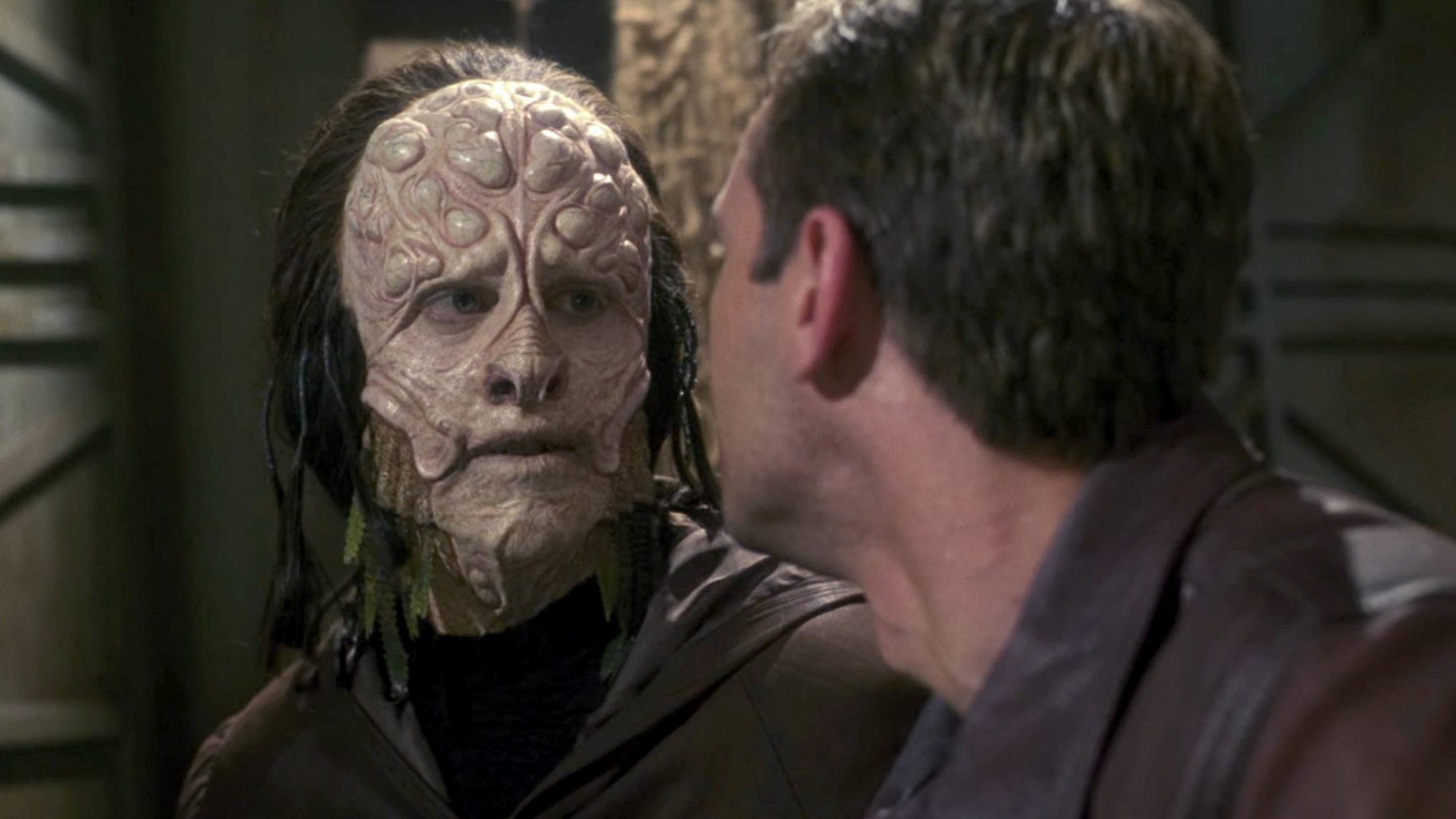
Date not given: Archer and Trip are mistakenly arrested for smuggling by the Enolians and are on a prison transport to the penal colony of Canamar. When it has just been announced that they would be released, the Enolian Kuroda and his Nausicaan aide incite a revolt and take over the ship. Archer gains Kuroda's trust when he tricks two Enolian patrol vessels by igniting exhaust plasma. Kuroda, however, does not intend to set his fellow prisoners free, but plans to incinerate the ship in the atmosphere of a planet after he has left. An Enterprise away team, having captured the shuttle that was going to rescue Kuroda, takes over the transport. Kuroda, however, does not want to leave and burns together with the ship.
Review
"Canamar" turns out better than expected and continues the recent trend of writing mature stories instead of filling cookie-cutter plot ideas with dialogue. Well, the story is fairly well known from "Con Air" with Nicholas Cage, but it works out nicely in a science fiction universe too. The setting is also reminiscent of TNG: "Gambit", where Picard and Riker had to play the bad guys in order to gain their leader's trust. It befits the producers' initial intention of showing a dark and dangerous universe, in which humans and Starfleet are not yet the revered space police. For once, I found the excessive beating and shooting appropriate, considering what type of people Archer and Tucker were dealing with. In this light, it seems even less realistic and much less desirable that they are frequently getting into equally brutal conflicts, although their opponents should be expected to be more enlightened and civilized than this wild bunch of criminals.
The characters were not as stereotypical as one could have assumed, considering that the plot was borrowed from a successful movie. On the downside, there was Zoumas, the guy who was talking to Tucker all the time (giving Trip his weekly dose of embarrassment). He was funny. But he was quite two-dimensional too and the comical relief seemed a bit out of place here. The only surprise was that he didn't get killed, although this would be the usual fate of such a character. Zoumas reminded me a lot of Neelix in his first and worst two seasons, after which I was equally surprised that Neelix was still aboard and even developed a quite credible personality. Kuroda was definitely the strongest character here, as he even dominated Archer in almost every respect (at least that's what he thought). He may have seen it as his personal victory that he was still free to make the decision to die rather than to be taken to Canamar. On the other hand, I'm always skeptical about that "buddy" type of criminal, who tells touching tales of his past to someone he doesn't know and makes new allies quickly. I just don't think that it's realistic for someone who is such a ruthless misanthropist as Kuroda.
Archer and Tucker leave an ambivalent impression here. On one hand, it is remarkable how especially Archer lies and pretends to subdue himself, as opposed to his usual straightforward behavior (along the lines "Hey, we're Starfleet and you've just been waiting for us"). But in what they are doing, they are just too successful. They don't only master the alien technology that they should be least of all familiar with, they also perform their roles too well and elegantly evade anything that could expose them. Manipulating someone, as Archer did with Kuroda, is anything but easy, especially since Kuroda was not undecided, but had concrete plans. The Enolian officials were just another cliché of a militaristic, in every way very human regime, like already before in "Shadows of P'Jem", "Detained" or "The Communicator" and many TNG and Voyager episodes. Maybe it had better been a previously established Alpha Quadrant species than yet another clone. But perhaps, of all these very similar races, we will see the Enolians again.
It is remarkable that the episode doesn't have a cozy and comical ending, as it is too often the case only minutes after the last phaser shot. Archer's anger about the Enolian authorities was quite understandable, and for once we have to agree about his lack of diplomacy. It had quite an effect on me after the (once again) rather action-heavy episode, that something to reflect about was put at the very end where it wouldn't get lost.
On a final note, we were not shown how the transport ship with Kuroda still aboard was destroyed when entering the atmosphere, although we may surely have expected that. I wonder if the scene was cut from the episode because of the Columbia disaster.
Annotations
- Remarkable quote: "I may not know how to fly this ship, but I am sure I can figure out how to crash it!" (Kuroda)
- Remarkable ships: We see an Enolian transport and two patrol vessels, all nicely modeled with a definite retro touch. The shuttle that saved the prisoners may be yet another Enolian design, although it doesn't belong to the military.
Rating: 6
The Crossing
Synopsis

Date not given: Enterprise is swallowed by a much bigger spacecraft. After exploring its interior, Commander Tucker turns out to be possessed by a non-corporeal alien lifeform. Archer's demand to leave Tucker and to release the ship is apparently fulfilled by the alien. But as the crew is working to get the ship operational again, more aliens come aboard, taking over 24 of the crew, while the rest manages to hide in the impenetrable nacelle catwalk. Dr. Phlox, incompatible with the aliens, floods the ship with carbon dioxide, making the possessed crew almost suffocate, whereupon the aliens leave.
Review
This is an overall unremarkable episode, not really boring but quite banal and superficial. The main reason is that there can be hardly anything surprising in the overused "alien possession" concept. The plot is much an amalgam of episodes from TOS: "Return to Tomorrow" to TNG: "Power Play" (evil aliens in the crew's bodies) and from TOS: "By Any Other Name" to TNG: "Liaisons" (aliens experiencing human emotions). But "The Crossing" does not even attempt to come up with any new insight or any unexpected plot twist. Even the catwalk trick with one crewman (Tucker then and Phlox now) staying behind to get rid of the aliens is rehashed from "The Catwalk".
Something remarkable is that "The Crossing" jumps straight to action already in the teaser, without any introductory dialogue. But not to the episode's advantage. I don't expect that everything strange is completely explained in every episode. But I don't like if Enterprise is turned into a mystery series that keeps posing questions without bothering to answer them. In this particular case, time was probably the decisive constraint, seeing how the episode starts and ends abruptly to fit the story into 45 minutes. Only sporadically time is spent for consultations among the crew and for explanation attempts, although action is not very dominant either. Considering that the experience of being possessed by aliens ought to change the crew's lives, the reset button is too easily pressed in the end. But even more sadly, there is not any feedback from the crew, not even a sigh of relief after the aliens have left. The episode, unlike some of its predecessors along the same lines, remains on the very surface of its topic. So we don't see any change of the aliens' behavior once they have assumed human bodies. We don't learn if perhaps the "crossing" might be a worth while experience, if it were only temporary. Or if a solution to mutual satisfaction could have been found. In the 24th century, Picard would probably be more open-minded in the same situation — and he definitely wouldn't end up destroying the alien ship, although I admit that the peacefulness of his mission was often accomplished through unexpected and maybe unrealistic plot twists. 22nd century Trek is different in this regard, but it is not the Trek I like most.
Something curious is that Archer must have read many sci-fi novels, considering how fast he realizes that Tucker is possessed by a non-corporeal alien. Well, we already know how visionary he is since his idea of silicon lifeforms in "Strange New World". T'Pol, on the other hand, needs quite a while to recognize Reed's condition when it was already known what was going on. Maybe, with her preconceptions about humans, she found it plausible for Reed to harass her? On a different note, why do non-corporeal beings from subspace need a starship? At least, it would have been a time to show a really outlandish vessel instead of a rather conventional design. Also, what was the big hatch useful for? As T'Pol explained, they only needed to transfer themselves to humanoid hosts because their ship was deteriorating. So what would they normally do with that hatch? This and many other questions remain unanswered.
It is an open secret how Enterprise purposely employs gratuitous sex apparently to reach its target group. Reed's harassment of female crew members (the aliens couldn't have picked a better male victim!) was still amusing, but I wonder why it was necessary to show T'Pol in very casual wear once more — besides Trip's customary underwear show. On a final note, I liked the episode's somber score, the first to impress me in quite a while. It successfully emphasized the plot, albeit it was a bit too dominant at times when nothing particularly threatening happened.
Annotations
- Remarkable quote: "Would you mind taking off your clothing. I would like to learn more about your anatomy.” (Reed-alien, to T'Pol)
- Remarkable fact: Enterprise is now 150 ly away from Earth. Starfleet encounters non-corporeal aliens for the first time.
- Remarkable starship: The alien ship is much more than 500m in diameter and travels at Warp 6 without any detectable warp field. While not really fitting for non-corporeal aliens, especially the interior of the ship is nicely arranged. It reminds me a bit of V'ger.
Rating: 2
Judgment
Synopsis

Date not given: Archer is on a Klingon court because he helped alleged rebels to escape. This is what Duras of the battlecruiser Bortas testifies. Although it is not customary any longer, Archer can convince his lawyer, Kolos, to let him tell his version of the story. The court, however, decides that he be transferred to the penal colony of Rura Penthe. Kolos has to join him for disobeying the court. After bribing Klingon officials, Archer can be rescued from Rura Penthe, but Kolos decides to stay behind.
Review
My verdict: guilty as charged. Like several times before in Enterprise I'm startled how easily Trek writers rip off previous stories without even trying to add any new aspects. "Judgment" is 60% "Star Trek VI" , 30% DS9: "Rules of Engagement" and 10% J. G. Hertzler as Kolos. The Klingon lawyer's initial unwillingness to help Archer as well as his discomfort with not being a revered warrior reminds me of his colleague that accused Worf in DS9: "Rules of Engagement". Still, Kolos is the only character worth mentioning and the only unknown quantity in this extremely predictable story. His initial un-Klingon cynicism, as well as his later courage, add at least a little diversity to the otherwise stereotypical roles (with typecast Klingon actors), but with only limited salubrious impact on the story. He is responsible for the only unexpected moment in the whole 45 minutes, when he accuses the court of having no honor. But even this swift criticism remains on the surface, because the judge sentences Kolos to join Archer on Rura Penthe and because time to bring this tedious story to a quick end is running out anyway with only a few minutes left. What I find more interesting is Kolos's remark that Klingons have become ruthless and obsessed with the military only recently during his lifetime. Kolos may be overstating the previous importance of his class of intellectuals, but the focus on war and warriors obviously won't change until the 24th century.
But that's it for the novelties. Everything else said or seen we know exactly from the two previous incarnations of this episode and from the large pool of Klingon stereotypes. Speaking of clichés, do we really need yet another episode in which Archer is captured by aliens? I can anticipate that my review will meet resistance, because "Judgment" was mostly well-received. I know that many viewers pay more attention to dialogues, directing and acting, while I think it can't put up with a plot that we have seen before and that has substantial flaws no less. Well, the director manages to keep together the unnecessarily complex patchwork (considering that we always exactly know what will happen) of brief scenes in real time and recounting, in the prison cell, on the court and on Enterprise. But owing to this structure of the story, I think that the episode has rather few good lines and just too many phrases. The only exception once again being the ponderings by Kolos. The rest is concerned with tactical operations in the recounting and the usual Klingon honor blurb on court. Uninspiring like a parliament debate. And without being given an opportunity to excel, the actors' performances are mostly routine.
The authors Taylor Elmore and David A. Goodman, whom I'm not familiar with, obviously think that recounting a previous story is a homage. That they are doing fans a favor just by bringing in fandom's all-time favorite aliens as an excuse for a new story. To make it worse, as a special "courtesy" they feed us with a dozen familiar names and details without any necessity. Duras, Toral, Bortas, Ty'Gokor, Rura Penthe, painstiks, the judge's spark stone. It's a different century. Doesn't that ring a bell? Things are allowed, even encouraged and often required to be different. But the story boils down to clichés like this: A guy walks in who is identified as Duras, Son of Toral. We immediately know that he is a treacherous coward, like all of is family have always been and will always be, just as Toral, Son of (another) Duras, in the 24th century.
Even though nothing could go really wrong because it was simple re-writing, there are two gaps in the plot. Firstly, how did Archer fall into the hands of the Klingons in the first place? I don't think it was explained, although it may have been important to know. But even more annoyingly, it was just too fast and easy to rescue Archer from Rura Penthe. Just bribe a few officials, send down your armory officer and get him. That was easily the least credible and most blatantly rushed ending in the series so far.
Although it was almost a waste of time like "A Night in Sickbay", three points because I like J. G. Hertzler, because I am still fond of Klingons whose reputation was at least not damaged here, and because the battle scenes with the D5 were cool.
Annotations
- Remarkable ship: We finally get to see a genuine 22nd century Klingon battlecruiser, the D5.
Rating: 3
Horizon
Synopsis

January 10th, 2153: While Enterprise is on a detour to investigate volcanic activity on a planet, Ensign Mayweather takes the chance to visit his family's ship, the ECS Horizon. His father has recently died, and although everyone is glad to see him, Travis soon has to learn that it's not his world any more. After an alien attack, he upgrades the ship's plasma cannons to his brother's displeasure. However, when the aliens return and demand the Horizon be turned over to them, the improved weapons help defeat the enemy.
Review
Look who's talking! It can be quickly summarized what I like about this episode. Firstly, Ensign Mayweather finally gets to say more than a few lines. Secondly, it was entertaining, with a good balance between the (dramatic) A-plot on the Horizon and the (humorous) B-plot with the horror movie night. Thirdly, like in "Fortunate Son" and rather few other episodes before, the series didn't try to imitate the setting of 24th century Star Trek.
On the downside, the similarities to "Fortunate Son" are already too striking. Although the stories are somewhat different, both episodes have the same recipe and use the same motives. Here we have Dad's recent death, there it was the captain who was wounded and off duty. Here we have unknown aliens attack the ship, there it was the Nausicaans. Here it is Paul Mayweather who declines Starfleet's help and mocks about Travis's new job, there it was Matthew Ryan. Only that the roles are switched, as Ryan wanted to take revenge at all cost, whereas Paul strives to avert the armed conflict.
What I don't understand is why Mayweather's father had to die. After the initial grief it has absolutely no significance in the plot. Perhaps a conflict of Travis with his father, as someone who has been a cargo ship captain for decades, would have even been more pronounced and more interesting to watch. Other weak points are that the trick with the upgraded plasma cannons is just too cheap, and the story is too quickly resolved. It seems that time was running out once again, like already in the two previous episodes. Travis is given a chance to say good-bye to his brother, but his mother doesn't show up once more after the fight with the aliens, and his girl-friend who appears only once doesn't seem to serve any purpose at all. I was hoping for Anthony Montgomery to finally show his talent, but his acting is mostly unremarkable. While the beginning gives him the opportunity to shed a few tears about Mayweather's deceased father, he remains too indefinite for the rest of the episode, always somewhere between sullen and happy.
- Nitpicking: In ENT: "Fortunate Son" Travis mentioned a sister and his brother-in-law being on the Horizon. Now there is suddenly a brother he didn't bother to mention, and his sister doesn't seem to exist.
- Remarkable quotes:
- "The three greatest horror movies ever made: 'Frankenstein', 'Bride of Frankenstein', 'Son of Frankenstein'." (according to Tucker)
- "Don't be surprised if you see me here again afterwards. I've little doubt that my headache will return." (T'Pol to Phlox, about the upcoming horror movie)
- Remarkable dialogue: Mayweather and Reed talk about families on Starfleet ships (reference to TNG!). Reed doesn't think it's a good idea, and suggests to get a psychologist too (or a counselor?).
- Remarkable facts:
- Mayweather's mother is the ship's medic and chief engineer. His grandpa even held five jobs, two of them on the bridge.
- Archer thought of joining a cargo ship, a few years before Starfleet was founded.
- Reed's last family reunion was almost a decade ago.
- The captain of a cargo ship is required to have an ECA License (where ECA obviously stands for Earth Cargo Authority, an organization not quite as strict as the FCA ;-)).
- According to Travis, Enterprise has gone "150ly, seen 22 inhabited worlds". This 150 ly must be the longest distance from Earth (mentioned in "The Crossing"), not the total way.
- The aliens plant a beacon with an explosive dicobalt device on the Horizon's nacelle.
- Remarkable ship: The ECS Horizon is a J-class cargo ship. It is 50 years old. The Horizon carries ten cargo modules with a load of 30,000 metric tons. The armament consists of two plasma cannons. Zefram Cochrane designed the warp core himself. He is rumored to have signed the inside of each reactor casing.
- Unremarkable ship: One major annoyance is the repeated re-use of the Akritirian ship from Voyager as the bigger pirate vessel. It was already inadequate as the Kriosian ship in "Precious Cargo", and here it is out of place again. There is no excuse in the time of CGI models. Moreover, Mayweather mentions that the vessel's technology is similar as that of the Mazarites. With such a broad hint in the script, why wasn't the Mazarite design re-used here?
Rating: 5
The Breach
Synopsis

Date not given: An away team with Tucker, Read and Mayweather is sent to evacuate a group of Denobulan geologists from a cave system on Xantoras. The mission doesn't develop as planned when Mayweather is hurt and the Denobulans are reluctant to leave. Meanwhile, Enterprise assists a passenger transport with medical aid and repairs after an accident. One seriously injured patient is an Antaran. It turns out that until 300 years ago there was a fierce war between the Denobulans and Antarans, which is why the Antaran, still full of hatred, refuses to be treated by Dr. Phlox. Urged by Archer to help, Phlox has to overcome his own pride and preconceptions to earn the trust and respect of the Antaran.
Review
The synopsis of "The Breach" didn't sound all that interesting to me, so I watched without great expectations. It turned out a very pleasant surprise. Looking at the ethical issues, I see "The Breach" as the best treatise in the whole series so far. I prefer it over the questionable swift change of morality in "Dear Doctor", and also over the rather pessimistic prospect of "Stigma". "The Breach" is definitely among the "Trekkiest" episodes of Enterprise in my book.
The two stances of the Denobulans and Antarans are very credibly presented - even though Phlox and his patient may not be representative of their whole respective species. The Antaran is filled with hatred in the beginning, not quite unlike many individuals on our own planet, who learn from their childhood about the atrocity of their alleged enemy, without ever meeting one of them face to face. He is a prisoner of his hatred, as he honestly thinks of doing himself a favor and hurting his enemy Phlox by denying the treatment and ultimately dying for his principles. Ironically, because of his physical weakness he gets a chance to change his mind and ultimately save his life, when the despised Dr. Phlox keeps talking to him. Even though Phlox is anything but guilty of the previous war crimes committed by his people, and even though Phlox tries to make clear to his patient (and to himself!) that he has no hard feelings for the Antarans, the patient doesn't give him a chance at first. Even worse, as Phlox is not the devilish person he would have expected, the Antaran permanently tries to provoke the good doctor. Finally, and this is again almost ironical, Phlox manages to establish a basic mutual understanding when he mentions that his own eldest son is member of a group who despise the Antarans just as many Antarans hate the Denobulans.
The episode changes our whole perception of the Denobulans and of Dr. Phlox without becoming inconsistent. We have known the Denobulans as always optimistic and imperturbable. But their apparent charming nature obviously doesn't prevent them from acting like brutal conquerors. Maybe their joyful life is even some sort of protection against too much remorse, which can be just as detrimental as hatred (the most prominent example from Star Trek being Marritza, who posed as the war criminal Gul Darheel to pay off his guilt in DS9: "Duet"). Anyway, it is a pleasant deviation from the conventional "villainous race" pattern that has unfortunately been established for many Star Trek species, meaning that specific "evil" characteristics about them are being stressed even in their normal lives (insidious Romulans, sadistic Cardassians, and lately, arrogant Vulcans). The new controversial portrayal of Dr. Phlox and the Denobulans helps to correct this image. From a humanist viewpoint (well, "humanist" being not exactly the correct term for Denobulans), xenophobia has no ground. There is nothing like an evil country, sex, race, or species. Everyone, irrespective of his/her/its passport, skin color or forehead bones does not only have undeniable legal rights, but also deserves to be treated with respect and kindness. It's simple, almost trivial to someone who had the luck to be raised in a free and open-minded society. But Denobula has apparently not yet reached this goal, although the planet may have been on a better way than the homeworld of the Antarans (Antares?). Phlox has always been trying to heed "humanist" principles. As he says to T'Pol, he didn't tell his grandma's horror stories about the Antarans to his own children, he tried to educate them to keep an open mind. But he himself is troubled when the Antaran keeps insulting him. I think everyone can understand that Phlox temporarily loses patience with his patient. It is actually the first time at all that we see him on edge, at least it is the first time that it happens because of his own problems.
The episode profits from the decent plot, but even more from strong dialogues and actors' performances, especially of Scott Bakula and John Billingsley. I was never too fond of Phlox as a character, just because he was always much the same, his facets being not very interesting or just too comical. The only exception so far was "Dear Doctor", but the insistence on his questionable personal ethics almost ruined that one for me. Just as Neelix was given the chance to step out of his clown role in the third and fourth seasons of Voyager (Phlox's alter ego, the EMH, even much earlier), Billingsley takes the chance to lead his character to maturity in "The Breach".
The plot thread about the Denobulan scientists and the away team doesn't strike me as very interesting, although it was probably deemed equally important for the episode as the Denobulan-Antaran conflict. At most, it provides some distraction from the too static setting in sickbay and too much pondering. But thinking that the main plot could have gone to even more depth, it seems almost like a waste of time to frequently switch to the caves. What I initially liked about it is that Mayweather was going to get a key role in the away team, but the "poor ensign" cliché soon prevails, when he must be left behind. It is also a bit contrived that it has to be Denobulan scientists, only because they would take the same transport as the Antaran in the end.
Annotations
- Remarkable quote: "If you don't start moving in the next five seconds, I'm gonna take my phase pistol and shoot you in the ass!" (Trip, to the Denobulan scientist crawling in from of him)
- Remarkable appearance: Dr. Phlox shows a Tribble to Hoshi, which obviously only serves as food in his little zoo.
- Remarkable facts:
- The last of several wars between the Denobulans and Antarans ended 300 years ago.
- Denobulan medicine has similar ethics as the human Hippocratic Oath, one important difference being that a Denobulan doctor has to respect his patient's wish under any circumstance, even if it means letting a patient die who could easily be healed.
Rating: 7
Cogenitor
Synopsis
Date not given: Enterprise makes first contact with the Vissians, whose advanced technology allows them close studies of a hypergiant star. While Archer is exploring the photosphere of the star together with the Vissian captain in a pod, Trip learns that there is a third gender among the Vissians, the cogenitor, destined for a life as a slave. Trip befriends the Vissian chief engineer's cogenitor and teaches it to read and shows it to enjoy life. When the cogenitor asks for asylum, Archer has to deny the request. Soon after the Vissians have left, Enterprise receives a message that the cogenitor has committed suicide.
Review
No doubt. This is the emotionally strongest Enterprise episode so far, with one of the most intriguing plots. TNG: "The Outcast" comes to my mind, where Riker was struggling for the right of a sexual minority likewise, also with strong personal involvement, and also in vain. Only that Tucker is obviously never sexually interested in the cogenitor, which may lower his motivation, but at the same time increases his credibility as a benefactor. We know from several previous episodes that in spite of or just because of his predominant occupation with machinery he has preserved a great deal of curiosity, of compassion and of honesty. The episode may have been written for any of the other characters, but I'm glad it was Trip. I just like this man.
My only criticism is about the episode's execution, which is losing cohesion and leaves some gaps after about 25 minutes. It almost seems like a lot has been cut from the episode. It may have been wiser to shorten Archer's pod ride and ditch Malcolm's little affair (especially since the latter was not resolved anyway) in favor of the Tucker story. But as already in last week's "The Breach" they were necessary fillers to break down the too heavy main plot into digestible bits. Something that seems strange to me is that despite the episode's overall objective perspective the viewer is forced into Trip's position occasionally, and exactly at the three times when he is being informed second-hand about the Vissians' anger about his actions, about Archer's decision to return the cogenitor to her people and finally about the cogenitor's death. I don't think this is consequential. It should have been either more like "Trip's Day", or the narration should have been entirely objective and omniscient.
Concerning the moral dilemma, who is right? T'Pol, who is against any interference with other cultures, and in particular against the application of human standards to aliens? Trip, who has to witness obvious injustice and feels obliged to do something against it? Archer, who does not want to jeopardize the new friendship and strives to find a satisfactory solution for all, while not violating any laws or protocols? I can't tell. Of course, Trip has a very good point. Even though T'Pol is right in pointing out that there is nothing such as "human rights" in an alien culture, it is made clear (thanks to Phlox) that all Vissians are created equal, just like all humans irrespective of their skin color or sex. More universal ethics need to condemn any kind of slavery of sentient beings, where the term "sentient" will be extended to include artificial lifeforms in the 24th century. But another 24th century example shows that such a principle may not apply always and anywhere. The Federation is allied to the Klingon Empire, a regime which clearly violates basic lifeform rights, even to a much greater extent. In this light convincing Vissians to respect the rights of cogenitors would be equivalent to ordering a Klingon warrior to lay down his bat'leth forever. I would never want to decide about it like Archer has to.
Unlike the contorted ethics in "Dear Doctor" and unlike the clear obligation to help in "The Breach", "Cogenitor" has no correct solution. The plot could have been constructed to please everyone in the end, a happy ending in which the Vissians may have made up their minds, could have granted the cogenitor more freedom and would ultimately have even profited from this enrichment of their culture. But quite the opposite happens. Everyone loses eventually. The cogenitor loses her life, Trip has to cope with his guilt and shattered illusions, Archer may have lost his friendship with the Vissian captain, and the Vissian couple may not conceive a child for a long while (which may seem like a minor loss, but could mean a lot to them). This is the first episode with a truly disillusioning outcome, and I applaud the producers for the courage of showing it in the Trek series where I would have least expected it. While I don't like the many off-screen events hidden from Trip and the viewers as mentioned earlier, I am glad that the death of the cogenitor was not on screen. It may have been turned into some sort of loud protest, which would not have befitted her character. We don't know about other cogenitors, but Trip didn't incite a rebel or even martyr spirit in her, he just made her discover a small part of her true potential.
Is the Vissian society as shown in the episode credible? Honestly, it doesn't completely convince me. The Vissians developed warp drive a thousand years ago. They have been thoughtful explorers ever since, they love to make contact with other civilizations. Still, they treat a minority on their own planet like slaves. If anything, the cogenitors' situation is comparable to that of the slaves on Earth, or more precisely, to humans who were not granted human rights mostly because they had the wrong skin color. But emancipation ultimately prevailed over racism, and I'm confident that this trend will continue as our society evolves. Why should it be that different with the Vissians? The obvious parallel in Trek, on the other hand, can be found among the Vulcans who, after thousands of years, still don't accept "melders" (at least, if we believe in the serious retconning in "Stigma"). But one difference with the Vissians is that the cogenitors not only don't dare to contradict, they obviously don't even know that something isn't right with their treatment. Is it really possible to keep people stupid for all of their life, if they are able to learn to read within an hour? I don't think so.
Annotations
- Science observations:
- I was almost missing the inoculations against radiation, but here they come again.
- On the bright side, the episode mentions that Earth scientists have discovered 92 naturally occurring elements. This is correct, as anything up to element 92 (uranium) is stable. And for once, this shows that 22nd century science is behind, considering the 200 stable elements in VOY: "Emanations", no matter how realistic these are.
- Remarkable dialogue: "I imagine the cogenitor provides an enzyme, which facilitates conception." - "What do you mean by 'provides'?" - "Well, first the female has to..." - "No — no, no. Don't tell me. I don't think I wanna know." - "Oh well. Hmm. I have pictures." (Phlox and Trip)
- Remarkable quote: "They treat her like a pet — kept in her room, not taught to read or write, no name. Porthos has a name!" (Trip, to T'Pol)
- Remarkable fact: No Earth ship has ever been within ten light years of a hypergiant.
Rating: 7
Regeneration
Synopsis
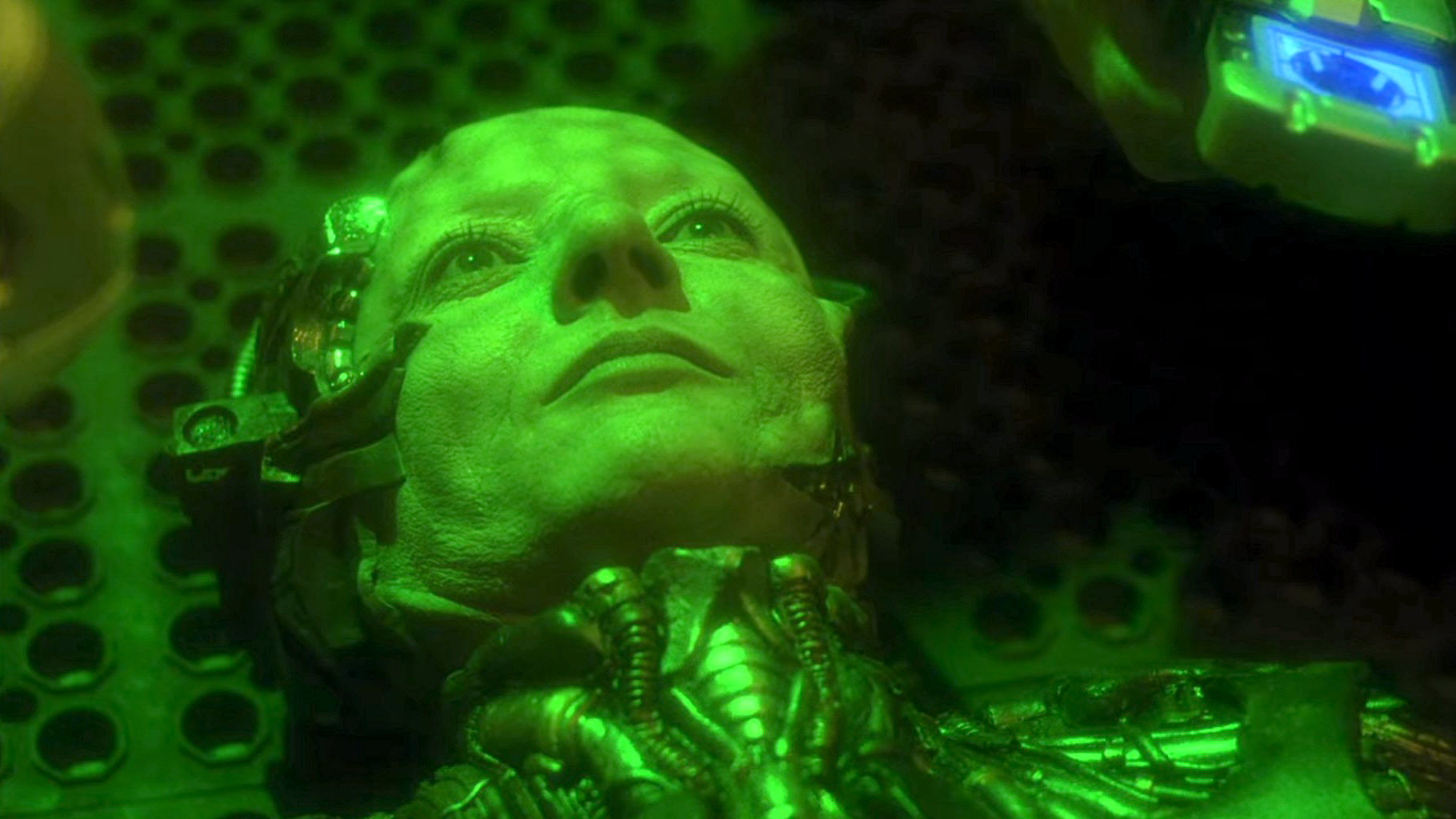
March 1st, 2153: When a research team discovers debris of the Borg ship that was destroyed in 2063 near the Arctic Circle, the drones begin to regenerate, assimilate the team and hijack their shuttle. Enterprise pursues the Borg and engages them while they are in the course of assimilating a Tarkelean vessel. With the Borg ship gone, the seemingly rescued Tarkaleans in sickbay inject nanoprobes into Phlox and begin to install Borg devices aboard, until Archer decides to blow them out into space. After disabling the Borg technology, Enterprise is able to catch up with the Borg ship and destroy it, while Phlox makes a recovery by exposing himself to omicron radiation.
Review
This is a truly action-heavy Voyager episode full of superb visual effects. But it suffers from the crude and predictable plot. And where the heck is Janeway?
Sorry, I must have been confused. After a couple of genuine 22nd century plots, Enterprise borrows excessively from its predecessor again. Although it is a common notion that I'm close-minded about it, this complaint is not primarily about continuity. It bugs me most of all that the authors frequently recycle old scripts or just throw together a few plot ingredients that fans allegedly expect from Star Trek. Voyager started this trend by carrying all sorts of Alpha Quadrant clichés into the Delta Quadrant where they don't belong. I frequently commented on that, and no one reproached me with being narrow-minded or dogmatic (we should all remember how it was and still is almost fashionable to criticize Voyager). Enterprise, however, does something worse by bringing the 24th century back through time, to a time that would desperately need more of a difference to 24th century Trek. The way it presents itself this week, the new series has not developed its own special feel. Moreover, whilst Voyager still had a great deal of imaginative and intellectually demanding writing, episodes like "The Breach" and "Cogenitor" are the exception on Enterprise. Even the rehashes are often dumbed down as if they were to fit with a lower series standard.
It is not only that Enterprise chases the Borg just like Voyager did occasionally and perhaps too often in four of its seasons. Aside from the finding that the Borg were known even much earlier than they should, there was almost nothing to learn from the Enterprise episode. Every single aspect of the Borg has been covered in a more detailed and often almost philosophical approach on TNG or Voyager. We all remember the dramatic events in TNG: "Best of Both Worlds", where Earth's future was at stake, and there was a great deal of personal involvement of the characters. Or TNG: "I, Borg" with the struggle about the Federation's ethical principles. Or Voyager's "Scorpion" with its many convoluted conflicts. "Regeneration" lacks the sophistication of most of TNG's and Voyager's Borg episodes and reduces its plot to effortless, almost dull action with a swift resolution. The acting is mostly unremarkable, because it is not conceded much room. Even Phlox, who was supposed to provide the personal commitment here, can never really convince as being partially assimilated, and his recovery is rushed and implausible. And what is the point in having Phlox mention the group consciousness and Archer and T'Pol not believing him? Sure, it leaves a bit of plausibility if there remains a little secret about the Borg. But what is the significance of such little mysteries to the fan who has all the knowledge of the Collective from the 24th century? The really only noteworthy aspect is that Archer is reluctant to destroy the Borg. Bakula is quite credible in portraying Archer with this stance, which contrasts with Picard's "this far, no further" or Janeway's "I prefer the Borg in pieces". But the outcome is the same anyway. Enterprise shoots the Borg to pieces. Good for what's left of continuity, bad as a plot idea. Sure, it was not possible to show something more profound without straining continuity even more. But that is just the reason why the episode shouldn't have been done in the first place.
I don't feel like going into details about the continuity breach here. After all, this time it may be excused as a consequence of the events in "First Contact", unlike in the Ferengi appearance in "Acquisition", where continuity was thrown overboard for an isolated episode of cheap comedy. I enjoyed "Regeneration" when I first saw it, but when I replayed it a few hours later, I noticed something outrageous. The writers repeat the trick of not calling the continuity violator by its name. "Borg" was not even mentioned in their standard introduction, where the first sentence "We are the Borg." was simply cut off this time. Incredibly contrived. Is this Star Trek or Rumpelstiltskin? How stupid do they think that Starfleet is, that they would forget about the Borg only because their name remains unknown? How stupid do they think the audience is, by feeding them with such a poor excuse of an excuse? They could have mentioned the Borg for good. But much better, they could have spared us of this whole episode, if they can't handle the problems they evoke.
"Regeneration" has an extraordinary number of references to establish continuity at least with the events in "First Contact". Within the boundaries of the premise, Archer's quoting of Cochrane's speech about the "cybernetic creatures" is pleasant continuity. I also like the occasional name-dropping (the Vulcan with a prosthesis, Denobulan research on nanotechnology, Tarkaleans whom we see for the first time after many mentions, Bynars who are using synaptic processors), which I find quite appropriate in this context. But I have seldom noticed so many obviously (self-) ironical remarks, from Reed's "holographic bullets" to Archer's and T'Pol's pondering in the end that the signal would need 200 years to reach the Borg homeworld (I wonder how he can know how far away it is located though). Somehow I have the impression that everything is supposed to be taken with a tablespoon of salt.
Why do I concede "Regeneration" two points? I enjoyed it more than other episodes that rank low in my view. In a manner of speaking, "Regeneration" is convincing as "Trek porn". Despite its predictability and superficiality it never becomes boring because it has lots of eye candy and action.
Annotations
- Nitpicking:
- The Borg ship went down 90 years ago, and the corpses are covered only with a centimeter of snow.
- What a coincidence: The transport ship heads away from Earth accidentally more or less straight into Enterprise's direction, at least close enough to be intercepted.
- The ship's mass increases by 3%, but where does the additional matter come from? Interstellar gas converted to heavy metals?
- Reed orders "Increase power to five megajoules". The authors will probably never learn the difference between energy and power.
- Another observation: With no one of the Enterprise crew even killed by the Borg, the hypocrisy continues.
- Also, there is Reed's remark: "Research team, heavily armed. How did these aliens manage to overpower them?" My question is rather since when Earth-based research teams are heavily armed in the first place. It may be because of the polar bears, but Reed's statement sounds as if research teams were always armed.
- Finally, Archer has never hesitated to consult Daniels's omniscient database to find something from the future, so why didn't he look up the Borg? Only because it would have given the death blow to the "don't say my name" trick?
- Remarkable fact: In a commencement address at Princeton University in 2064, Zefram Cochrane mentions details about first contact with the Vulcans, including "a group of cybernetic creatures from the future".
Rating: 2
First Flight
Synopsis

Date not given: Archer receives the message that an old friend, Captain A. G. Robinson, has died. While they are on a shuttle to explore a supposed dark matter nebula, Archer tells T'Pol about their time in the NX development project. Robinson made the first Warp 2 flight, but barely survived the following explosion of the NX-Alpha prototype. The project was about to be postponed. Archer and Robinson, with the help of Tucker, then took NX-Beta to an unauthorized flight, reaching Warp 2.5, upon which the project was continued. Archer and T'Pol can confirm the existence of dark matter in the nebula, by firing charges from the shuttle that light up the matter.
Review
"First Flight" is a decent history lesson and quite a nice homage to real-world space pioneers, but not much beyond that. The A-plot is just the kind of American hero story we are so familiar with, inside and outside Star Trek. Despite all the hardships and against orders we did the right thing, yadda yadda... It is complacent, glorifying, self-aggrandizing. Well, such a view suits Archer, along with his frequent complaints about the Vulcans, which are fortunately a bit toned down this time. But if anything may have been better for the story, it would have been a more objective retrospective. Moreover, the characters exhibit only few interesting aspects. We learn that Archer was more by the book a couple of years ago, and that T'Pol is unusually reverent, even empathic, when she talks with Archer about his dead friend. What bothers me most in retrospect is that Trip is of so little importance in this story, although it would have been a great opportunity to show how his friendship with Archer developed. Maybe it would have been more interesting if Tucker and Trip had talked to T'Pol about their time in the NX development project, both with their own personal views. But instead of that, the focus is on a man of whom we know that we will never see him again. Archer and Robinson, although they appear to be very different in the beginning, both turn out rather blunt. Neither of them has a family (that we know of), neither of them seems to have close friends outside the project, and their friendship is not (yet) that strong either. I wonder if they are really the type of hero we would like to identify ourselves with.
If something becomes blatantly obvious, it's that Starfleet has a severe problem with discipline. Firstly, astronauts who are jeopardizing their flight with risky stunts against orders is something unheard of. This hasn't happened in 40 years of Soviet or American spaceflight, at least not that I know of. And officers who like to get themselves into a fight in a bar is just another behavior that a military/scientific organization can't tolerate. But the selfish and reckless secret test flight is simply outrageous. Archer, Tucker and Robinson can be glad to have a superior like Forrest, who is more than lenient and who would rather show weakness in his own organization than bow to the Vulcans. Still, I don't like at all how irresponsible disobedience comes out as acceptable and is eventually rewarded in this episode.
Annotations
- Observations:
- The Starfleet patch looks like an intermediate design between NASA and the UFP Starfleet. It seems the responsible people in the Art Department have forgotten about giving the UESPA the Starfleet arrowhead (VOY: "Friendship One").
- In the 602 Club, we can see an image of the Enterprise XCV-330 (the ship with the hoop engine). Considering that it is shown as a tribute to test pilots, the ship very likely exists in the Enterprise Universe. We can also see many actual NASA patches.
- Archer and Trip didn't know each other prior to Trip's appearance just after Robinson's flight. That must have been ten years prior to the episode (it was mentioned in "Unexpected" that they know each other for eight years). But why didn't they meet earlier? They were both working on the same project, and Archer must have been in close contact with the engineering staff, especially since it was his father's project. Trip didn't sound as if he was new to the team.
- After the NX-Alpha has exploded, Archer looks at a table that obviously shows the speed vs. warp factor diagram. A red light is blinking at the Warp 3 threshold, although Robinson only achieved Warp 2.2. It may be an erroneous reading. But before the accident, one could see it blinking there all the time.
- Finally, there is one blatant error. NX-Alpha explodes very close to Jupiter. No one with a bit of common sense would plot a course along the solar plane, especially since the asteroid belt is located between Mars and Jupiter. We may blame the field instability for the ship getting that close to Jupiter, but on a half-way sensible course, that would have required a force to bounce the ship back.
- Remarkable dialogue: "As Doctor Phlox would say: Optimism!" - "Optimism doesn't alter the laws of physics." (Archer and T'Pol)
- Remarkable facts:
- "Trip" stands for "triple", as he is Charles Tucker III.
- The Starfleet Museum already exists as of 2153.
- The NX prototype was grounded for three months after the incidents in the episode. For over a year, the Vulcans were demanding additional simulations, until they admitted that the engine would probably work. Eight months after that, Duval broke Warp 3 in the NX-Delta. Five years later, the construction of Enterprise began.
Rating: 4
Bounty
Synopsis

March 21st, 2153: Archer is the prisoner of the Tellarite bounty hunter Skalaar, who is going to hand him over to the Klingons. T'Pol and Phlox have picked up microbes and need to stay in the decon chamber. The microbes cause a premature pon farr in T'Pol, and Phlox has a hard time to fend her off. In the meantime, Skalaar has to land his shuttle on a Class-L planet to escape a rivaling bounty hunter. Skalaar, whose ship, the Tezra, was seized by the Klingons, is willing to help Archer escape, when he learns that the Tezra has been disassembled. On the ship of the Klingon Captain Goroth, with the help of Skalaar's knowledge, Archer makes it to an escape pod, which can be tractored in by Enterprise.
Review
What an obnoxiously fanboyish script! This is one of the runner-ups for the worst Enterprise episode so far. "Bounty" still has some qualities that the trash of "A Night in Sickbay" was completely devoid of, but overall there is almost nothing about it that I enjoyed.
There are two almost equally important plots. Firstly, there is the A-plot with Archer and Skalaar. I don't really care for it, because it is too much composed of common clichés. We have seen all of it before, and better. Archer is in the hands of an alien kidnapper like so many times before. He comes to the rescue of the ship just like in "Canamar". To make things worse, this time he needs only a few seconds to understand the alien controls. The shuttle crash is very reminiscent of "Dawn", only that Archer does not help the alien the way Tucker did. Archer escapes to a lifeboat like Tucker in "Precious Cargo". An idiotic plan. Did he really expect he could make it off a ship full of Klingons, only "armed" with his handcuffs? Dialogues remain on the surface, and they sound too familiar. Another weak point is that too many different characters and ships are involved; they are only confusing and add hardly anything useful. The only noteworthy aspect about this plot is that there is good continuity with "Judgment". And for what it's worth, we finally get to see the Tellarites with their enhanced makeup.
The B-plot is simply sickening. T'Pol in pon farr. We all knew this would come, as B&B make absolutely no effort to spare us any such adolescent ideas. There is simply no decent way to handle a wet fantasy topic like female pon farr. But setting the whole plot in the overused pseudo-erotic decon chamber and having T'Pol run around sweating and in underwear was certainly the worst they could do with it. At least Jolene Blalock was quite convincing in playing what I never asked to see. I have great respect for the actress who didn't show any sign of silliness and thereby prevented the episode from going the whole way down the drain.
Annotations
- Nitpicking:
- Female pon farr is not inconsistent with what has been established so far in Star Trek. It was only never mentioned. The condition of B'Elanna in VOY: "Blood Fever" may be regarded as an exception, as there is no necessity that Vulcans women would enter pon farr likewise. Much rather than that, it is a mathematical problem now that we know that both Vulcan sexes have a pon farr cycle. If Vulcans women as well as men are sexually active only for one day exactly every seven years, that would give us a probability of 1:6.5 million that any Vulcan couple could ever reproduce. Unless there is some sort of forced correlation, Vulcans would be doomed to become extinct in a few generations.
- It was mentioned once again after "Judgment" that Archer was the only prisoner ever to escape from Rura Penthe. With bribing the guards being as easy as seen in "Judgment", that claim is anything but credible.
- Who constructed the decon chamber on Enterprise? A lock which may be opened by simply ripping it off the wall? And opening the door doesn't even set off an alert!
- Captain Goroth's ship does not look very Klingon on the outside, but is supposed to be Klingon. Unlike T'Pol explicitly stated in "Sleeping Dogs", it has escape pods. Was it necessary at all to design yet another Klingon vessel? Especially since they unashamedly re-used the Cardassian station.
- Remarkable scenes:
- There are at least two humorous moments I like. The first is T'Pol grabbing the food on her plate with her hand like a Klingon would, which reminds me of her notion "Vulcans don't touch food with their fingers".
- The second is Reed, who blows up the Tellarite decoy "with pleasure, sir".
- Remarkable facts: Skalaar talks of his ship, the Tezra. She was the first of her class, capable of holding 1 million metric tons at Warp 4.5. The ship was disassembled by the Klingons.
Rating: 1
The Expanse
Synopsis

April 24th, 2153: A probe sent by the Xindi devastates areas in Florida and the Caribbean Sea, costing 7 million lives, among them Trip's sister Lizzy. According to the Suliban's visitor from the future, the Xindi did that in preemptive self-defense, because their homeworld would be destroyed by humans 400 years hence. They are about to be building an even larger device to destroy the whole planet. Chased by the Klingon Duras, who is going to capture Archer, Enterprise heads back to Earth. Against Vulcan advice, Archer convinces Starfleet Command to send Enterprise against the Xindi, who are supposed to be hiding in the Delphic Expanse, a region of space dreaded by all spacefaring races. T'Pol decides to stay aboard against her orders. Equipped with new photonic torpedoes, Enterprise destroys Duras's vessel and enters the Expanse...
Review
This must be a conspiracy! B&B made an episode with everything they could think of just to annoy me. "The Expanse" must be one of the most fanboyish episodes ever made. Action and conflict were deemed to make up for the dramatic shortcomings. Florida burnt down. Battles with Klingons (three of them!). Photonic torpedoes. A platoon of MACOs (="Starfleet Marines?) on board (whom we may not have seen yet only because of budgetary reasons).
The episode did not challenge us with profoundness, but only with its fast pace. Whilst the end of most recent episodes was rushed, this time it was already the beginning. Fanboys may cheer if there's a battle every few minutes, but I expect a story. It was hard to find one. The Xindi attack, the Klingon High Council scene, the briefing on Enterprise, Archer abducted once again by the Suliban, the first Klingon attack. All in only ten minutes. There was no time to tell a story. And ironically Enterprise was on a travel of several months back to Earth, which seemed to last at most a few days, just as the time needed to refit the ship too. The correlation between intended real time and perceived episode time did not work. Most importantly, Tucker's grief about his sister's death got totally neglected. Between his initial hope that she might be alive and his defiant denial to mourn when he talks to Reed months later there is an emotional vacuum. When and how did he realize that Lizzy was dead? We will never know. I'm sure that it would have been a great character story, given Connor Trinneer's unsurpassed performance among the regular actors. But it remained superficial, and it is just like Lizzy died for nothing but a little personal involvement needed to link together Earth's and Enterprise's destinies.
Fortunately the pace slowed down after Enterprise had reached Earth, but the story didn't really become more profound. There were scenes with some novelties in them, for instance between T'Pol and Phlox, who discussed their loyalties. And the already mentioned interaction between Trip and Malcolm, which was only too late, months after Trip's sister's death. But most dialogues were composed of the same type of phrases we have been hearing over and over. Especially the latent Vulcan-human hostility resurfaced vehemently, without showing us any new facet. Once again, Vulcans were opposed to Enterprise's mission, once again they denied the possibility of time travel, once again they called anything "foolish" or "illogical" that they didn't understand, once again T'Pol was called back to Vulcan. Even politicians in the real world have more imaginative arguments and act more pragmatically despite all of their dogmas. Never has any Star Trek series been so shamelessly repetitive. It almost seems like the producers were mistaking a lack of development for continuity. Among the regular debaters, Soval remained the annoyance he had been throughout the whole series as the Vulcan pighead who believes in an absolute truth and who acts against anything he should have learned from Surak. And he didn't notice what an illogical crap he was telling himself. Fairy tales that "the laws of physics don't apply" in the Expanse, of mutilated Klingons and finally the video of Vulcans becoming insane. Send that guy back to Vulcan and let him perform the kolinahr!
Summarizing, there was too much of what should be of secondary importance in a TV drama. Too much action, too much VFX (although it was well-done), too many people, too many places. A bit less of everything would have served the story well. Especially the Klingon sub-plot was totally unnecessary, as it was not linked to the rest in any way and is not supposed to be continued in the follow-up now that Duras is obviously dead. Klingons were only conceded a part of comic relief. But stripping the plot of all the dead weight may have exposed its overly simplistic nature even more, which boils down to "We'll do what we have to", as Archer put it.
B&B have crossed the line this time. In more than one respect. Regarding continuity, we had several major breaches before, but there was always some sort of loophole to allow fans to make up twisted theories why various events or inventions would not interfere with established facts. Not that I would concur with cheap tricks like not mentioning the names of the Ferengi or Borg, but at least it showed that they still cared. From now, they won't. Why bother about Romulans, who are supposed to be at war with Earth, if you can have the much cooler Klingons and pull some mysterious aliens like the Xindi off the hat? Everything's possible from now. But what concerns me even more, is Enterprise's "bold new direction". Quite obviously it's a militaristic one. Not that I would be generally opposed to that kind of storyline. DS9 was quite successful with something along these lines. But I think it is simply indecent to exploit people's feelings after 9/11 like that. I support self-defense in the real world as well as in Star Trek, but linked to events in the real world in such a strong way, the episode seems to me specifically like a promotion for George Bush's "crusade" against the evil. With the Vulcans playing the part of "Old Europe". The only ironic undertone in this respect is the reason for the Xindi attack, that they have done it in preemptive self-defense. I assume that this is a hidden message and I hope it has reached the audience.
On a side note, this was the last time the show had "Faith of the Heart" with the old main theme. Some fans were complaining about the optimistic lyrics and the retro guitar sound from the very beginning, instead of paying attention to good stories and to continuity. They have won. Enjoy the "bold new direction" and most likely some patriotic March as the main theme!
Annotations
- Technical stuff:
- The Xindi weapon rips open the soil at a width of some 500m and a depth of perhaps 200m with an incredibly sharp border. It looks like a volume of 4000km*500m*200m = 400km^3 of soil simply vanished. If it was all vaporized, it would have burnt many kilometers of ground on either side. Moreover, it would have created a catastrophic pollution of Earth's atmosphere.
- Still, the number of 7 million deaths is vastly exaggerated. 4000km*500m gives us a mere 2000km^2 of devastated ground. Only metropolitan areas on Earth are that densely populated, not a random strip from Florida to Venezuela, which includes 50% of sea. The weapon must have affected several kilometers on either side of the rift, maybe through radiation. But that would have left corpses.
- Photonic torpedoes. Oh my. Only one year ago, Hoshi found what she translated as "photon torpedoes" in the Klingon ship's complement. Not even Malcolm knew what they were about. But even much worse, it is yet another technology that doesn't belong into the 22nd century. It was my sincere hope that they would spare us at least this one anachronism. To make my annoyance complete, they just took the torpedoes in use since "The Wrath of Khan" and repainted them in silver, the color to insinuate "primitiveness". Oh, and now it seems intentional that they are launched from the pod and not from the main hull, although the refit was not that extensive.
- The Klingon Bop is a new model with the necessary changes to make it different from the 23rd/24th century version. But who asked for yet another Klingon ship? There are already four(!) distinct 22nd century designs, as many as for the movie era and 24th century combined.
- We finally get to see two other types of Starfleet ships. They may be kitbashes, but are nicely done if we don't look too closely.
- Remarkable quote:"It's interesting. You and I - the only aliens on board this vessel. To go or to stay. For me, it was a simple question of loyalty toward the Captain, and the sad realization that he'll need me more than ever on such a crucial mission. But for you, it's a more difficult decision. Does your allegiance lie with the High Command, or with Captain Archer?" (Phlox, to T'Pol)
Rating: 3