The Original Series (TOS) Season 3 Reviews
Spectre of the GunElaan of Troyius
The Paradise SyndromeThe Enterprise IncidentAnd the Children Shall Lead
Spock's BrainIs There in Truth No Beauty?The EmpathThe Tholian WebFor the World is Hollow and I Have Touched the Sky
Day of the DovePlato's StepchildrenWink of an EyeThat Which SurvivesLet That Be Your Last Battlefield
Whom Gods DestroyThe Mark of GideonThe Lights of ZetarThe Cloud MindersThe Way to Eden
Requiem for MethuselahThe Savage CurtainAll Our YesterdaysTurnabout Intruder
Spectre of the Gun
Synopsis
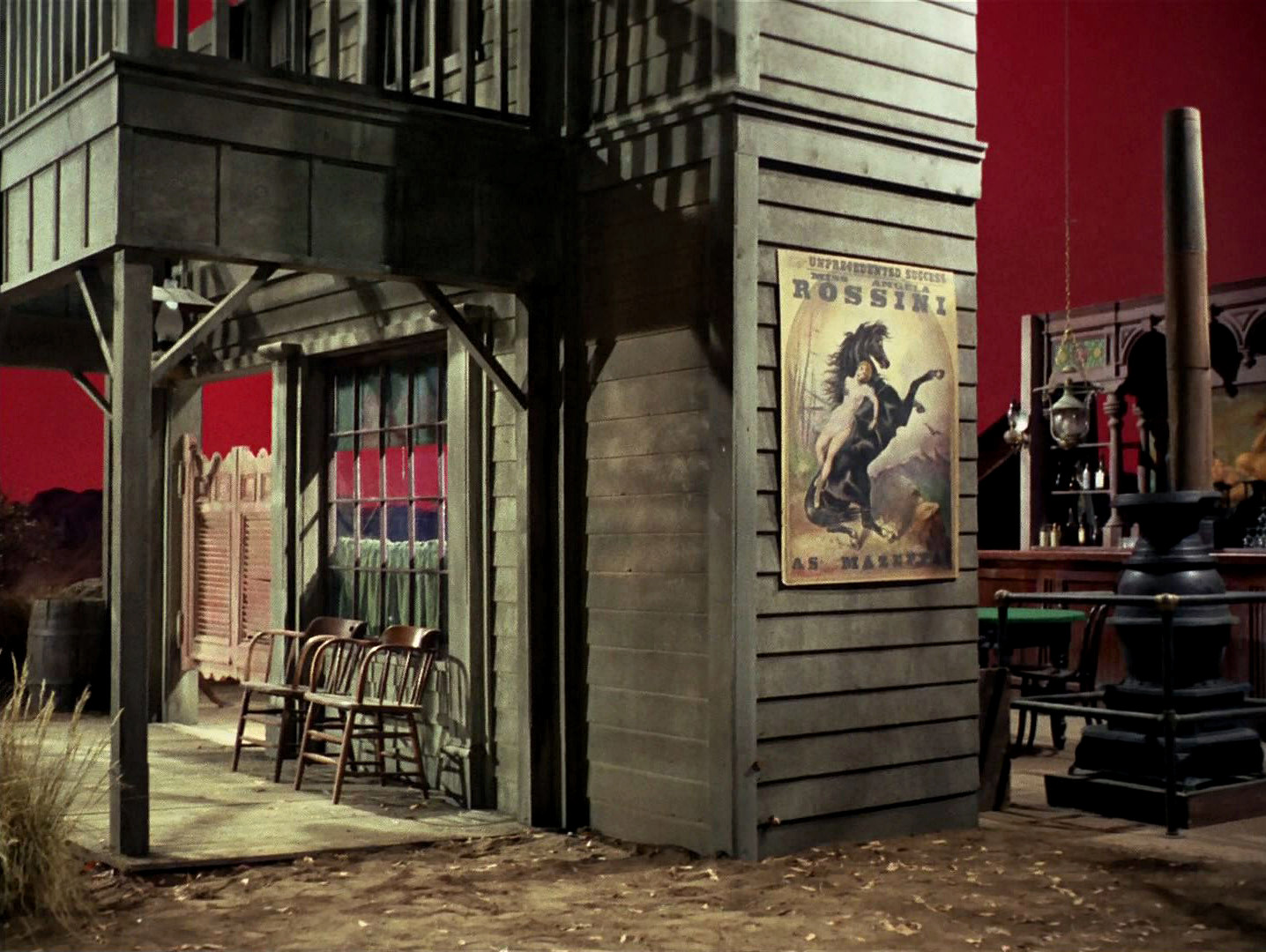
Stardate 4385.3: As the Enterprise's mission is to establish contact with the Melkotians at any rate, Kirk chooses to ignore one of their warning buoys. When Kirk, Spock, McCoy, Scott and Chekov arrive on the planet, the Melkotians have set up an old Western town for them, where they are meant to die. It soon becomes obvious that the five are supposed to take part in a re-enactment of the gunfight at the O.K. Corral in Tombstone, Arizona, in 1881 in the roles of the Clanton Gang, who would lose the fight. Chekov, however, is killed by Morgan Earp before the big shooting. Since the tranquilizer that Spock and McCoy have prepared for the Earps does not work, Spock concludes that the whole scenario is just an illusion. With a Vulcan mind-meld he prepares his fellow crew members for the gunfight, telling them that the bullets are not real. They survive, and find Chekov alive back on the ship's bridge. The Melkotians, who now have proof of the Federation's peaceful intentions, agree to send a delegation.
Review
If there is one cliché that TOS is particularly fond of then it is the one of Earth sceneries on remote planets. But "Spectre of the Gun" is somewhat different. No complicated explanation or lame excuse for the Western/sci-fi cross-over is necessary here. It is neither yet another planet that has taken a parallel development or was contaminated by an insane Federation official, nor yet another time travel to Earth's past. It is clear from the very beginning that the Melkotians have set up the whole scenario for a test of character. One designed with special attention to Kirk's cultural background. Moreover, the power of illusions is credibly visualized for the first time since "The Cage", and not less impressively.
The most obvious weak point of "Spectre of the Gun" is that it takes even Spock until the end of the episode to recognize that nothing about the Melkotians' scenario is real. The members of the landing party don't look like the Clantons, much less is the rudimentary Melkotian version of Tombstone authentic. Why does everyone among the landing party still expect that history would repeat exactly? Why does everyone assume that the other participants are real human beings? If they were, where could they have come from? From the past? Why doesn't McCoy take into consideration that he has been fooled when he states the death of the man killed by Morgan Earp? Why does Kirk bother trying to explain to everyone that he is not the real Ike Clanton? All these figures are unreal and have too obviously been programmed to react the way they do.
Overall, the episode is convincing though and well executed. I think it profits from the routine that many of the staff, in front of and behind the camera, may have had from Western series.
Open question: In the end Kirk surmises that Chekov has probably been on the bridge all along. Does the same apply to the rest of the landing party? Was the illusion so strong that they believed to have beamed down to that planet while they were still on the ship? We can't really tell.
Annotations
- Remarkable dialogue: "Aye. [takes a slug of bourbon] It's to kill the pain." - "But this is painless." - "Well, you should've warned me sooner, Mr. Spock. Fire away." (Scotty, who has agreed to test the tranquilizer, and Spock)
- Remarkable quotes:
- "What can I do, Captain? You know we're always supposed to maintain good relations with the natives."
- "Physical reality is consistent with universal laws. Where the laws do not operate, there is no reality. All of this is unreal." (Spock)
- McCoy is looking for medical supplies in the local dentist's practice, not knowing that the dentist is Doc Holliday, one of his opponents. McCoy is accordingly frightened when he learns whom he has just asked for help.
- The second impressive scene is the one in which Spock prepares his crewmates for the fight with mind-melds, with cuts to the Earps, who are already approaching the O.K. Corral.
- Everyone hears the voice from the buoy in his own language (Vulcan, English, Russian, Swahili), upon which Kirk concludes it must be telepathy.
- Chekov "dies" in much the same fashion as previously McCoy in "Shore Leave".
Rating: 6
Elaan of Troyius
Synopsis

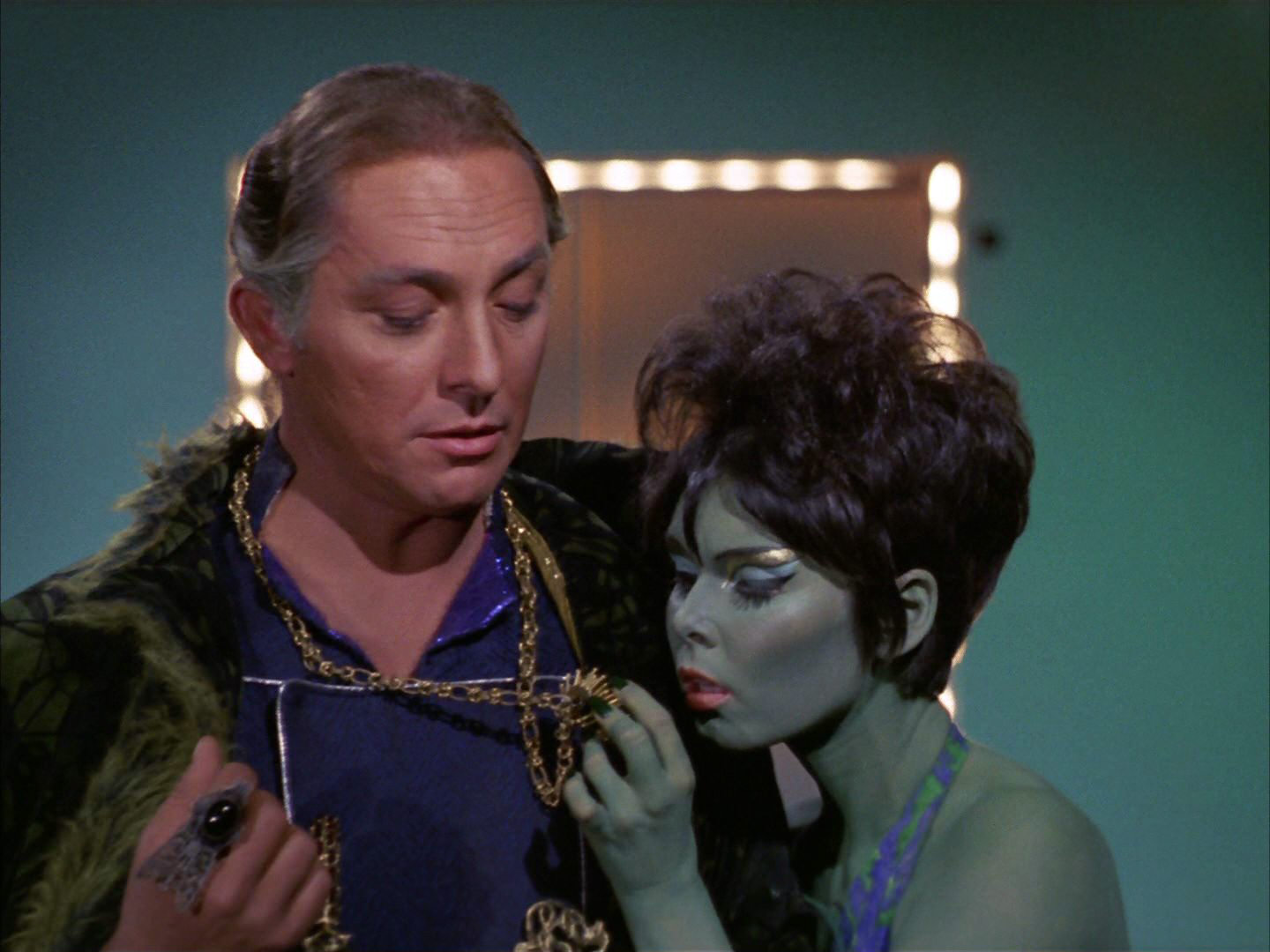
Stardate 4372.5: The Enterprise ferries Dohlman Elaan of Elas to the adversarial world of Troyius for a marriage arranged to end the war. Elaan, however, is more than just reluctant. She stabs Ambassador Petri of Troyius, who was going to teach her the customs of his people. Now his role falls to Kirk. He gets into contact with Elaan's tears, whereby a biochemical bond with her is forged. Kryton, one of Elaan's guards, however, kills a crewman and sabotages the ship's warp reactor, just as a Klingon battlecruiser appears. As the Klingon ship is attacking the helpless Enterprise, Spock discovers that Elaan is wearing a necklace made of dilithium, a gift from Petri, which helps restore warp power. The naturally occurring dilithium on Troyius may be the reason why the Klingons are interested in the planet in the first place. Kirk and Elaan eventually recognize that they both have responsibilities that don't allow them to stay together.
Review
"Elaan of Troyius" is rather unremarkable. The intention of John Meredyth, who wrote and directed the episode, was to create a science fiction version of Shakespeare's The Taming of the Shrew. But it came out much like a reissue of last season's "Journey to Babel". In both episodes the Enterprise is attacked by an invisible alien ship and has delegates on board of whom one is a traitor. "Journey to Babel" came first and was more exciting anyway.
I like France Nuyen as Elaan in the first acts, when she is still overbearing and reacts furiously on anything that is not quite perfect. This part of the episode is quite amusing, also because of the many sound bites. But her sudden change of mind, when she laments that nobody likes her and vows to change that, takes away the steam. Moreover, it reduces the importance of her character, especially since the actress doesn't portray the soft side of Elaan quite convincingly. Well, Elaan does have a plan when she "infects" Kirk with her tears, because she would much rather stay with him than with the despised Troyians. But it is only minor point in a story that Elaan can't dominate any longer.
Elaan's tears that bewitch Kirk through a biochemical reaction are an extraneous plot device. As we wouldn't have otherwise expected, Kirk turns out immune to the infection or temptation thanks to his overwhelming sense of duty. His affection towards Elaan was never credible anyway.
I like how the Enterprise is in a real battle with the Klingons for the first time. On the other hand, their involvement remains rather brief and accordingly superficial.
Annotations
- Remarkable dialogue: "Spock, I've isolated the biochemical substance of the Elasian tears. It's a kind of an infection, and I think I've found an antidote." - "You are too late, Doctor. The captain has found his own antidote." - "Are you out of your Vulcan mind? Do you know how long I've worked on..." - "The antidote to a woman of Elas, Doctor, is a starship. The Enterprise infected the captain long before the Dohlman did." (McCoy and Spock)
- Remarkable quotes:
- "There are no more [quarters] available, but if that's the only way you can get gratification, I'll arrange to have the whole room filled from floor to ceiling with breakable objects." (Kirk)
- "Do we not have the freedom of this ship? We have granted your crew the permission not to kneel in our presence. What else do you want?" (Elaan)
- "It's been my experience that the prejudices people feel about each other disappear when they get to know each other." (Kirk)
- "Mister Spock, the women on your planet are logical. That's the only planet in this galaxy that can make that claim." (Kirk)
- "If I touch you again, Your Glory, it'll be to administer an ancient Earth custom called a spanking, a form of punishment administered to spoiled brats." (Kirk)
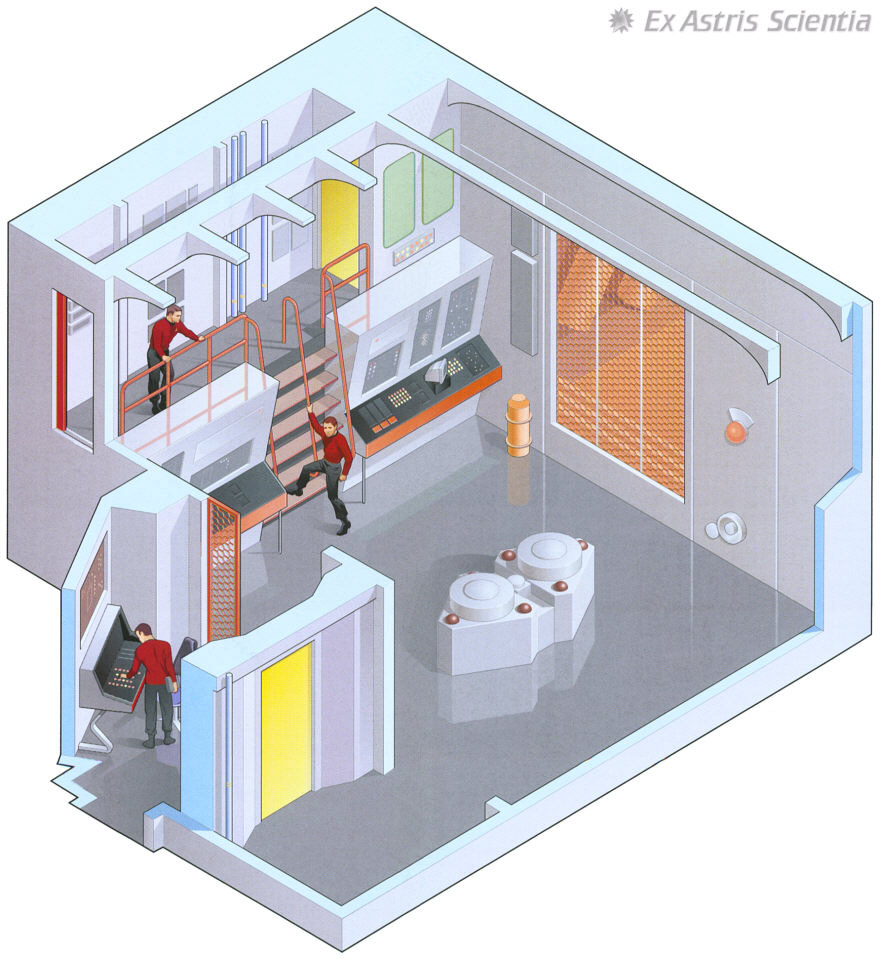
- Remarkable set: We can see the dilithium chamber, which is located between the two domes in the center of main engineering. There was no such installation in the old engine room of the first season. Instead of that, the dilithium crystals were kept in some sort of cabinets ("The Alternative Factor") and looked quite different (copper plates instead of irregularly shaped clear crystals).
- Remarkable costume: The Elasian guards look like artfully peeled oranges.
- Remarkable ship: This episode marks the first appearance of the famous Klingon D7 designed by Matt Jefferies. We can also see the new Klingon emblem for the first time, here still horizontal on the bridge of the Klingon ship. In the remastered version of the episode the now digital ship was given bluish impulse engines for the first time.
- Remarkable fact: Kirk tells Elaan that the sickbay is the best protected part of the ship. But maybe he just wanted to know her in McCoy's custody.
- Remarkable title: The title is a play on words on "Helen of Troy".
- Crew losses: 1
Rating: 3
The Paradise Syndrome
Synopsis
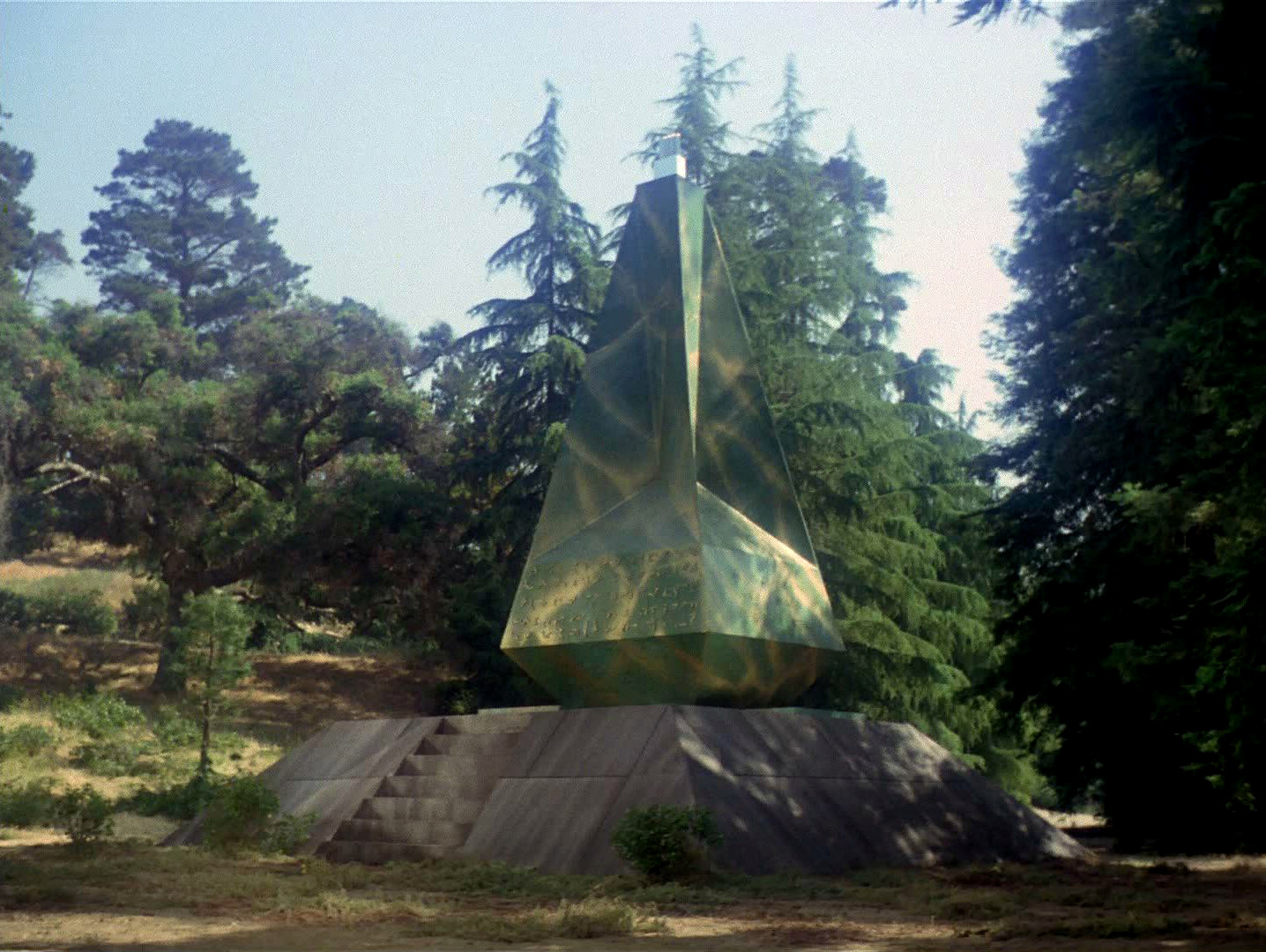
Stardate 4842.6: Kirk finds himself trapped in an obelisk on an alien planet. Having lost his memory, he is adopted by an American Indian tribe, while an asteroid crash on the planet is imminent. Kirk, who now calls himself "Kirok" and is worshipped as a god, falls in love with a young woman named Miramanee. The Enterprise's efforts to deflect the asteroid fail, but the "Preservers", who once transferred the Indians to this planet to save them from extinction, have taken precautions for this case and installed a deflection system in the obelisk. Spock and McCoy arrive in time to activate it. However, they are too late to save Miramanee, who has been stoned by her people when Kirk has failed to avert a storm.
Review
Although it deals with yet another primitive culture and even another unlikely Earth reference, this episode excels like hardly any of its thematic predecessors. While Kirk has always had insignificant brief romances so far (as far as we know about it), he now really falls in love with all the consequences, including marriage and pregnancy of his wife. This is a completely new aspect in Star Trek, showing up as late as in its third year. Alas, the tragic outcome is that Miramanee is killed, and the unborn child with her. And to make it still worse, it is Kirk's fault. It's a pity not only for Kirk, but also for the viewers who would have loved to see a sequel.
I don't know how realistic Kirk's partial amnesia is, but it is interesting to see how he is still acts much like the captain although he has no memory of his own life. At least he remembers basic first aid and saves the injured boy's life, thereby gaining the gratefulness of the natives, which lays the foundation for one of the better "false god" stories of Star Trek. Maybe it was a wise decision to choose Indians as the planet's natives, because their culture can be credibly portrayed without a lot of expenses for make-up, scenery and props. The episode is also unusually complex and "modern", as it has several turning points and is set in two different places most of the time. And the romantic flute score is very nice, just for a change.
Annotations
- Nitpicking:
- Although everything fits together nicely in the end, there are some technical oddities and plot holes in the episodes. Right at the beginning, while Kirk, McCoy and Spock are discussing the evolution on the planet that has taken a similar path as on Earth, they are surprised to stumble across the obelisk. What is the likelihood that they accidentally run into this unique artifact without previously picking up something? Sure, they could have located something from the ship and beamed down nearby, but then the three shouldn't have been surprised about finding something but just about exactly what they have found. At Kirk's request Spock explicitly states that it is made of "an alloy resistant to probe" as if it is something new.
- Also, what is the chance for the words "Kirk to Enterprise" to activate the door of the obelisk?
- After search parties and sensor probes of the area have failed to locate him, why doesn't Spock draw the obvious conclusion that Kirk is somewhere inside the impervious obelisk, where he wanted to go anyway?
- The attempts to move the asteroid using the power reserves of the Enterprise are not completely believable, and Spock's notion that the obelisk must be an asteroid deflector seems far-fetched.
- Finally, why is Nurse Chapel beamed down instead of beaming Miramanee up? Why is she taken to the village (back to the people who stoned her)? Although McCoy's excuse is that she has severe internal injuries, it looks like the good doctor ultimately kills her!
- Remarkable quote: "My bairns! My poor bairns!" (Scotty, as the sparks are flying from his engines)
- Remarkable scene: McCoy orders Spock to get rest eventually. Spock lays down on the bed, but rises again as soon as the doctor has left the room.
- Remarkable fact: The concept of the "Preservers" is introduced to justify the odd fact that the people on most planets look human, or at least humanoid. It is an ingenious idea that can explain away many oddities of TOS. The DNA seed theory in TNG: "The Chase" will provide an even more comprehensive rationale.
Rating: 6
The Enterprise Incident
Synopsis
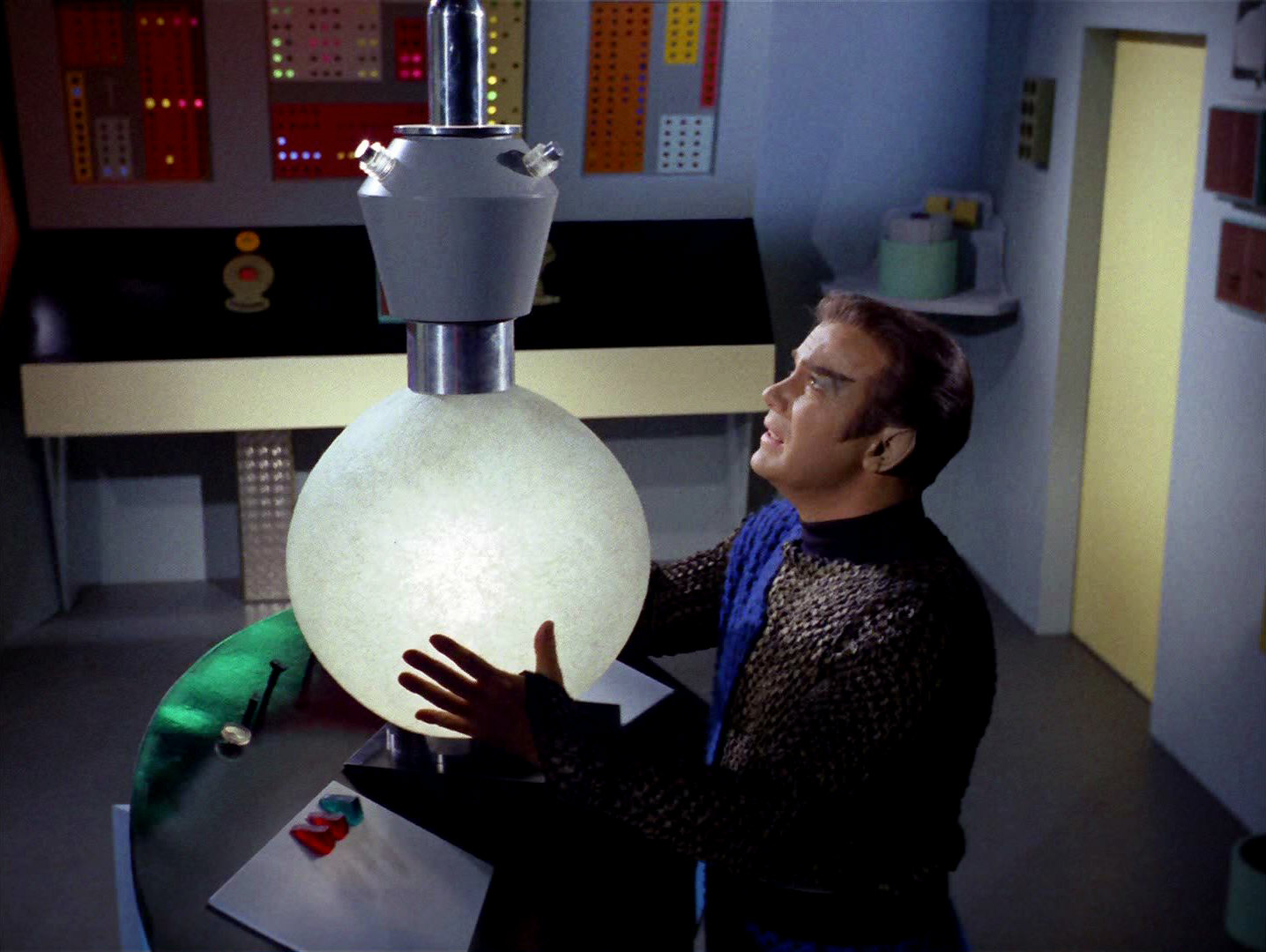
Stardate 5031.3: As ordered by an ostensibly irrational Kirk, the Enterprise enters Romulan space and is instantly surrounded by three Romulan warships. When Kirk and Spock beam over to the lead ship, Spock accuses Kirk of acting without orders and for personal reasons, whereby the Vulcan officer gains the trust of the Romulan commander. The "insane" Kirk attacks Spock, who then "kills" his captain with the "Vulcan death grip". The "dead" Kirk is beamed back to the Enterprise, but returns in Romulan disguise to steal their cloaking device, which has been the true goal of his mission all along. When Spock is being beamed back again, the Romulan commander is with him and is welcomed by Kirk as a "guest". Scotty manages to make the device work on the Enterprise, and the Federation ship escapes the Romulan pursuers.
Review
Every time I am watching "The Enterprise Incident" I am torn between the suspense from the first to the last minute on one hand, and the practically non-existent plot logic on the other hand. On the bright side, with its overall complexity, its countless twists and unexpected revelations the episode is not as predictable as most other TOS installments. I like how the potential that lies in the Vulcan-Romulan relationship is being used. The interaction between the passionate Romulan commander and the usually stoical Spock is interesting to watch. I find it realistic how the crew are putting up with Kirk's orders because it's their duty, while questioning his sanity. There are also some technically and tactically realistic elements in the overall unlikely story, such as the course change just after the activation of the cloaking device to dodge the incoming fire. But other than that, the story becomes the less convincing the more I think about it. This mission of the Enterprise is only successful after a chain of extremely improbable coincidences.
What if the crew had not followed the order of the apparently insane Kirk to enter the Neutral Zone? What if the Romulan commander had not fallen for Spock's ruse to put the blame on Kirk alone and thereby gain her trust? What if Spock and the commander had not accidentally passed by the cloaking room, and Spock wouldn't know where it is located? What if the Romulans had not believed the tale of the "Vulcan death grip"? What if McCoy, who was the one needed to confirm Kirk's death, had not been allowed to beam over? What if the "dead" Kirk had not been transported off the Romulan ship? What if Kirk had not had a chance to beam back again? What if Kirk had not gained access to the cloaking device? What if Kirk had not managed to remove the device immediately? Finally, Scotty, who didn't even know anything of the plan in the first place, installs the completely unknown cloaking device aboard the Enterprise in just 15 minutes as if he had never done anything else, and it works perfectly. Among all his miracles of engineering, this is probably the least likely.
I also have a problem with the way Kirk, Spock and McCoy are acting on the Romulan ship, with "acting" in the sense of a stage performance. At latest when Spock puts the whole blame on Kirk and Kirk freaks out, calling him a "filthy traitor" it becomes obvious that the two are actors in a farce devised to distract the Romulans. A farce that culminates in Spock performing the "Vulcan death grip" when an "insane" Kirk assaults him. It is frightening just for a moment, before the viewer comes to the realization that nothing can be as it seems, and that Kirk, Spock and McCoy (who apparently doesn't even know what is going on but still plays his role) are suddenly just as skilled actors as Shatner, Nimoy and Kelley, respectively. It is ludicrous. Starfleet officers may be able to pretend something (just like McCoy did for a moment in "Amok Time", for instance), but this whole stage play is taken way too far to be credible.
Annotations
- Even if we believe that there was a plan whose chances of success were deemed high enough by Starfleet Command, there are still numerous inconsistencies in the story:
- Spock says that he thinks the Romulans have designed a cloaking device, as if this was something totally new. He must have forgotten about what he saw (or rather didn't see) in "Balance of Terror". The latter episode is not once referred to, in the sad "tradition" of TOS not to build upon previous events. Well, the cloaking device could have been further developed until now, still it isn't their first one.
- The Romulan commander says that a subspace message to Starfleet would need three weeks, although historically the Neutral Zone has to be very close to Earth because the ships must have been slower.
- The two Romulans that came to the Enterprise were wearing helmets. Kirk takes one of their uniforms, but without the helmet, and beams over. How can he be sure that he wouldn't raise suspicion wearing that uniform without the helmet? And wouldn't it have been better to wear it anyway, in order not to be recognized so easily? Heck, considering that the helmet covers the ears and eyebrows, he could have even forgone the surgery to make him look like a Romulan!!!
- Kirk is desperately waiting for a word from Spock about the location of the cloaking device, which Spock was aware of even before he "killed" Kirk. But Spock was apparently so busy with the Romulan commander that he felt unable to send a message. Only when she leaves the room to change clothes, he finally calls Kirk, who is already on the Romulan ship and could be discovered any second. Since being alone for a minute was everything he needed, why didn't Spock simply pretend that he had to go to a restroom, or something like that?
- Why don't the Romulans detect the transporter beam when Kirk beams over? And wouldn't they have their shields raised all the time? Just like the Enterprise's that would have to be dropped to allow beaming?
- When Kirk and later Spock are being beamed back, once again, how is this possible through the shields?
- Why does Mr. Scott have 15 minutes to get the cloaking to work? What would keep the Romulans from blowing the Enterprise to dust before allowing the ship to escape? If the time refers to the presumed duration of Spock's trial on the Romulan ship, why would the Romulans even bother listening to him right now? They could just as well execute him immediately or postpone the whole thing until they can set up a show trial on Romulus.
- Remarkable quotes:
- "I have heard of the Vulcan integrity and personal honor. There is a well-known saying, or is it a myth, that Vulcans are incapable of lying." (Romulan commander)
- "Well, are you coming, Jim? Or do you want to go through life looking like your first officer?" (McCoy, asking Kirk to come down to have his ear extensions removed)
- Remarkable facts:
- Spock has been a Starfleet officer for 18 years.
- Romulan and Vulcan physiology is virtually identical, expect for a light difference that Chekov can use to locate Spock on the enemy ship.
- Remarkable symbol: This is the only episode to show the Romulan emblem that was purposely designed to resemble the Klingon one, for it would be possible to spot the latter on the hulls of the originally Klingon ships.
- Remarkable ship: The producers obviously decided to use the new and better looking Klingon ship instead of the Romulan BoP. Irrespective of the technical reasons, it was not a good decision in hindsight that the Romulans would have Klingon D7s. In the remastered episode this was alleviated by replacing at least one of the three Klingon vessels with a genuine Romulan BoP and by giving the D7s a Romulan bird painting on the underside.
Rating: 5
And the Children Shall Lead
Synopsis
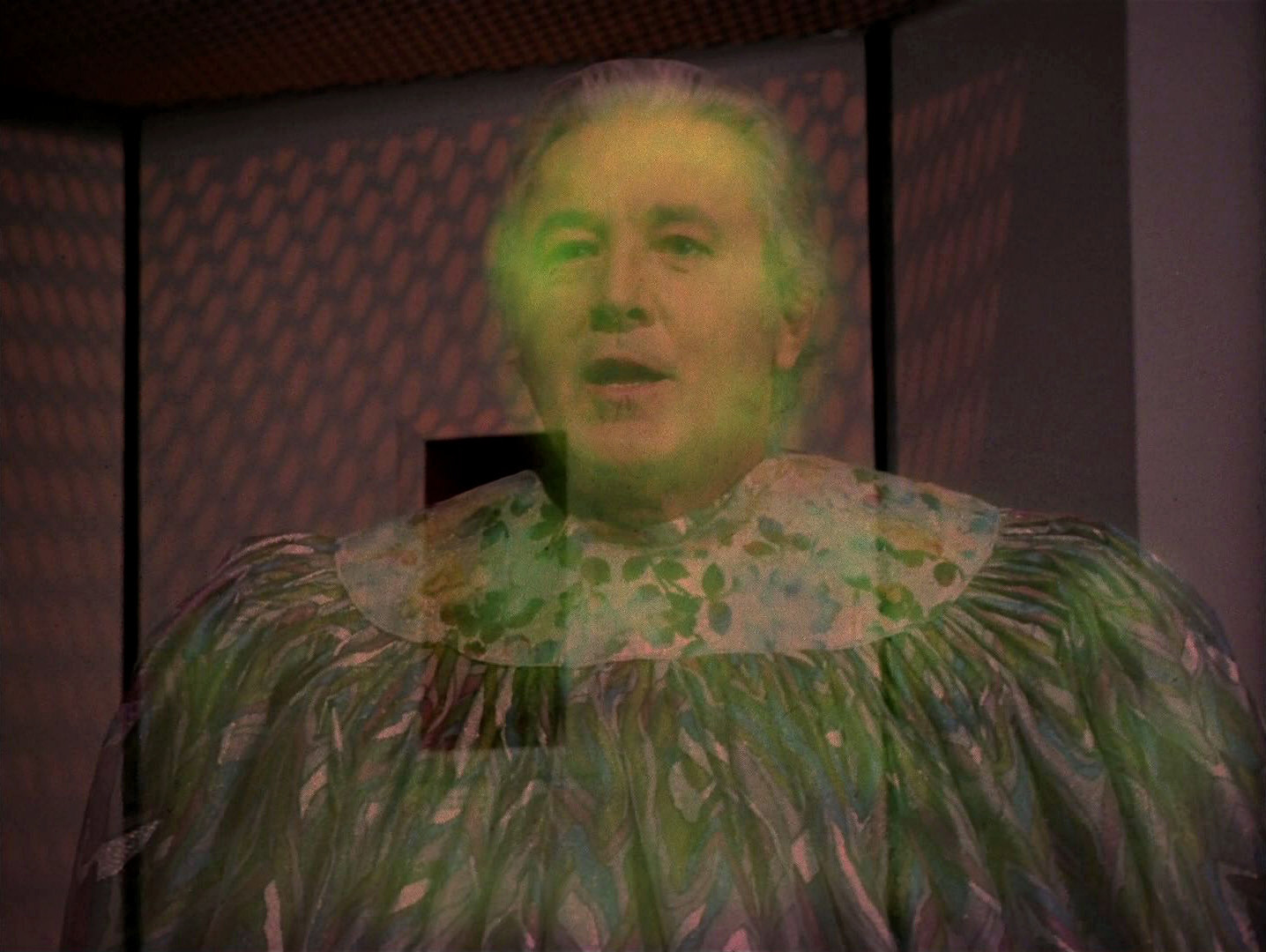
Stardate 5029.5: All scientists of the outpost on the planet Triacus have apparently committed suicide, but their children do not seem to be troubled about it at all. They are under the influence of the "Friendly Angel" Gorgan, a non-corporeal being from Triacus that is actually responsible for the deaths. The children help Gorgan induce hallucinations in the crew to take the ship to Marcus XII, where he hopes to find more victims. Two crewmen die as they are beamed into space because unbeknownst to the crew the ship is no longer in orbit of Triacus. But Kirk and Spock finally convince the children to turn against Gorgan, showing them what he has done to their parents.
Review
All hands battlestations! The terrible kids from "Miri" are back! While the circumstances are somewhat different here, the theme of estranged children who stir up trouble is essentially the same. The rest of the story entirely consists of other well-known clichés. We've got yet another outpost whose entire crew is dead, yet another destroyed alien civilization whose spirit has survived in the form of pure energy, yet another "ghost" who is evoked with some mumbo-jumbo and yet another alien attempt to hijack the ship with mind control and induced hallucinations. Yet again Kirk and Spock are the only two crew members who are immune to the alien influence. And Shatner's over-acting is cringeworthy when Kirk is temporarily haunted by the idea that he has lost control of the ship. Eventually Kirk and Spock save the ship all alone, and not even McCoy contributes anything to that end.
It is a pity that the episode takes such a course, because it starts off as mildly interesting, as the landing party discovers the dead scientists and their children that are strangely unaffected by the deaths of their parents. I like the mystery that is being built up in the first couple of minutes, and how Kirk, Spock and McCoy are doing their best to find possible explanations, only to decide that it could do damage if the traumatized children were confronted with the whole truth too soon. The interaction of the children with the crew is nice at first, especially when Nurse Chapel produces ice cream for them and when Kirk attempts to talk with Tommy Starnes, the oldest and perhaps most reasonable of the kids. But then Gorgan appears and the rest of the story is utterly predictable. Gorgan is an extremely weak villain-of-the-week anyway. His powers are apparently so limited that he can only control the simple minds of the children. It seems that only through their bodies (as they are hammering with their fists, which gets very annoying after a while) he can induce hallucinations in the crew. He can be fooled easily, as he is summoned by Spock with a simple recording of the children's chant. And his motivation never becomes clear, other than that he is just another alien lifeform who wants to rule the galaxy.
Speaking of Gorgan's mental influence, it leaves a very bad impression that he can make the children forget or totally ignore that their parents are dead, only through trivial promises that they can get whatever they want and go to bed whenever they like to. The children unanimously follow him for totally selfish and inconsiderate motives. As Gorgan says himself about adults, "but you are gentle, and that is a grave weakness." Still it remains a mystery how the children first gloss over the deaths of their parents, even as they are dancing around the dead bodies in an extremely macabre fashion, and then remember them with the help of a simple video that Kirk and Spock replay to them.
Annotations
- Nitpicking:
- The children obviously haven't influenced Kirk, Spock and the transporter operator when they beam two guards into open space. They correctly recognize that the ship is no longer in orbit, only too late for the two unfortunate men. So the transporter doesn't seem to have any safeguards that would have warned them or better, prevented the transport in the first place!
- Kirk refers to the "Friendly Angel" as "Gorgan" (or rather Gorgon from Greek mythology?). But the name has never been mentioned until then.
- Why should the non-corporeal Gorgan grow blains when his power dwindles away?
- Remarkable quote: "Humans do have an amazing capacity for believing what they choose and excluding that which is painful." (Spock)
- Remarkable prop: This episode shows the ugly red UFP pennant, which rather looks like the banner of a US high school football team. No offense to US high schools, but I would have expected an exceptional design for the United Federation of Planets.
- Remarkable fact: "According to the legend, Triacus was the seat of a band of marauders who made constant war throughout the system of Epsilon Indi. After many centuries, the destroyers were themselves destroyed by those they had preyed upon." (Spock)
- Crew losses: 2
Rating: 1
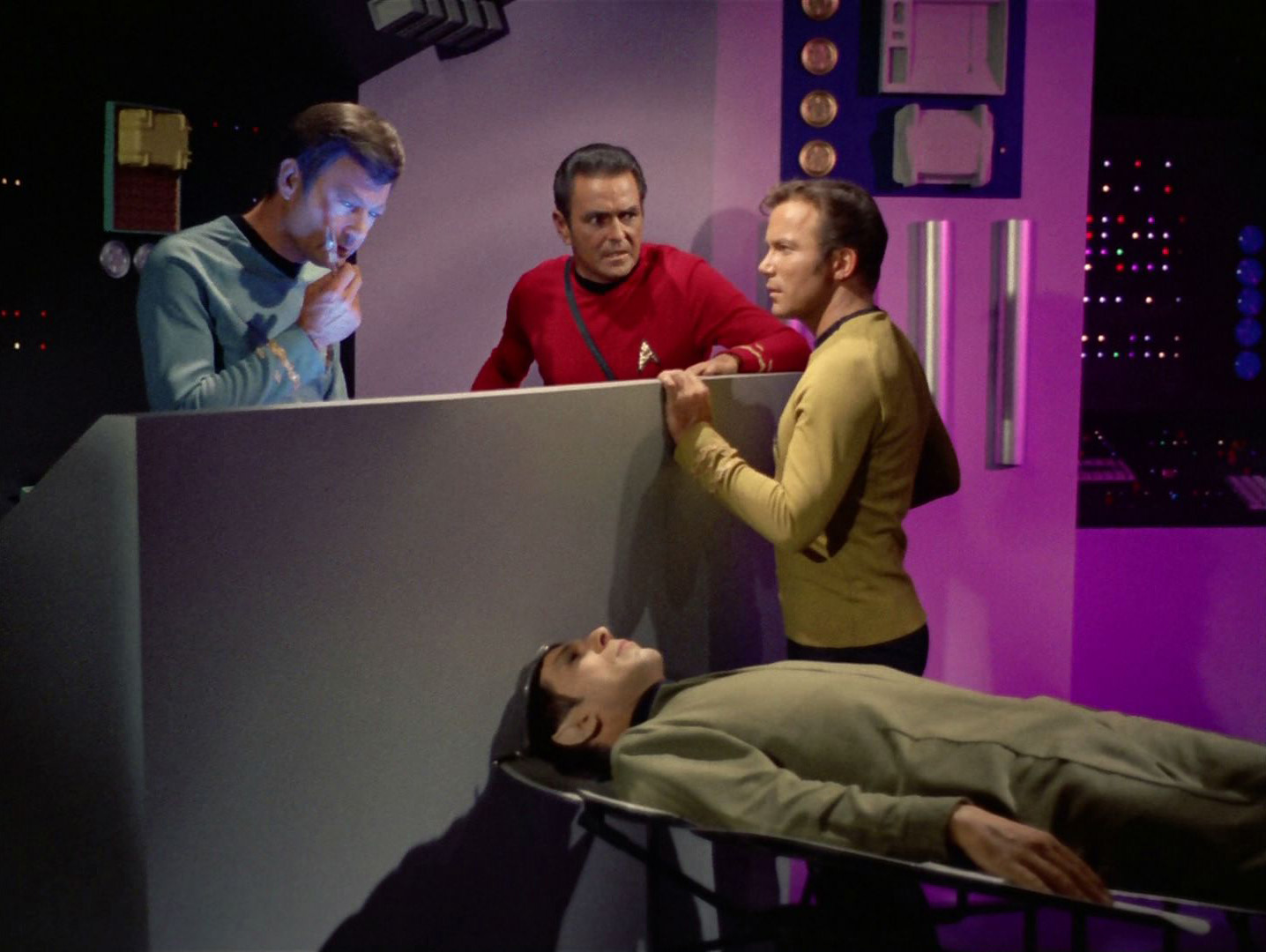
Spock's Brain
Synopsis
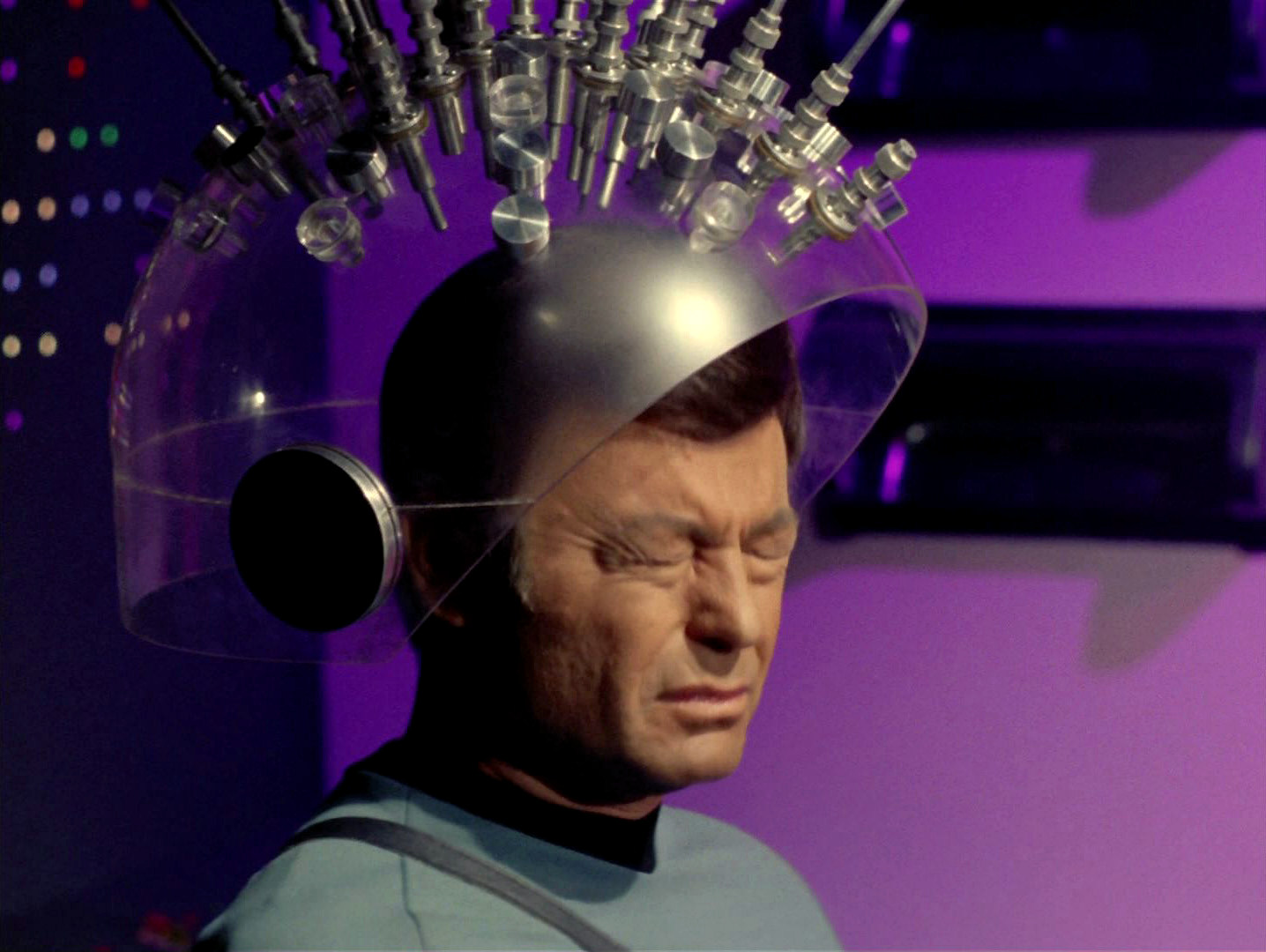
Stardate 5431.4: A beautiful female intruder stuns the crew of the Enterprise and disappears with Spock's brain. After following the ion trail of her ship to the Sigma Draconis star system, a landing party investigates a suspect planet on a primitive cultural level but with a significant energy source. McCoy beams down with Spock's remote-controlled body and joins Kirk and Scotty. They enter a cave that was prepared as a trap for the primitive men, the Morg, who live on the surface. An elevator takes them hundreds of meters below the surface. There they meet the intruder, Kara, again. She refuses to return the brain, which now serves as the "Controller" of her people, the Eymorg. The Eymorg themselves don't know how their technology works. Kirk, however, has established a communication link with Spock's brain and finds the "Controller". Kara shows Kirk the "Teacher", a device that temporarily gave her the knowledge to remove Spock's brain, but she again denies any help. McCoy uses the "Teacher" and partially restores the brain; but when he begins to forget how the procedure works, Spock himself has to assist him.
Review
This episode has a reputation that seems to be set in stone for being the worst of TOS, and there are many reasons why most fans find it cringeworthy. The mere idea that someone could remove Spock's brain and leave behind a remote-controlled body much like a zombie is absurd to start with. However, at least it gives this story some distinctiveness, because otherwise it bears many similarities to "The Apple". In both cases we have a civilization whose natural development is held back by a powerful machine, dumb natives who have no concept of sexuality and a captain who doesn't mind interfering with their culture.
Anyway, why did Spock have to walk in the first place, why didn't McCoy simply put his body into a wheelchair and keep it unconscious? There is no apparent reason for dragging Spock along in this rather complicated fashion. Only Kirk's trick to use the remote-controlled Spock to disable the punishment belts retroactively justifies the decision. In any case, the mere sight of Spock as a "walking dead" appears to cross a line. On the other hand, stranger things have happened in Star Trek, and characters under alien influence or not in control their emotions are bread-and-butter issues. In this episode it only comes across as funnier than elsewhere.
However, other concepts of "Spock's Brain" are just as silly. The Eymorg with their miniskirts and high boots are so unbelievably attractive and yet so daft, the depiction of their civilization could pass as a parody. The talking of Spock's brain from inside the Controller is way too hilarious to be taken seriously. And finally Spock helps McCoy in the reconstruction of his own brain, the way an electrician advises his apprentice to connect the right wires! This is just too much satire, and unlike the well-dosed humor in "The Trouble with Tribble" or the genuinely farcical set-up of "I, Mudd" the humor is unintentional here. But while this episode winds up as ridiculous it is enjoyable nonetheless. Several other TOS episodes are much less entertaining, and much more annoying. So I still give "Spock's Brain" one point.
Annotations
- Nitpicking:
- Kirk, Spock and Scotty are impressed by the alien ship's ion drive, which is said to be something more advanced than the Federation has. But ion drive is a real-life development that has been successfully tested for use in space probes and, of course, it is capable of sublight speeds only.
- When he is inside the "Controller", why is Spock speaking with his own voice? Did they remove the vocal chords and the voice box as well?
- Since when is mere knowledge sufficient for McCoy to perform an extremely delicate brain surgery? Wouldn't he need special equipment just as well? As McCoy says himself when he has forgotten everything again, it's like "trying to thread a needle with a sledgehammer". Knowledge couldn't change anything about that.
- Remarkable quote: "Brain and brain. What is brain?" (Kara, the Eymorg)
- Remarkable props: Spock's remote control and the "Teacher" that looks like a drying hood
- Remarkable ship: The Eymorg ion drive ship that used to look like a "flying dildo", but was totally redesigned to a compact bullet with pods for TOS-R
- Remarkable facts:
- On the industrial development scale, "B" denotes the Earth equivalent of approximately 1485, and "G" stands for the year 2030.
- As the landing party has materialized on the cold planet, Kirk says: "Suit temperatures to 72." So the standard issue uniforms appear to have built-in air conditioning.
Rating: 1
Is There in Truth No Beauty?
Synopsis
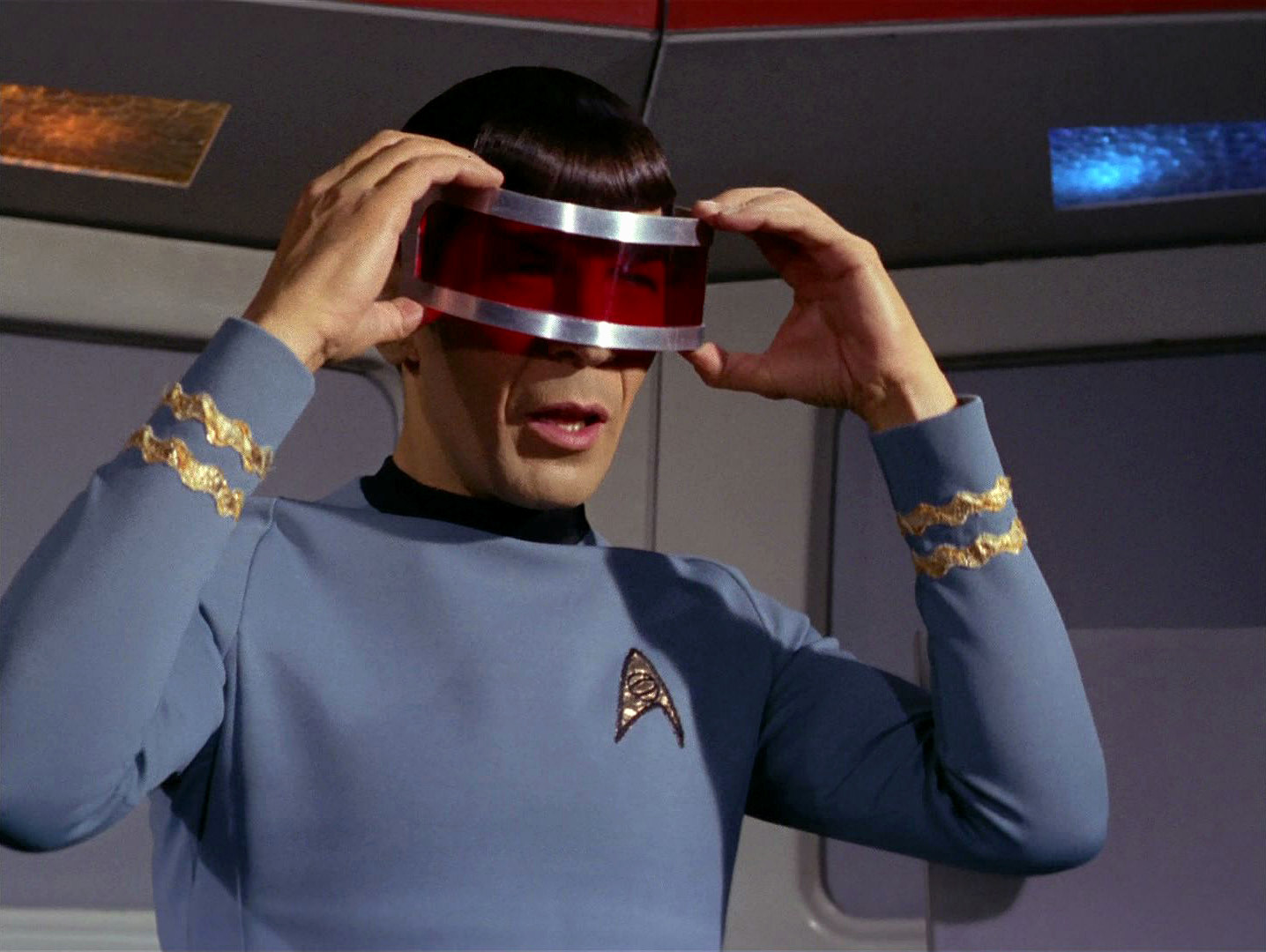
Stardate 5630.7: Ambassador Kollos is brought aboard, a non-corporeal Medusan whose mere sight will drive any human insane. He is accompanied by Miranda Jones, who was trained on Vulcan and who can telepathically communicate with Kollos, and the engineer Larry Marvick, who is in love with Miranda. The jealous Marvick attempts to kill Kollos, but the mere sight of the Medusan drives him mad. He takes control of engineering, steers the ship into an uncharted region beyond the rim of the galaxy and eventually dies of the damage to his brain. Only the Medusan with his skills in the field of navigation could find a way back, and Kirk decides that Spock should link with Kollos, against Miranda's wishes. After returning the ship to known space Kollos, in Spock's body, forgets to put on the protective glasses again, upon which Spock's mind suffers heavy damage. He is healed when Miranda telepathically links with him.
Review
This episode has an interesting premise as far as the communication with the non-corporeal Kollos is concerned. However, when Marvick turns mad, seizes control of the engine room and puts the ship at risk like so many many people have done before, it winds up as one of those many cookie cutter adventures that don't permit much variation and inherently focus on Kirk or Spock, one of whom then saves the ship. This time it is up to Spock - albeit with the help of Kollos. The episode still has its moments, especially in the interaction of Spock and Jones and their competition to link with Kollos, and in the scene when Kirk confronts Miranda with her jealousy and even alleges that she would like Spock to die. But other than that, much about the script as well as about the directing is wrong or feels wrong.
A principal weakness of the whole story lies in the very idea that the mere "sight of a Medusan brings total madness". Some technobabble that radiation coming from the Medusan overloads and irreparably damages the human occipital lobe in a way to feed the brain with wrong visual information would have made the whole phenomenon more Trek-like and overall more plausible. But the way the phenomenon is shown in this episode it comes across as too mystical. Even worse, in a lack of a better explanation McCoy explicitly attributes the effect of the Medusans on human beings to their ugliness. By all means, such an idea ("by your ancient Greeks", as Spock puts it) is obsolete already by 20th century standards, utterly intolerant and devoid of a scientific basis. But a few more lines of dialogue as well as the episode title readily pick up the pointless idea of the Medusans being ugly.
While I like the character of Miranda Jones except for her unjustified secrecy about her blindness, Larry Marvick is a total jerk even before he is driven insane. And it wouldn't have been necessary for Marvick to die just for the melodramatic impact. On the contrary, I believe it would have been much more tragic if he had been committed to a mental institution for the rest of his life.
Annotations
- Nitpicking:
- After already stating at the dinner that someone is planning a murder while apparently seeing Kollos's box in her mind, Miranda is alone with Marvick. When she has a second vision of Kollos's box, she asks Marvick: "So it's you... Who is it you wanna kill?" She must have actually seen something else than we were shown.
- Why is Marvick carrying a phaser? He is an engineer and not anyone who would be allowed to run around on the ship with a weapon.
- Why is the lid of Kollos's box opening when Marvick comes in? It is possible that Kollos can control it himself, but then it should have been mentioned in some fashion that the ambassador, perhaps telepathically alerted by Miranda, acted in self-defense when he exposed himself to Marvick. And why doesn't Marvick turn round immediately when the box opens?
- What happened to phasers on stun? At latest when Kirk and the security storm into the engine room, they could overwhelm Marvick much more quickly and conveniently than with physical force.
- In a matter of two minutes the Enterprise crosses the edge of the galaxy. Marvick can't be all that insane if he accomplishes such a miracle.
- Miranda Jones is blind and she needs the sensor net to see anything. But her eyes move as if she could see. So someone built mechanically perfect eye prosthetics for her but didn't include image sensors there?
- Why does Miranda Jones make a secret of her being blind anyway, except for another melodramatic impact when it is discovered?
- When Dr. McCoy states that Miranda is blind and Spock places his hand in front of her eyes to test her reflexes, she backs off. Spock says, "Fascinating". But what is fascinating? That Miranda is blind and has reflexes nonetheless, or that she is blind and the director just didn't notice that Diana Muldaur was supposed to stand still?
- When Kollos/Spock walks behind the shield, some seven or eight people are looking at him but no one notices that he left his immensely important protective glasses on the console? Come on! This is like Spock walking into an airlock without a spacesuit and no one telling him!
- Continuity: Spock mentions to Miranda Jones that, just like Kollos, also McCoy feels uncomfortable when he is being transported. He still doesn't like being beamed in "Star Trek: The Motion Picture".
- Remarkable quote: "A madman got us into this, and it's beginning to look as if only a madman can get us out." (Chekov)
- Remarkable scene: The scenes from "Mad Spock's" perspective are filmed with an extreme wide-angle lens and are quite impressive.
- Remarkable facts:
- Marvick brought the ship to a speed past Warp 9.5, when it "entered a space-time continuum", according to Spock.
- It is the third time after "Where No Man Has Gone Before" and "By Any Other Name" that the Enterprise crosses the edge of our galaxy.
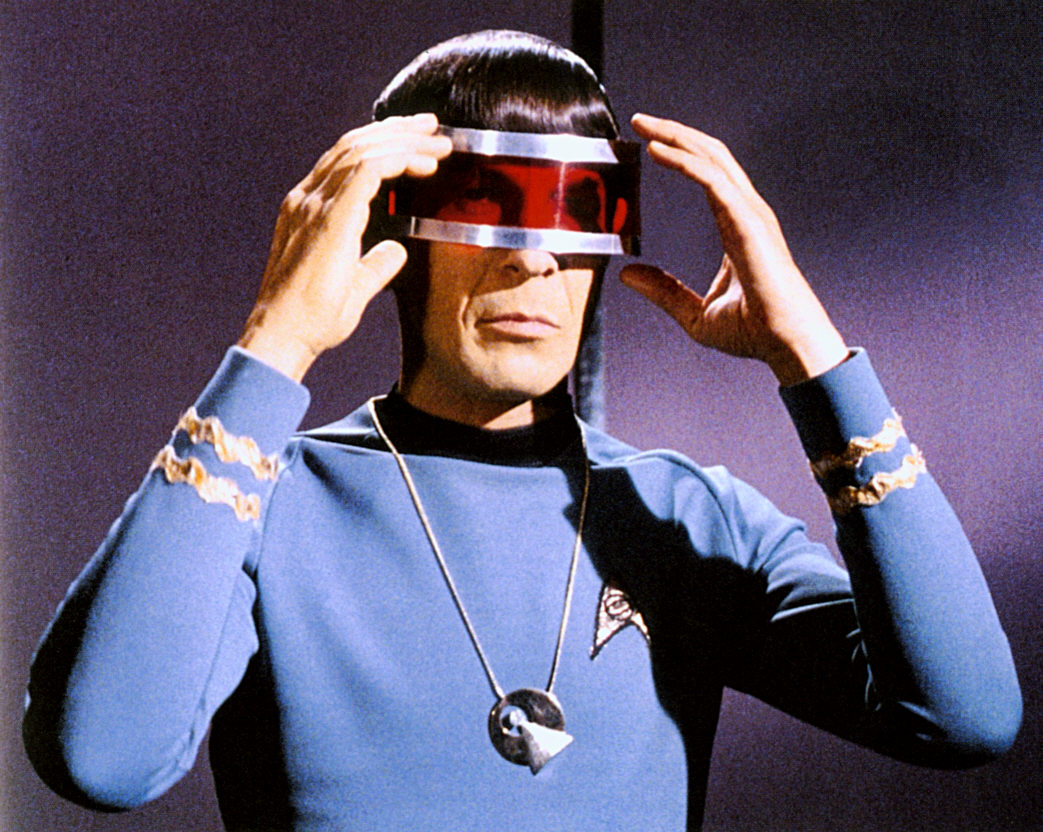
- Remarkable prop: This episode introduces the Vulcan IDIC symbol (Infinite Diversity in Infinite Combinations) that Spock is wearing.
- Remarkable appearance: Diana Muldaur, who plays Miranda Jones, previously appeared in another notable guest role as Ann Mulhall in TOS: "Return to Tomorrow". She will return to Trek as Dr. Pulaski in TNG's second season.
Rating: 3
The Empath
Synopsis
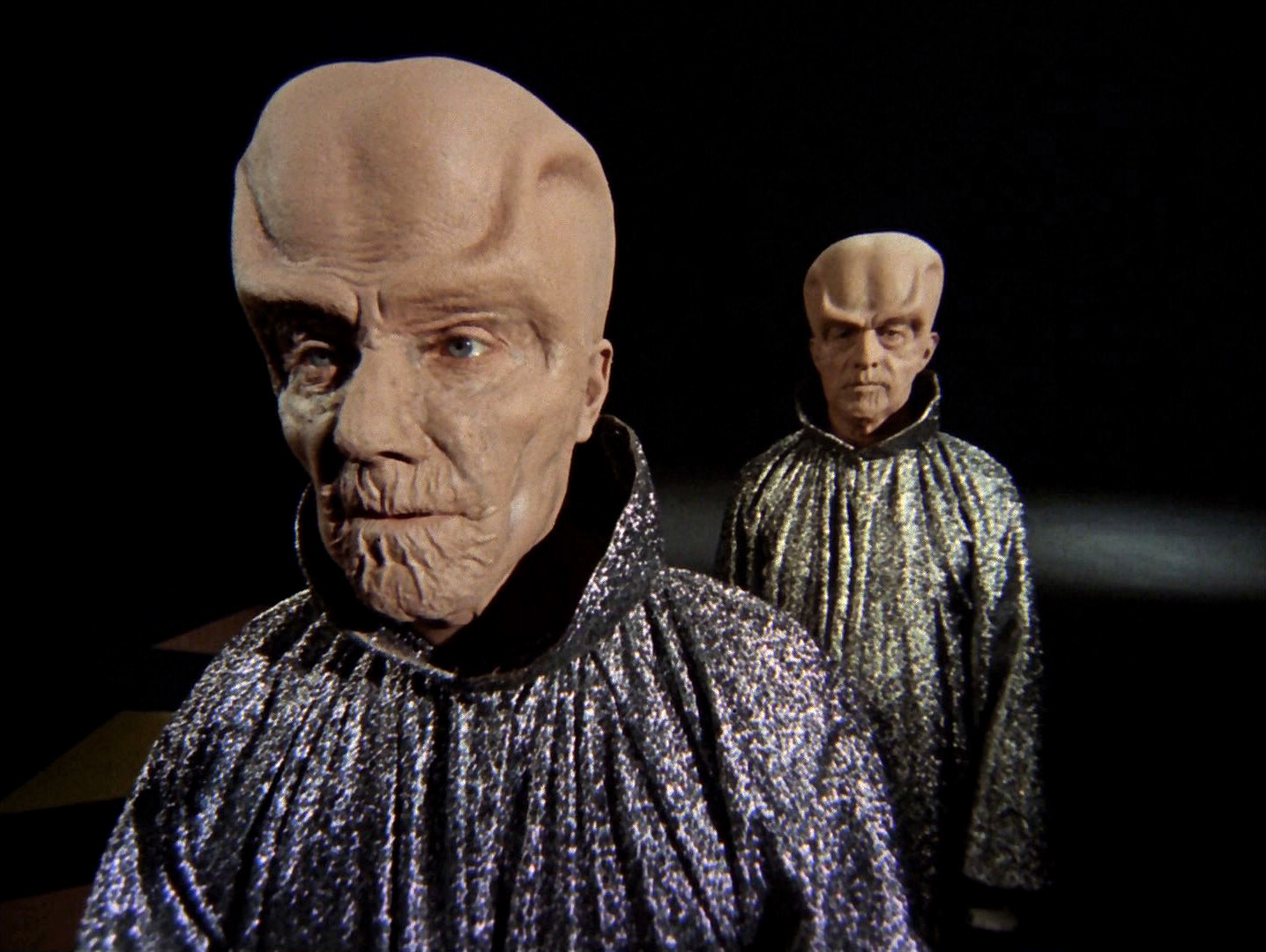
Stardate 5121.0: The Enterprise is ordered to evacuate a research outpost in the Minarian system whose sun will go nova. When the attempts to contact the station fail, Kirk, Spock and McCoy beam down and find that the crew is gone. Then a transporter locks on to the three officers and beams them into an area where they are being held captive by two Vians - together with a mute woman whom McCoy nicknames "Gem". The Vians have already tortured the crew of the research outpost to death, and they intend to continue their cruel experiments with the Enterprise landing party. After Kirk has been hurt, Gem turns out to be an empath and absorbs his pain. The crew's subsequent attempt to escape together with Gem fails and is obviously part of the Vians' plan. When it comes to the final test, McCoy disables Kirk and then Spock with a hypospray and thereby "volunteers" to be the victim. Kirk and Spock finally manage to transport themselves into the torturing area, where McCoy is already dying. The Vians' actual goal, however, is to test Gem's ability to overcome her instinct of self-preservation and help McCoy, which she does eventually. When Kirk and Spock manage to overwhelm them and end the cruel scheme, the Vians concede that are satisfied now. In their view Gem has proven that of all inhabitants of the Minarian system her race is worthy of being saved.
Review
This episode never gets really exciting, because we have seen the crew in the hands of superior alien captors so many times before. The only difference is that this time the aliens' intent is not the usual one, which would be to keep the crew as their pets or slaves. I also like the deaf-mute Gem because she is a new kind of character. Yet, the depiction of Gem's empathy with her exaggerated gestures is overly melodramatic, even kitschy at times. But even though she represents the gender cliché of a passive and compassionate woman (just imagine a man in her role!), she benefits the story. I only wonder: Was she aware, at any time, that it would be up her to save her whole people? This question remains unanswered.
As the Vians' plan ensues with its unusual cruelty we have to wonder what in the world the very advanced (but clearly not very enlightened) Vians are going to accomplish. When it becomes clear that they are testing Gem's abilities, rather than the crew of the Enterprise, this is still rather satisfying. But the ultimate resolution, that they are going to evacuate Gem's race but need confirmation that they are worthy of being saved, comes as a big disappointment. It is such a pathetic excuse that as soon as there is a lot at stake it is allowed to throw overboard all ethical concerns and torture people to death to achieve a goal. The quite conciliatory ending of the episode does not work at all with me, because not only do the Vian killers get away with their cruel methods; also millions of people will have to die because of the Vians' arbitrary decision to save just Gem's race, and because of the Federation obviously doing nothing.
If the Vians really wanted to help the inhabitants of the Minarian system, the way it can be expected from a very advanced race, the only possible course of action would be to evacuate as many people as possible (and some artifacts) from as many planets as possible and as fast as possible. Or enlist some other advanced race to help them. They would have had several months to prepare the evacuation of one or more planets, considering that the Federation set up a research outpost to observe the central star already six months ago. But as the catastrophe is near, the Vians are still wasting precious time with their pathetic tests! Tests that are just as absurd and abhorrent as the tortures in medieval witch trials or the Nazi experiments on prisoners. What could the Vians possibly prove by taking just one sample of a race in the form of Gem and test just one of her characteristics? This is so utterly unscientific, it would be laughable if it weren't so cruel. And what would they have done if the Enterprise hadn't brought them new "test subjects"?
But one other point about the premise irks me just as much as the Vians' stance. The Federation has set up the research outpost to monitor the dying star and must have been well aware that the system is inhabited (by sentient species on at least two planets, although the Vians who speak of "all the planets" insinuate there are several more). But the Enterprise's only concern is to save their own two people. No one of the crew only bothers to mention at any time that millions (or perhaps rather billions) of inhabitants and several different civilizations will perish, until the Vians bring up the issue. The Federation didn't even bother to study them before they would be extinguished, because evidently no one of the crew is familiar with Gem's race. There may have been no way for the Federation to get out all the inhabitants even in as many as six months of time, but what about saving just as many as possible, as many as a couple of starships can carry? In some way the Vians' stance is more ethical than that of the Federation, even though their methods are despicable. The reason for the Federation being so unconcerned is not made an issue here, but it will be retroactively justified in TNG: "Homeward". In the TNG episode the crew is convinced that letting the inhabitants of a doomed planet die in accordance with the Prime Directive is the right thing, because it is said and shown to be better for a primitive race to be extinguished than to be spoiled by the wonders of technology. I am only glad that the TOS episode averts the hypocrisy that lies in this stance, by simply neglecting to mention the rationale of the Federation.
Annotations
- Nitpicking:
- As the three crew members have disabled one Vian (Lal) and are walking away with Gem trying to find a way out, Lal quickly recovers and is joined by the other one (Thann) when the fugitives are only a few meters away. It is clear that the two want them to try to escape. But no one among the four even looks back, where they would spot the two Vians. This is just bizarre.
- When we see Kirk (probably a body double) from behind as he is dangling on chains from the ceiling, the chains are stretching out his arms straight. In the close-up of his face and chest, however, his elbows are bent. Also, when Kirk is shown from behind again and he is swinging, we can see that the chains are not tightened (so he can move his arms to a limited extent and something else must lift him above the floor). I wonder how they accomplished this effect.
- Remarkably pathetic excuses for murder: "You're wrong. Their own imperfections killed them. They were not fit subjects.", "We did not kill them. Their own fears killed them."
- Remarkable facts:
- There is a Ritter scale (reminiscent of the Richter scale) to rate solar flares.
- The Vians are using a "matter-energy scrambler, similar to our own transporter mechanism", according to Spock.
- "The sand bats of Manark IV appear to be inanimate rock crystals until they attack", as Spock says.
- There is a mute civilization on Gamma Vertis IV, as Kirk remembers.
- Remarkable set: I dig the dark set without visible walls and with sparse decoration that most of the action takes place in. It is a nice contrast to the usual narrow corridors, dungeons or caves.
- Remarkable reaction: In the UK, the BBC rated this episode as too violent (at least compared to other TOS episodes that are largely free of graphic violence; but we are not shown the actual act of McCoy's torturing, for instance) and didn't air it until 1994.
Rating: 2
The Tholian Web
Synopsis
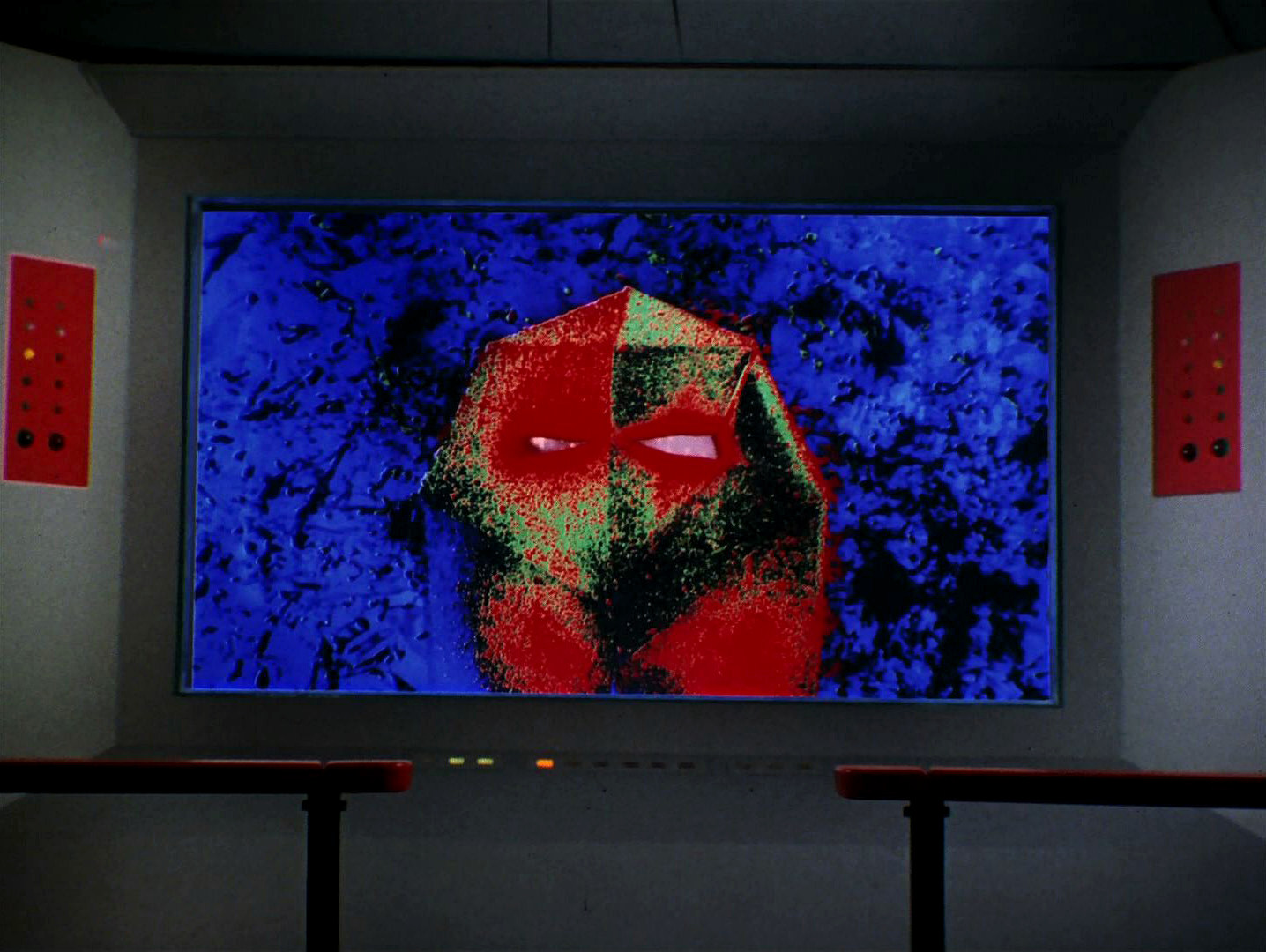
Stardate 5693.2: The Enterprise finds the missing USS Defiant in an interphase corridor to another universe. Kirk, Spock, McCoy and Chekov beam over, only to find that the crew have killed each other. As the interphase is interfering with the transporter, Kirk has to stay behind and vanishes together with the Defiant. Briefly later Chekov and other crew members exhibit signs of the same insanity that killed the crew of the Defiant. Moreover, a Tholian ship appears. Commander Loskene claims this region of space for the Tholians and gives the Enterprise just enough time until the next interphase to rescue the captain. But the interphase does not occur as calculated, the Tholians attack the Enterprise and Spock returns the fire. The Tholians come back with a second ship and begin to weave an energy field in the form of a "web" around the Enterprise. As there is no chance any longer to rescue Kirk, Spock declares the captain dead. When Kirk's image appears to Uhura, McCoy confines her to sickbay just like the crew members that have gone mad. McCoy successfully develops an antidote to the effects of the space on the crew. In the meantime, however, more of the crew have seen Kirk, who is obviously still alive. Spock devises a plan to break free from the just completed Tholian web by entering the interphase corridor, and the transporter beam on Kirk drags him out of the area as well. The Enterprise successfully re-enters normal space outside the web, and Kirk is beamed aboard alive.
Review
"The Tholian Web" is an episode with an intelligent plot and with special emphasis on the relationship between Spock and McCoy. For the first time in the series Kirk is missing for the most time, and this is to the episode's benefit. Not that I wouldn't appreciate his presence, but it shows that the other main characters may take over the lead roles too.
I think McCoy's criticism of Spock's command decisions is unwarranted, and the way he questions Spock's ability to command the ship is very inappropriate. I can understand Spock when he repeatedly tells McCoy that he has a job to do in sickbay, rather than rehashing things that can't be undone anyway, even though Spock's reaction too is disproportionate. On the other hand, their conflict is unusually intense and enduring just because Kirk is missing to moderate it as usual. And if further proof is needed how much the two miss Kirk, McCoy and Spock apologize to one another and settle their conflict after watching Kirk's recorded message.
The story is a bit overburdened as it comes with three big problems at a time, when A) Kirk vanishes, B) gradually the crew goes berserk and C) the Tholians show up. I think the episode could have gone without B). Still, while I don't like Walter Koenig at all as the squeaking mad Chekov, I like the wide-angle shots that show the environment through Chekov's eyes and those of other crew members as they run wild.
One more thing I have to criticize is the way Kirk reappears. Uhura is the first to see him or to believe to see him hover in her mirror, and naturally no one gives here credence. Actually, I would have preferred if he had been detected with subspace sensors (he was caught in the transporter beam after all, and not simply hovering in normal space), as this would have been a more Trek-like and less esoteric concept. Actually, the original draft of the script even called for "spirits" floating in space.
Annotations
- Remarkable dialogue: "In critical moments, men sometimes see exactly what they wish to see." - "Do you suppose they're seeing Jim because they've lost confidence in you?" - "I was merely stating a fact, Doctor." (Spock and McCoy)
- Remarkable speech: "Bones, Spock. Since you are playing this tape, we will assume that I am dead, that the tactical situation is critical, and both of you are locked in mortal combat. It means, Spock, that you have control of the ship and are probably making the most difficult decisions of your career. I can offer only one small piece of advice, for whatever it's worth. Use every scrap of knowledge and logic you have to save the ship. But temper your judgment with intuitive insight. I believe you have those qualities, but if you can't find them in yourself, seek out McCoy. Ask his advice. And if you find it sound, take it. Bones, you've heard what I've just told Spock. Help him if you can. But remember he is the Captain. His decisions must be followed without question. You might find that he is capable of human insight and human error. They are most difficult to defend, but you will find that he is deserving of the same loyalty and confidence each of you have given me. Take care." (Kirk's taped message)
- Remarkable scenes: Spock and McCoy watch Kirk's recorded farewell, and maybe for the first time they admit they agree with one another. When Kirk later asks if they have seen the tape, they deny it unanimously. Who said Vulcans are not able to lie?
- Remarkable costume: The spacesuits may look dated today but are definitely one of the most remarkable costumes of TOS. Unfortunately they can be seen only in this one episode and briefly in "Whom Gods Destroy".
- Remarkable substances:
- Theragen, as used by McCoy as the basis of the antidote, is a Klingon nerve gas.
- McCoy gives Kirk a shot of a tri-ox compound to support his respiration, as already in TOS: "Amok Time".
- Remastering: The TOS-R episode has new effects shots, most notably with slightly redesigned and more realistic looking Tholian vessels. The image of Commander Loskene, on the other hand, remained unchanged and was not updated to comply with the new Tholian look in ENT: "In a Mirror, Darkly."
- Sequel: ENT: "In a Mirror, Darkly" picks up the storyline of the Defiant that has vanished from our universe. In this ENT episode the ship ends up in the Mirror Universe and also travels back in time to the 22nd century.
Rating: 7
For the World is Hollow and I Have Touched the Sky
Synopsis
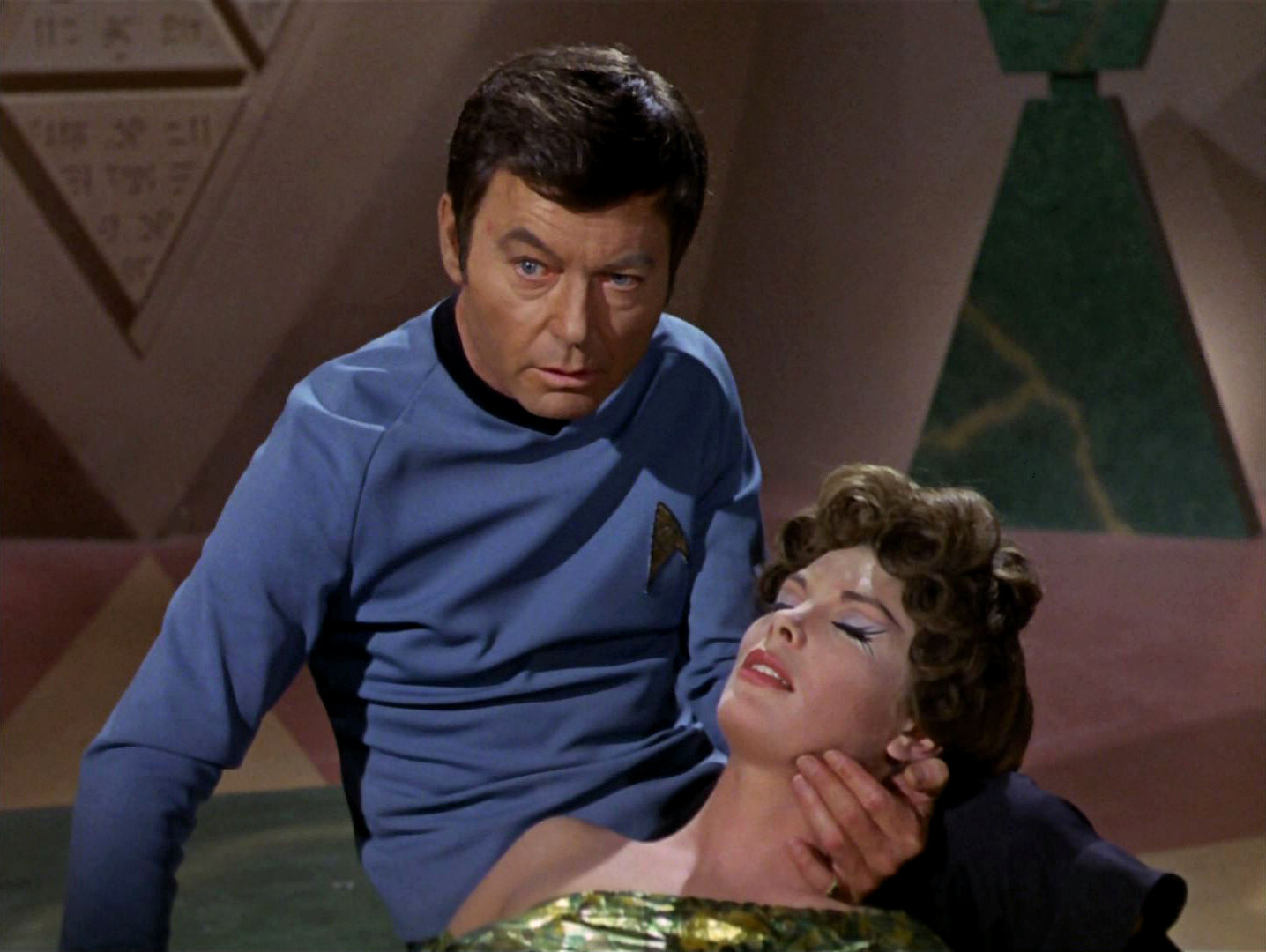
Stardate 5476.3: The Enterprise is attacked with ancient missiles, whose point of origin is an inhabited ship in the form of an asteroid. As the asteroid is on a collision course with the planet Daran V, Kirk and Spock beam down to warn the crew of the asteroid. McCoy insists on joining them, although he suffers from an incurable disease, xenopolycythemia, which leaves him just one year to live. It turns out that the inhabitants of the asteroid, Yonada, are not aware that they are on a ship, rather than on a planet. High Priestess Natira falls in love with McCoy. When Kirk and Spock are caught examining Yonada's "Oracle", they are due for execution, but McCoy convinces Natira to let them go, while he himself decides to spend the time that is left to him on Yonada. But soon he discovers a book of ancient knowledge and contacts the Enterprise. Kirk and Spock manage to gain access to the control room and correct the asteroid's course. And they also find a cure for McCoy in Yonada's databanks.
Review
Although we may know or believe to know a lot about Dr. McCoy today, we learned next to nothing personal about him during the three years of TOS. This episode is one of very few with the focus on McCoy. This fact alone makes the story at least as interesting as similar Kirk-centered ones, for instance "The Paradise Syndrome" earlier this season. The similarities to the latter episode are conspicuous: Just like Kirk as "Kirok", McCoy is now separated from the rest of the crew, while his two friends are struggling to save him and his guest world. Just as the Native Americans in the other episode, the inhabitants of Yonada are not aware of their true whereabouts, while an advanced computer system is guiding and protecting them without their knowledge.
However, there are unique qualities about "For the World is Hollow..." aside from McCoy's very personal involvement. It is the first time in Star Trek that we see some sort of generational ship. The story is overall plausible and without unlikely twists. Only the conclusion is too rushed, when Kirk and Spock bring the ship back on course as if they had never done anything else and, while they are at it, find a cure for McCoy too.
"For the World is Hollow..." is also a story about McCoy's friendship with Kirk and Spock, and how everyone cares for everyone else, even though they wouldn't always admit it. In one of the best scenes of the episode the three have been stunned by the Oracle. Spock and Kirk recover relatively fast while McCoy is still unconscious, so Kirk decides it is the time to let Spock in on the Doctor's secret. When McCoy wakes up too and is visibly weak, Spock instinctively grabs McCoy's shoulder. McCoy looks at Spock's hand in disbelief, and Kirk tells him "Spock knows."
Considering that this is his character's episode, I am not quite satisfied with DeForest Kelley's performance though. It is a bit too inhibited. He always gives us that same sad glance, somewhere between defiance and resignation. Well, I probably wouldn't look much different if I were in his situation, but I would have expected to see more and more different emotions from Kelley. Even as he is talking with the charming Natira, he is stuck with the pitiful facial expression.
Something I like is how Kirk discusses with Spock the implications of the Prime Directive, when it comes to revealing to the people of Yonada that they are on a spaceship. When Spock reminds him of the Prime Directive, Kirk interjects, "The people of Yonada may be changed by the knowledge, but it's better than exterminating them." I only wonder why Kirk doesn't proceed as he suggests, telling the people of Yonada everything in order to save them.
Annotations
- Remarkable dialogue: "Bones, this isn't a planet. It's a spaceship on a collision course with Daran V." - "I'm on a kind of a collision course myself, Jim." (Kirk and McCoy)
- Remarkable scene: There is one very unusual camera perspective. As everyone is walking down the staircase from the surface, we are looking at the room through the stairs.
- Remarkable sets: I like the writing and the symbols in the Yonada sets, especially the Oracle Room. The sets are among the best of the third season. The only exception is the control room, which doesn't look alien at all and could just as well be found on the Enterprise.
- Remarkable disease: xenopolycythemia (with polycythemia, an overproduction of red blood cells, being a real blood disease and "xeno-" obviously denoting an alien origin)
- Remarkable title: "For the World is Hollow and I Have Touched the Sky" is the longest title of any Star Trek episode of any series.
- Remastering: The asteroid Yonada was changed to look more like real-world asteroids.
Rating: 6
Day of the Dove
Synopsis
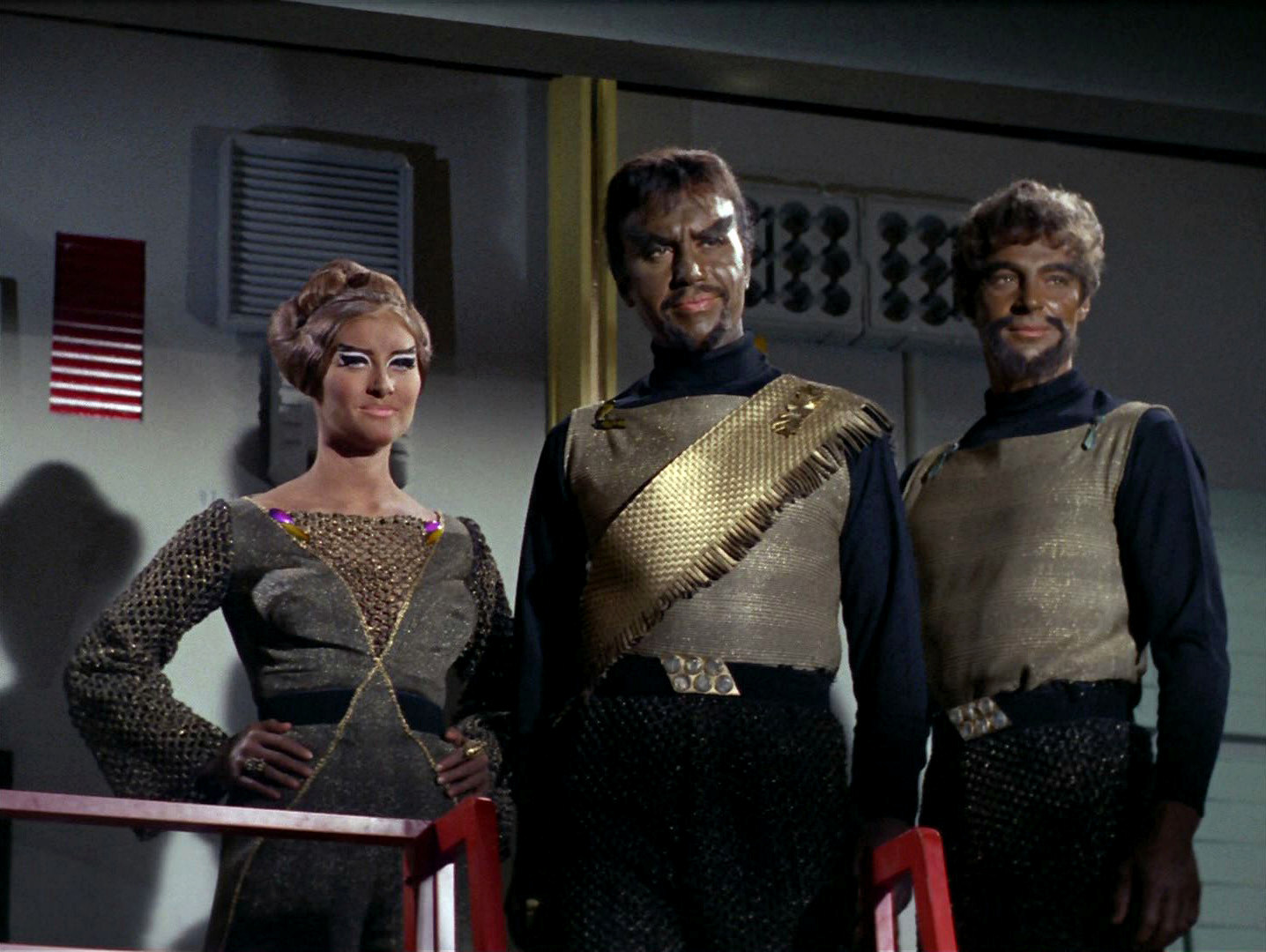
Stardate not given: The Enterprise receives a distress call from a human colony, but the landing party doesn't find any traces of it. Briefly later a badly damaged Klingon battlecruiser appears. Its commander Kang blames Kirk for the death of 400 members of his crew, just as Kirk makes the Klingons responsible for the destruction of the colony. The Klingon survivors are beamed to the Enterprise and confined. Strangely all phasers on the ship mutate to blade weapons, and some of the Enterprise crew and the Klingons are trapped in the upper sections of the ship. They engage in endless skirmishes that are pointless because all wounds heal rapidly, whereby the balance of power is maintained. It turns out that an entity composed of pure energy is catalyzing the fighting, because it lives on hatred. With the help of Mara, Kang's wife, Kirk can finally convince Kang to bury the hatchet, whereupon the entity leaves the ship.
Review
"Day of the Dove" is an overall entertaining episode with a mostly original plot. Unlike "Wolf in the Fold" and "And the Children Shall Lead" with their similar premises it consists of more than just clichés. Well, the story development and execution is rather bumpy and not everything that happens appears plausible. The idea of a lifeform consuming bad emotions is odd, and fortunately no one even tries to explain it. The agreement between Kang and Kirk in the end is exactly what I like about Star Trek, that a peaceful solution can be found, even though it boils down to defeating an odd alien lifeform as a common enemy here.
The Klingons are certainly the opponents of choice in this episode because the conflict with them has been previously established. Yet, the alien entity seems to be able to create hatred from nothing, as Chekov's delusions about his non-existent brother prove, and a Vulcan-human conflict between Spock and Scott is on the verge of breaking out as well. So ultimately the struggle could have been one between the Enterprise crew and any other aliens, or even among the crew. I am glad that it was Klingons though. Discounting a fake Kahless still to show up, this is the final appearance of Klingons in TOS, and arguably their most remarkable one because they are more than just the cruel conquerors in "Errand of Mercy" or the jerks in "Friday's Child" here, but people with an attitude, which becomes clear even though they are acting under the influence of the alien entity.
I am usually glad about Star Trek's lack of graphic violence, but in this episode it is inappropriate. The fight scenes have a good choreography and they would appear credible if the almost complete absence of blood didn't make them look like humans and Klingons were just doing sport fencing. Even when Chekov slays the Klingon with his sword, it remains totally clean. Sure, more blood wouldn't have been possible in a 1960s TV series, but it still doesn't feel right. The gender clichés are another issue that would be handled differently today. It is good to see Mara and another Klingon woman (briefly in the transporter room). But in the following Mara behaves exactly as a human woman was expected to in the 1960s, and is being treated accordingly. Chekov kills the male Klingon and spares Mara's life because he has a different interest in her. But the gallant Captain Kirk comes to her rescue. Even more obviously, as Kirk and Spock are walking into sickbay and through the corridors with her, Mara neither attempts to escape at any time, nor does any of the Starfleet crew attack her or only take offense by the presence of an enemy. Also, while Spock and Kirk are discussing the alien entity for several minutes, Mara remains silent and just listens all the time.
As for the characters, after "The Naked Time" it is the second occasion that many of them are totally on edge and act accordingly irrationally. I think the acting is overall quite fine. Well, and it was a great opportunity for Shatner to over-act. I love the scene on the bridge when he explains to Spock and Scott in a long monologue how the alien entity is driving them all crazy, quite visibly including himself. But other than that he of all crew members remains rather level-headed most of the time, and besides Spock he is the only one that can restrain his emotions, a cliché that is harked back to frequently since it was once established in "The Naked Time" and lately in "And the Children Shall Lead".
Speaking of clichés, I don't like at all that once again an alien force tampers with the propulsion system and brings the Enterprise on a course out of the galaxy (where the ship has gone several times before).
Annotations
- Continuity:
- One thing that has bothered many people in Trek fandom for many years is the location of engineering on the Enterprise. 400 crewmen of the Enterprise are trapped on the decks below engineering, but if engineering is somewhere in the secondary hull, it is hard to imagine that 400 people would incidentally be down there on the few remaining decks. Also, Spock reports that the Klingons "control deck six and starboard deck seven, while we control all sections above". So since Starfleet still controls engineering it can't be anywhere below these decks. Furthermore the alien entity can be seen entering engineering from a curved corridor as it should only exist in the saucer. On the other hand, in the end it exits engineering from the secondary hull.
- Kang says, "For three years, the Federation and the Klingon Empire have been at peace. A treaty we have honored to the letter." This refers to the Organian Peacy Treaty from TOS: "Errand of Mercy".
- Inconsistencies:
- After the great trick to suspend the transport of the Klingons, it is corny how easily three Enterprise security officers overwhelm five armed Klingons. At the very least, it should have been demonstrated that Scotty had disabled the disruptors in the transporter beam, but the Klingons are not even fast enough to try to use them.
- When Kirk wants to beam with Mara into engineering, why does he set the transporter set to automatic? Why doesn't Scotty simply come with them to the transporter room?
- Remarkable quote: "Four thousand throats may be cut in one night by a running man." (unnamed Klingon)
- Remarkable facts:
- 400 crewmen of the Klingon ship are dead according to Kang, and Mara mentions 40 survivors. This gives us a crew complement of 440 for the Klingon battlecruiser.
- Intra-ship beaming is established as dangerous here. This may have to do with the fact that normally the transporter beam uses certain channels into and out of the ship that would not be available if the destination is still inside the ship. But then beaming someone onto an alien ship or through solid walls of a building, as it is done frequently, would be just as risky.
- Remarkable false fact: Pavel Chekov mentions his brother Pyotr, who was allegedly killed in a Klingon attack on the outpost on Archanis IV. But according to Sulu he is an only child. There is also a small goof as Walter Koenig says "Pytor" when he mentions the brother the first time.
Rating: 6
Plato's Stepchildren
Synopsis
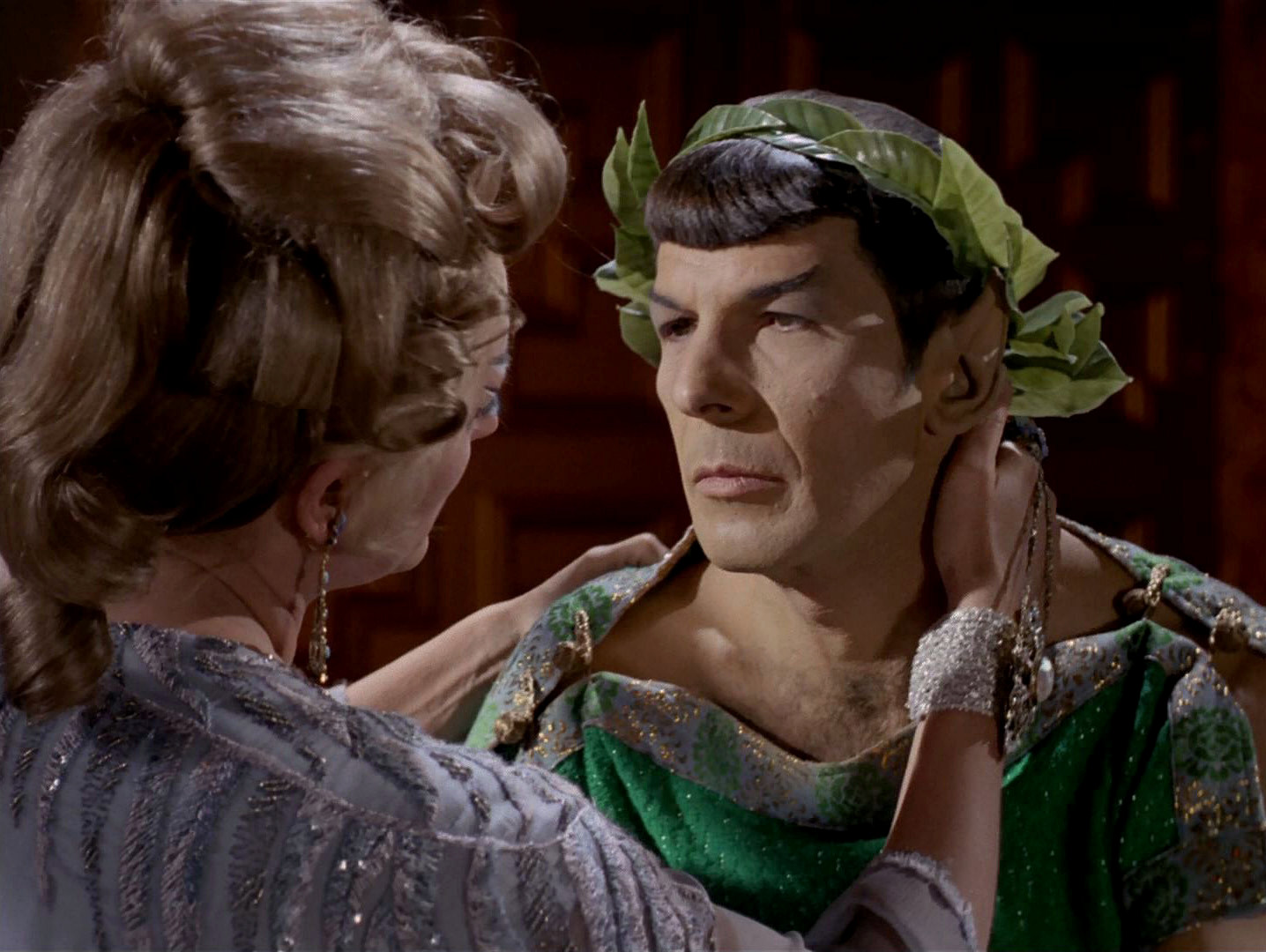
Stardate 5784.0: The Enterprise receives a distress call from a planet that was so far believed to be uninhabited. On the surface they are greeted by the short-statured slave Alexander. After McCoy has cured Parmen, the leader of the utopian society of Platonius, Parmen does not allow him to leave again. Using his enormous telekinetic powers he plays cruel games with Kirk and Spock and forces McCoy to watch everything. Kirk and Spock, however, find out that the telekinesis is not inherent to Parmen's race, but is caused by kironide, a substance found on the planet. As everyone can obtain these powers, the crew members eventually defeat Parmen with his own methods and leave together with Alexander.
Review
There is hardly anything original in the episode, considering how frequently superior aliens have already captured landing parties for their sadistic pleasure and usually threatened the ship as well with their powers while they were at it, as notably seen in "The Squire of Gothos", "Catspaw" or "The Gamesters of Triskelion". We've had tie-ins from Earth's history many times before, and "Who Mourns for Adonais?" in particular already featured a long-lived alien who wanted to revive the world of ancient Greece. There have also been more credible as well as funnier occasions in which the crew acted like clowns, whether willingly or not.
The story at least doesn't bother us with gratuitous revelations that the Platonians may have influenced Earth's development by posing as gods or famous historical figures. In fact, Alexander lays out almost the entire history of his people and their rather casual connection to Earth in a single minute in the teaser. This leaves the remaining time to tell the actual story. Unfortunately, that story consists of endless cruel yet silly games that the Platonians play with the crew, with very little reflection. Much of the episode is so cringeworthy that it is hard to endure, let alone enjoy. The scene in which Kirk plays horsey with Alexander on his back is the absolute low point, and it truly seems impossible for anything to be worse. Yet there is still plenty of runtime left, so the games drag on until the big reveal, which feels like a form of salvation for the viewer as well.
The only positive aspect of "Plato's Stepchildren", which comes far too late to matter much, is its message that all humanoids are created equal. The diminutive Alexander has been bullied by the arrogant members of Platonian society all along, yet in the end he proves to be just as powerful as they are. He turns out to be a positive surprise, even though he initially totally fits the old clichés of TV dwarfs. He is quite literally tossed around, and his character seems to exist mainly for comic relief, but he ultimately manages to break out of that role.
One could argue that the self-complacency of powerful alien beings is depicted here with unprecedented intensity. Whether intentional or not, the Platonians come across as pitiful in their decadence. They refer to their society at different times as a republic, a principality and a kingdom. Perhaps this confusion reflects their crude understanding of how a utopian society should function. It is doubtful that they still have any clear idea of what they are talking about. Rather than a king, prince, or president, Parmen is best described as a dictator. He says, "My dear Mister Spock, I admit that circumstances have forced us to make a few adaptations of Plato, but ours is the most democratic society conceivable. Anyone can, at any moment, be or do anything he wishes, even to becoming ruler of Platonius if his mind is strong enough." This statement moves from Plato's ideas about truth and justice through Darwinism to outright fascism in a single sentence. I may be reading too much into it, however, since the episode ultimately plays out as a farce concerned with exasperating games rather than serious political or philosophical ideas.
Finally, something that does not work at all is that the episode has no consequences and that Platonius remains a secret. The story carelessly establishes that a simple injection of the substance kironide, combined with certain natural hormones, grants telekinetic abilities - which will never be revisited. But perhaps it's for the best that later Trek simply forgets about this episode.
Annotations
- Remarkable quotes:
- "What would be better than a serenade from the laughing spaceman?" (Parmen, announcing Spock's singing)
- "For so long I've wanted to be close to you. Now all I want to crawl away and die." (Chapel, to Spock)
- "I have a little surprise for you. I'm bringing a visitor aboard." (Kirk, to Scotty, about Alexander)
- Remarkable sets: I like that the "ancient Greek" sets of the episode are not as sterile as on most other occasions in TOS.
- Remarkable fact: The Platonians are a result of an eugenics program on their home planet of Sahndara. They arrived on Platonius 2500 years ago and formed an utopian society numbering just 38.
- Remarkable kiss: "Plato's Stepchildren" is famous for featuring Kirk's and Uhura's "first interracial kiss" on television. However, more recent research shows that it had happened before. Anyway, even the racists who protested against it should have noticed it was a forced kiss. But if it helped at least a tiny bit to demonstrate that we are all created equal, the kiss didn't miss its point.
Rating: 1
Wink of an Eye
Synopsis
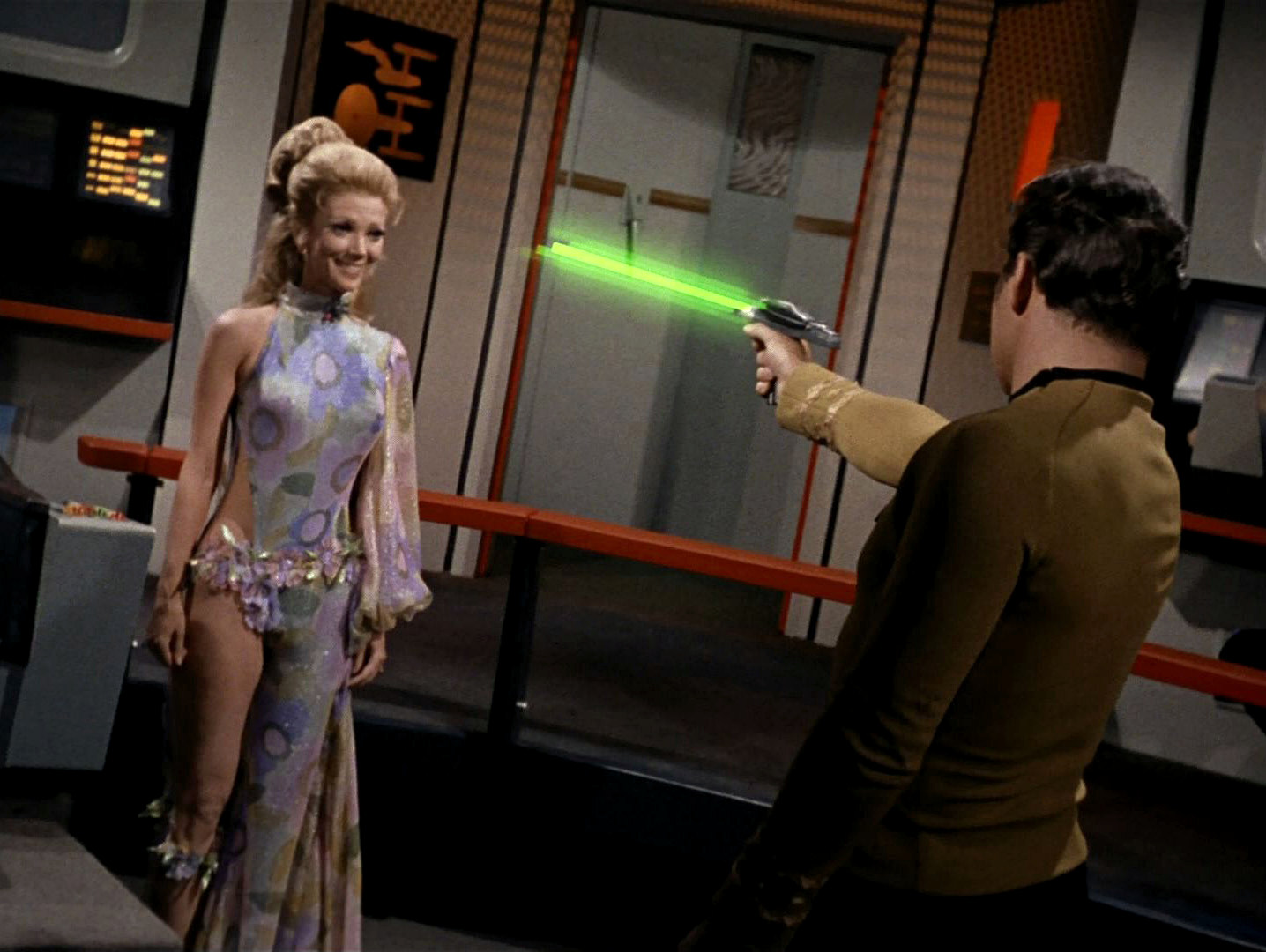
Stardate 5710.5: The Enterprise receives a distress call from the planet Scalos, but the landing party doesn't find anything but strange lifeform readings and the apparent sound of insects. Then one of the team, Compton, suddenly disappears. Upon the return of the landing party a series of malfunctions occurs on the ship. After drinking a coffee Kirk suddenly finds himself on an accelerated time level, where the Scalosian woman Deela welcomes him. The Scalosians are hyperaccelerated and sterile after a natural disaster on their planet, and they abduct outworlders to their time level in order to maintain their species. However, as the death of Compton drastically demonstrates, the accelerated outworlders easily die of cumulative cellular damage after the slightest injury. This is why the Scalosians plan to turn the Enterprise into a "deep freeze", to preserve the crew for their long-term demand. Kirk, however, manages to record a tape with a message that McCoy finds in his computer on the slow time level. He and Spock, who has discovered that the "insect" sound is accelerated speech, develop an antidote. Spock arrives on the accelerated level, where he and Kirk destroy the Scalosian installation. They send the Scalosians back to their planet. Kirk successfully tests the antidote, while Spock remains on the fast level to repair the ship quickly.
Review
I have a soft spot for stories about "weird science" that gets the crew into unusual situations. In this regard "Wink of an Eye" is a gem, perhaps even the most interesting episode of its kind in TOS, and definitely the best episode of the third season. Despite all its almost inevitable flaws it is pure intelligent science fiction, compelling and amusing at the same time.
There are a few points of criticism though. The Enterprise is hijacked by aliens like so many times before. And talking of clichés, it is once again Kirk who is immune to an alien temptation because he loves his ship more than anything else (more than the prospect of spending his life with the lovely Deela in this case).
The effects of the acceleration are impressively visualized as the non-accelerated actors are standing still (well, not perfectly motionless) and the camera is being tilted. In addition, there is the "buzzing insect" sound and the off-key trombone. All this creates an unusually eerie atmosphere, unlike in many episodes that were meant to be scary in very their premise but wound up as rather silly.
Rael, the leader of the Scalosians, is a rather uninspiring character, one who only wants to carry out his plan until he discovers that he is jealous about Kirk. He is much like Rojan in a similar situation in "By Any Other Name". Deela is much more interesting with her caprice and her continuing playful attempts to test and challenge Kirk. A refreshing change in the depiction of alien hijackers.
Annotations
- Remarkable dialogue: "His species is capable of much affection." - "I have noted that." - "I wonder if they will demonstrate it to us." (Deela and Rael)
- Remarkable quotes:
- "They all go so soon. I want to keep this one for a long time. He's pretty." (Deela about guess who)
- "I can think of nothing I'd rather do than stay with you. Except staying alive." (Kirk, to Deela)
- "I found it an accelerating experience." (Spock)
- Nitpicking:
- On a couple of occasions the crew seem to have problems with phenomena that should be rather simple to explain. For instance, after Compton has disappeared before his eye, McCoy says: "I was looking at him... and he just wasn't there." Wouldn't someone from the 23rd century rather assume that Compton was beamed away with an alien transporter? In the same vein, in the beginning everyone assumes that they are watching a live message from the Scalosians. Only after the landing party has returned without meeting anyone down there, Spock takes into consideration that it may have been pre-recorded.
- Isn't it quite ironical, if not an error in reasoning, that the accelerated Scalosians intend to keep the rest of the Enterprise crew in suspended animation for the future? Wouldn't it be absolutely sufficient to keep them as slow as they are anyway? Well, unless the lifespan of the Scalosians is about as long as ours, which would translate to a hundred million years of their time!
- Remarkable scene: We can see how Kirk is sitting on the bed, putting his boots on, while Deela is combing her hair. It apperas that something has happened between them that should not have been allowed to happen. At least not in the 1960s.
- Remarkable fact: Spock rates Scalos as a "7" on the industrial scale.
- Remastering: The matte painting for Scalos was originally re-used from Eminiar VII ("A Taste of Armageddon"). In the remastered episode this was fixed, and a new city was digitally created.
- Crew losses: 1
Rating: 8
That Which Survives
Synopsis
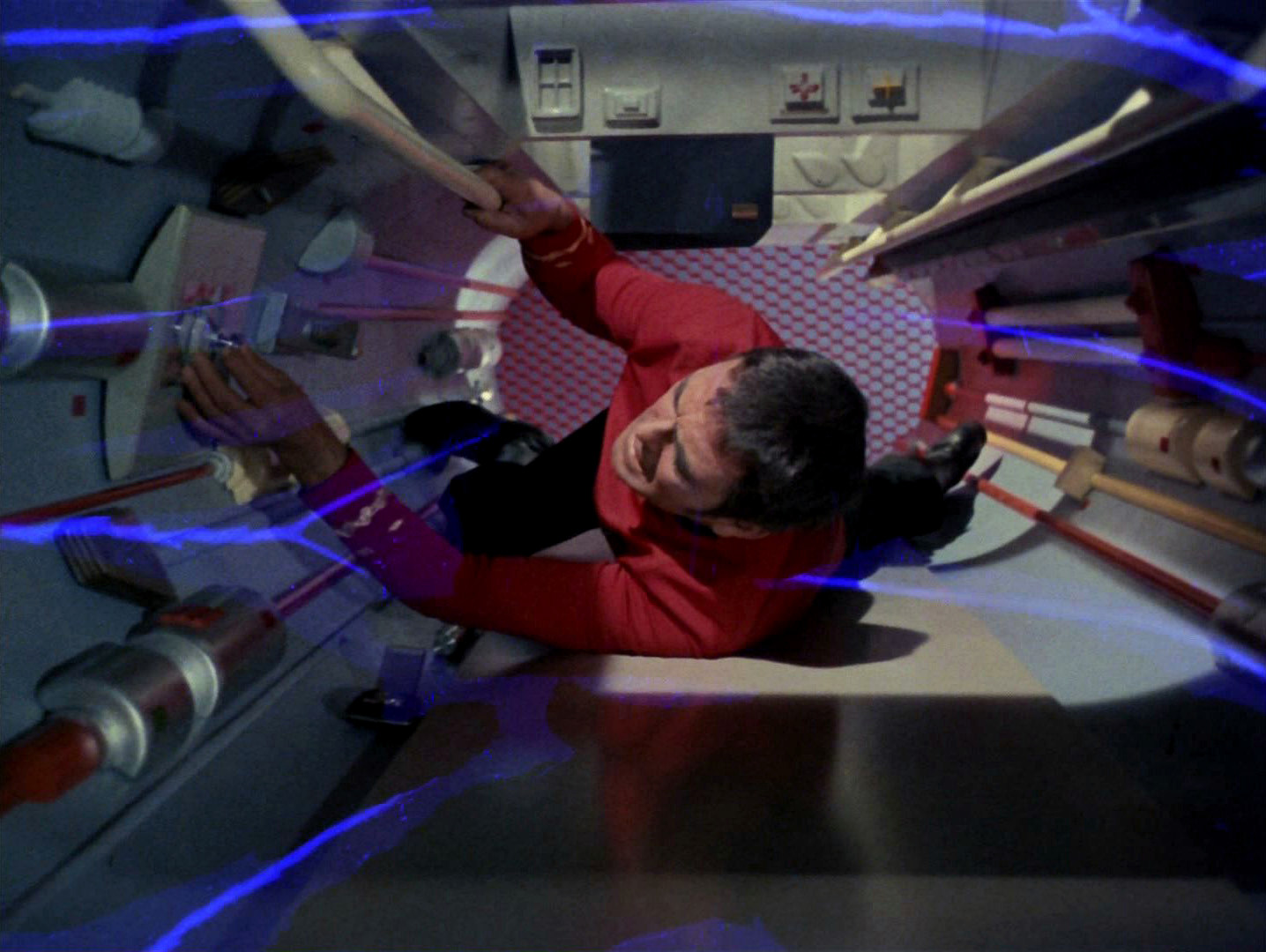
Stardate not given: After Kirk, McCoy, Sulu and the geologist D'Amato have beamed down to a seemingly uninhabited planet, the Enterprise is hurled away almost 1000 light years. While they are left on their own on the planet, a woman first comes and kills D'Amato, then reappears and hurts Sulu. Each time this woman called Losira appears, she is capable of killing just a single specific crew member. Meanwhile on the Enterprise, the woman has killed two more of the crew and sabotaged the ship's engines to blow up. In a race against time Scott and Spock manage to repair the damage. Kirk, McCoy and Sulu find the entrance to an underground habitat, where they are facing three copies of Losira, each programmed for one of them. Spock beams down with a security officer, who disables the computer that controls Losira. It turns out that the planet is an artificially constructed Kalandan outpost, whose population died long ago because of a deadly virus that may have been spread to other colonies and erased the civilization.
Review
This episode has its moments but it is built around an utterly pointless premise. "I am for you." This is only good for a melodramatic impact. It is a totally ineffective defense mechanism to program probes in the guise of the beautiful woman Losira to kill just a single predetermined invader at a time. It is made a big deal but will remain unanswered why the computer acts like this, and what could be gained by "matching the arrangement of chromosomes" of the victims. It is ludicrous how easily the otherwise enormously powerful probe can be stopped by those for whom it is not programmed with a minimum of physical force. And the resolution that Spock appears with a security officer and simply needs to destroy the computer is extremely disappointing. Spock says that the computer's "moves were immensely logical". I beg to disagree. It didn't make sense at any time.
There are a couple of redeeming factors though. The landing party's efforts to find ways to survive on the planet on their own are quite credible. As we wouldn't have otherwise expected, only the permanent cast members survive the encounter with Losira, but their mourning of D'Amato's death is fitting, considering how often crew members die and are not even casually commemorated in the end. I also like the interaction of Spock and Scott in their attempts to save the ship from blowing up. And the scene in which Scotty is working in the crawlway is one of the most thrilling in all of TOS.
Annotations
- Inconsistencies:
- Lt. Rahda, who has has taken over the helm from Sulu, appears to be awfully incompetent after the ship has been rocked. She first states that the planet is "gone" and some time later, almost casually, that the stars are "wrong". Since stars are a primary navigation reference, it shouldn't be too much to expect from her to 1) check the stars and hence the ship's position immediately after the planet has "gone", 2) to arrive at the conclusion that the ship must have moved, rather than the planet, and 3) not to hold back the calculated new position, some 1000 light years away, as improbable as it seems. At least she redeems herself when she has already plotted and laid in the course back to the planet before Spock orders it.
- At Warp 8.4 as established as in the episode, it would take the Enterprise a little more than two years to go back the 990.7 light years to the planet, not a few days or only hours.
- Scott says that the engines will blow up in 15 minutes and Spock corrects him, saying "I would calculate 14.87 minutes". Aside from that fact that insisting on a precise time of failure is unsound, how can he calculate anything at all, as he doesn't have any data?
- Continuity: Sulu mentions the silicon creatures on Janus VI (TOS: "Devil in the Dark") as examples for life that could exist on Losira's planet.
- Remarkable dialogues:
- "Once in Siberia there was a meteor so great that it flattened whole forests and was felt as far away as..." - "Mister Sulu, if I'd wanted a Russian history lesson, I'd have brought along Mister Chekov." (Sulu, referring to the Tunguska disaster of 1908, and Kirk)
- "What a terrible way to die." - "There are no good ways." (Sulu and Kirk)
- "You have eight minutes, forty one seconds." - "I know what time it is. I don't need a bloomin' cuckoo clock." (Spock and Scott)
- Remarkable effect: The "wavering rocks" effect, simulating the earthquake on the planet set, was nicely done.
- Remarkable fact: The Enterprise was displaced using a molecular transporter and is out of phase, and Scotty has the impression that "the ship feels wrong". This is why the magnetic flow increases as Scott is working in the crawlway, and Spock advises Scotty to reverse the polarity of his magnetic probe to compensate for it.
- Crew losses: 3
Rating: 2
Let That Be Your Last Battlefield
Synopsis
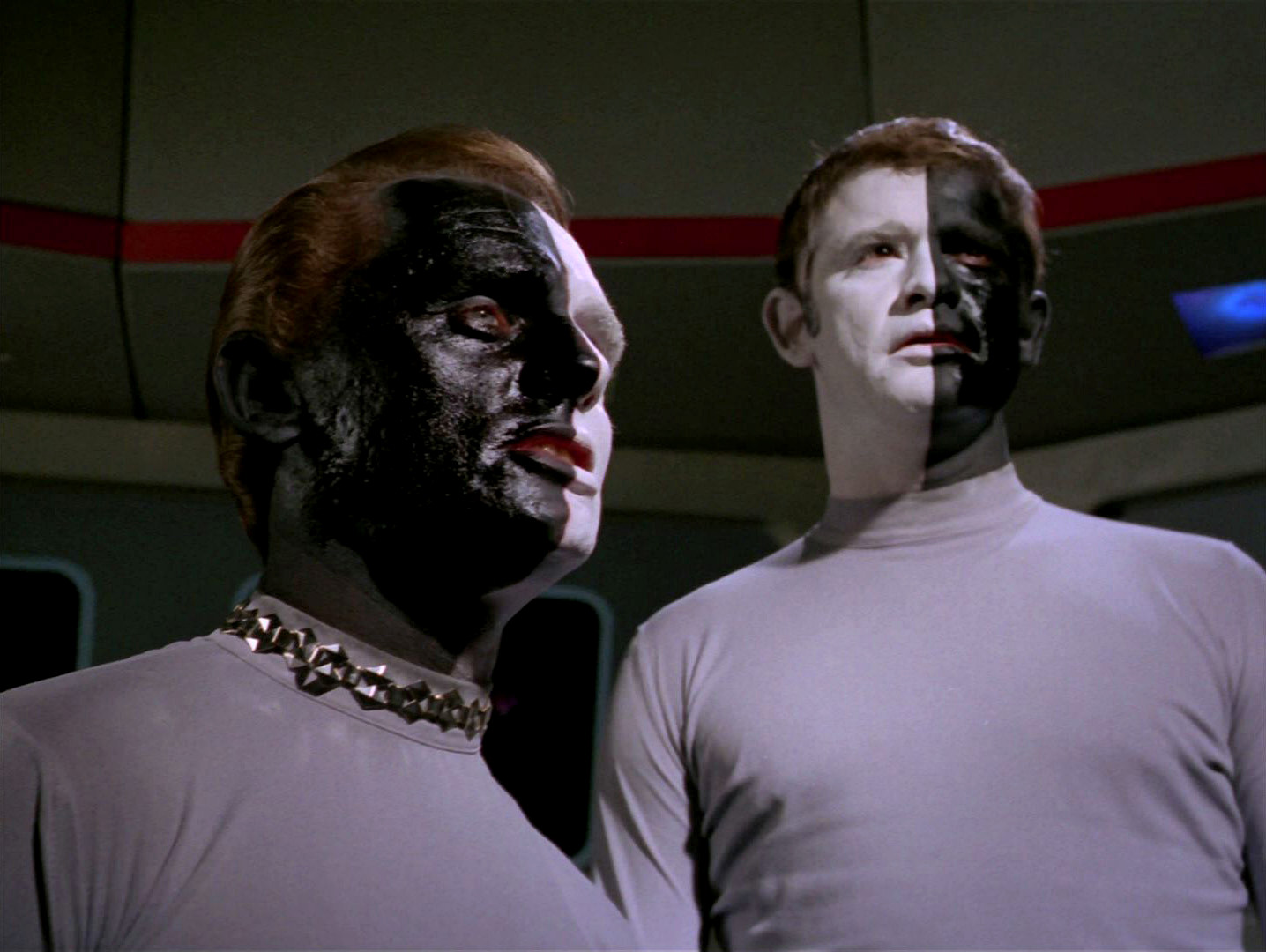
Stardate 5730.2: An alien with unique skin colors named Lokai is picked up by the Enterprise and requests political asylum. Briefly later Bele, obviously a member of the same species, appears on the ship and demands the extradition of the alleged criminal Lokai, which Kirk refuses. They are both natives of the planet Cheron, but it becomes obvious that Bele and Lokai despise each other mainly because of racial prejudices - with their difference boiling down to Bele having a white left half of his face and a black right half, while Lokai's face colors are reversed. When Bele takes control of the ship, Kirk threatens to self-destruct the Enterprise. After another sabotage by Bele the Enterprise finally arrives at Cheron to drop the two unpleasant guests. Their world, however, has been completely devastated as a result of their mutual hatred.
Review
The planet with two races who despise one another only because of opposite colors of their face halves (black/white vs. white/black) is a very clear allegory to present-day racism on Earth, especially since Lokai refers to his people as former slaves who may have been freed long ago but who were never given equal rights. In my view the analogy is a tad too obvious and the emotional side of their conflict is over the top. It would have been beneficial for the credibility of the episode if the two had been less obsessive, and their whole civilization likewise. And what is the deal with Bele chasing Lokai for as much as "50,000 of your terrestrial years", which is a big stretch where a much shorter time would have been absolutely sufficient? Finally, while their symbolic black-and-white faces are a key element of the episode, they look quite unrealistic.
I also have a small beef with how the story is set up. At first it seems that the biological aspect of how Lokai and later Bele can possibly have have two different face halves is the big deal, rather than their fanatical conduct. Especially the teaser, when the score ends with the usual dramatic fanfare as Lokai's face becomes fully visible for the first time, is misleading in this regard. Some time later in sickbay, when McCoy, Kirk and Spock marvel about the genetic miracle of a sharply divided face that they believe must be a mutation, it still seems that the episode deals with some sort of scientific phenomenon. I only wonder why no one cares to ask Lokai why he looks the way he does. Hence, the crew are very surprised when Bele appears, with exactly the same "mutation" as Lokai as it seems. In fact, Kirk and Spock are rather amazed about Bele's look than about a man that is suddenly standing on their bridge, defying the deflector shields! I always found this part of the plot absurd.
On the other hand, I like the already mentioned symbolism. Considering that Bele and Lokai look equally alien to everyone on the Enterprise, it is only fitting that a seemingly very small disparity that everyone else would overlook turns out to be the catalyst of the whole conflict. Just like present-day racism on Earth is based on trivialities.
The episode is successful in that it leaves us, the citizens of 23rd century Earth, with the question why all this could happen to a very old and extremely advanced civilization, and how it could have been averted. This is why the episode has grown on me, although the mere story never made too much sense and although everything the guest characters say and do comes across as stagy. Discounting a few overly solemn sermons by Bele and especially by Lokai, I think the dialogues of this episode are well-written. In particular Kirk does have a couple of excellent lines.
Annotations
- Remarkable dialogue: "You're from the planet Earth. There is no persecution on your planet." - "There was persecution on Earth once. I remember reading about it in my history class." (Lokai and Chekov)
- Remarkable error: Kirk mentions that Cheron is in an uncharted region of the galaxy. Bele's invisible and extremely fast vessel, besides other advanced technology like the personal shields and the way Bele controls the Enterprise with his mind, is clear evidence that the people of Cheron could reach Federation space without Starfleet being able to return the visit. Yet, towards the end of the episode the Enterprise travels from Ariannus to the unknown planet in no time.
- Remarkable scene: Kirk initiates the self-destruct in order to deter Bele from taking over the ship. The scene is excellently staged, with extreme close-ups on the involved characters. This gem of directing clearly makes up for the awkward pulsing camera zoom whenever the red alert lights are shown in this episode (as if the flashing light and the klaxon were not already dramatic enough).
Rating: 5
Whom Gods Destroy
Synopsis
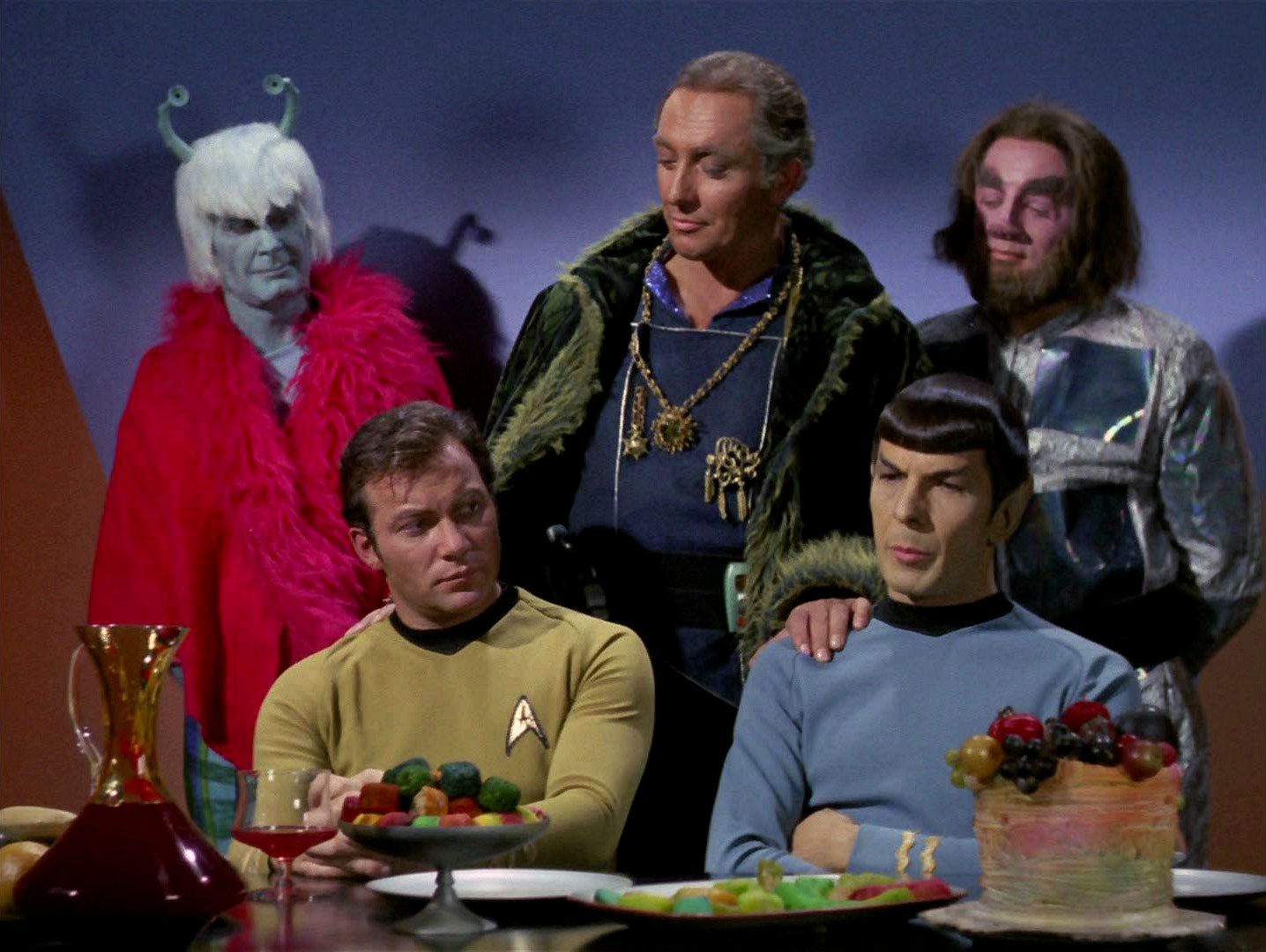
Stardate 5718.3: Kirk and Spock beam down to Elba II, a penal colony for the criminally insane, to deliver a medicine that could heal them. They are welcomed by Governor Cory, who leads them to a cell in which Governor Cory is being held as a prisoner! The wrong Cory turns out to be Captain Garth, who has acquired the ability of shapeshifting and who is leading a mutiny of the prisoners. Garth morphs to Captain Kirk, but he fails to fool Scott on the Enterprise, because he does not know the password. Garth tortures Cory and then Kirk himself to get the password, but in vain. His attempt to trick Kirk into revealing the password by morphing into Spock fails as well. After a bizarre "coronation ceremony" Garth demonstrates his power by killing his inmate Marta with a powerful explosive. Spock manages to escape from his cell, only to face two Kirks that both claim to be the right one. But he finally identifies Garth in disguise and stuns him with a phaser. The treatment of the prisoners with the new medicine proves to be almost immediately successful.
Review
"Whom Gods Destroy" fails because it is gradually turned into a complete farce, a story that is dominated by the nonsensical statements and actions of Garth. Unlike the equally farcical "I, Mudd", the ironical undertone is largely missing this time though, except in a couple of Spock's lines. The episode tries to be inappropriately serious.
Everything starts off as mildly entertaining when we discover that the man in the cell is obviously the same that just welcomed Kirk and Spock. Steve Ihnat is initially quite amusing as the overbearing and pompous "Lord Garth". After a couple of minutes, however, his character and also his play become boring, as Garth turns out to be a pitifully weak opponent. Perhaps most importantly the story fails to provide Garth with a genuine motivation. I was waiting for some trauma in his past to be revealed, as a possible reason for his insanity, something to create some sympathy with the villain. Especially when he and Kirk allude to an accident that happened prior to his stay on Antos IV, I would have expected to learn more about it. But the way it appears in the episode he just turned mad for unknown reasons, and it doesn't matter whether he always bore the trait or whether the accident or the treatment on Antos IV did something to him. This is most dissatisfactory.
"Whom Gods Destroy" also draws way too much on tropes rather than on intelligent original concepts. Horrors in a mental institution (as in "Dagger of the Mind" from where it borrowed a lot more than just the console of the torturing device), revolutionary medicines with almost immediate effects, high-ranking Starfleet officers who go mad, villains who use Kirk doubles, villains who send a woman to infatuate Kirk, villains who set out to conquer the universe, we've had it all before. In addition, although it is not a trope, there is the "most powerful explosive of the universe" as an extremely lame plot device that comes to play only once to demonstrate Garth's power when he blows up poor Marta.
There are a couple of things I unequivocally enjoy about this episode, however. Spock's wry responses to Garth's hollow threats are priceless. I also like the cat-like movements of Yvonne Craig as Marta very much, as they perfectly emphasize the capricious nature of her character, although I have to say that Marta is overall too cartoonish for Star Trek. Marta is the first Orion character since Vina in "The Cage" and the first real one. On a technical side note, as if the green Orion make-up were not sufficient, Marta is additionally illuminated green much of the time, except when she is standing beside someone else.
Annotations
- Nitpicking:
- Why isn't McCoy or anyone of his staff in the landing party when the mission is to deliver a medicine? Interestingly, McCoy didn't beam down to Tantalus either in TOS: "Dagger of the Mind", but that was because he had an argument with Kirk about Dr. Adams's methods.
- Since when have Kirk and Scotty agreed upon a password for the case that Kirk demands to be beamed up? It is the first and also the last time.
- What happened to Cory's staff? It is never mentioned.
- How could Garth "learn" shapeshifting? Perhaps the people of Antos IV did something to his physiology, or they equipped him with a device that changes his cellular structure. But either manipulation should have been discovered in an examination.
- The "most powerful explosive" should have been discovered too. Where could Garth possibly hide it, without the danger of blowing up himself and the whole planet any time? Also, Alfred Nobel earned a fortune by developing dynamite as a replacement for the highly hazardous nitroglycerine. Something like Garth's explosive can't possibly have much practical use.
- Remarkable quote: "It is somewhat reminiscent of the dances that Vulcan children do in nursery school." (Spock)
- Remarkable scene: The Andorian and the Tellarite drag the seemingly unconscious Spock off his cell. Then Spock quickly gets on his feet and stuns them both with a neck pinch.
- Remarkable costume: We see the spacesuits from "The Tholian Web" again, when two of Garth's thugs take Marta outside the dome into the poisonous atmosphere.
- Remarkable reaction: The BBC did not air this episode until 1994, due to the unusual graphic violence when Garth blows up Marta.
Rating: 2
The Mark of Gideon
Synopsis
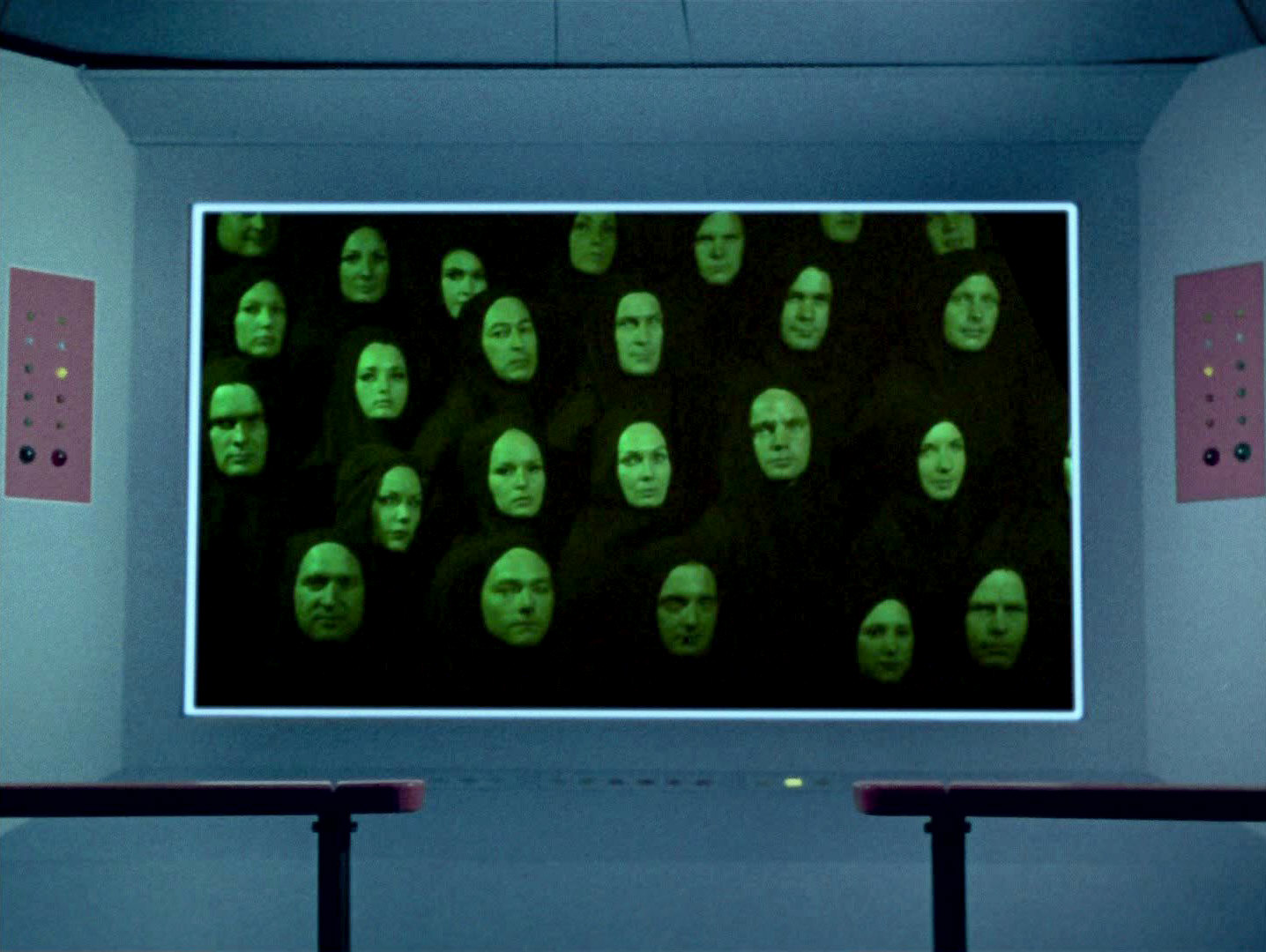
Stardate 5423.4: Kirk is going to beam down to the isolationist planet of Gideon, but instead of the ground he materializes on a totally unmanned Enterprise. Moreover, he lost nine minutes in which he obviously bruised his arm. Kirk meets an apparently confused woman named Odona who too was transferred to the empty Enterprise. As Kirk gets closer to Odona, he notices that they are being watched. He is not on the Enterprise, but on a perfect replica of the ship. It was built for the sole purpose to bring Kirk and Odona together, to infect her with the deadly Vegan choriomeningitis, whose virus Kirk is carrying. Gideon is hopelessly overpopulated, and by introducing an illness Hodin, the council leader and Odona's father, hopes to ease the situation. Meanwhile Spock has defied orders from his superiors and Hodin's warning and has beamed down to search the captain. He beams back with Kirk and Odona, and McCoy successfully treats her infection. Odona, however, is now carrying the virus and still hopes to "help" her people by spreading it.
Review
The beginning of this episode is quite promising, as Kirk is beamed aboard an empty Enterprise and is trying to find first his crew and then a reasonable explanation for the phenomenon. The story, however, loses a lot of steam after the first excitement. I don't think this is primarily due to the unusually slow pace of this episode, which is pleasantly free of gratuitous action. Actually, I like how the characters reflect about the situation the way Kirk is doing while he is alone on the Enterprise, and Spock and the rest of the bridge crew when are trying to find him and struggling against Starfleet bureaucracy and Gideon's diplomacy. The main reason why this episode doesn't work very well is the contrived setup. It is cliché time as it becomes clear that Kirk, and only Kirk, has been isolated by those aliens with an attractive woman as a bait. And this is rather uninspiring, even though the reason for the scheme is yet to be revealed.
The perhaps most remarkable aspect of the episode is its clear statement that birth control may be necessary to prevent overpopulation, in contrast to the doctrines of conservative circles around the world and in particular of the Catholic clergy. The problem on Gideon is certainly much more pressing because there is literally no room for its inhabitants, while in Earth's development countries there is primarily "only" a problem of feeding the ever growing population. Also, on Gideon the ethical principles are twisted if the population honestly thinks that contraception is evil but that it would be in order or even desirable to die at the age of only twenty, as Kirk correctly criticizes. On the other hand, perhaps only Hodin and Odona's stance is so extreme, and the majority of the people on Gideon would love to change something about their situation without suffering and premature deaths. Perhaps no one of the elite has ever asked them whether they want to die painfully from a virus infection?
Annotations
- Nitpicking: I have absolutely no idea why the colossal effort to build a replica of the ship was deemed necessary, so incredibly perfect that Kirk never noticed the slightest inconsistency. The Gideons could have transferred Kirk to any other place where he was alone with Odona or with anyone else who wanted to get the infection. Moreover, how could they acquire all the plans to build the ship, for it should be classified information and the Gideons are definitely not omnipotent? Finally, I wonder how overpopulated the planet actually is. The episode gives the impression there is so little room for the inhabitants that they are crowded together even directly around the Enterprise imitation. Even if diseases and crime were eradicated in their society, all food supplies and other resources would be gone long before such a state could be reached, also in a technologically very advanced civilization.
- Remarkable quotes:
- "There was considerable interference with your transmission. A lot of noise drowned out." (Hodin, the "noise" being criticism directed at him from Scott, Uhura and McCoy)
- "Your Excellency, please do not interfere. I already have one serious problem to resolve with upper echelons." (Spock, as he beams up with Kirk and Odona and without permission from Hodin)
Rating: 4
The Lights of Zetar
Synopsis
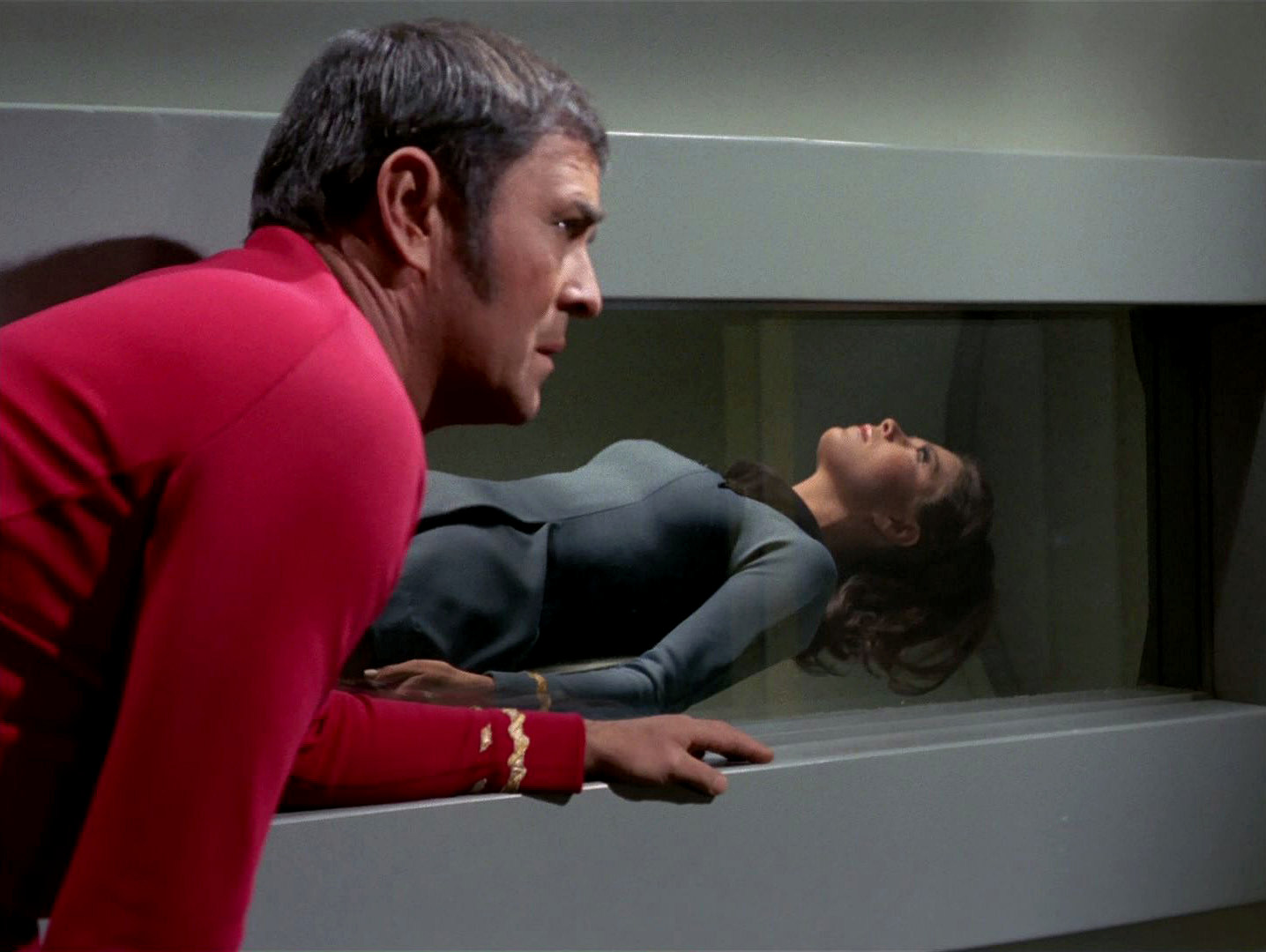
Stardate 5725.3: A strange energy storm first attacks the ship, then alters course and kills the personnel of the databank of Memory Alpha. Lt. Mira Romaine, Scotty's love interest, who inexplicably passed out during the first attack, predicts the return of the phenomenon before the Enterprise's sensors are able to locate it. McCoy and Spock's investigation comes to the result that the storm consists of ten distinct lifeforms, who are seeking to occupy Mira Romaine's body that they deem most compatible. The storm eventually penetrates the ship's shields and the aliens, survivors of the dead planet of Zetar, take possession of Mira Romaine. She is taken into a pressure chamber, creating a condition that kills the aliens.
Review
"The Lights of Zetar" is one of the better stories about shapeless alien clouds or energy entities, which used to show up every few weeks since the second season. One distinguishing mark is that this time the aliens are not the embodiment of plain evil such as in "Wolf in the Fold", "Obsession", "And the Children Shall Lead" or "Day of the Dove". Unlike on other occasions, Kirk first orders to evade the Zetarians, then attempts a negotiation, followed by a shot across the bow. Locking the phasers on the target is only a last resort. Well, it may have been a more conciliatory ending if the Zetarians had not simply been killed, but if a way had been found to give them something in exchange for leaving Mira Romaine's body. Also, it may have been a better episode without two overused clichés. I think it would have absolutely sufficed to get just Mira Romaine in trouble, instead of having the aliens first kill everyone on the outpost an then threaten the entire ship.
Some limited sympathy is created with the Zetarians. They have a motivation to live in a body again, and they voice it when they have the chance while they are occupying Mira Romaine's body. A discussion with Kirk ensues whether they would be allowed to destroy another life in order to regain their bodies. Well, this is much as already seen in "Return to Tomorrow" though, so it doesn't come as a real surprise.
The perhaps most noteworthy thing to remember about the episode is that it is one of the few times that Scotty plays an important part in the series, one that exceeds his role of an engineer. While I don't begrudge him the little love affair, his affection towards Mira Romaine comes across as rather clumsy though. Scotty is protective of her all the time and attempts to be gallant. But what we see is a nice uncle of forty-something who stimulates a woman of twenty-something with his sturdy charm. I'm missing the passion in it. Well, for once he does seem to have success with a woman, after the previous bad experiences in "Who Mourns for Adonais?" and "Wolf in the Fold".
Regarding Mira Romaine, I could have imagined her as a new permanent cast member. She would have had the potential, seeing how defiantly she reacted when McCoy first examined her, and that in the end everyone attested her that she had fought well against the intruders in her body. Aside from the occasional fainting her role was pleasantly devoid of the usual gender clichés of the series.
Annotations
- Nitpicking:
- Kirk says that "no natural phenomena can move faster than the speed of light." Are Redjac from "Wolf in the Fold" or the cloud from "Obsession" unnatural? It is a moot point what can be classified as "natural", but clearly no one has "constructed" these lifeforms.
- Mira and Scotty make it a big deal that she saw him dying in one of her precognitions. I was waiting in vain for this situation to come about, and for the explanation why Scott wouldn't actually die. But all that happened was that Scotty was tossed across the floor by the Zetarians.
- Remarkable error: In contrast to what the computers states, no two measured samples can be absolutely identical. It is a physical impossibility. If they seem identical, then the measurement accuracy must be far from sufficient to allow such a statement in the first place. If anything, the emissions of the energy lifeforms and Mira Romaine's brain patterns may be a close match.
- Remarkable quote: "Well, I'm relieved to hear your prognosis, Mister Scott. Is the doctor there with you, or will I find him in engineering?" (Kirk, to Scott, who is watching over Mira in sickbay)
- Remarkable sets:
- I like the pressure chamber very much. It is one of the most realistic sets of TOS, and it is a pity that it wasn't used more often (perhaps in slightly differing roles) than in "Space Seed" and "The Lights of Zetar".
- It is the last time in the series that we see the emergency manual monitor, the area on the upper level of engineering.
- Remarkable facts: McCoy reads Mira Romaine's bio: "Romaine, Mira. Lieutenant. Place of birth: Martian Colony Number Three. Parents: Lydia Romaine, deceased. Jacques Romaine, chief engineer, Starfleet, retired."
Rating: 4
The Cloud Minders
Synopsis

Stardate 5818.4: The planet Ardana is home to the wealthy and friendly city of Stratos that is floating above the clouds, but also to the underdeveloped and aggressive miners known as Troglytes. As the Enterprise arrives at the planet to pick up an urgently needed shipment of the rare mineral zenite, the Troglyte "Disrupters", who demand equal rights for everyone, hold it back. Kirk accepts High Adviser Plasus's invitation to Stratos, where he is attacked by Vanna, one of the Disrupters. He later helps her escape because he disapproves of Plasus's methods to make her talk. And he offers her a mask that would filter out the gas in the mines that is holding back the mental development of the Troglytes. But instead of leading him to the zenite, Vanna and her people take Kirk as a hostage. When Kirk gains the upper hand again, he orders Plasus to be beamed down to witness the effects of the gas himself. The Troglytes eventually hand out the zenite, and Kirk urges Plasus to implement social reforms, if necessary under the auspices of the Federation.
Review
Class conflict in space! Karl Marx would have been proud of the makers of Star Trek. Well, the episode avoids specific references to Earth's history, but the phrases that the Troglyte "Disrupters" are using are reminiscent of those of 20th century communists. Moreover, the Disrupters seem to be a rather small intellectual elite among their people. Other than that, their movement may just as well symbolize the struggle to liberate the slaves on 19th century Earth. The episode is full of symbolism anyway, the most obvious being the location of Stratos on "Cloud Nine", while the Troglytes (derived from Greek troglodytes = cave dwellers) are confined to their caves. It would have been a tad more credible if the people from Stratos hadn't been so awfully self-complacent and the miners somewhat less rebellious. But especially the depiction of Plasus serves to expose his hypocrisy. For instance, his daughter makes a naive claim that there is no violence on Stratos, and in the very next scene we see how he tortures the Disrupter Vanna.
The perhaps biggest mistake of the episode is that it heavily relies on plot devices. The first one is the zenite, a substance that is needed to avert a planet-wide disaster, has to be delivered within just a few hours and is available only on Ardana. I could easily imagine that the plot may have worked without the urgently needed zenite. Not only would it have been more credible, it would also have involved the crew more personally, because they couldn't simply hide their actions behind the noble goal to avert a disaster. The second plot device is the gas mask, or more precisely the suddenly discovered effect of the gas that has impaired the Troglytes' mental development for centuries and for which there is now a remedy. The only beneficial effect of the discovery pertaining to the plot is that Kirk has something to offer in return to the Troglytes in the form of the masks. But other than that it should rather aggravate the situation on the planet. Would the Troglytes further work in the caves, with or without masks, with the knowledge that it is so harmful? With all Troglytes suddenly becoming more intelligible, wouldn't they likely do much more than just issue a few demands? And would Plasus really change his mind about the Troglytes, now that he knows that they are not really inferior to his people? Wouldn't he rather rate them as even more dangerous? In my view the planet is on the verge of a civil war after Kirk's interference, or should be realistically. And finally the effect of the gas provides a retroactive reason or even justification for the discrimination of the Troglytes by the people of Stratos.
Droxine is an annoying character from the start. The mere sound of her voice annoys me. Droxine is more naive than even the women in "Spock's Brain". She doesn't seem to understand at all what is going on on her planet. And perhaps she never wanted to understand in the first place how her society works. I was only waiting for her to carry along a chihuahua or say something like "If they don't have bread let them eat cake". Well, I have to admit that her character is set up nicely though, because at one point she calls into question the methods of her father: "Father, are we so sure of our methods that we never question what we do?" She shows that she is not quite that stupid after all. But this is her only bright moment in the whole episode; she doesn't contribute anything to convince her father to change something on Ardana except for her idea to visit the mines. I really wonder why Spock of all people should feel in any way attracted to this Paris Hilton of space.
Annotations
- Nitpicking: So Ardana is a member of the Federation, although it doesn't even grant equal rights to all of its citizens?
- Remarkable quotes:
- "This troubled planet is a place of the most violent contrasts. Those who receive the rewards are totally separated from those who shoulder the burdens. It is not a wise leadership. Here on Stratos, everything is incomparably beautiful and pleasant. The High Adviser's charming daughter Droxine particularly so. The name Droxine seems appropriate for her. I wonder, can she retain such purity and sweetness of mind and be aware of the life of the people on the surface of the planet? There, the harsh life in the mines is instilling the people with a bitter hatred. The young girl who led the attack against us when we beamed down was filled with the violence of desperation. If the lovely Droxine knew of the young miner's misery, I wonder how the knowledge would affect her." (Spock)
- "No, I wasn't thinking of Captain Kirk. It's the one with those exquisitely shaped ears. His name is Spock. He's the one I was thinking about. Did you know that he has the most incredibly sensitive hearing? Why, I almost believe that if I stood here and called out to him, he would hear my invitation to come and visit with us for a little while longer." (Droxine)
- Remarkable scene: Early satellite photos of Earth are used to for the view of the planet from Stratos. Impressive.
- Remarkable sets: I really like the work of the set builders. They took the chance to make Stratos something special also from the inside, with various pieces of art instead of just the usual gray walls with colorful illumination.
- Remastering: This is arguably one of the episodes that profited most from the remastering, even though it concerns only a few shots. The views of the refined city are among the most spectacular in the whole series.
Rating: 4
The Way to Eden
Synopsis
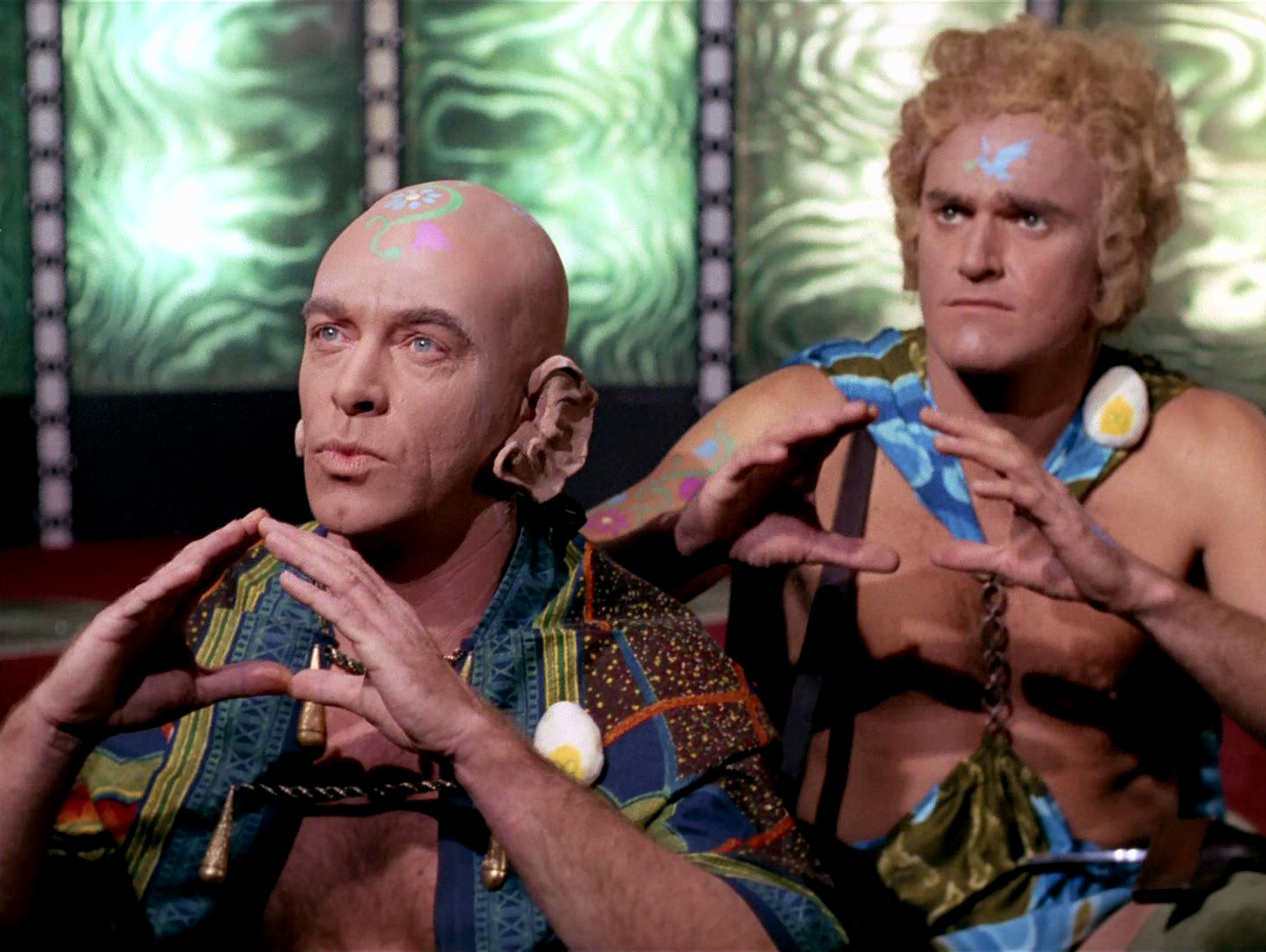
Stardate 5832.3: The Enterprise rescues a group of six "hippies" led by Dr. Sevrin from a stolen ship whose engines they have unwisely overloaded. Kirk is advised to bear with the behavior of the group, as the son of the Catullan Ambassador is among them. Spock establishes a dialogue with the group, in particular with the musician Adam. The hippies hope to find a planet called "Eden" where they plan to lead a simple and peaceful life, and Spock locates that planet for them. Chekov discovers that his former girl-friend Irina belongs to the group too, and inadvertently helps them to hijack the ship when he shows her the auxiliary controls. Once they arrive at Eden, Sevrin and his people disable the crew with ultrasonic sound. They find a world where everything is beautiful but poisonous. Adam eats an indigenous fruit that kills him, and when a landing party beams down to rescue the rest of the group, the obviously insane Sevrin commits suicide when he bites into a fruit too.
Review
Many fans dislike "The Way to Eden" for the anachronism of "space hippies", for the almost unabashed Flower Power style of clothes, customs, language and music of Dr. Sevrin's movement that should have no place in a science fiction series. But hey, I learned in this episode what a sit-in means! And I find parts of it rather entertaining, such as the songs and particularly Spock's session with the hippies. Anyway, the hippie style is one of the few distinguishing marks of the episode that otherwise rehashes all the common motives. Once again the crew is struggling against an insane opponent, once again the ship is hijacked with ridiculous ease, once again there is the danger of running into the Romulans, and once again an ostensible paradise turns out to be poisonous (as already in "This Side of the Paradise" and "The Apple"). The idea of the planet Eden that is only a myth but can be located by Spock nonetheless after a little bit of research is utterly incredible anyway.
The only really interesting aspect is how Spock can "reach" the hippies, unlike Kirk who quickly earns the unfavorable nickname "Herbert". Spock almost appears as a proponent of a counter-culture here, but in my view this does not really comply with the role he is generally playing in TOS. On many occasions Kirk is the more open-minded person, while Spock is bound to his uncompromising logic. Actually, I think Spock of all crew members should realistically have difficulties to understand the desires of the hippies. The mere fact that he has a complicated and somehow "colorful" heritage doesn't make him a natural ally of dissenters, although I concede he was pressed into that role just as Kirk was quickly and wrongly labeled as an unimaginative person. At least Spock's friendship with the musician Adam, who tragically dies eating from a "forbidden fruit" on Eden, appears to be genuine. When McCoy has testified his death, Spock notes with an unusual air of sadness, "His name was Adam."
While it is nice that Pavel Chekov is being personally involved (replacing Captain Kirk who is customarily the one who has met anyone who's out in space before), his interaction with his former fellow cadet and lover Irina is corny. His permanent talking about his duty and his open disapproval of the different path that Irina has chosen makes him appear very stiff, and much more so than Captain Kirk.
Annotations
- Nitpicking:
- Neither the holding cell nor the auxiliary control are secured in any fashion, such as by simple access codes.
- The hippies agree that sound "beyond the ultrasonic" doesn't simply stun but destroys (which is scientific nonsense, of course). They don't mind using it against the crew though. But although Kirk deactivates the sound as late as the hippies have long left the ship, no one seems to retain a permanent damage. So the sound just stunned everyone in spite of all the fuss about it? And if it is so easy to stun the complete crew, why wasn't it done on dozens of occasions when it would have been a great opportunity either for intruders or for the crew to gain control of the ship?
- What happened to the Romulans? The last three times a Federation ship crossed the Neutral Zone, they showed up almost immediately and were not open to negotiations. Kirk takes the threat way too easy this time, when he beams down to care about the hippies, rather than about his ship.
- The planet Eden is said to have no animal life, but the colorful flowers indicate that there should be something like insects.
- Remarkable quotes:
- "There are many who are uncomfortable with what we have created. It is almost a biological rebellion. A profound revulsion against the planned communities, the programming, the sterilized, artfully balanced atmospheres. They hunger for an Eden where spring comes." (Spock)
- "Gonna crack my knuckles and jump for joy. I got a clean bill of health from Doctor McCoy." (Adam)
- "This stuff you breathe, this stuff you live in, the shields of artificial atmosphere that we have layered about every planet. The programs in those computers that run your ship and your lives for you, they bred what my body carries. That's what your science have done to me. You've infected me. Only the primitives can cleanse me. I cannot purge myself until I am among them. Only their way of living is right. I must go to them." (Sevrin)
- "Miss Galliulin. It is my sincere wish that you do not give up your search for Eden. I have no doubt but that you will find it, or make it yourselves." (Spock)
- Remarkable absence: Uhura is not in this episode and is replaced with Lt. Palmer.
- Remarkable shuttle: The shuttlecraft was relabeled "Galileo II" for this episode, finally acknowledging that the original Galileo and even its successor of the same name had been destroyed.
- Remastering: In TOS-R, the modified Tholian ship that represented the Aurora was replaced with a more fitting Federation-like design.
Rating: 2
Requiem for Methuselah
Synopsis

Stardate 5843.7: The Rigelian fever has broken out on the Enterprise. Kirk, Spock and McCoy beam down to Holberg 917-G to find ryetalyn, the only known basis for an antidote. The planet's sole resident is a man named Flint, and despite his initial hostility he agrees to let his robot M-4 collect and synthesize the ryetalyn. He invites the landing party to his house and introduces them to his foster daughter Rayna Kapec. Rayna feels attracted to Kirk, and while he returns her feelings he also feels that something is wrong and that Flint deliberately defers the delivery of the antidote. What's more, Spock discovers that Flint possesses previously unknown works of Leonardo da Vinci and Johannes Brahms and that the man is probably around 6000 years old. When the ryetalyn is ready, the landing party discovers a lab with android bodies, all copies of Rayna. Rayna is an android, and the immortal Flint used Kirk to let her emotions come to life. However, as Kirk and Flint are struggling for the welfare of Rayna, she dies of her inner conflict. Dr. McCoy successfully stops the epidemic. He also finds out that Flint is subjected to normal aging again since he has left Earth. As Kirk is suffering from the loss of Rayna, Spock decides to ease the captain's pain with a mind-meld.
Review
To start with, this episode could have been so much better without the urgency to obtain the ryetalyn from Flint. Considering that we are never even shown anyone of the infected crew members, the whole fuss about the situation on the Enterprise is quite contrived. What's more, instead of tending to his many patients the ship's chief medical officer has apparently nothing better to do in this crisis than hanging around and drinking brandy supervising the refinement of the ryetalin, which Spock or a qualified assistant could have done as well. Why couldn't the Enterprise simply run into Flint's planet by pure chance? This would also have given Kirk and Rayna more time than just two hours(!) to build a more credible emotional attachment.
Flint's enormously powerful robot M-4 is just one more unnecessary plot device, especially since it looks and acts almost exactly as Nomad in "The Changeling". And the trick with the Enterprise as a voodoo miniature is much the same as already in "Catspaw" (I liked seeing the 3ft model on the desk though). Isn't it astonishing enough that Flint is 6000 years old, that he has influenced Earth's history and created countless works of art under various identities and that he has built a perfect android with all the body functions of a human being?
Aside from all these attempts to sidetrack the story, "Requiem for Methuselah" sort of continues where "What are Little Girls Made of?" ended. The first-season episode was overburdened with discussions about androids and their dangers, how they outperform human beings, and how they could eventually replace or even destroy humanity. The approach of "Requiem for Methuselah?" is more subtle, as it focuses on the question whether androids that are created exactly like human beings can ultimately become human beings, by acquiring a free will and true emotions. Unfortunately it is not until the final couple of minutes that this question is posed. And, perhaps more importantly, the question whether Rayna would be free to decide about her life once it holds true. But then an awkward brawl between Flint and Kirk ensues, and it kills not only Rayna but also the ambition to make a decent episode about androids. At least Rayna's tragic fate gives the episode back some profundity and originality. Her death bears traits of more or less illogical self-destructive tendencies of humans, of the kind that machines are just not supposed to exhibit, and hence proves that she was more than just an android. I also like how Spock relieves Kirk's pain through a mind-meld.
Annotations
- Remarkable quote: "She loved you, Captain. And you, too, Mr. Flint, as a mentor, even as a father. There was not enough time for her to adjust to the awful power and contradictions of her new-found emotions. She could not bear to hurt either of you. The joys of love made her human, and the agonies of love destroyed her." (Spock)
- Remarkable scene: Back on the ship, Kirk has fallen asleep at his desk. Spock and McCoy are watching him. When he is going to leave, McCoy says: "Well, I guess that's all. I can tell Jim later or you can. Considering his opponent's longevity, truly an eternal triangle. You wouldn't understand that, would you, Spock? You see, I feel sorrier for you than I do for him because you'll never know the things that love can drive a man to. The ecstasies, the miseries, the broken rules, the desperate chances, the glorious failures, the glorious victories. All of these things you'll never know simply because the word love isn't written into your book. Good night, Spock." Then Spock goes to Kirk to perform a mind-meld, saying "Forget".
- Remarkable prop: Flint's robot is a combination of the Romulan cloaking device and Nomad.
- Flint's previous identities: Akharin (born 3834 B.C.), Methuselah, Solomon, Alexander, Lazarus, Merlin, Leonardo da Vinci, Johannes Brahms, Abramson, Brack. He has works of Gutenberg, Shakespeare and Reginald Pollack. But there is no better indication that these people are previous identities too.
- Remarkable name: Rayna Kapec is named in honor of the Czech writer Karel Čapek, who is credited to have invented the word "robot".
- Remarkable similarity: A scientist as a planet's only inhabitant, along with his daughter and a robot that can synthesize anything are well-known characters from the groundbreaking early sci-fi movie "Forbidden Planet". It is just too obvious that the episode has "borrowed" these motives.
- Crew losses: 3
- Remastering: Flint's castle was originally represented by the re-used matte painting of the castle on Rigel VII. For TOS-R a new digital painting of a quite impressive building was created. Only the sky remained purple.
Rating: 3
The Savage Curtain
Synopsis
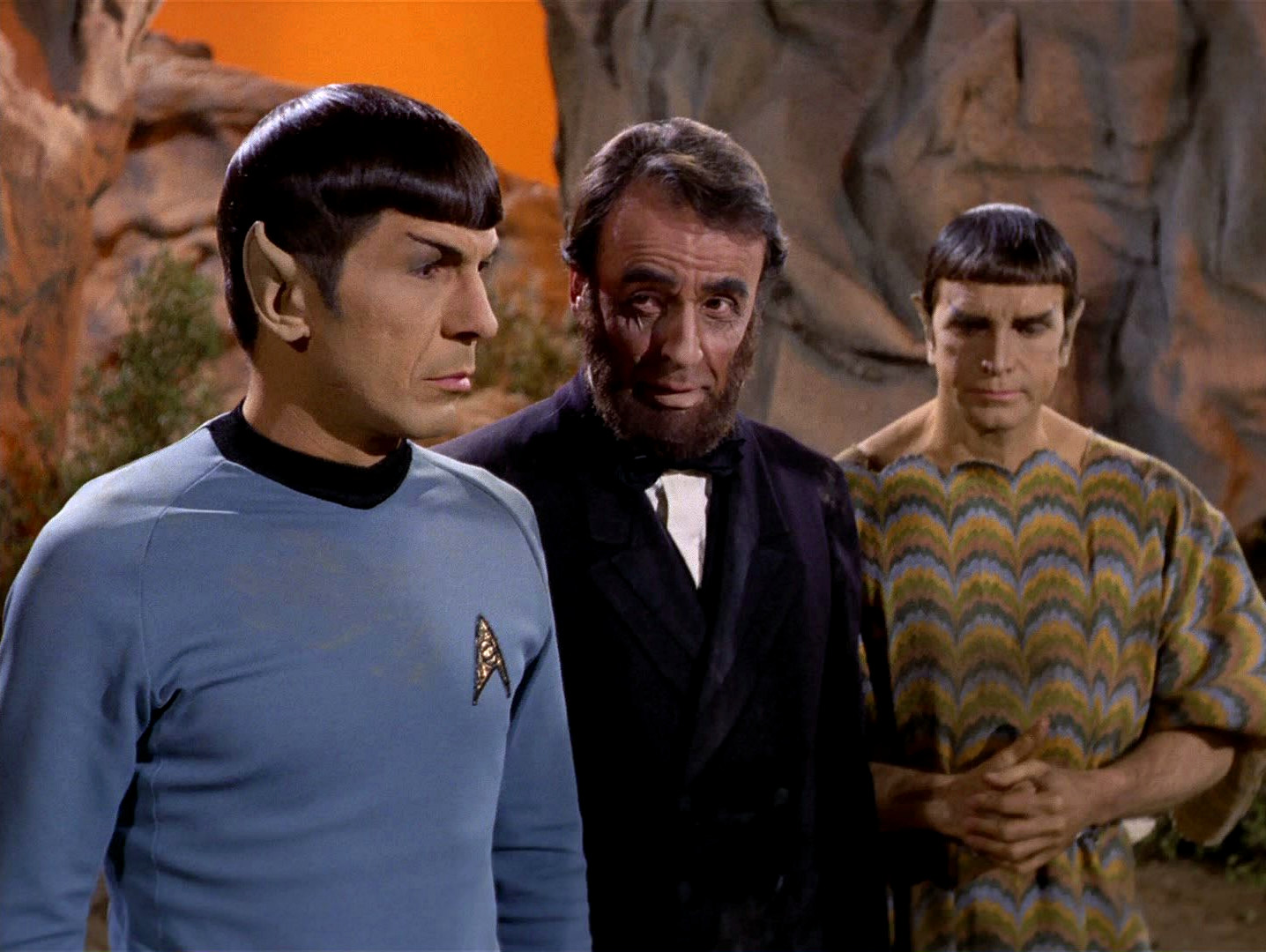
Stardate 5906.4: Just as the Enterprise is going to leave the orbit of a seemingly uninhabited planet with a surface of molten lava, "President Lincoln" requests to be beamed aboard. An area with breathable atmosphere forms on the planet, and Kirk and Spock beam down with Lincoln. On the planet, an indigenous Excalbian stone creature declares that Kirk and Spock, together with the "good" Lincoln and Vulcan philosopher Surak, have to fight against the "evil", namely Genghis Khan, 21st century warlord Col. Green, the ruthless scientist Zora from Tiburon and the Klingon villain Kahless. Surak and Lincoln are killed, but Kirk and Spock manage to defeat the villains. The fight served the sole purpose to explain the concepts of good and evil that the Excalbians do not know, but they are disappointed that they saw no difference under the given circumstances.
Review
The episode begins with big mumbo-jumbo, as suddenly "President Lincoln" appears on the screen, sitting in a chair that is hovering in open space as it seems. Clearly everyone of the crew is aware that this can't be the real Lincoln, and has to be some sort of illusion created by aliens. But unlike on other occasions where he simply dismissed what he saw and demanded a quick explanation, Kirk now decides to cooperate perfectly, obviously rather because of personal nostalgia than for any good reason. So Kirk receives his "president" with presidential honors, with full dress uniform and anthem, which is quite ridiculous. But it becomes plain absurd as two security officers are pointing their phasers at the revered guest!
The story doesn't get any better as the actual purpose of the whole charade is being revealed. On the contrary. Actually, among the various plots in which aliens test the crew for allegedly scientific purposes, such as notably TOS: "Arena" and "Spectre of the Gun", this is by far the most pointless one. So Kirk and Spock, together with their "good" allies, have to prove to the Excalbians that their philosophy is superior to the "bad" ways of Colonel Green and the likes. Well, at one point we may still think that the Excalbians have more in mind than just evaluating skills and methods of fighting. As Surak suggests, "perhaps it's our belief in peace that is actually being tested." But no, dear Surak, it's really just about fighting. Dull fighting until the bitter end with fake allies against fake enemies, in a fake environment. Only the prospect of being killed is real.
In the end the Excalbian is disappointed that there is no difference between good and evil. What did they expect? That the bad guys would slaughter our heroes relentlessly, without meeting any resistance? Or perhaps the same, only other way round? That the good guys could convince Green and company to end the fighting, although the latter were programmed to be sneaky and cruel? We may accept that the Excalbians have no idea of good and evil, which may only speak in their favor. We may forgive them that they use sentient beings as guinea pigs in their cruel experiments, which is what many superior lifeforms are doing. But there is no excuse for the crime they have committed against science and logic, when they predetermine the results of their so-called "research" that is about as enlightened as medieval witch trials used to be.
Only the character of Surak with his uncompromisingly peaceful philosophy is a plus factor in this otherwise inane episode. And even though the appearance of President Lincoln, as yet another representative of America's past, is very gratuitous, I like how he is portrayed. The depiction of Kahless as a voice imitator, on the other hand, is ridiculous.
Annotations
- Nitpicking: Kirk knows extremely little about the history of Vulcan. He hasn't even heard the name Surak before his friend Spock tells him who Surak is!
- Technical note: Kirk tells Scotty to "disengage nacelles, jettison if possible" when the antimatter containment is about to fail. It really seems that at this time the antimatter was supposed to be in the nacelles.
- Remarkable quotes:
- "The face of war has never changed, Captain. Surely it is more logical to heal than kill." (Surak)
- "There is no honorable way to kill, no gentle way to destroy. There is nothing good in war except its ending." (Lincoln)
Rating: 1
All Our Yesterdays
Synopsis
Stardate 5943.7: The Enterprise arrives in the Beta Niobe system whose star will go nova in three and a half hours. When they find that all inhabitants of the planet Sarpeidon inside that system have vanished, Kirk, Spock and McCoy beam down to what seems to be a library of the planet's history. There they meet Mr. Atoz, who asks them to select a period of interest and shows them a machine called the Atavachron. After viewing a recording, Kirk inadvertently steps through a time portal and finds himself in what is the planet's equivalent to Earth's 17th century. He is being accused of witchcraft, but he receives help from a man who himself came from the future. Kirk finds an exit and returns to the library. Meanwhile Spock and McCoy, who were trying to find the captain, have ended up in Sarpeidon's ice age. They get help from a lonely woman named Zarabeth, who was exiled to that era. Spock somehow reverts to an emotional state of ancient Vulcans, and he falls in love with Zarabeth. Only because of McCoy's insistence they find the way back to the library, just before the planet is destroyed. Zarabeth, however, has to stay behind, because her physiology has been altered by the Atavachron prior to her transfer to that time.
Review
This is a final highlight of the series, whose third season gave us rather few really remarkable episodes. "All Our Yesterdays" is interesting first of all because it puts a fresh spin on the idea of time travel. This time it doesn't revolve around the mind-boggling question what would happen to the present if the planet's past was changed, although the Sarpeidonians must have taken into account the grandfather paradox in some fashion. More about the episode's time travel problems here. The story is about the population of a planet that has not yet developed space travel, and whose only escape from the imminent disaster is to the past. And about how Kirk, Spock and McCoy can escape from this past, rather than having to worry about messing with the timeline. Ironically, while our heroes "normally" would have plenty of time to find a way back while they are caught in the past, time is pressing in the present, as there will be no library to return to once the star has exploded.
The second reason why I like "All Our Yesterdays" is because it leaves the conventional paths of storytelling. Usually there is only one plot thread in TOS, in which Kirk, Spock and McCoy are working together until the problem is solved, and each of them has a clear role. This time the three are separated for the most time. Also, their parts are somewhat different than usual. The much more interesting sub-plot of the episode is the one with Spock and McCoy in the ice age, where the two somehow switch their roles. Already the scene when Zarabeth first appears is very impressive, as her face is completely covered by a fur hood and she doesn't say anything but just leads the strangers the way. Although he would personally attribute it to him having become "savage", Spock falls in love with Zarabeth. When he is eventually and inevitably separated from Zarabeth, this is one of the most tragic moments of TOS, second perhaps only to Edith Keeler's death. The ice age is also the far more impressive looking scenery, while Kirk's era is just too much a carbon copy of the 17th century in Europe or North America, unremarkable as many of the "parallel Earths" especially of the second season.
The build-up of the story is quite amusing, as the landing party stumbles across the various replicas of Mr. Atoz, and also because they and Atoz are talking at cross purposes all the time. Atoz doesn't know that these people came from another world, and he assumes that they are to choose a period of history to escape to, whereas Kirk and his men only want to review some files to see where all the inhabitants have gone. Yet, I wonder why they don't simply tell Atoz what exactly they want to know. There is no culture any longer to contaminate!
Well, the end of the episode is quite rushed, as dictated by the imminent explosion of the star. I would have preferred Spock to have some time to say goodbye to Zarabeth, and perhaps to make some provisions for her. In any case this is one of the rather few TOS episodes that would have called for a follow-up, had the series continued.
Annotations
- Continuity: Kirk says in his log entry: "We have calculated that Beta Niobe will go nova in approximately three and a half hours. Its only satellite, Sarpeidon, is a Class-M planet, which at last report was inhabited by a civilized humanoid species. Now our instruments show that no intelligent life remains on the planet." Since a star doesn't go nova all of sudden, and even in our time there are methods to predict such a pending disaster, the Federation obviously wasn't willing to help the people of Sarpeidon. This failure to assist seems unethical but may be sanctioned by the Prime Directive and is also consistent with the quite similar situation in "The Empath". Well, Kirk later tells Atoz: "We came as soon as we knew what was happening." But that is most likely just a white lie.
- Nitpicking:
- Why do Bones and Spock, as opposed to Kirk, end up in the glacial period? Why does the portal send people to the place one of them has accidentally "selected" by just watching it, not to the one defined by the disk in the viewer next to the gate? I hate patronizing technology.
- At the time Kirk has come back from the "17th century", he contacts Scotty, who tells him that the nova will occur in 17 minutes. But as Kirk has been sleeping in his cell and has been questioned twice, he should have been there considerably longer. Also, Spock and McCoy must have been longer in the ice age, considering that the doctor would hardly recover so fast. Moreover, as 17 minutes are left until the explosion, about 15 minutes of episode time are left, but the following events in the library and in the ice age (with Spock hitting on Zarabeth!) likely last longer than depicted.
- It doesn't make any sense that in this and only this episode time travelers need to be "prepared" in order not to revert to an earlier stage of development. Spock has not been prepared (and even if he went through such a procedure, would the Atavachron know how to perform it on a Vulcan?). This is why he reverts to a savage ancient Vulcan, as if his cells knew that they are in a time in which they don't belong. If Spock had been prepared, would he have stayed the same? Apparently yes. It may have protected his physiology in some fashion. But Zarabeth allegedly can't return just because she has been prepared. So would her physiology evolve to something "too advanced" if she came back to the present?
- So Spock plans to build a greenhouse, which may be heated using the underground hot spring. Where does he want to get the plants or seeds? Not to mention the glass.
- Why must Spock and McCoy pass through the gate together? Even Mr. Atoz doesn't know why. Did I mention I hate patronizing technology?
- Remarkable error: Spock tells Zarabeth that he comes from a planet "millions of light years away".
- Remarkable dialogue: "Spock, are you in the library?" - "Indeed not. We're in a wilderness of arctic characteristics." - "He means it's cold." (Kirk, Spock, McCoy)
- Remarkable scene: Zarabeth removes her fur coat, and she is just wearing a mini dress made of patches of leather!
- Remarkable computer: The Atavachron is a redress of Gary Seven's computer from "Assignment: Earth".
- Remarkable props: The small silver disks for data storage look just like CDs, they are only much thicker.
- Remarkable names: Mr. A-to-Z and Atavachron (Roman-Greek for "forefather's time"), two successful puns
- Remarkable fact: Zor Kahn the Tyrant sent his enemies to unpleasant places such as the ice age. Zarabeth was exiled because members of her family conspired to kill the tyrant.
- Remarkable absence: There is not a single scene on the Enterprise in the episode. We only hear Scotty off-camera.
- Remastering: The remastered episode has an impressive final scene, in which we see how the planet is being devoured by the shockwave of the nova.
Rating: 7
Turnabout Intruder
Synopsis
Stardate 5928.5: The Enterprise arrives at Camus II, where members of an archeological team have died of an allegedly unknown radiation. While his people investigate the site, Kirk stays at the bed of the ill Dr. Janice Lester, with whom he was once in love. Lester, however, activates an ancient machine that transfers her consciousness into Kirk's body and vice versa. Lester-Kirk is beamed up to the Enterprise with her accomplice, Arthur Coleman, the unconscious body of Kirk-Lester and the unsuspecting landing party. Lester-Kirk and Coleman are waiting for an opportunity to kill Kirk-Lester. But Kirk-Lester regains his consciousness. Spock performs a mind-meld, which convinces him that the person with Lester's body really is Captain Kirk, whereas McCoy finds no evidence that there could be something wrong with the man who appears to be Kirk. Lester-Kirk orders a court martial against Spock, but when McCoy and Scott decide to vote for Spock, she orders their execution. Eventually, however, the emotional stress in her mind reverts the exchange.
Review
"Turnabout Intruder" is the final episode of the series and also the last one that was produced. While it presents an overall interesting story, the script suffers from various weaknesses, and the execution is overall a bit half-hearted.
Star Trek already had various episodes with look-alikes especially of Captain Kirk, so the mere sight of yet someone else posing as him is nothing that would have justified another episode along these lines. In "Return to Tomorrow" Kirk and two fellow officers agreed to switch places with disembodied alien entities. The variant that someone switches bodies with Kirk (or anyone else) without consent and without anyone knowing was missing so far. Such a story could have involved some alien villain who was going to take over the Enterprise, because he needs the powerful ship to fight his enemies or something like that. The story of "Turnabout Intruder", however, is built upon a rather implausible premise and comes across as contrived.
Firstly, the villain in this case is a woman who was once in love with Captain Kirk. Sure, Kirk just has to know her. He knows everyone in space, and he frequently meets his exes out there. This is clearly one of the most overused clichés of TOS, considering that it can possibly work only on one or perhaps two occasions. Secondly, Lester claims that, as a woman, she couldn't become a starship captain. Instead of giving her a real, a personal motivation, she blames the poor captain in her delusion. Even worse, the story just transfers gender roles of the 1960s to the 2260s, as if the human society had made no progress until then. Thirdly, as the episode was made in the 1960s, a sexual aspect of the body switch is missing. Totally missing. We can't tell whether Janice Lester may be transsexual. I mean, in addition to being completely nuts. The question of her sexual identity wasn't allowed to be posed. At some point she should have "examined" her new male body, which could perhaps have been shown in a decent fashion. But there isn't anything like that. Vice versa, Kirk should be genuinely shocked when he discovers that he is in a woman's body. But overall he copes with the situation too well. Also, except for Lester-Kirk occasionally displaying some stereotypically female mannerisms (such as lifting her forefinger or repeating statements to make sure that she is being listened to), there are no cues that a woman is posing as Kirk. On the contrary, her behavior is especially "tough" on several occasions, for example when she hammers on the table with her fist. Perhaps the director or Shatner were afraid that otherwise the portrayal could come across as "gay". Overall, Janice Lester is a very unpleasant character with an insufficient motivation, and she is never really convincing, neither in her own body nor in Kirk's.
In spite of everything Janice Lester is initially successful as she is posing as Captain Kirk, and the depiction is rather credible. She always formally calls her chief medical officer "Dr. McCoy" instead of "Bones", but otherwise she is familiar enough with the starship and how it is run to make no serious mistakes. And still we can notice in Shatner's play how hard she tries to avoid mistakes. We have to bear in mind that Lester-Kirk needs to repress her temper above all, rather than imitating the captain. Lester-Kirk also does a good job concealing her true intentions when she initially pretends to trust Dr. McCoy, rather than Coleman's advice. I rather like that part of the episode.
In the following the story gets the more implausible, the more erratic Lester-Kirk's behavior becomes. The court martial realistically shouldn't have taken place in the first place. Yet, I like how Spock puts his personal conviction that Lester is actually Kirk above the scientific evidence provided by Dr. McCoy. And Scotty decides to back Spock's position, because he trusts in what he sees himself and because he has the highest regard for the Vulcan's infallible logic. McCoy, on the other hand, feels an obligation to stick with the facts, despite his (and everyone else's) impression that there is something very wrong with Lester-Kirk. In some fashion, he and Spock have switched their usual roles. In any case the interaction of these three characters is a highlight of the episode. However, at latest when Lester-Kirk totally freaks out and orders the execution of her senior officers, no one should have still obeyed the "captain's" orders. This is when the episode becomes farcical.
Throughout the episode Kirk-Lester is rather passive, as if being a woman did have an impact on him after all. Even though he is fully conscious again, Kirk-Lester does little to try to convince his crew that he really is Kirk. For instance, he could tell Chapel details of missions or personal information that only Kirk could know. The trick to cut through the (obviously very weak!) straps on the biobed with a shard shows that he won't give up though. And rather than Spock himself, it is Kirk-Lester who comes up with the idea of a mind-meld to prove that Kirk is in Lester's body.
Lester's accomplice Dr. Coleman and his interaction with her is another disappointment. He does comparably little to help Lester in the course of the episode, he is discreetly absent from the court martial and other important events, and his emotional involvement doesn't seem to be all that strong. We have to wonder anyway what kind of relationship he has with Lester. It is not unthinkable that he would support her wish to become a man, supposing that Lester might be transsexual. But his support goes far beyond that. He was the one responsible for the deaths of the research team. He is on Lester's side until the end. And unlike Lester, Coleman is obviously not mentally unstable, which may perhaps have excused his actions. Still it almost seems as if he would be exonerated in the end instead of being locked up for the crimes he committed.
Annotations
- Inconsistencies:
- David L. Ross reappears as a security officer and is credited as "Lt. Galoway" in this episode. But Lt. Galloway was evidently killed in "The Omega Glory".
- In "The Menagerie" the improvised court martial required the presence of three commanding officers or flag officers. Now a captain and two officers of the rank of lieutenant commander are sufficient to hold a tribunal.
- Chekov says: "Starfleet expressly forbids the death penalty." Sulu adds: "General Order IV. It has not been violated by any officer on the Enterprise." But that should be actually General Order VII. Sulu may have mixed up the order and the planet Talos IV.
- In the end, when the emotional stress to Lester-Kirk becomes unbearable, the consciousnesses move back where they belong very easily. If this is possible even without technology, couldn't the switch occur again at any time, or at least at any time when Kirk is close to Lester?
- Continuity: Kirk-Lester mentions to Spock the events from "The Tholian Web" and "The Empath", in an attempt to provide proof of who he really is.
- Remarkable quote: "Sir, there is only one issue here. Is the story of life-entity transfer believable? This crew has been to many places in the galaxy. They've been witness to many strange events. They are trained to know that what seems to be impossible often is possible, given the scientific analysis of the phenomenon." (Spock)
- Remarkable visual effect: We can see the "halos" of Kirk and Lester switch places as the transference takes place. I don't think that such a broad hint was necessary.
- Remarkable medical technology: The Robbiani dermal-optic test is a medical test of a patient's reactions to optical stimulation with certain wavelengths. This allows to assess his emotional structure.
- Remarkable change: Chapel is now brunette. Majel Barrett will definitely be remembered as the person with the most different hair colors in Star Trek.
- Remarkable absence/appearance: Lt. Uhura is not in this episode and is replaced by Lt. Lisa. Lisa is played by Barbara Baldavin, who previously appeared as Angela Martine in TOS: "Balance of Terror" and as Angela Teller in "Shore Leave". While her name and her hair color already changed between her first two appearances, it is a matter of interpretation whether she got a new name once again and also transferred to the operations department, or whether Lisa is a different person.
Rating: 5