


Time Travel in Star Trek: The Original Series (TOS)
"There may be some logic to the belief that time is fluid, like a river, with currents, eddies, backwash." (Spock, TOS: "The City on the Edge of Forever")
The Series
TOS: The Naked Time
The first time travel in Star Trek is little spectacular and occurs at the end of the episode when the Enterprise escapes from the collapsing planet. While the ship is moving to the past, the (mechanical!) clock on the bridge is running in reverse direction, amounting to three days altogether. The clock is obviously not an autonomous ship system, as it would have been synchronous to the "biological clocks" of the crew (i.e. forward) in that case, but displays a Federation time signal. It is mentioned at the end of the episode that the same method may be purposely used to travel to the past. We don't know if exactly that is done on later occasions. It seems that the slingshot effect (TOS: "Tomorrow is Yesterday") is the preferred method.
 In the remastered version of this episode the look of the clock was updated. Also, the new chronometer displays not only hours, minutes (left) and seconds (right), but the stardate on the left side and the shipboard time on the right side. The label "shipboard" is an obvious problem, as it insinuates that the clock itself is located on board, which is not possible as it would have to run forward all the time.
Classification: travel to the past, without consequences
TOS: The Alternative Factor
At one point in the episode Lazarus claims to be a time traveler. But as almost everything else he says this may be a lie, in an episode where almost nothing makes sense anyway.
Classification: unknown
TOS: Tomorrow is Yesterday
Though it is still one of the most exciting descriptions of a time travel in all of Star Trek, this episode raises a big bunch of problems to be explained. First of all, beaming Air Force pilot Christopher out of his cockpit should already have set off a new timeline and potentially have caused a paradox. At latest Kirk's decision to keep him aboard should have altered history. When the decision is already made and Christopher has no future on 20th century Earth any longer, Spock eventually finds out that Christopher will have a famous son. Obviously this record has remained unscathed just as the rest of the ship and its crew, indicating that they are somehow protected against paradoxes all the time. This will routinely happen almost every time someone in Star Trek travels to the past, so in later occurrences it is often not worth mentioning. Besides, although he freely admits that he made an error when he didn't check for descendants with "relevant contributions" to history, Spock's attitude that insignificant individuals have no influence on the timeline is unusually arrogant and illogical.
Regarding the question how to return to the 23rd century, it is inconsistent why everyone initially thinks the ship is trapped in the 20th century, although a method for time travel is already known from "The Naked Time". However, it explains why the effort is made to steal the tapes and films from the Air Defense Command, which wouldn't have been necessary if the time travel incident was going to be fixed by going back even further in time. As the further complication with the security sergeant that is accidentally beamed aboard proves, it really wasn't such a good idea.
The method to restore the timeline and simultaneously return to the 23rd century using the slingshot effect is unfortunately too complicated to make sense. It is supposed to work like this: The Enterprise heads toward the Sun at high speed (Warp 8), whereby clock is running backward, taking the ship to a time prior to its arrival in Earth's atmosphere. After pulling away from the Sun, time runs forward again and the Enterprise passes by Earth at warp speed, with the chance to beam back first Christopher and then the security sergeant to a time before they discovered the ship and the burglars, respectively. The Enterprise would then continue to move forward in the time warp until the ship arrives in the 23rd century and needs to brake rather abruptly in order not to overshoot its time. So far, so good. The contradictions become obvious as we watch closely and think further.
So the Enterprise goes back in time, and history is fixed by beaming Christopher back into his cockpit. How is this possible if the past Christopher is already in there? It is the only time that such a "temporal re-integration" of two versions of the same person is performed, whereby the memory of the time after it is lost. Something similar will be done again only in VOY: "Relativity". Moreover, after Christopher has been re-integrated, the Enterprise that he has just spotted is suddenly gone. So the most recent presence of the Enterprise in that time would somehow erase the previous one in Earth's low orbit where Christopher saw it, which would be another unique effect? But if this were true, the ship would have to be gone already prior to that very instant, because the Enterprise originally went back even further. Why should beaming back Christopher have any bearing on the ship's presence? In a more consistent depiction no one would have seen the ship in the first place, and it wouldn't have been necessary to beam back Christopher and the sergeant to fix the timeline, except to re-integrate them. Even more obviously, in the case of the sergeant there would be nothing suspicious he could notice in the first place, because at this time Christopher has already safely landed his aircraft and nothing related to the incident has ever happened.
There are also huge problems with the timing. If the Enterprise were heading from Earth toward the Sun at Warp 8, the ship would have to pull away after only one second at that speed, but the journey takes several minutes on screen. If it were really just one second, the correct timing of the slingshot would not be delicate but simply impossible. Considering how little time is left, Captain Christopher would have no time to stay on the bridge and then go down to the transporter room, realistically he should be already on the pad, waiting to be beamed back. Moreover, the transporter suddenly has a range of millions of kilometers and can be operated at high warp, considering that the ship is passing by Earth, and two people have to be beamed down one after another with a precise timing regardless of the distance and relative speed to Earth. Even if it were possible to beam at warp, Earth would be out of transporter range within a second. Finally, the Enterprise moves to the future rather slowly after passing by the Sun and then Earth, with a few hours translating to a couple of minutes. At that rate it would take years for the ship to arrive in the 23rd century, unless it were possible to use the engines to accelerate within the time warp. But the way it is shown, it takes less than a minute without additional acceleration before only 50 years are left to go, and Spock counts down "40, 30,..." with ten years equaling one second.
In the remastered version of this episode, like already in "The Naked Time", the "shipboard" chronometer is running backward, although only a clock receiving a signal from outside the ship could indicate that the ship is going back in time.
Classification: past incursion, corrected with "temporal re-integration"

TOS: The City on the Edge of Forever
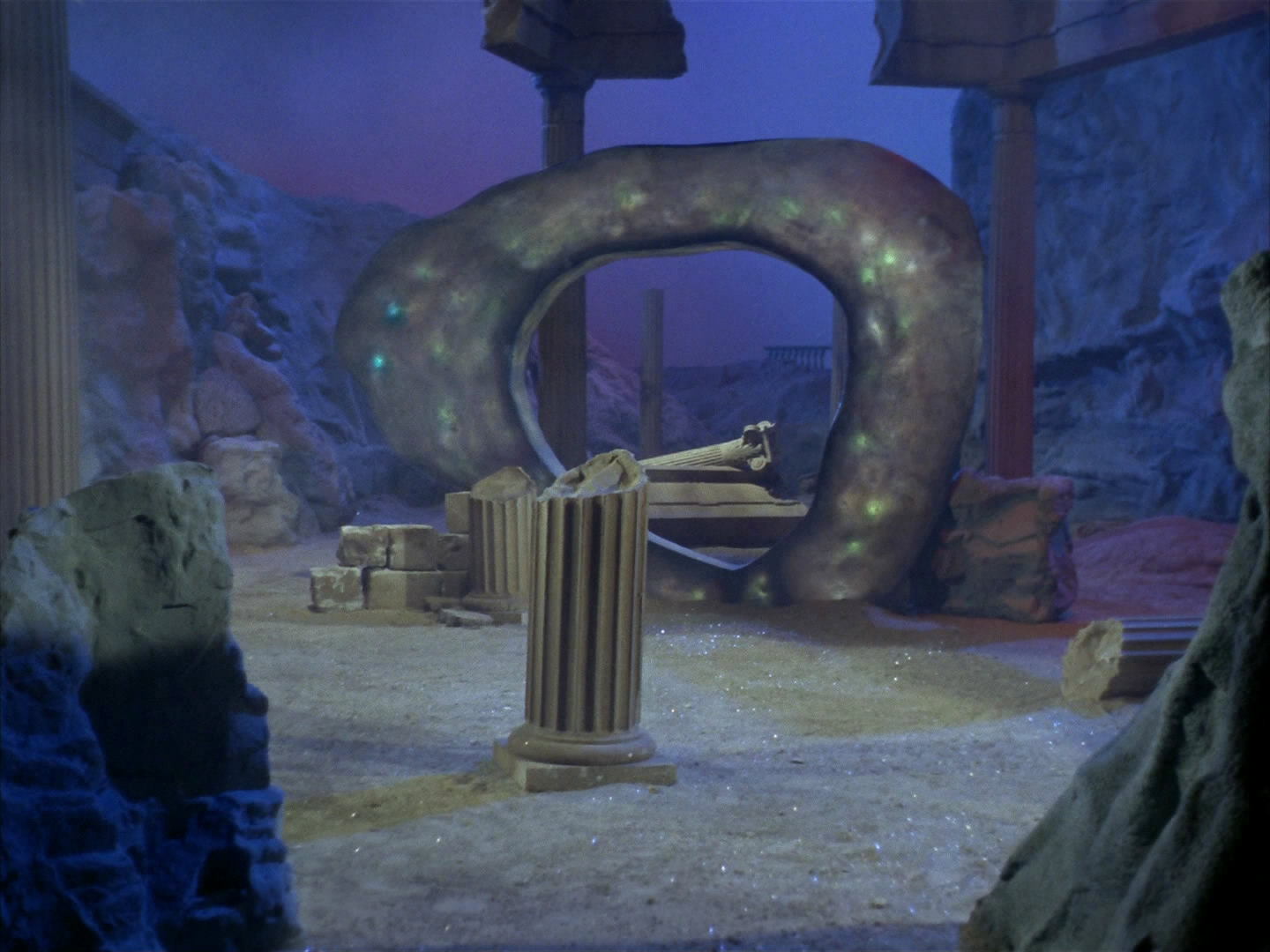
In this episode McCoy, who has become temporarily insane after an overdose of cordrazine, travels back to New York in the 1930s using a time portal, the Guardian of Forever. Obviously the Federation ceases to exist in the instant he rescues the pacifist Edith Keeler and thus involuntarily enables the Nazis to win the Second World War. So when McCoy enters the time portal, history is immediately altered. The landing party of the Enterprise are the only remnants of the old timeline, while the Enterprise has disappeared together with the rest of Starfleet. Though it is not explicitly mentioned, the planet has to be shielded against changes in the timeline, an effect that will be used as a loophole in several other episodes, because someone has to be left to fix history. We do not know what happens to McCoy in New York after changing the timeline. Probably he is protected likewise, since he would otherwise cause a paradox with unknown impact.
Based on the recorded data of McCoy's disappearance, Kirk and Spock select exactly the right instant to enter the portal and to correct history. It is quite astonishing that the two officers arrive only a few days before McCoy, since, based on what the portal shows, a delay of only one second would have led to a deviation of many decades, let alone a wrong place to arrive at.
Basically any of McCoy's actions in the past could have changed the timeline. Fortunately Spock has records of both timelines shown in the portal, one prior to and one after McCoy's incursion. So Kirk and Spock can conclude that Edith Keeler is the focal point of the timeline switch and they do not have to speculate on it. The inevitableness of Edith Keeler's death makes this episode probably the most tragical of all Star Trek, not only for Kirk and McCoy. However, it is improbable that Edith Keeler dies in the same accident in the original timeline without Kirk, Spock and McCoy being at the scene as well as in the final (restored) timeline where the three are in a way responsible for her death. Maybe this is an incidence of a predestined timeline, but there is no further evidence.
Classification: past incursion, corrected
TOS: Assignment: Earth
Unlike in almost all other episodes the Enterprise, using the slingshot effect known from "Tomorrow is Yesterday" (called "light speed break-away factor" here), travels back in time on purpose here. The goal is to investigate a nuclear warhead detonation in Earth's atmosphere in 1968. Such missions seem to be prohibited by the Temporal Prime Directive in the 24th century and later. But only one year after the possibility of time travel has been discovered (discounting that time travel would be almost commonplace in Star Trek Enterprise, more than 100 years earlier), such a directive has obviously not yet been issued.
Anyway, having arrived in the 20th century, the Enterprise crew and a mysterious man called Gary Seven both attempt to prevent a nuclear conflict, however, they hinder one another in doing so. The result of the uncoordinated efforts is a nuclear explosion in the atmosphere just 104 miles above the surface, whose investigation is exactly the reason for the time travel in the first place. So this episode presupposes a predestined timeline that is not actually changed by any of the time traveler's actions. This is inconsistent with most other episodes, and especially it is not in line with the two other occurrences of the slingshot effect ("Tomorrow is Yesterday" and "Star Trek: The Voyage Home") where there is no sign of predetermination.
Classification: predestined past incursion ("causality loop")


TOS: Wink of an Eye
In a broad sense this episode involves time travel. Time passes very fast for the Scalosians relative to the Enterprise crew and to the rest of the universe. The crew notices nothing of the Scalosians' presence but some insect-like buzzing. This is because they are moving and speaking too fast to be perceived. Vice versa, the Scalosians see the Enterprise crew stand still. The effect of imperceptibility requires a speed ratio Scalosians/Enterprise of roughly 1,000,000. In this case Kirk and Spock would have spent several decades on the fast time level and should have aged accordingly, while only a couple of minutes would have passed from the perspective of their crewmates. Besides, already at a ratio of 100 a human being, whose aural perception has a cut-off frequency of typically 15kHz, could not hear any talking or noise of the accelerated people while still being able to see them.
The most striking inconsistency of this episode is that the effect is not ascribed to some technological device that might be capable of altering the course of time itself. Instead, it is purportedly a solely biological effect, a hyperacceleration of the Scalosian organisms: "The water was polluted. Radiation was released. That changed us. It accelerated us." When Captain Kirk drinks the drugged coffee, his body begins to work faster, while he stays within our space-time. The dilemma is that body functions, e.g. heartbeat and blood circulation, metabolism and neural activity, are subject to strict physical and biological limitations. They cannot just be accelerated, let alone by a factor of some 1,000,000. Not only is a brain working at multiple light speed a biological miracle, it is also physically impossible within normal space-time and even in the realm of Trek science as long as no additional technology is involved.
Another major problem with this episode is the oxygen that fills the ship. At an accelerated level, there would be no reason why a person or object should be able to move through the ship's normal atmosphere without creating enough friction to burn up, similar to a real spacecraft entering the Earth's atmosphere. Also, for a hyperaccelerated person the ship's interior and the atmosphere's molecules would vibrate at an incredibly low rate, meaning that the ship would be too cold for them to survive in, even if they could move through it. A similar argument can be made that there would be no reason why accelerated bodies could metabolize the air in the ship.
On the other hand, the problem of UV or, vice versa, IR shift in case of different time levels does not occur in this episode. While the speaking frequency of the accelerated person is of course much higher and actually too high to be perceived by a normal human being, light coming from the person is subject to the normal laws of physics. So the invisibility effect in this case is based on the inertia of the human eye and possibly on a Doppler shift that is not negligible -- and not because the light waves themselves would be "accelerated" and hence shifted to UV. The internal sensors of the Enterprise, however, should have been able to track the Scalosians' movements better, since we can suppose they are much more advanced than present-day image sensors.
In one scene of this episode Kirk fires a phaser at the Scalosian woman Deela. As the phaser is not accelerated (it didn't have a drug in its coffee ;-)), Deela is able to move faster than the beam and can easily dodge it. The Scalosian devices, on the other hand, all work fast enough for the accelerated time level. But how can the Scalosians accelerate inanimate matter or energy, which would require a completely different method than for lifeforms? Anyway, if we assume that the beam moves at light speed and take this as a speed reference, Deela's acceleration ratio would be even in the range of 100,000,000. It would be associated with a significant Doppler shift of outgoing light with every of her movements, not to mention relativistic effects. However, irrespective of the light beam's actual speed, Deela would never be able to make way for it. This is due to the simple fact that she could perceive the beam as late as it reaches her eyes, and this is certainly too late to react.
Also, the synchronicity of events in normal time is sometimes lacking. For instance, Spock tells Scotty to meet him in the transporter room. We then see Scotty at the entrance of the transporter room on the accelerated level. Meanwhile, on the normal time level, McCoy and Spock are working on an antidote. Back in the accelerated time, however, Scotty is still standing in the door!
Classification: different time levels
TOS: All Our Yesterdays
It is a really weird idea to send back the whole population of a doomed planet to the past, since this would cause millionfold paradoxes that interfere with each other, even if all time travelers did their best to obey the non-incursion directive. However, exactly this was done on the planet Sarpeidon. The time portal itself and Mr. Atoz (A to Z) are not affected by the paradoxes, or the paradoxes just do not become obvious.
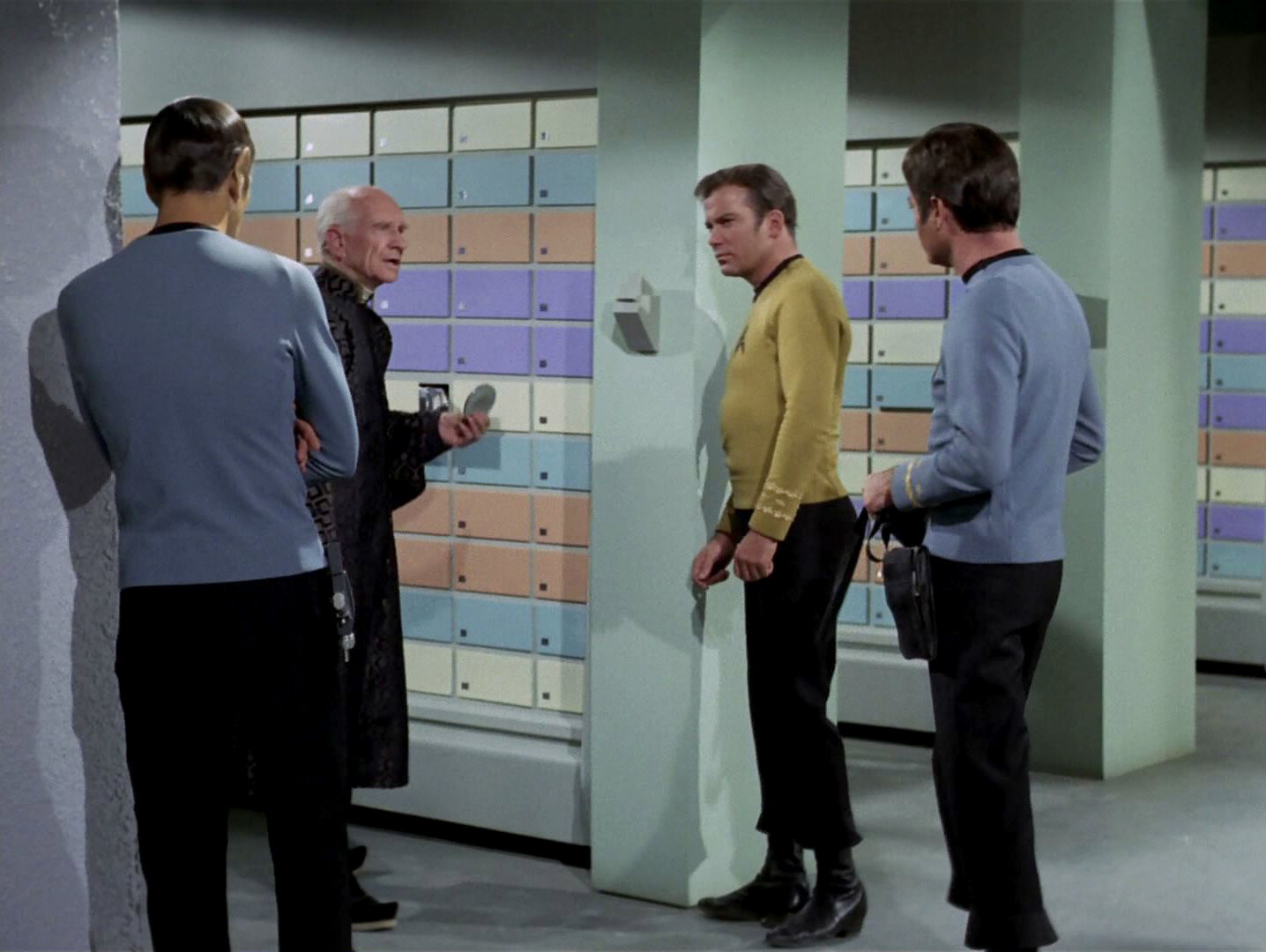
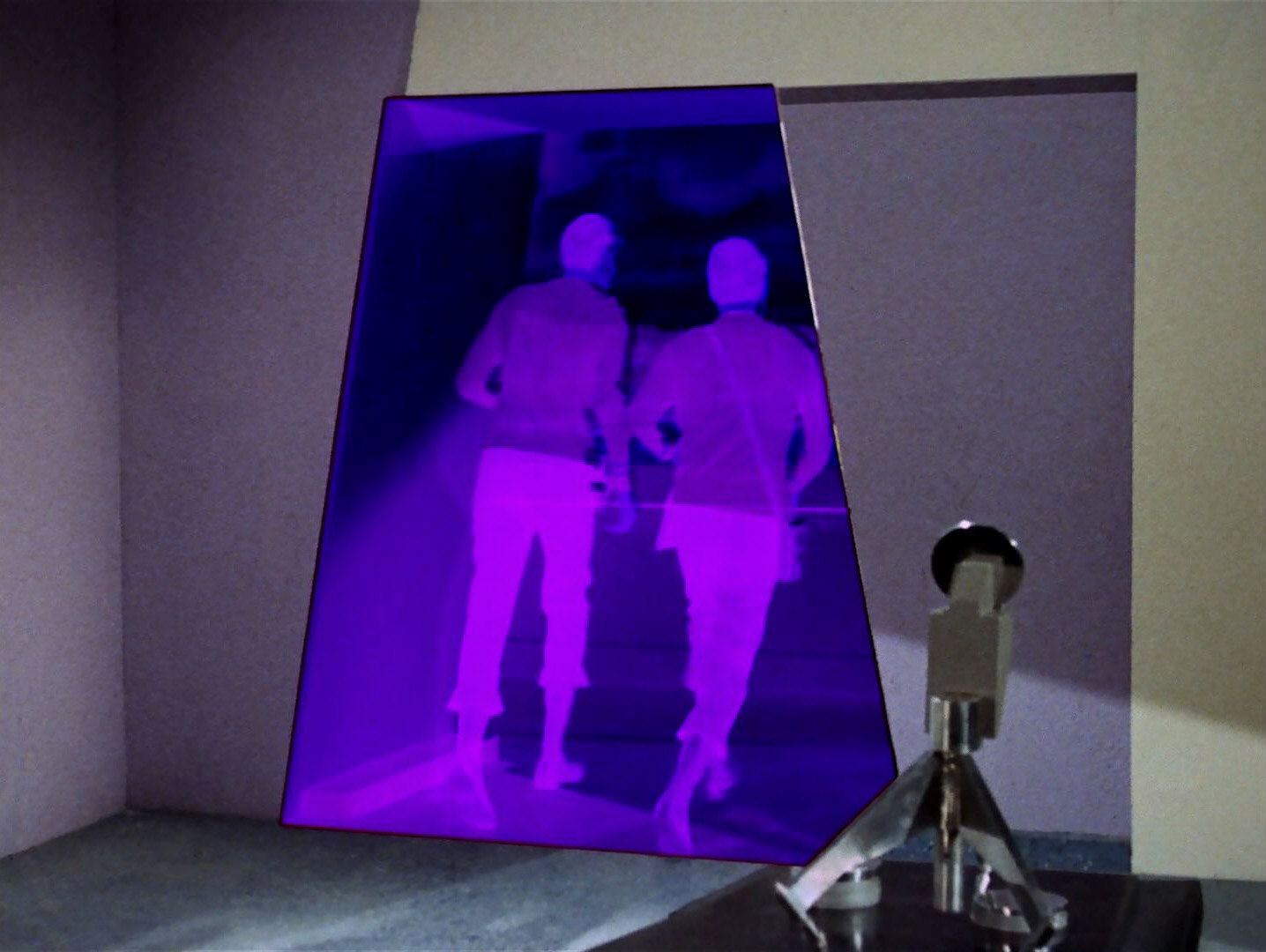
The working principle of the time portal in this episode is not plausible. Why do Bones and Spock, as opposed to Kirk, end up in the glacial period? Why does the portal send people to the place one of them has accidentally "selected" by just watching it, not to the one defined by the disk in the viewer next to the gate? Also, when they return, why must Spock and McCoy pass through the gate together? Even Mr. Atoz doesn't know why.
It doesn't make any sense that in this and only this episode time travelers need to be "prepared" in order not to revert to an earlier stage of development. Spock has not been prepared (and even if he went through such a procedure, would the Atavachron know how to perform it on a Vulcan?). This is why he reverts to a savage ancient Vulcan, as if his cells knew that they are in a time in which they don't belong. If Spock had been prepared, would he have stayed the same? Apparently yes. It may have protected his physiology in some fashion. But Zarabeth allegedly can't return just because she has been prepared. So would her physiology evolve to something "too advanced" if she came back to the present?
Classification: past incursion, without visible consequences, but biological impact of time travel
The Movies
Star Trek IV: The Voyage Home
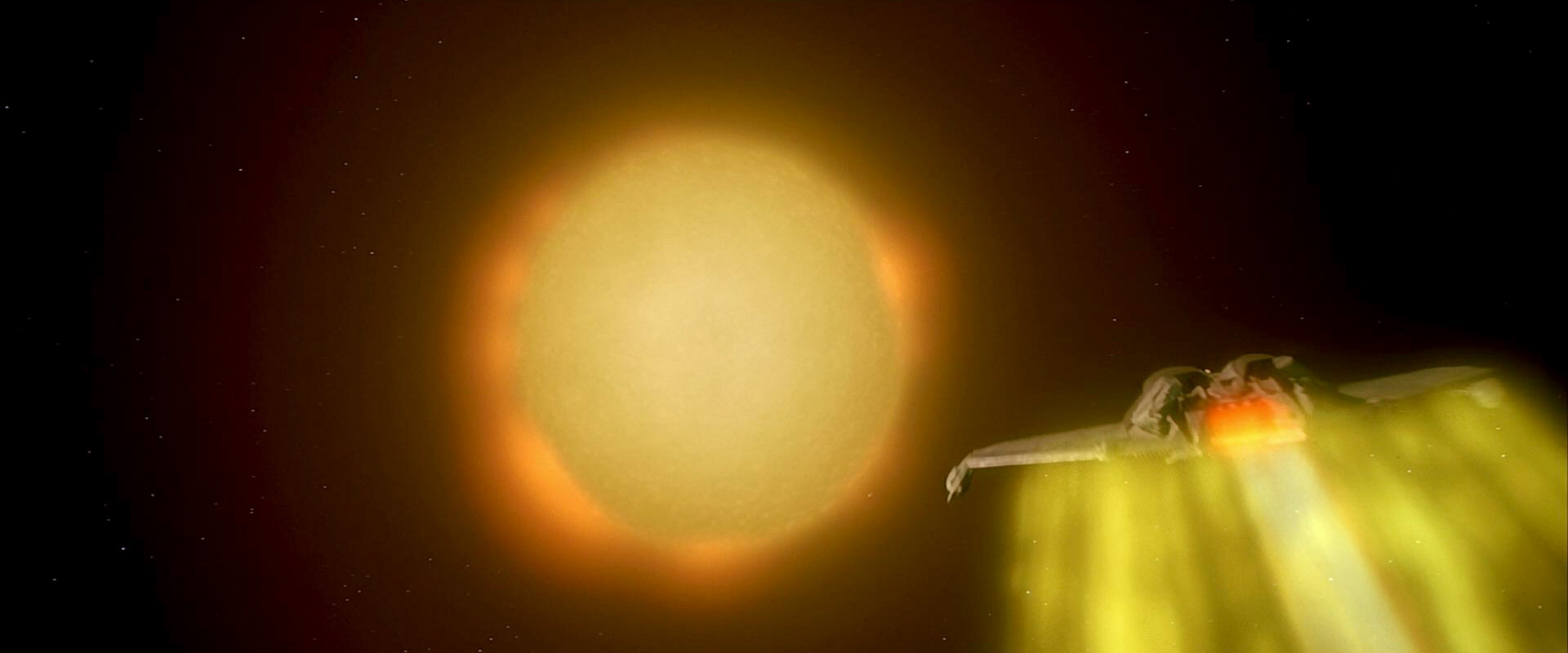
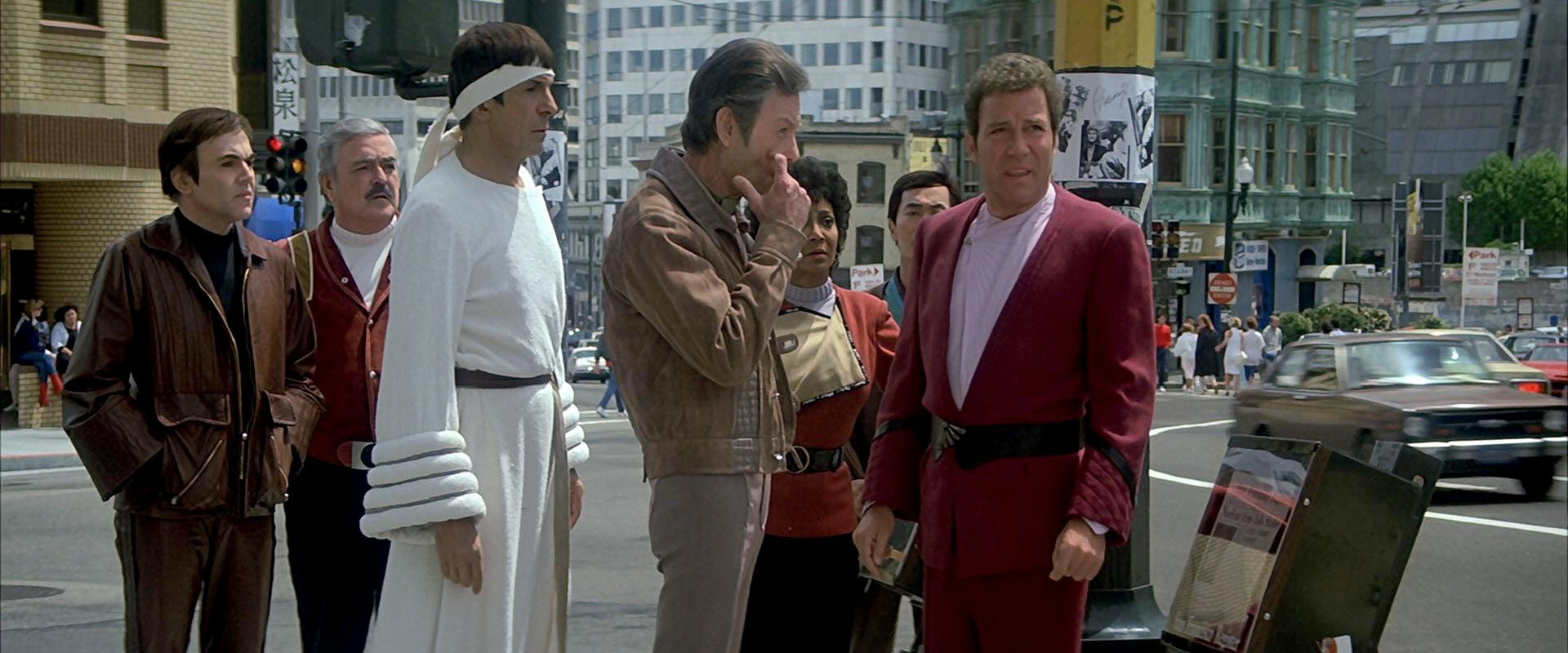
Using the slingshot effect, Captain Kirk & crew "time warp" to the 20th century in a Klingon Bird-of-Prey to get hold of a humpback whale. It is not evident why it is necessary to land the ship in San Francisco, which probably consumes much more precious energy than simply staying in orbit. Moreover, the ship on the ground could be detected any time.
In the 20th century the crew members do no care very much about the timeline, and they produce a lot of possible paradoxes due to their mere presence and their actions. The most severe error is to reveal the formula of transparent aluminium which will almost certainly alter history and lead to a paradox. What's more, Chekov's phaser and communicator that remain in the past and the unforgettable hospital scene with a patient suddenly growing a new kidney and other "miracles" will surely entail consequences. Finally, Gillian Taylor who may have given birth to children leaves the 20th century without anyone considering the consequences.
On an ironical side note, the windows of Starfleet Headquarters in the 23rd century are still made of glass which gets shattered by the storms induced by the Whale Probe. Glass could be still in use, but in such a crucial place?
Classification: intentional past incursion, without visible consequences
Credits
Some screen caps from TrekCore. Thanks to Vinnie for the note about the glass windows in the 23rd century and to Jonathan Bates for additional hints about effects in "Wink of an Eye".


