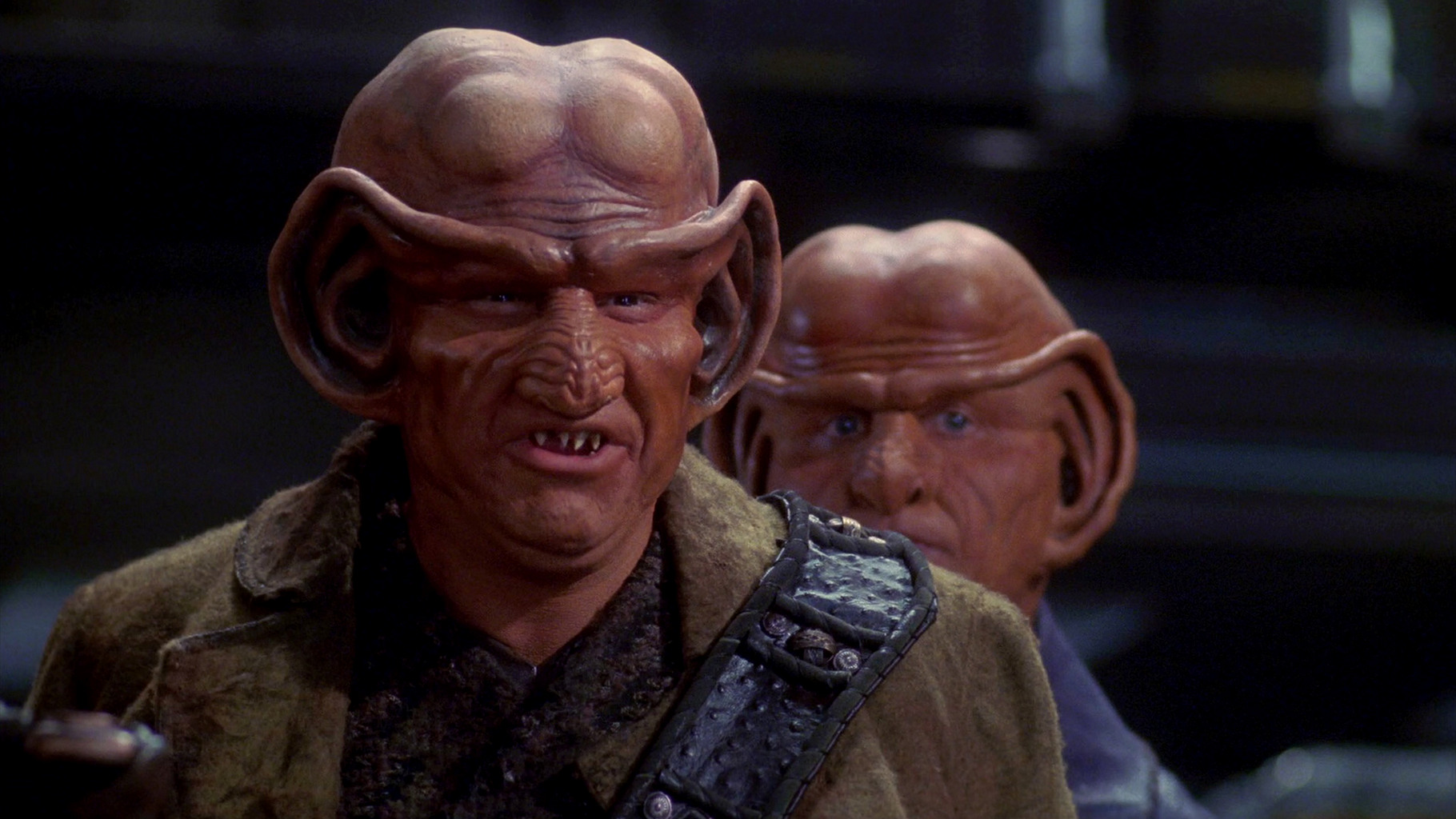
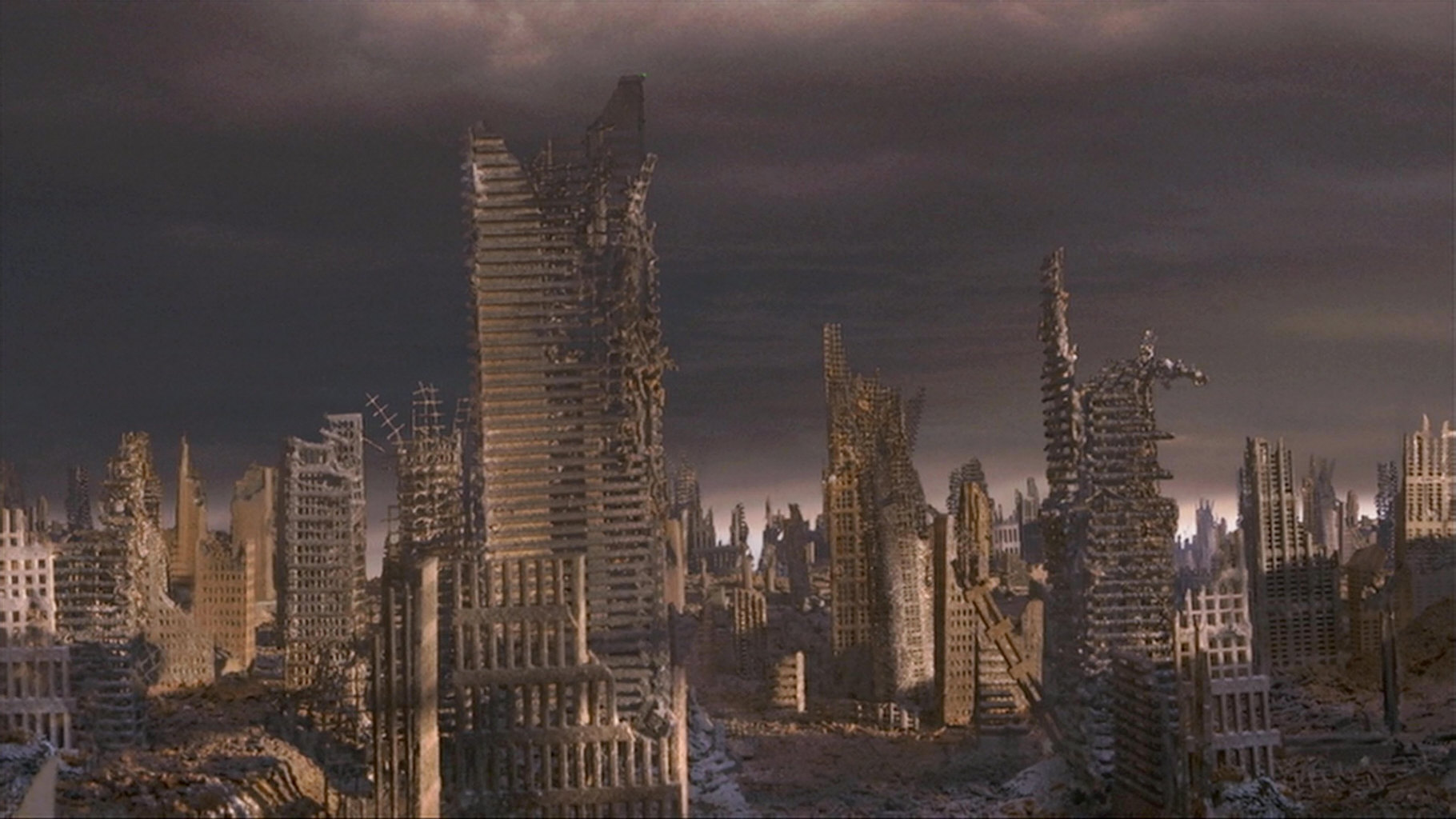
Star Trek Enterprise (ENT) Season 1 Reviews
Season 1Season 2Season 3Season 4
Broken BowFight or FlightStrange New WorldUnexpectedTerra NovaThe Andorian Incident
Breaking the IceCivilizationFortunate SonCold FrontSilent EnemyDear DoctorSleeping Dogs
Shadows of P'JemShuttlepod OneFusionRogue PlanetAcquisitionOasisDetained
Vox SolaFallen HeroDesert CrossingTwo Days and Two NightsShockwave I/II
Broken Bow
Synopsis

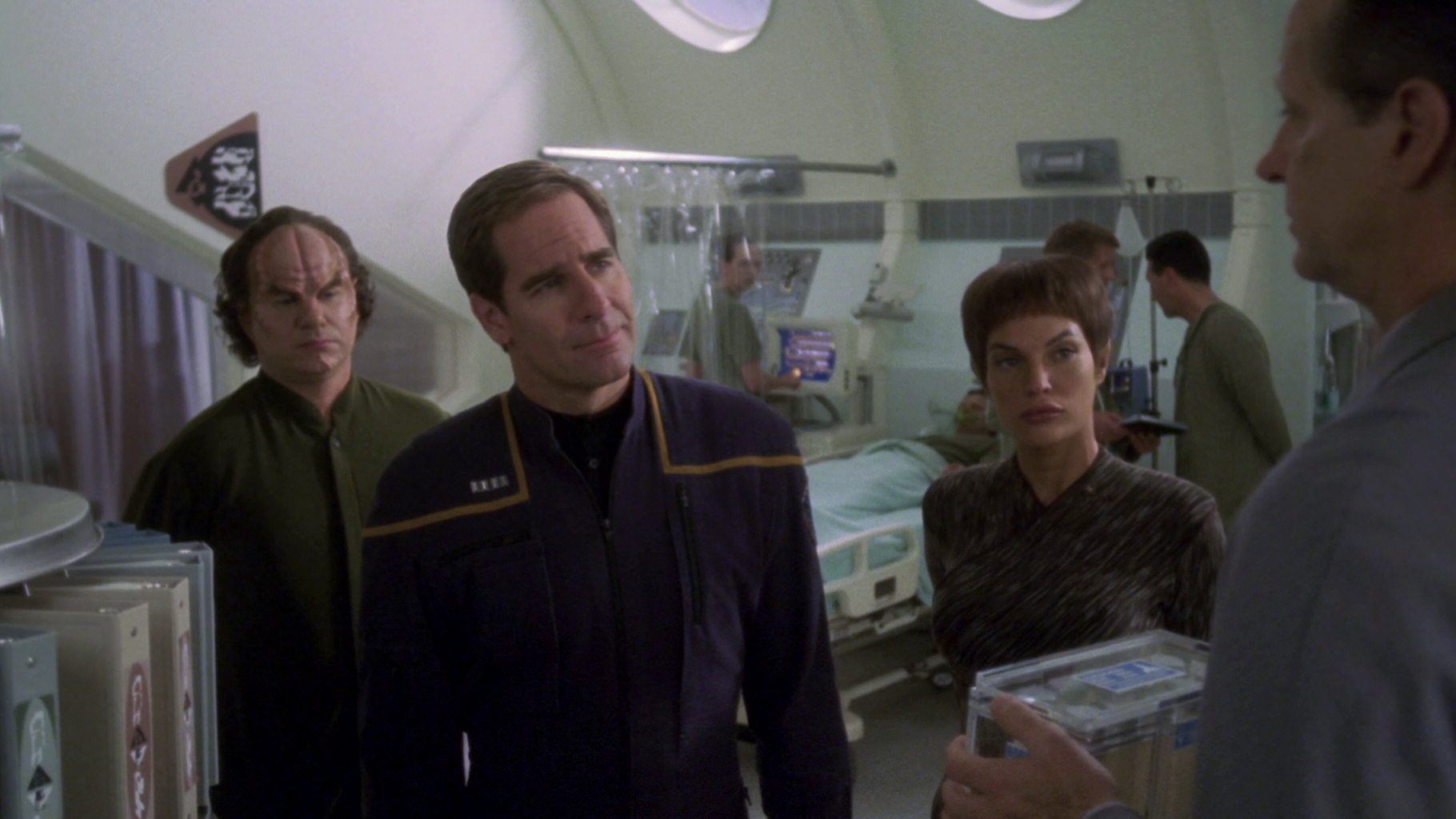
April 16th, 2151: The Klingon Klaang crash lands on Earth in Oklahoma, chased by two Suliban. One of them easily squeezes through the narrow gap in the door of a grain silo. Klaang destroys the silo, killing both pursuers, only to be shot by a farmer. The Vulcans, led by Ambassador Soval, intend to take care of this interstellar matter their way. However, Starfleet Admiral Forrest decides to return the Klingon to his homeworld using Earth's new Warp 5 starship, Enterprise. Captain Jonathan Archer, whose father designed the engine but didn't live long enough to witness the launch, assembles his crew ahead of schedule, including the Denobulan physician Phlox. Vulcan science officer T'Pol is assigned to the mission to supervise the inexperienced humans, much to the dismay of Archer and Chief Engineer Charles "Trip" Tucker. Enterprise launches successfully, and linguist Hoshi Sato begins establishing communication with the injured Klingon. However, while en route to Qo'noS, the ship is boarded by Suliban agents who abduct Klaang. T'Pol recommends aborting the mission, but Archer decides to continue and follows a lead to Rigel X. A landing party consisting of Archer, Tucker, T'Pol, Reed, Mayweather, and Sato travels by shuttlepod to a large trading outpost on the planet. There, Archer learns from a Suliban operative named Sarin that a faction known as the Cabal has been genetically enhanced and supplied with advanced technology by an unknown benefactor from the future as part of a "Temporal Cold War". Their mission is to trigger a Klingon civil war, and Klaang carries evidence that could expose the conspiracy. Sarin offers to help the Enterprise crew but is killed by the Cabal. Pursued by the Cabal, the landing party escapes to the roof of the complex where the shuttle awaits, though not before Archer is wounded. T'Pol assumes command. But she honors Archer's wish to continue the mission and devises a method to track the Suliban ship to a space station hidden inside a gas giant's atmosphere. Once Archer recovers, he resumes command. Enterprise is outgunned by an swarm of small Suliban vessels, but the crew uses the ship's grappler to catch one of these cell ships. Archer and Tucker use it to infiltrate the space station, the Helix, and free Klaang. Archer activates a device that unlocks the magnetic docking mechanism of the Helix. He is successful but has to stay behind on the station, where he faces the leader of the genetically altered Suliban, Silik. Just as Silik is about to kill him, Archer is rescued by the ship's newly installed transporter. After Enterprise successfully delivers Klaang to Qo'noS, the Klingons extract the information encoded within his blood cells. Impressed by the mission's success, Starfleet authorizes Enterprise to continue its exploration mission. T'Pol also chooses to remain aboard the Earth vessel as part of its crew.
Review
This is a 2026 update of the review that I wrote in 2001, shortly after "Broken Bow" had aired. Back then, I was dismayed by the series premise. I thought the character concepts were bland, and I doubted that the writers could successfully handle the self-imposed restrictions of a prequel, in which much of the advanced technology of the TNG era realistically should not exist yet. I was also disappointed by the "Akiraprise" design. After watching the pilot in 2001, however, I found that I liked it. It came with a good story and was unmistakably Star Trek. At the same time, it confirmed several of my apprehensions. My overall opinion on story and characters has not changed all that much between 2001 and 2026.
Let me begin with the characters. First of all, we have Jonathan Archer, the only one whose background is explored to any significant extent. His feelings toward the Vulcans date back to his childhood, when he realized that his father's project was progressing more slowly than it could because the Vulcans were withholding technology. As T'Pol herself says about Enterprise's sensors, "Vulcan children play with toys that are more sophisticated." Archer embodies the inferiority complex that many humans must have felt in the 22nd century. He compensates with a certain underdog pride for his father's and his own accomplishments, that they managed to build their starship on their own, even if it took over 30 years. Archer believes that the Vulcans are not merely cautious but fundamentally arrogant. Unfortunately, they prove him right on nearly every occasion. Archer's response is a form of arrogance of his own; he constantly strives to provoke them. He seems to take pleasure in behaving exactly like the caveman the Vulcans see in him: acting on instinct and emotion, using rude language and deliberately doing the opposite of what he is advised to do. And, of course, eating a large steak in front of the vegetarian T'Pol. He also enjoys pointing out every Vulcan mistake. Overall, he is full of prejudice and defiance and is by far the least skilled diplomat among the Star Trek captains we know. There is clearly plenty of room for development in "Broken Bow", and that development would indeed take place over the course of the series, leaving me very satisfied in hindsight. It is also a nice touch how the flashbacks to Archer's childhood and his model starship mirror the present-day story and illustrate that one should have confidence in oneself rather than relying on, or blaming, others.
T'Pol, like her two fellow Vulcan characters in the episode, comes across as overly smug, unlike Spock or Tuvok, who are generally polite and respectful in both word and deed. Although Archer and T'Pol constantly criticize each other, I feel they are more alike than either would care to admit. Both seem determined to prove the other wrong and fail to realize that they often argue merely for the sake of arguing. For example, I simply don't believe it would be logical to eat grissini with a fork and knife, yet T'Pol does exactly that because she feels compelled to make a point. I can only describe the behavior of both Archer and T'Pol as childish. When I first watched the episode in 2001, I did not see T'Pol as having much potential to become the ship's darling in the tradition of Seven of Nine, although she would eventually undergo a similar development. The way she softens during the course of the pilot is a start, but I still do not really understand why she suddenly changes her mind and continues the mission according to his wishes while Archer is incapacitated. Nor do I see a convincing reason for her decision to remain aboard Enterprise. The story doesn't develop these points sufficiently, making them feel somewhat gratuitous.
Charles Tucker is the third most prominent member of the cast, yet we gain surprisingly little insight into his character. Most of the time, he simply echoes Archer's opinions, especially during his numerous disputes with T'Pol. In 2001, I found Dr. Phlox disappointing, describing him as a sort of hybrid of the EMH and Neelix. I expected him to serve mainly as comic relief throughout the series. Today, I see him differently. In "Broken Bow", Phlox consistently encourages people not to take matters too seriously or personally. He acts as a mediator of sorts, despite rarely interacting directly with T'Pol. My 2026 self finds Phlox far more agreeable than the three constant squabblers.
Hoshi Sato is clearly the most pleasant character in the pilot. In hindsight, I probably overrated her potential in 2001, imagining that she would become a fan favorite rather than T'Pol. Nevertheless, she represents the positive side of humanity in the 22nd century. Unlike Archer and Tucker, she is fully aware of both her strengths and weaknesses and feels no need to pretend otherwise. Despite having relatively few lines, she makes several noteworthy contributions, although the perhaps most memorable one is a casual remark: "You might think about recommending seat belts when we get home."
The contributions of "space boomer" Ensign Mayweather are minimal, and I certainly did not anticipate in 2001 that this would remain true, with only a few exceptions, throughout the series. Malcolm Reed likewise contributes little beyond occasional reports about whether the weapons are or are not ready.
There is one thing that bothered me in 2001 and still today. There hardly seem to be any crew members aboard besides the main characters. A few people can be seen in the corridors and engineering, and one crewman is attacked by the Suliban in sickbay. Nevertheless, considering that Enterprise is supposed to be more crowded than ships such as the Enterprise-D or Voyager, the extras are remarkably inconspicuous, almost as if they were cloaked. I also wonder who is actually in command of the ship while the entire senior staff is down on Rigel X.
Let me come back to the depiction of human-Vulcan relations. The clashes between Archer and Tucker on one side and T'Pol on the other are presented as almost disastrously severe. In my view, the argument at Starfleet Medical early in the episode would have been enough to establish the tension between humans and Vulcans. Yet Archer, Tucker, and T'Pol never seem able to leave the issue alone. Nearly every conversation highlights the cultural divide between the two species, even when far more important matters should be under discussion, such as the mission itself. The constant bickering becomes especially irritating because it is so repetitive. T'Pol criticizes human impulsiveness again and again, while Archer and Tucker complain about Vulcan arrogance all the time. At some point, any reasonable human or Vulcan should have concluded that everything worth saying had already been said. I still don't understand why so much attention is devoted to this conflict. The absence, or rapid resolution, of long-term interpersonal conflicts was frequently criticized in Voyager. I have always found that criticism strange because Star Trek never really needed them before, and Gene Roddenberry actively discouraged them. TOS had the famous disagreements between Spock and McCoy, but those were usually little more than good-natured personal friction and often humorous. TNG attempted, with limited success, to recreate such a dynamic between Data and Pulaski. DS9 came with so many organic tensions among its characters that none of them ever became tiresome.
We are already familiar with "smug Vulcans" from "Take Me Out to the Holosuite" in the final DS9 season, in which Captain Solok challenges Sisko to a baseball game with the only purpose to demonstrate Vulcan superiority. In some respects, the constant verbal sparring between Archer, Tucker, and T'Pol serves as a precursor to that display of bad spirit on both sides two centuries later. I certainly don't appreciate this kind of "consistency". These are simply not the Vulcans I know from characters such as Sarek, Spock and Tuvok, whose logic and manners set a much higher standard. Star Trek should not undermine itself by casting its two most important founding races in such an unflattering light. I think it is inappropriate still today, and it is hardly an excuse that some of the post-2017 Trek continued in the same vein. "Broken Bow" would have benefited from less human-Vulcan conflict, or at least a much more restrained portrayal of it.
The story of "Broken Bow" is not especially cerebral, but it's convincing. The plot develops slowly yet effectively. Some elements, however, become repetitive, most notably the constant Vulcan-human arguments. As already mentioned, the ending does not entirely work for me. Archer and T'Pol spend most of the episode insulting one another, and then, once the mission succeeds, everything suddenly seems fine. Archer admits that he may have misjudged T'Pol, while T'Pol becomes noticeably more cooperative and even expresses a desire to remain aboard the ship. I find it difficult to believe that either of them could have gained so much insight in such a short time. There is an illogical gap in the narrative. It would have been more convincing if they had either reached some understanding much earlier or if T'Pol had ultimately been ordered to stay aboard against her wishes.
In 2001, I also complained that locations such as Rigel X, the Suliban station, the corridors of Enterprise, the decontamination chamber and Qo'noS were excessively dark. That was before darkness became the visual standard on Discovery and Picard. Likewise, I disliked some of the more overtly "scary" moments, such as the Suliban infiltration scenes. These work considerably better for me today.
"Broken Bow" introduces a number of new alien species, all of which we never see again in later centuries - well, with the exception of some Denobulans in Lower Decks. It's also one of those "historical event" stories that a series can realistically afford only once or twice per season. The pilot is filled with firsts: first contact with the Klingons and Suliban, the launch of the first Warp 5 ship, the first phase pistols, the first transporter use, and more. In 2001, and still to some extent in 2026, I found it slightly frustrating that so much supposedly new material was introduced all at once. In this accumulation, it tends to weaken rather than strengthen continuity.
"Broken Bow" also confirmed my concern that Enterprise would portray "Americans in space" rather than a united humanity exploring the unknown together. Almost everything about the series, from the characters and locations to customs and attitudes, is designed as distinctly American. The only notable exceptions are the Amazon University and Malcolm Reed's British accent. This raises the question of why the organization is called Starfleet rather than something like "US Space Navy", since the rest of humanity has to stay at home anyway. Even the otherwise excellent opening credits display a pronounced American bias in their depiction of human achievements, with the exception of the H.M.S. Enterprize.
I'm still a sucker for the Enterprise opening credits. When I first watched "Broken Bow", I rewound the media player several times just to see them again. I understand that not everyone would immediately embrace a Rod Stewart song (performed by Russell Watson here) instead of a traditional orchestral theme, or a montage of exploration history instead of purely space-oriented imagery. Nevertheless, it is strange that, immediately after "Broken Bow" aired, so many fans were annoyed by the title song and demanded it to be replaced by a new theme, or at least an instrumental version, as if this were the most important issue about the series, rather than the setting, stories or canon concerns. In my view, despite or just because of the lyrics that fit perfectly, Enterprise couldn't have a better title theme.
"Let's go!" - "Broken Bow" depicts an adolescent humanity venturing into deep space while being critically monitored by its Vulcan mentor civilization. It is enjoyable to witness this historical milestone, much as it was to watch Cochrane's first warp flight in "Star Trek: First Contact". The pilot also demonstrates how the crew make mistakes, how their technology falls short of their expectations and how their judgments are sometimes clouded by prejudice. Unfortunately, although these themes would have worked perfectly well if they had simply been shown rather than repeatedly explained, they are overshadowed by the obtrusive human-Vulcan conflict, which at times seems more important than the mission itself. Instead of yet another action sequence or yet another argument, the episode might have benefited from scenes showing more of how the ship operates, or perhaps a small subplot for underused characters such as Mayweather or Reed. Despite its weaknesses, however, "Broken Bow" has become something of a classic.
Annotations
- Nitpicking:
- Enterprise, traveling at Warp 4.5, can apparently reach Qo'noS in just four days. This would place the Klingon homeworld only about one light-year from Earth, which is clearly an error.
- The old Rigel problem appears in a new light. Sato assumes that Rigel is a Klingon name for a star system, and Archer does not refer to it as Rigel until T'Pol tells him about it. This is a rather clumsy writing mistake, probably born of ignorance, because Rigel is a real star that humans should certainly know about. However, we can now assume that the Rigel of this episode, and of Star Trek in general, is not the actual star. Otherwise it would be far beyond the reach of NX-01 and even the NCC-1701. Case closed.
- Not solved, however, is the question of how Enterprise can cover the 15 light-years to Rigel so quickly. According to T'Pol, the journey should take only a short time, whereas it ought to require as long as 60 days at the ship's stated maximum speed of Warp 4.5. This is essentially the same speed problem as with Qo'noS. Enterprise relies on the good old plot drive more heavily than any previous Star Trek series and somehow manages to visit at least one inhabited planet every week.
- When attacking the Suliban, Enterprise fires from four points in the bow where there is nothing that remotely resembles a beam emitter.
- Klingon "Warbirds" is an awkward mix-up with the Romulan ship type.
- Why does the capital on Qo'noS look completely different from how it will appear 200 years later? Perhaps the Klingons relocate their capital at some point. Alternatively, this may simply be another of the many cities on the planet.
- Starfleet and Archer establish extensive contact with the Klingons. In the TOS era, humans seemed to know next to nothing about them. Their customs and even their anatomy were still a mystery to Starfleet in "The Undiscovered Country". Even at the time of TNG, some aspects of their culture remained unfamiliar. "Broken Bow", however, shows Klaang receiving intensive treatment at Starfleet Medical and Archer's crew visiting the Klingon homeworld. Were all records of this encounter erased?
- Moreover, in TNG: "First Contact" (the episode, not the movie), Picard states that first contact with the Klingons was disastrous and led to a prolonged period of hostility. Nothing in "Broken Bow" resembles such a scenario. Even if the High Council was less than welcoming, they must have appreciated the fact that humans saved Klaang and preserved the evidence he carried. It is hard to imagine a more successful first contact.
- More things I dislike:
- Enterprise NX-01 looks rather awkward when viewed from below, in contrast to the cool "Akiraprise" profile from above. The redesign by Doug Drexler would eventually address this issue and has become canon through Star Trek Picard season 2.
- The phase pistol fires visible energy bolts and is clearly a particle weapon, arguably more advanced than the lasers seen in "The Cage". It already possesses the ability to stun. Likewise, the transporter does not appear significantly less advanced than the one aboard the original Enterprise. It is not slower; only its capacity seems limited to a single person at a time. The problem is that both the phase pistol and the transporter are technologies whose operation is virtually indistinguishable from their counterparts 100 or even 200 years later.
- Another issue is the apparent use of faster-than-light communication when Enterprise, still near Qo'noS, receives a message from Starfleet.
- A minor but interesting detail concerns the door controls. Why are doors not fully automatic, as many already are today? And why are the buttons mounted beside the doors rather than on them, forcing people to reach for the controls?
- The decon chamber is more like an excuse to have characters rub each other's backs than something that really makes sense.
- Why does the Rigel system need yet another inhabited planet? We already know that Rigel II, IV, V, VII and XII possess breathable atmospheres, and now Rigel X is added to the list for no obvious reason.
- More things I like:
- I was not particularly fond of the set design, especially the bridge, when I first saw it in 2001. My opinion has changed considerably. While I still think the overall layout could have been more cramped, more submarine-like and more distinct from later starships, I now believe the set works well as an earlier stage of starship development. I especially like the push-button consoles, the metallic finish of the surfaces and the sturdy doors.
- T'Pol uses a viewing box reminiscent of the one Spock frequently employed.
- The ship's corridors, complete with their bulkheads, are very well designed.
- I also appreciate the labels attached to consoles and hatches, which resemble the identification plates found on present-day engines and industrial equipment.
- The crew use flip-open communicators, and communication stations are built into the walls just as they are in TOS.
- The shuttlepods look considerably better with their wings extended. Many fans complain that they appear too modern compared to the TOS shuttles, but it makes perfect sense that a less advanced craft designed for atmospheric flight would be more streamlined to minimize air friction.
- I have never cared very much about uniforms, but the crew's jumpsuits feel convincing as an earlier style and provide a welcome contrast to the shirts and pants of later centuries.
- Another pleasant surprise is the grappler, a completely mechanical predecessor to the tractor beam. In fact, it is one of the few technologies that is visibly distinct from its 24th-century equivalent.
- Reed mentions the deflector as an essential system that prevents particles from damaging the hull.
- The "sweet spot" Mayweather shows Tucker is another clever idea. It is entirely plausible that gravity generators would not produce a perfectly uniform field.
- Archer mentions a speed of 30 million kilometers per second, which is roughly correct, corresponding to about one hundred times the speed of light, or approximately Warp 4.6.
- Remarkable quotes:
- "Volatile? You have no idea how much I'm restraining myself from knocking you on your ass." (Archer, to T'Pol)
- "Today we're about to cross a new threshold. For nearly a century, we've waded ankle-deep in the ocean of space. Now it's finally time to swim." (Admiral Forrest)
- "Imagine it. Thousands of inhabited planets at our fingertips. And we'll be able to explore those strange new worlds, and seek out new life and new civilizations. This engine will let us go boldly where no man has gone before." (Zefram Cochrane)
- "If you're going to try to embrace new worlds, you must try to embrace new ideas." (Dr. Phlox)
- Remarkable dialogues:
- "Do you know how to tell him to shut up?" - "SHUT UP!" (Archer and Sato, about the Klingon)
- "Chugdah heg:h, volcha va." - "I'll take that as a thank you." - "I don't think they have a word for thank you." - "What'd he say?" - "You don't want to know." (Klingon Chancellor, Archer, Sato)
- Remarkable scene: Reed tells Mayweather, "Didn't you read the profile report on these Klingons? Apparently, they sharpen their teeth before they go into battle." Mayweather smiles in disbelief, only for his expression to freeze a moment later.
- Remarkable decoration: Archer's ready room features images of the sailing ship Enterprise, the aircraft carrier of the same name, the space shuttle Enterprise and NX-01. He also keeps a statue of Zefram Cochrane, evidently modeled after the one in Montana, along with a water polo ball.
- Remarkable dog: Archer's dog, Porthos, is a beagle.
Rating: 8
Fight or Flight
Synopsis
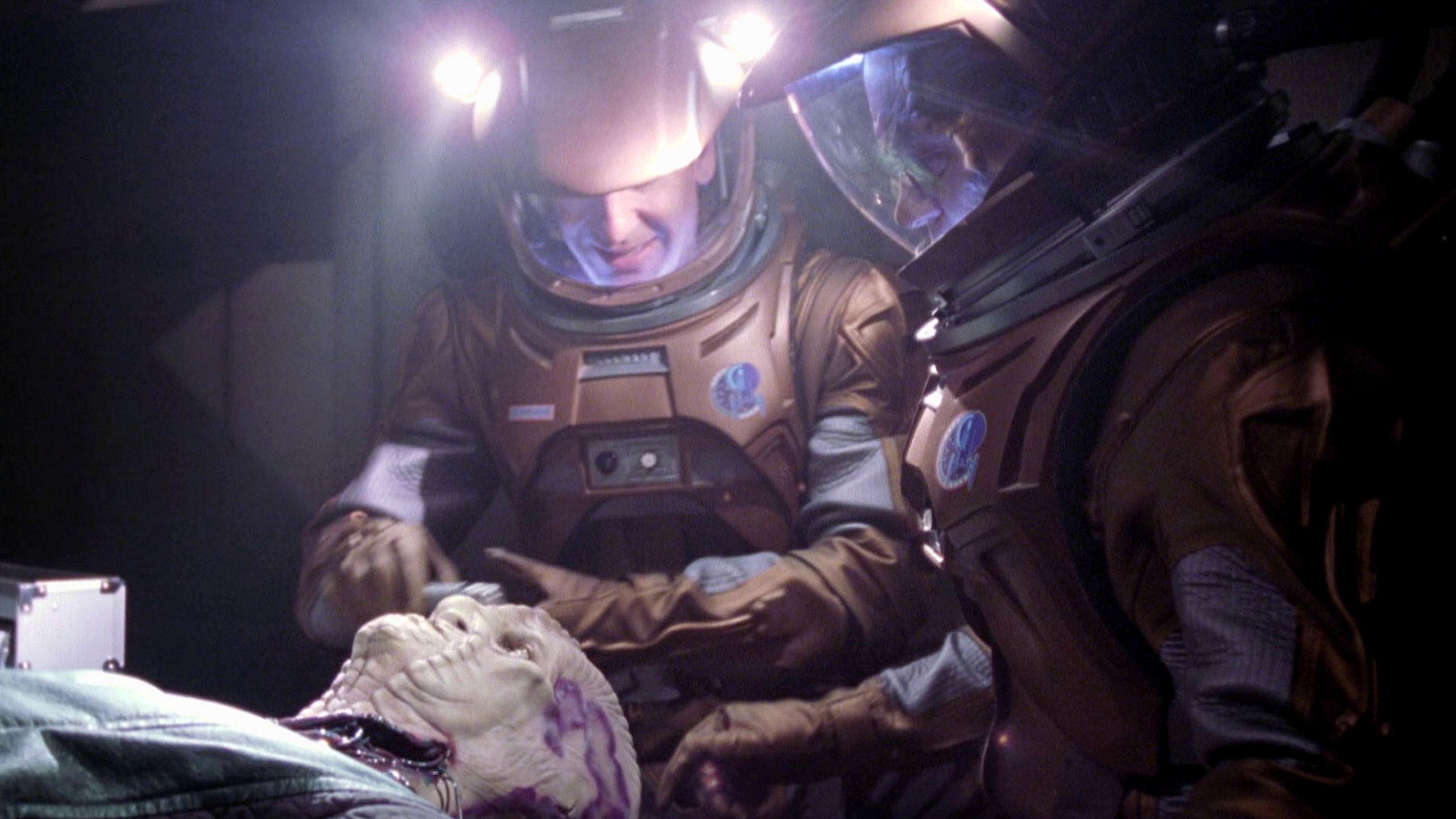
May 6th, 2151: The crew is growing bored after two weeks without encountering any intelligent life. Hoshi Sato is concerned about an alien slug they picked up on a planet, which is not doing well in its new environment. Malcolm Reed uses the downtime to work on calibrating the targeting scanners for the ship's spatial torpedoes, but without success. The sensors then detect an alien vessel adrift in space. When hails go unanswered, Archer decides to investigate despite T'Pol's objections. He, Reed and Sato take a shuttlepod to the ship and discover its crew dead, their bodies connected to a network of strange pumps. Since there is nothing they can do for the victims, Archer follows T'Pol's advice and resumes the original course. Meanwhile, Hoshi begins to doubt whether she is suited for the hardships of space exploration and considers resigning from Starfleet. As Enterprise gets underway again, Archer changes his mind. He feels he owes it to the dead crew to find out who they were and who killed them. Enterprise reverses course, and Archer returns to the alien vessel, this time accompanied by Phlox, Tucker and Sato. Phlox determines that the crew were murdered for the triglobulin extracted from their bodies. Hoshi manages to decipher the basics of the aliens' language and sends out a distress call. Shortly afterward, the unknown attackers return aboard a massive ship. The shuttlepod barely makes it back into Enterprise's launch bay before the enemy opens fire, disabling the warp drive. It soon becomes clear that the attackers have identified Enterprise as their next source of victims. Reed's torpedoes prove ineffective against the larger vessel. A second ship arrives, one with a configuration similar to that of the derelict vessel and evidently responding to Hoshi's distress call. Its captain initially misunderstands the translation matrix, prompting Archer to ask Hoshi to speak directly with him, despite her limited knowledge of the language. She eventually succeeds in communicating the situation, and the alien captain attacks and destroys the hostile ship. Together with the friendly aliens, the Axanar, the Enterprise crew recovers the bodies of the victims. Phlox and Hoshi also manage to find a new home for "Sluggo".
Review
When they announced the series in 2001, Berman and Braga promised that Enterprise would show us the dawn of space exploration, a "developmental stage" in Starfleet history. If that was the goal, they had to reconsider the formulas of Voyager and approach familiar story concepts differently. "Fight or Flight" accomplishes this clearly better than most episodes of the series. It presents the crew as inexperienced and uncertain. They make mistakes and second-guess themselves. They also can't rely on the advanced technology of the TNG era. The concept works remarkably well here. In a sense, "Fight or Flight" justifies the very existence of the series. If you are going to make a prequel, it should feel different from what came before. Nobody needs stories that are merely recycled from Voyager. Unfortunately, a number of those would still follow in the first two seasons.
Where "Broken Bow" took the human-Vulcan conflict too far, however, "Fight or Flight" emphasizes human weakness and uncertainty too much. Reed's late reaction when the torpedo he fired is looping back toward his own ship is still amusing, but it also makes him look rather incompetent. Archer becomes increasingly agitated after leaving the alien corpses behind and begins to direct his frustration at T'Pol and Tucker for circumstances they cannot possibly change. I understand his motivation. He feels guilty about abandoning the victims, wants to do the right thing and needs some sort of confirmation. Still, there is a fine line between leadership and pressuring others into agreeing with him. On the other hand, this leads to one of the episode's strongest moments, quite literally a turning point, when Archer orders Enterprise to reverse course. He commits himself to a course of action that will define his command style and, in many ways, the future philosophy of Starfleet.
Then there is Hoshi. On the one hand, she is terrified by the sight of the corpses hanging from the ceiling of the alien vessel. On the other hand, she generally doubts her ability to cope with the hardships of deep-space exploration and is uncomfortable wearing a spacesuit. I already mentioned in my review of "Broken Bow" that Hoshi feels particularly human because of her vulnerabilities. In "Fight or Flight", however, the accumulation of insecurities is almost excessive. By the end of the episode she gains confidence after establishing communication with the Axanar, something neither Enterprise's technology nor anyone else aboard could have accomplished. Yet this achievement concerns linguistics, which is her core competence anyway. It doesn't suddenly make her less fearful of danger or the unfamiliar environment of deep space. Her development is believable, but perhaps a little too fast.
Nevertheless, "Fight or Flight" is an uplifting and heartening episode. It demonstrates the values that make Star Trek special, just because the characters have not fully embraced them yet. Hoshi experiences meaningful growth. Archer makes an important decision, one that eventually becomes part of Starfleet's philosophy - "we care". The episode also depicts the first successful contact with an alien species under difficult circumstances. I wouldn't have minded learning a little more about the Axanar, but leaving the rest to our imagination is acceptable.
As an early episode, "Fight or Flight" benefits greatly from the fact that the "space rookies" premise is still fresh and used to its fullest advantage. At the same time, it becomes clear that the series cannot rely on this forever. The crew must gradually gain confidence, experience and routine. Once again there are numerous horror elements, and once again they work reasonably well because they serve the story rather than merely to frighten the audience. Even so, Enterprise should not have continued down that path. Too often, horror would be used as a substitute for meaningful story development. So "Fight or Flight" is an excellent example of how to use the basic premise of the series effectively, but it should not be overrated as a template for the show.
One aspect I particularly like is the fact that Enterprise spends two weeks without encountering any intelligent life. Admittedly, this raises the question how thats fit with the claim in "Broken Bow" that Qo'noS is only four days away. And Rigel X even less. Still, when I first watched "Fight or Flight", I appreciated the implication that space is vast and sparsely populated. I thought the series might maintain a degree of realism by not encountering an inhabited planet every week. Reality turned out somewhat differently. At least, gross violations such as instantaneous interstellar travel will remain rare.
The episode also features several pieces of technology that feel refreshingly realistic. There is the docking arm that physically pulls the shuttlepod into the launch bay, the well-designed environmental suits, and above all the difficulty of opening the hatch on the alien vessel. Earlier Star Trek series generally assumed that docking ports throughout the galaxy were somehow standardized and universally compatible.
Annotations
- Nitpicking:
- To enable Reed's target practice, Archer orders to drop out of warp and find something to blow up. He does that out of the blue, apparently without knowing whether there is actually a nearby asteroid field the ship could reach on impulse.
- When the torpedoes hit the alien ship without effect, why doesn't Reed try the beam weapons?
- Remarkable quotes:
- "We've been out here for two weeks and the only first contact we've made is with a dying worm." (Tucker)
- "My people don't share your enthusiasm for exploration." (T'Pol)
- If I'm not mistaken, they are preparing to mate. Do you think they might let me watch? (Phlox, about two crew members, to Tucker)
- Remarkable species: The Axanar are androgynous and live for 400 years.
- Remarkable fact: According to T'Pol, only one out of 43,000 planets supports intelligent life.
Rating: 7
Strange New World
Synopsis

Date not given: Enterprise arrives at a beautiful Earth-like planet covered with lush vegetation. T'Pol recommends following standard procedures and conducting a probe survey before anyone lands on the surface. Archer, however, decides to lead an away team personally. Accompanied by T'Pol, Tucker, Mayweather, Cutler, Novakovich and Porthos, he lands on the planet to begin the exploration. After Archer and Porthos return to Enterprise aboard the shuttle, the rest of the team remains on the surface overnight. When a storm forces them to seek shelter in a cave, strange things begin to happen. The crew members start seeing people, creatures and even moving rocks. Novakovich becomes so terrified that he flees the cave and disappears, leaving the others unable to locate him. Meanwhile, Archer attempts unsuccessfully to land the shuttlepod through the worsening storm. Eventually, Novakovich is beamed back to Enterprise, but a malfunction causes plant material to become embedded in his skin. Fortunately, Phlox is able to treat the physical injuries. He also determines that Novakovich's hallucinations were caused by tropolisine, a psychotropic compound naturally present on the planet, and initially concludes that the effects will wear off within a few hours. What Phlox fails to realize is that the compound breaks down into a toxic substance. As Novakovich's condition rapidly deteriorates, Phlox works to develop a cure based on inaprovaline injections. Time is running out to save the landing party, not only because of the poisoning but also because the situation escalates. Convinced that T'Pol is conspiring with alien lifeforms on the planet, Tucker pulls a phase pistol on her. In a desperate attempt to defuse the situation, Archer pretends that Tucker's delusion is true. He claims that the mission is a classified operation to establish contact with a silicon-based lifeform known only to T'Pol, but insists that Tucker must lower his weapon so she can communicate with the "rock people". The ruse works. As soon as Tucker lowers his guard, T'Pol stuns him. She then retrieves the antidote that has been beamed down and administers it to the affected crew members, saving their lives. Novakovich eventually recovers as well.
Review
"Strange New World" has a promising start. Enterprise arrives in orbit of a beautiful planet, the eponymous strange new world. It feels as if the episode could continue along the lines of "Fight or Flight", exploring the unknown through the eyes of an inexperienced crew equipped with comparatively primitive technology. At this point, I don't even mind another argument between Archer and T'Pol. She, of course, wants to follow protocol and conduct a survey with probes. He, of course, wants to take a shuttlepod down and be the first one to set foot on the planet. Well, Porthos will beat him to it. The setup is engaging, and for a while we are left wondering what surprising discoveries await the crew and how they will deal with them.
After about nine minutes of pleasant anticipation and lighthearted banter, however, we get a taste of the direction the story will actually take. Around a campfire, Mayweather shares a ghost story. And really, though unrelated and harmless in itself, this sets the tone for what will follow: a violent storm, a creepy cave and eventually unsettling hallucinations - ghosts. The crew begin seeing all sorts of apparitions, from people to mysterious rock creatures. The explanation is alien pollen. Unfortunately, the effects don't stop here. The affected crew members also lose their grip on reality. Novakovich flees in terror. Tucker completely freaks out and spends the rest of the episode threatening T'Pol with a phase pistol. Meanwhile, T'Pol, much like Spock in the days of TOS, remains largely immune and ultimately saves the day. The logic behind it is sound enough, but do we really need to revisit these old stereotypes once again?
There is remarkably little that stays with me after the episode is over. Tucker pointing a weapon at T'Pol for like half of the time is more exasperating than suspenseful. There is almost no character development because none of the affected crew members are acting of their own free will. Or are they? Tucker's resentment toward the Vulcans resurfaces vehemently once the hallucinations take hold. One could argue that the psychotropic compound only reinforces a sentiment that is already in him. Perhaps he secretly wants to harm the Vulcan who keeps patronizing him? But does it really matter? Hallucinations and paranoia of real-life patients don't make sense, and stories built around them often suffer from the same problem. I don't dislike the concept in principle. There are excellent stories about delusions in Star Trek. TNG: "Frame of Mind" remains one of the franchise's most effective explorations of a character questioning his own sanity. "Strange New World", by contrast, is more about exploiting the situation for easy thrills than about examining the characters themselves. It's an example of how not to approach this type of story.
Speaking of exploitation, the horror elements are technically well executed. The eerie creatures and the moving rocks look convincing. The problem is that they feel largely unmotivated within the narrative. They are exactly the sort of thing I mentioned in last week's review: horror effects and jump scares used as a substitute for genuine story development. Instead of learning something interesting about the planet, the crew or the larger setting, we spend much of the episode watching people lose their minds in increasingly dramatic ways.
One redeeming quality of "Strange New World" is that it is the first episode to involve crew members other than the lead officers. Cutler and Novakovich get quite a bit of screen time. For a while, I was concerned that Novakovich would become the series' first redshirt, dying solely to demonstrate how dangerous the planet is for the main characters. Fortunately, the story avoids at least this one cliché.
Annotations
- Continuity: In his attempt to appease Tucker, Archer says: "Starfleet sent us here to make contact with a silicon-based lifeform." Over 100 years later, the very concept of the silicon-based Horta will be unknown in TOS: "Devil in the Dark". How can Archer make up such a lifeform if none is known yet? Well, rather than being a visionary, he may simply have read about theories that such lifeforms may exist.
- Nitpicking:
- It is irresponsible to leave the survey team behind on the planet without a means to be evacuated fast when needed.
- Phlox explains Novakovich's toxication with "a stray neutron", as if he were a physicist and not a physician. He also says the stray neutron can be found in each "tropolisine atom", which makes no sense at all because it is a complex compound composed of many different atoms.
- Remarkable quotes:
- "Where No Dog Has Gone Before." (Tucker's comment after Porthos is the first survey team member to leave the shuttle)
- "Challenge your preconceptions or they'll challenge you." (advice from Mr. Velik, Tucker's Vulcan teacher)
- Remarkable facts:
- Ensign Cutler's special field of expertise is entomology.
- The sky on Vulcan is occasionally blue, according to T'Pol.
- T'Pol has been to 36 Minshara-class planets before. Minshara is a Vulcan designation unknown to humans at this time - and a nice homage to what will be known as Class M.
- Inaprovaline is already in use as a multipurpose medicine.
- Enterprise has a crew complement of 82.
Rating: 3
Unexpected
Synopsis

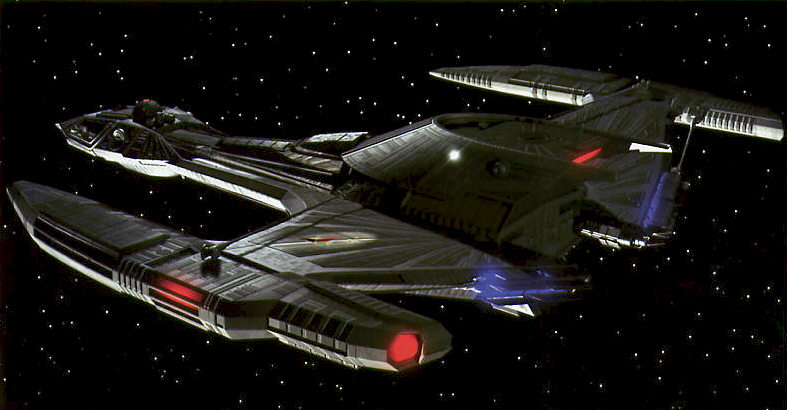
Date not given: The reason for several system malfunctions turns out to be a cloaked Xyrillian vessel with power problems taking a ride in Enterprise's warp field. Trip Tucker transfers to the Xyrillians to help them with repairs, and he befriends the female engineer Ah'Len. After the Xyrillian ship has left, a nipple begins to grow on his arm. Dr. Phlox's surprising diagnosis is that Trip is pregnant. Enterprise discovers the Xyrillian ship, which is now on the tail of a Klingon battlecruiser. The Klingon captain wants to kill the apparent parasites, but Archer and T'Pol manage to convince him to let the Xyrillians go in exchange for their holotechnology. Trip's child is implanted into a Xyrillian male host.
Review
So "this is the first incident of a human male getting pregnant", according to T'Pol, if we do not count Arnold Schwarzenegger in "Junior". The episode could have turned out really silly, but fortunately the humor in "Unexpected" is subtle rather than slapstick. When Trip is astonished to learn about the pregnancy, when he suffers from mood swings, and when he shows his embarrassing condition to the Klingons, it can still be taken seriously. Who would have thought Tucker to have a "brooding mother" aspect to his character? What I like too is that Tucker is anxious about the decompression phase and the unusual atmosphere on the Xyrillian ship. He is probably nervous about meeting the aliens too. Here Enterprise proves itself different from Voyager once again: There is no intrepid Harry (no pun intended!) as in VOY: "Nightingale", to save the day without breaking into a sweat. As with every episode so far, however, there were a couple of scary effects, such as when Trip was exposed to the Xyrillian atmosphere. I think we've had more than enough of that for now. What this episode showed very clearly is that T'Pol is a real bitch. Instead of trying to find out what really happened or even comforting him, she is full of preconceptions about human behavior in general and, in particular, Trip's alleged affair on the Xyrillian ship. For once, though, her attitude is a really nice contribution to the story.
The interior of the "ship of the week" (Xyrillian) is really alien in every respect, for once. I especially enjoyed the idea of food growing all over the seemingly organic ship. It doesn't suit the series that its exterior is very much like the Species 8472 bioship, though. For such a small vessel I would expect a more compact shape, bioship or not. I only wonder how Trip can be of any help to them, considering how different the Xyrillian technology is. And why is Trip going to their ship all alone, when this is the first time Starfleet encounters these aliens? Talk about trusting behavior! And if their atmosphere needs a long and painful adaptation, why doesn't he simply take a spacesuit along? Why, why, WHY?
Annotations
- Continuity & nitpicking: Although the episode is overall pleasant, two seemingly unimportant details leave a bad taste.
- First of all, we see a fully functional holodeck on the Xyrillian ship. Only the creation of interactive characters is not possible, but I see this as a rather small step until the functions will be the same as we know from TNG. This holotechnology may be okay if it remains a secret of the Xyrillians, a race we won't see again (which in this case may be explained by the fact that their ships are cloaked). There is, however, absolutely no way that the Klingons should get their hands on holotechnology as early as in the 22nd century, while the Federation will need no less than 213 years until the first lifelike holodeck will be installed aboard the Enterprise-D. Remember how excited Riker was about it in "Encounter at Farpoint"? Or Picard in "The Big Goodbye"? Or Lwaxana in "Manhunt"? It is even more implausible considering that we have never seen a holodeck on a Klingon ship even in the 24th century. We may make up excuses in that it was just a personal enjoyment of the Klingon captain that was never commonly accepted by the Klingons, or that his ship was destroyed and the holotechnology with it. But why should we try to excuse the carelessness of the producers who couldn't wait longer than four episodes to show us the most typical of all 24th century devices, woefully inappropriate within their self-imposed series premise? What bothered me too is that the Xyrillians had no problem adapting the device to the Klingon power grid, something that was always made out to be a big problem in, say, Voyager. So the impression is that their holodeck technology is even more advanced than the Federation's of the 24th century.
- The other nuisance is the K't'inga-class battlecruiser, a design whose lifetime is now at least 225 years! The argument that Klingons are warriors and not engineers is a cheap excuse in my view. Warriors frequently need new weapons. Even the good old bat'leth may have been improved several times using new alloys, and the same should apply to ship hulls. The Klingons are not Hirogen, they want to win a battle and do not care much for the thrill of fighting a superior enemy with traditional hunting rituals. They are eager to get the new holotechnology, as they will also quickly adopt cloaking devices over 100 years later, but their ships always stay the same? There's also the fact that Klingons are waging war all the time. They frequently need to replace ships, far more often than an organization dedicated to peaceful exploration. No one can tell me the Klingons wouldn't come up with new designs, if they need new ships anyway. Also, in TOS the Klingons were clearly on the same technological level as the Federation, which makes a lot of sense since it was supposed to reflect the Cold War in the real world. At that time, the Soviets and the Americans kept the balance of power by developing new horrible weapons and countermeasures almost in parallel. It doesn't seem that the Klingons were very busy developing anything new from 2151 to the end of the Cold War, if they are still using their old rust buckets from the distant past. Finally, in DS9: "Once More Unto the Breach" Kor mentions the old D5 cruiser. Since the TOS cruiser and the K't'inga are different ships but share the designation D7 (VOY: "Prophecy"), what in the world could a D5 be, if not a really different looking (older) ship? [Note: We now know, however, that the inclusion of the K't'inga was due to a lack of production time, and that a new ship design had indeed been postulated. For posterity, the rest of the review shall reflect the view state of knowledge of 2001.]
- Remarkable quote: "Three days. You were there only three days and you couldn't restrain yourself." (T'Pol)
- Remarkable scene: The episode teaser where gravity fails in Archer's shower is just too cute.
- Remarkable facts:
- Archer's quarters are on E-deck.
- Trip Tucker entered Starfleet 12 years ago. He has known Archer for eight years, and, four years ago, Archer saved his life. The latter could refer to the training in spacesuits mentioned in "Strange New World".
Rating: 6
Terra Nova
Synopsis
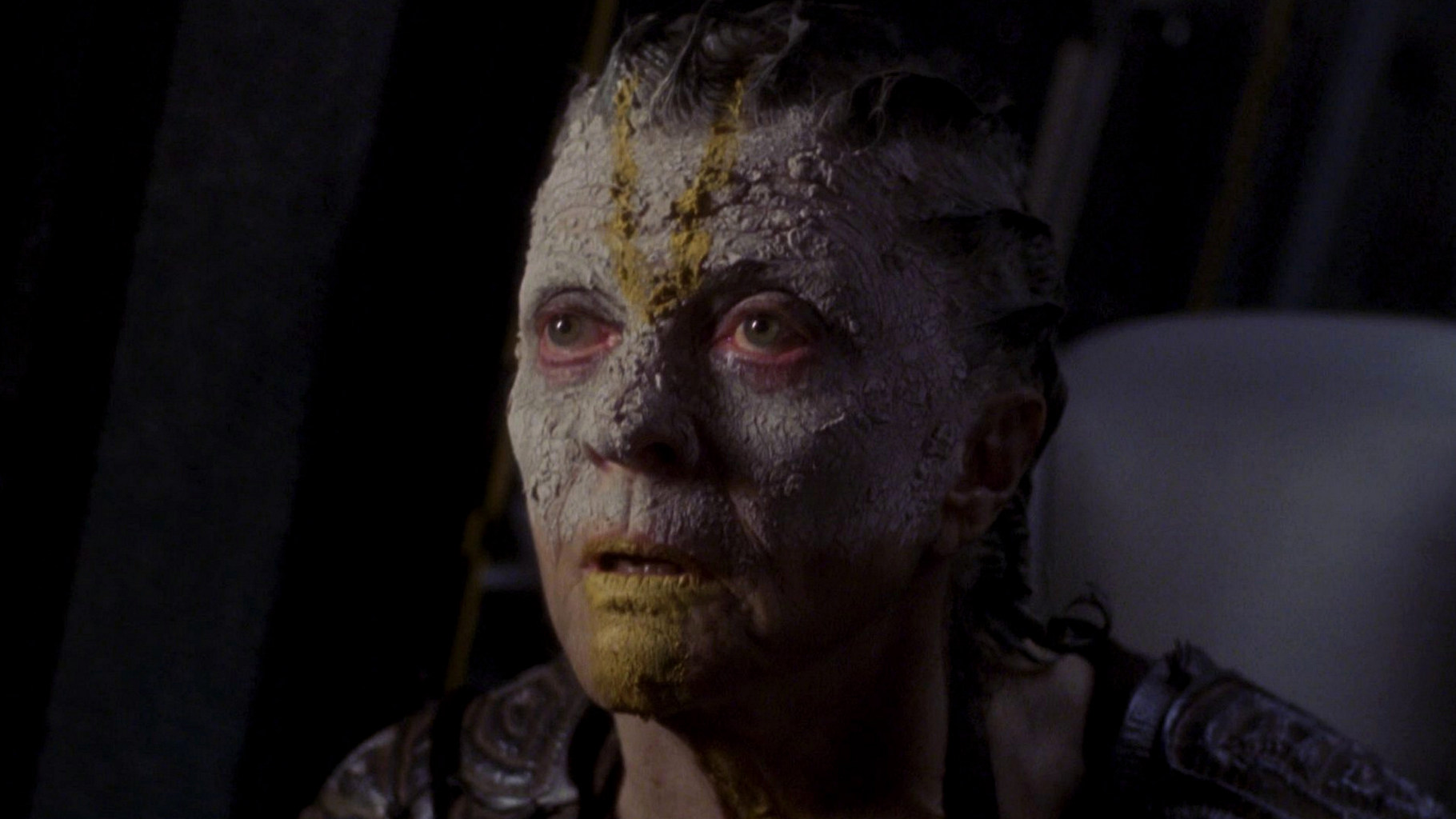
Date not given: Enterprise arrives at the site of the first extrasolar human colony with which contact was lost 70 years ago. The seemingly indigenous "Novans" are found living in caves, but they are actually humans who have forgotten about their origin over two generations after an asteroid had hit the planet and released lethal radiation. They take Reed as hostage and refuse to believe that they are actually the descendants of the colonists. Phlox treats one of them, an old woman called Nadet, against lung cancer, and she can be convinced that she is actually Bernadette, the daughter of a settler family. The Novans agree to release Reed and allow themselves to be relocated to a region of the planet that is not affected by the radiation.
Review
This is the second - and perhaps worse - disappointment of the series so far, as it has even less original ideas than "Strange New World". As previous reviews (from colleagues who were lucky to view it directly) have already pointed out, "Terra Nova" is very reminiscent of VOY: "Friendship One", only that this time the victims are human, rather than aliens. I would like to add TOS: "This Side of Paradise" as well as TNG: "The Ensigns of Command" to the list, as they both deal with forgotten Earth colonies that were affected by radiation and whose inhabitants somehow managed to adapt. If we count all "re-discovered colony that is in trouble or needs to be relocated" plots, we end up with about a dozen episodes based on pretty much the same idea. To be fair, though, Enterprise is just the right series to showcase a plot like this, but the idea is so exhausted that it would be better off without it. Hopefully it will be the last time we see such a story.
I didn't care very much for the "underside" Novans. They could easily have been just another set of "aliens of the week". I never expected a tearful reunion with humanity, but the level to which their problem was shown didn't strike me as very profound. Only Archer and T'Pol's discussion about how to help them was interesting in this respect. I don't quite understand how they suddenly seemed to switch sides in the course of their talk. First Archer is reluctant to relocate them by force as suggested by T'Pol. Then again, T'Pol has doubts about taking them to Earth, whereas Archer wants to bring them back at any cost, since it's their birth right as human beings. What I liked least about the episode was the completely unnecessary plot twist with the shuttle crash (we had enough of them on Voyager) and the rescue of the Novan who had fallen into the pit. This contributed hardly anything to the episode. I mean, what is this? "Lassie"? And how in the world could they salvage the shuttle from a depth of eight meters? This question remains unanswered, just like we weren't shown how Reed was freed and how the Novans were relocated. The episode ended abruptly with the usual captain's dinner and a few insignificant lines by Mayweather.
Annotations
- Technical stuff & continuity:
- It was a shock to hear that Enterprise has no more than two shuttles. As a starship without a transporter as a regular means of transportation, Enterprise would have to rely heavily on the shuttle pods, each of which can transport only six persons. And what about the cargo? I doubt that they would beam large amounts of food supplies. So what happens if one shuttle is defunct and the other one is on the way?
- I anticipated that the phase pistol would have more than just the stun and kill setting, as opposed to what Archer said in "Broken Bow". Here it is used for cutting with a continuous beam. This alone is no error (after all, something like that would be even possible with a present-day laser), but I wonder in how far the phase pistol differs from a latter era phaser. Visually, there is no difference at all.
- A particularly troubling continuity error is that Terra Nova should be the only inhabitable planet within 20ly from Earth. This contradicts the idea that there is one in the Alpha Centauri system (4ly away), as mentioned a few times as a Federation planet (either a human colony or an alien civilization). There may be two possible explanations: Either Alpha Centauri was already known to the humans as the home of an alien civilization, and therefore it wasn't taken into account, or it was made inhabitable or terraformed later. In the latter case, however, it is unlikely that Zefram Cochrane ever lived there.
- Another strange thing is how the children of the Novans could inherit the obvious radiation poisoning from their parents (like Nadet). I would expect them to become like that after hundreds of years, but certainly not after two generations.
- Finally, there is a nitpicky error with the radiation which T'Pol gives as "800 millirad"; however the unit rad refers to a time-dependent dose and not an intensity, so it makes no sense at all. You'd think a Vulcan could speak science, surely.
- Remarkable language: The Novans use some really strange terms (very reminiscent of the Vori in VOY: "Nemesis"), such as "before families" = ancestors, "skyship", "overside" = surface, "underside" = underground, "belly hollow" = hungry, "rotting" = dying, "shale" = lie.
- Remarkable dialogue: "Terra Nova?" - "I'm surprised you've never heard of it." - "I'm not familiar with the early years of human space exploration." - "Really? Every school kid on Earth had to learn about the famous Vulcan expeditions." - "Name one." - "... ... History was never my best subject." (T'Pol, Archer, Tucker)
- Remarkable facts:
- The most important thing we learn here is that Phlox is a Denobulan.
- Terra Nova is the only inhabitable planet within a range of 20ly from Earth. The journey of the colony ship, the Conestoga, took 9 years. It was disassembled to form the foundation of the colony. After the first five years, contact was lost with the settlers. The reason is that an asteroid hit the planet and the dust cloud made communication impossible. Only the children survived the disaster and retreated to the caverns. That was 70 years ago.
- Remarkable ship: The Conestoga fits well into the design lineage, and it resembles the conjectural S.S. Valiant as depicted in the Star Trek Encyclopedia I.
Rating: 2
The Andorian Incident
Synopsis
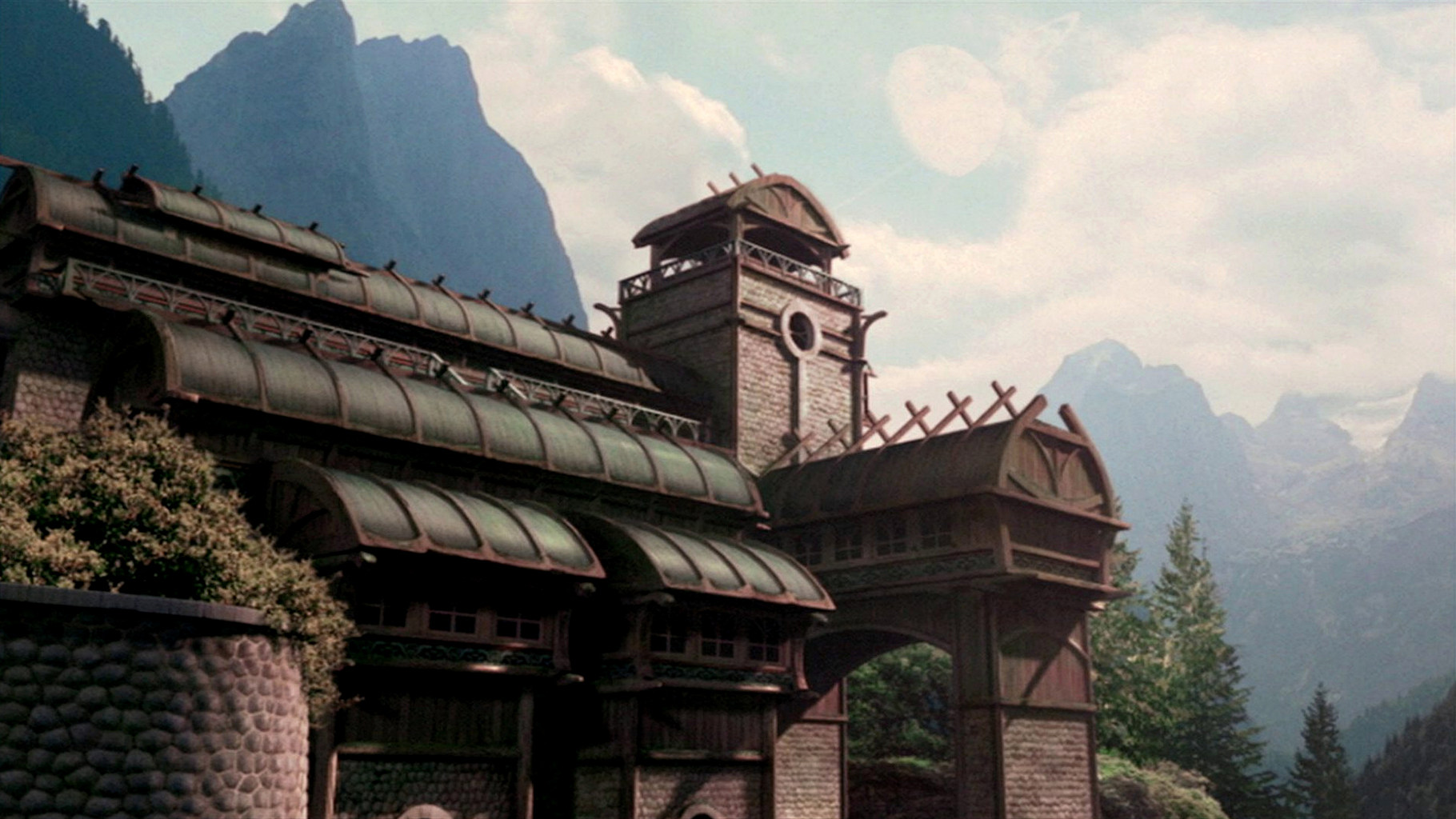
Date not given: Archer, T'Pol and Tucker are taken hostages by violent Andorians, who have occupied the ancient Vulcan monastery of P'Jem. Their leader, Shran, claims that the Vulcans are spying on Andoria from there. When the Vulcan monks refuse to defend themselves, Tucker contacts the ship through an old Vulcan transmitter, and Reed beams down with a landing party. The Andorians retreat to the catacombs, where Archer discovers a gate to a modern outpost of the Vulcans. He allows the Andorians to leave with this information.
Review
The episode title is far more suspenseful than the episode itself. Peaceful Vulcans and curious humans are taken hostage by violent Andorians. So far, so boring:, a conventional plot that would suit a mediocre crime TV series, rather than Star Trek. Half of air time is dedicated to fighting; it gets exceptionally cruel when Archer is beaten up by the Andorians three - yes, three - times. There are no intelligent plot twists, hardly any good dialogues, and despite the simplicity of the situation it doesn't really make much sense at all. Why, for instance, does Reed have to beam down and blow up half of the monastery rather than simply having the four Andorians beamed up, to takle them into custody? No need to mention that I'm a bit tired of dim lighting, people running around in caves and spooky effects.
Not even the fact that the culture and the mutual relationship of two races from the TOS Universe are explored can make the episode any more interesting. On the contrary, anyone who expected some profound insight into, and careful development of, the Andorians and Vulcans, or even tidbits for TOS fans, is left utterly disappointed after "The Andorian Incident". The way the Andorians and Vulcans are portrayed here is simply alienating (no pun intended, although it would have been great if it was). First of all, we have to keep in mind that only ten years later they would found the Federation together with humanity: something that seems very unlikely from what we see of them in the Enterprise Universe. Yet, the episode may not be all that detrimental to the Andorians - all we knew about these aliens was that they were blue-skinned and somewhat volatile - which they proved perfectly here. Jeffrey Combs as Shran, unlike in his previous roles on Star Trek, isn't offered a lot of potential here, considering that all he had to do was demonstrate the Andorian method of interrogation. Only his remark at the end: "We're in your debt", indicates that his character and the Andorian race in general will be further developed. There is hope.
The turning point of the story - when the gate to the Vulcan spy station is discovered - was probably meant to give the whole dumb shooting and fighting a more profound background and allow follow-up episodes in the tradition of the DS9 story arcs (The Dominion War, etc.). But from what I have seen here, I'm definitely not looking forward to more stories about two paranoid races struggling against each other. These are simply not the Vulcans I used to know. I would rather forget the last few minutes when their secret is discovered. I'm not saying that everything about Vulcans should be likable, but the way they are gradually being defamed since the seventh season of DS9 is obnoxious. Paranoid, xenophobic and dishonest people who misuse an alleged religious sanctuary to hide a spy outpost, like a villain in a James Bond movie? This episode takes it too far. This twist, that was supposed to make the episode more interesting, eventually completely ruined it. The worrying thing is that we can't simply forget about this episode, as was possible with "Strange New World" where nothing important happened anyway.
Captain Archer's behavior is irritating too. He hardly knows anything about the Vulcan-Andorian cultural relationship, and much less about the actual purpose of the Vulcan outpost. The Vulcans may keep unpleasant secrets, but they are Earth's only ally, and Archer is completely jeopardizing that. I simply cannot buy that his main intention was to reveal the truth for the sake of honesty, as Picard did it in a very similar situation in TNG: "The Pegasus". Archer never saw the Vulcans as friends (he also didn't try to defend them in his interrogation). In his opinion Andoria and Earth are suffering from the same problem, dominated and spied on by the Vulcans. Now he sees an opportunity to show the Vulcans their limits or even take revenge.
Annotations
- Nitpicking and continuity:
- If the Vulcans and Andorians are supposed to live in neighboring star systems, how and why would the Vulcans use a sensor array on a remote planet to spy on them?
- Also, why doesn't anyone of the human Enterprise crew know anything about the Andorians who are neighbors and rivals of the Vulcans, although Reed and Sato are shown to have permanent access to the Vulcan database?
- Finally, I knew this would come. The "transporting device" isn't only as fast as 200 years later, it can also transport at least three persons at once. Let's wait and see how many more will fit on the platform...
- Remarkable quote: "So if anyone has any suggestions, I'm all ears. No offense." (Archer, to the Vulcans)
- Remarkable make-up: The new Andorian make-up looks great. It is a careful improvement of what we have seen in TOS, and the moving antennae are a fabulous idea. Only the forehead ridges are completely unnecessary.
- Remarkable building: The Vulcan monastery is actually the first Vulcan building we see in 35 years of live action Star Trek.
- Remarkable facts:
- "Pinkskins" is what the Andorians call the humans at times.
- The Andorians group call themselves the "Andorian Imperial Guard".
- T'Pol calls their homeworld "Andoria", although "Andor" was generally accepted. There may be two different versions, of which Andoria is the Vulcan name.
Rating: 2
Breaking the Ice
Synopsis

Date not given: Reed and Mayweather examine the surface of a large comet that is being observed by a Vulcan ship, theti'Mur. On Enterprise, it is discovered that T'Pol sent an encrypted message to the Vulcans. When he translates it, Tucker is embarrassed to see that it was private. T'Pol has to decide whether to stay on the ship or get married on Vulcan. In the meantime, Reed and Mayweather get into trouble when the comet rotates and its surface heats up because of a nearby star. A rift forms underneath their shuttlepod, and they can only be rescued when Archer asks the Vulcans to pull them out with their tractor beam. T'Pol decides to stay on the ship.
Review
"Breaking the Ice" is, overall, an enjoyable episode with a lot of fun and trivia. The children's drawings are a cute idea. But I bet even T'Pol is not as embarrassed about her somewhat crude portrait as Picard was about "Captain Picard Day". ;-) It is a bit of a distraction from the other events - and yet it is nice to see how the crew answers the children's questions. As opposed to Tucker who calls the question about the ship's toilets a "poop question" (imagine that word in TNG), at least Dr. Phlox seems to have quite a lot of fun telling the children of germs in space. His manner of speech again brings to mind Voyager's Doctor. Reed and Mayweather have their share of fun too when they build a snowman with pointed ears (although I do wonder how they could have done it without melting the snow with their hands), and Reed is happy to be given something to blow up, again. It is, however, a negative point that we see a very similar shuttle accident to the one that occurred in "Terra Nova", but this time it is an important part of the story.
It is also a sort of "collective character-building episode" for Archer, Tucker and T'Pol. I find Archer barely likeable in this episode. While he is, admittedly, in character, I find it hard to believe he could ever have come so far with his defiant attitude. He still takes any opportunity to showcase his animosity toward the Vulcans. His awkward attempts to "impress" (or whatever) the Vulcan captain with his nonchalant and obtrusive talking reminded me of the awful "Guess who's coming to dinner" scene from "Star Trek VI". His only concern seems to be showing the Vulcans that he doesn't need to be patronized even after he has learned that T'Pol's secret messages were anything but spy reports. Archer even hesitates to accept Vulcan help in the end, even though refusing it would mean the loss of two officers. Tucker (yes, the very same Tucker who *loves* the Vulcans) and T'Pol have to remind him that the Vulcans would expect exactly this sort of arrogance from him. On the other hand, I wonder if a Vulcan captain who was in need of human assistance would have lowered himself to ask for it, or accept it if it were offered. This, however, doesn't excuse Archer's behavior, especially taking into consideration his soft spot for everyone but the Vulcans, which even includes the brutal Andorians.
In many regards this episode marks the departure point of Tucker's character from Archer's in terms of their previously shown like-minded opinions (their stances were different only in "Fight or Flight" so far). Trip Tucker is both a more realistic and a more sensitive person here. He feels the need to apologize to T'Pol, although Archer is just as guilty of spying on her, if not more guilty since he is the captain. The fact that T'Pol seeks his advice gives the title "Breaking the Ice" a second meaning. Trip also vouches for accepting the help by the Vulcans, and he is interested in their technology. Although it was quite clear that the help would be accepted, even though Archer was still reluctant, I was glad that in the end he finally broke the ice too when he allowed the Vulcan ship to help.
Annotations
- Science and nitpicking:
- We finally learn how the protein resequencer (for food) and the biomatter resequencer (for waste) work, and it sounds a lot like the replicator in TNG, which also works on a molecular basis. At least the device on Enterprise doesn't seem to be able to handle inorganic materials.
- I also wonder how a comet can have an acceleration of approximately 1g. Its density would have to be enormous for that.
- It is also strange that this should be the largest comet ever encountered by humans. There should be a couple of rocks of this size in the Oort belt at the outer rim of our solar system, that fortunately don't come close to the Sun or the planets.
- The mineral eisilium is unknown to humans, but why have the Vulcans given it a Latin(ized) name?
- Another (minor) problem is why T'Pol is supposed to marry so late. According to the draft of Enterprise she is 65 years old. Spock was in his early 30's in TOS: "Amok Time", and even Tuvok who got married after his first Starfleet career, was under 40. So there must have been many deferments to T'Pol's marriage already.
- Remarkable quote: "Your inexperience and your arrogance are your enemies, not us." (Capt. Vanik)
- Remarkable facts:
- Dr. Phlox is from the star system Denobula Triaxa.
- Trip Tucker had three relationships prior to the episode (not sure if he counts in the one from "Unexpected" ;-)).
- T'Pol's fiancé is named Koss, and he's an architect.
- Remarkable starship facts:
- The Ti'Mur is a Surak-class ship. It has a top speed of Warp 6.5.
- Captain Vanik has been in command of this ship for 15 years. He has been serving in the space program for 76 years altogether.
- Archer has once been to a Vulcan vessel, the Maymora-class ship Yarahla, headed by Captain Tok.
Rating: 5
Civilization
Synopsis

July 31st, 2151: When Enterprise discovers a planet with a pre-industrial culture, neutrino emissions from an antimatter generator don't fit into the image. Archer's away team breaks into the house with the generator, where they meet Riann, who is investigating an illness spreading through the city. Shop owner Garos turns out to be a Malurian, who is mining viridium, ruthlessly taking into account a contamination of the ground water with a toxic lubricant, which is the cause of the illness. When Enterprise is threatened by a superior Malurian ship in orbit, T'Pol has the antimatter generator beamed up directly in front of the enemy ship and destroyed, thereby disabling their shields.
Review
The story would have made an average episode in every Star Trek series so far, and it's not different with Enterprise. Certain similarities to TNG: "Thine Own Self" (the episode where Data inadvertently contaminated a pre-industrial village) are quite obvious, as well as to the many TOS stories of advanced civilizations exploiting a primitive culture. So the basic idea is not original, but at least it is no shameless plot recycling. Anyway, the difference to the familiar stories of this kind could have been more pronounced. In the beginning, we learn that Vulcan has some sort of "Prime Directive" while Earth has none, we see how Hoshi has to analyze the alien language and program the universal translator, we are shown how Dr. Phlox acts as a make-up artist, and we notice the uncertainty of the landing party when they are amidst the native population.
In the following, however, the episode does not live up to its potential. Instead of putting emphasis on technological problems, a cultural clash, ethical questions, everything that always makes Star Trek interesting and could have been in the focus here, it becomes a rather simple detective story with a two-dimensional villain. And even this plot is subordinated to Archer's and Riann's relationship, which doesn't work out as well as it could. The character of Riann does not strike me as very interesting. Her anxiety about and curiosity for the alien technology and her affection to Archer is just not sufficient to make a good story, and besides that her contribution to the plot is rather marginal.
Annotations
- Science & technology stuff:
- How can sensors pick up voices from a planet's surface through the vacuum of space? While such a technology would have been problematic even in the 24th century (although I don't remember a particular occurrence), the "acoustic relays" used on Enterprise are just implausible.
- A technology that I liked in this episode was the transporter. After beaming it up from the surface, it was necessary to materialize the antimatter generator on the transporter platform first before it could be beamed out in space. For once, they have shown a really less advanced device.
- What was interesting too is that the alien look of the crew is seemingly just make-up and not (yet) some sort of plastic surgery. I only wonder why of all crew members Dr. Phlox should be an expert in this field. After all, he is a doctor, not a make-up artist.
- Remarkable quote: "Starfleet could have sent a probe out here, to make maps and take pictures, but they didn't. They sent us - so that we could explore. With our own senses." (Archer)
- Remarkable scene: When the translator fails and Archer hears Riann speak in her native language, he gives her a passionate kiss while trying to fix the translator. Although Riann seems to be pleased, he excuses his behavior. He claims that someone walked by and that he thought it would have been the best disguise to pretend they were a couple. Later, when Archer gives her a good-bye kiss, Riann ironically asks, "Is your translator broken again?" - obviously she is smarter than he thought.
- Remarkable facts:
- The planet is named A'kali and is inhabited by roughly 500 million people. The lack of EM emissions is a clear sign of a pre-industrial culture.
- Garos, on the other hand, is from the Malurian system. This may be the same system in which Nomad will wipe out all life (TOS: "The Changeling") 100 years later. Garos says that he came to A'kali 18 months ago. He appears to know the Tellarites, and it sounds as if Tellarites are involved in his mining project (and that we will see them later in the series). :-)
Rating: 4
Fortunate Son
Synopsis

Date not given: Enterprise assists the Earth freighter Fortunate with repairs after a Nausicaan attack. Matthew Ryan, who is in command after Captain Keene has been hurt, has captured a Nausicaan. He refuses to release his prisoner. After trapping four Enterprise crew members in a jettisoned cargo container, Ryan leaves the scene with the Fortunate, eager to take revenge on the Nausicaans. However, the Fortunate is soon outnumbered by Nausicaan ships. When Enterprise arrives, Archer tries to negotiate that the Fortunate may leave in exchange for the Nausicaan hostage. Eventually, it is "space boomer" Ensign Mayweather who can convince his former colleague Ryan that revenge is not the right way.
Review
I dig this episode. It has a thrilling plot, a strong 22nd century background, lots of eye candy and a great deal of Trek spirit. "Fortunate Son" is the third key episode of the series, and it may be the beginning of another story arc.
The question may occur why there is such a great difference in my ratings between "The Andorian Incident" and "Fortunate Son", both of which were very well received by most other viewers and rank next to "Broken Bow". The first reason is that "Fortunate Son" is much more entertaining, with its many turning points and changing places. It is a sophisticated plot, worthy of a Star Trek series. In contrast, I was simply bored by the static hostage situation in the other episode, which didn't see any advancement until the very end. "Fortunate Son" has its deal of shooting and beating too, but I can much rather accept it here because it has some effect and is not simply used to fill time or to show how evil the villain is. Another reason is that "The Andorian Incident" was about a pointless conflict between two xenophobic and paranoid species, the humans being more enlightened than any of them. I don't want to deny that such an intolerance may exist, but the way it was shown was simply obnoxious. This is completely different in "Fortunate Son" where there is a reason for the aggression that the viewer can relate to. It is an actual controversy for the viewer too, and not a simple finding that neither of two positions is the right one. Archer has to make a decision how to save the Fortunate and at the same time appease the Nausicaans, and so has the viewer. Although the situation is much more pressing here, this time he doesn't precipitate the matter, and he doesn't simply impose his opinion on the viewer, like he did in "The Andorian Incident". What gave me a bad taste of Archer's character there, he can compensate here.
What I like too is the wealth of information in this episode. We learn a great deal about the lives and the attitudes of people that have to stay on their ships for years without shore leave. It is only logical that they would become some sort of closed community, mistrustful and disdainful of outsiders. Travis Mayweather, who grew up on a cargo ship but then decided to join Starfleet, is the obvious exception. It is nice to see more of this underused character, although he has only two important scenes. Travis has a hard time with Ryan, who is an especially unpleasant member of his community. This is in part because he doesn't really want Starfleet's help, after all they could discover his Nausicaan prisoner. But there is more to it. At first, Mayweather and Ryan still understand each other, but then the difference between Starfleet and freighter crew member gradually becomes more and more obvious. Ryan is still impressed with Enterprise's technology, but then they talk about reasons why Travis went to Starfleet that Ryan doesn't understand. In the engine room, he claims that to him Warp 1.8 is more than sufficient, obviously defying Starfleet's rationale for getting a faster warp drive. In the mess hall, finally, Travis inadvertently finds his weak spot when he asks Ryan about his parents, not knowing that they were killed on the North Star, in an accident (or attack?) that appears to be well known. Ryan's reaction is that he accuses him of abandoning his people, and leaves Travis who is very touchy in this respect with a bad conscience. Fortunately Travis is able not only to save the Fortunate's crew but also to return the "favor" by pointing out that Ryan detracts from his people's cause if he is out for revenge.
Annotations
- Science & technology stuff: Now we have the confirmation. FTL communication between the ship and Earth is possible in real time. There is not the slightest delay when Archer and Admiral Forrest talk with each other. I am aware that TNG was very inconsistent about FTL communication speed (which was sometimes real-time and sometimes took hours), but this wouldn't have hindered the Enterprise producers to make at least a little concession to the 22nd century. The way it is, this technology is unnoticeably less advanced than what we know from the 24th century, just like propulsion, phasers and transporters are too.
- Remarkable quote: "They say that, for a split second, you can actually feel yourself at both places at once." (Ryan, about the transporter)
- Remarkable scene: While some children are playing hide-and-seek on the Fortunate, T'Pol finds one girl behind a hatch. When a boy asks her, "Have you seen Nadine?", she replies, "I'm sorry, I don't know which child is named Nadine." She just told him the truth. ;-)
- Remarkable starships:
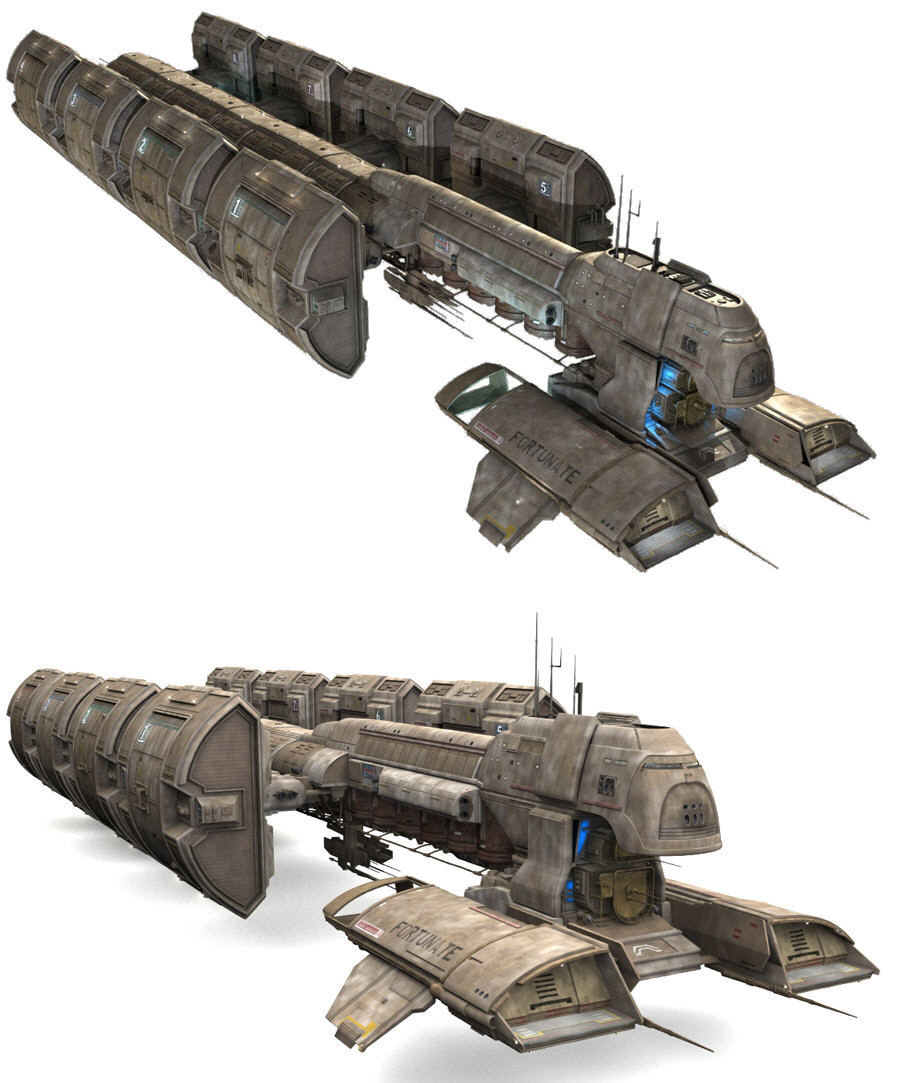
- The ECS Fortunate is a Class-Y freighter with eight cargo modules, a crew of 24 and a maximum speed of Warp 1.8.
- The ship Ensign Mayweather was on, the Horizon, is a smaller Class-J ship. His parents, his sister and her husband are still on the Horizon. Ryan, on the other hand, lost his family on the freighter North Star that was destroyed. It is not revealed if it was an accident, or if the North Star was attacked.
- Remarkable fact: The Nausicaans are back, and they are as unpleasant as TNG: "Tapestry" has shown them. Their home planet is called Nausica.
Rating: 7
Cold Front
Synopsis
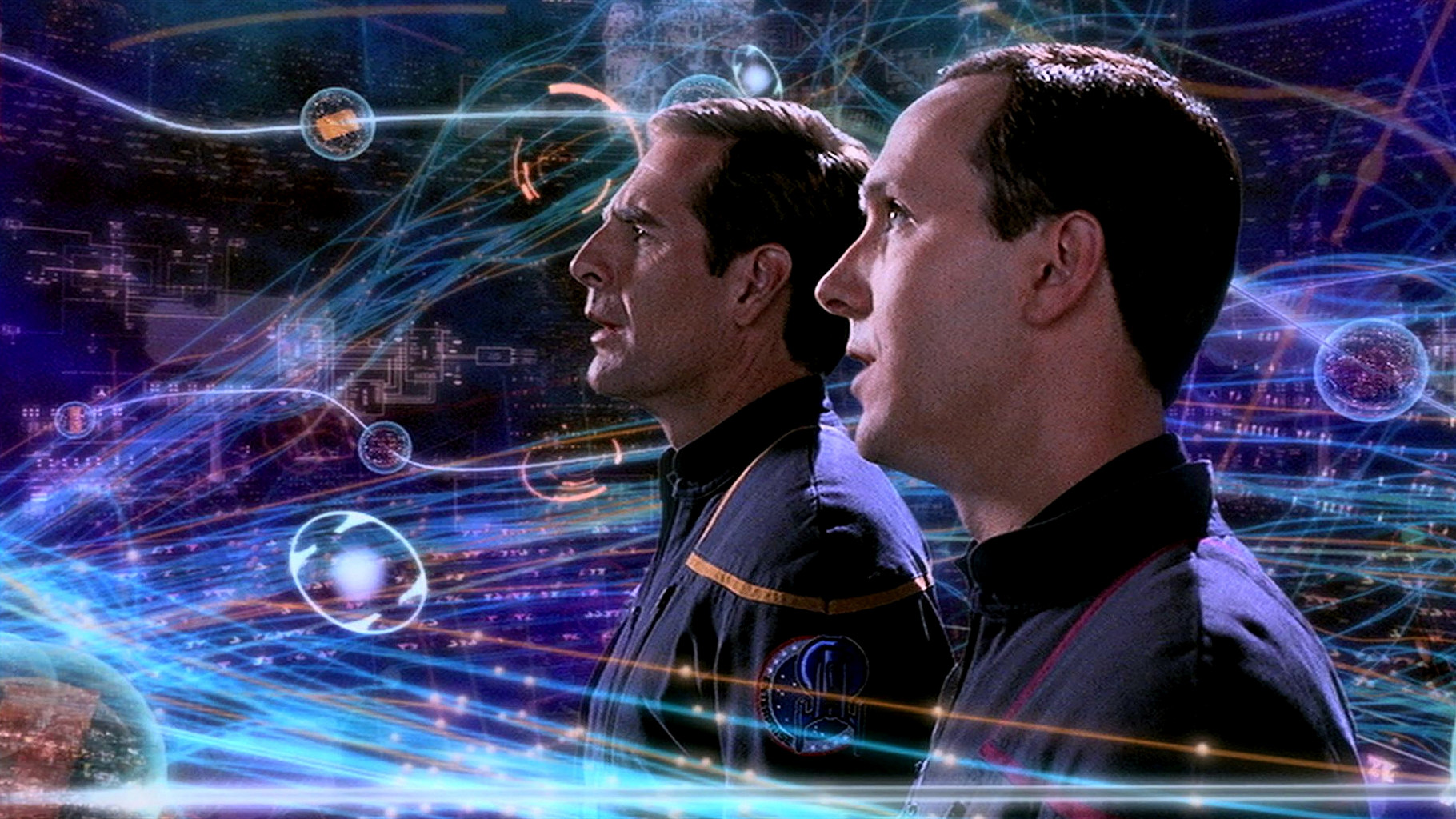
Date not given: Enterprise is visited by a group of pilgrims. They are going to watch a neutron burst from a protostar, which is a spiritual experience to them. Among them is the surgically altered Suliban Silik on a mission to prevent a cascade reaction in the warp reactor that would have otherwise destroyed the ship. To Archer's surprise, Enterprise Crewman Daniels turns out to be a time traveler from the 31st century, and he demands that Silik be stopped. Archer reluctantly agrees. Silik, however, apparently kills Daniels and manages to escape, leaving Archer with the question what he was really going to accomplish.
Review
"Have you learned how it works?" - "Not a chance." Scully and Mulder (aka T'Pol and Archer) obviously refer to the alien clock in the end, but the same perplexity applies to whole "Temporal Cold War" spy story. Archer has no idea who is fighting whom and why, neither has the viewer. We don't know what specifically is Silik's mission and what is Daniels doing on the ship; we can't be sure who of them is really the bad guy this time. Maybe Daniels is not even dead, considering that it doesn't look like he is blown to pieces by Silik's weapon, but rather erased like a hologram (Tucker was sure he was dead, though).
Usually Star Trek episodes have tied together some loose ends when the 45 minutes are over, but it is quite the opposite here. I'm not glad about that. I'm not even able to rate this drama based on criteria like plot advancement and logic, because this doesn't play much of a role (yet) and it would depend on a later episode if all this makes sense at all. The way it is, the characters stumble through an unfinished plot. It is obvious that the Temporal Cold War is a big story arc of the kind we have seen on DS9 for the first and so far last time in Star Trek. But I don't think that this would require open endings like in "Cold Front" and, a bit less pronounced, with another story arc in "The Andorian Incident". Even the DS9 Final Chapter had at least weak episode conclusions, and the episodes were aired in direct sequence. Considering that it will be several weeks until the whole story is continued (not to mention the Christmas break), to me it is like trying to catch up with a book I stopped reading weeks ago. With a book, I can at least be sure that there will be a conclusion.
Rather than the diffuse spy story, a couple of tidbits made the episode interesting. Tucker's talking about the warp core (after he didn't get the opportunity in "Breaking the Ice") was cute, as was Mayweather's careful occupation of the captain's chair and Reed's worries about his armory. What I liked too is how the alien ship docked to lateral docking hatches of Enterprise (well, although the interface was coincidentally compatible here). The scene when the airlock of the shuttlebay was opened was a highlight, although I doubt that Archer would stand a chance against an explosive decompression.
Annotations
- Continuity: It is remarkable that, for the first time in Star Trek, human religions are explicitly mentioned as being still existent. Dr. Phlox says he has been to a Tibetan monastery and that he has attended a mass at St. Peter's Square.
- Treknology: "Gravimetric field displacement manifold" is probably the worst technobabble in a long time, I would have guessed anything but never that it could denote the warp reactor. What does the matter/antimatter reactor have to do with a gravimetric field? The following discussion about the positrons and how they are constrained, on the other hand, was quite fitting.
- Remarkable quote: "Tell the chef to prepare... something." (Archer)
- Remarkable facts:
- Engineering is located on C-deck.
- The Enterprise database has 50,000 movies, among them such masterpieces like "Night of the Killer Androids".
- At the time of this episode, Enterprise has been underway for four months, three weeks and six days.
Rating: 5
Silent Enemy
Synopsis

September 1st, 2151: Archer is worried about his reserved armory officer, who will soon celebrate his birthday, and he assigns Hoshi to find out Reed's favorite food. When Enterprise is attacked and boarded by unidentified aliens, Archer orders the ship to head back to Jupiter Station to have the phase cannons installed. The engineering team around Reed and Archer tries to get the phase cannons online even sooner. In a test shot they inadvertently overload the weapon. When the aliens return and firing at nominal power doesn't help, they reproduce the overload and force the enemy ship to retreat. The captain surprises Reed with his favorite, a pineapple tart.
Review
Watch this episode to learn more about Malcolm Reed than he would ever tell us in his whole life. In fact, everyone save Mayweather has a decent share of screen time and a few nice lines, like never before in this series and long ago in Voyager. It's B-plot and trivia time, whereas the main plot is much like a combination of "Broken Bow", "Fight or Flight" and a bit of "Cold Front" too. It is a déjà vu especially when the aliens crawl through the ship and when their device in the launch bay is found. Moreover, as threatening these aliens-of-the-week are in this episode, as insignificant they will be in the scope of the whole series. Considering that they only contribute to the enemy inflation in the 22nd century, I wonder why the authors didn't simply give the Suliban another appearance for this purpose or the evil aliens from "Fight or Flight", or perhaps the Romulans. I like the typical 22nd century aspects of the "superior hostile alien" theme in "Silent Enemy" though. Like in the three other episodes too, the Enterprise crew don't just pull a Treknological solution out of the hat, but really learn how to operate their ship and their weapons in particular.
The perhaps best scene is when Hoshi talks to Reed about his food preferences in the mess hall, and to him it sounds as if she were asking him out. I somehow knew that it would turn out this way, and this made it even funnier. Although everyone gets something to do this time, the most interesting character development is again conceded to Archer. At the beginning, he is excited as usual to meet another alien race, but this soon turns into the first serious doubts about the mission. He even accepts Vulcan help for the first time. Archer is rather late with that in my opinion. Anyway, when he visits Tucker in engineering, Archer admits that the ship (and maybe the crew too) was not yet ready to go out into space, and that he rushed that. It is obvious that his long-time friend is the only person who he could talk to about that. I just imagine how it would have turned out if he had confided in T'Pol. ;-)
Annotations
- Treknology & Nitpicking:
- The most blatant problem is with the weapon energy, which seems way too high at 500 gigajoules, compared to figures of the 24th century. What's more, the 500 gigajoules are called "*power* output". Some basic physics lessons for the writers should be mandatory! Considering this copious amount of energy (which would be released in at most a few seconds, yielding a power in the 100 gigawatt ballpark), the phase cannons are quite small.
- I like the whole engineering and armory sets very much. In one scene there is a pipe labeled "liquid helium" which is obviously a part of a cooling system, although not explicitly mentioned.
- What I don't like is that, once again, Enterprise encounters a cool and advanced enemy ship. If the vicinity of Earth is so full of superior (potential) enemies, it is a miracle that Earth hasn't been conquered long ago, much less that Earth may become a major player in space within only ten years.
- Finally, there is a minor problem with the crew count. In "Strange New World", it was 82, Daniels left in "Cold Front", but now the crew consists of 81 humans, one Vulcan and one Denobulan (plus one dog). Maybe the figure was supposed to include only the human crew in "Strange New World".
- Remarkable dialogues:
- "Maybe they checked us out and decided we were not very interesting." - "Us - not interesting?" (Mayweather and Reed)
- "This time we won't be leaving before we're ready." - "Are your ears a little pointier than usual?" (Archer and Tucker)
- Remarkable facts:
- The two subspace amplifiers, Echo 1 and Echo 2, are destroyed by the unknown aliens. Enterprise prepares to launch another one, probably closer to Earth, in the end.
- Enterprise is designed to have three phase cannons, two facing forward and one aft.
- Duval, a friend of Archer's and Tucker's, has been promoted to command the Shenandoah.
- Tucker's ex-girlfriend lives in Pensacola.
- Facts about Malcolm Reed: Malcolm's parents currently stay in Kota Baharu, Malaysia. His relatives include a sister, an uncle and two spinster aunts. Grandfather Reed served in the Royal Navy. Malcolm suffers from allergies to dust mites, oak, pollen, tropical grasses and various plant enzymes, including bromelin, as found in pineapples, which happen to be his favorite fruit.
Rating: 6
Dear Doctor
Synopsis

Date not given: A pre-warp vessel with an ill crew is found adrift in space. The Valakians have left their planet in the hope of contacting an advanced civilization that could find a cure against the illness that is spreading on their homeworld. The Enterprise crew is surprised to learn that there is a second humanoid species on the same planet, the Menk, who are not affected by the illness that is actually a genetic defect of the Valakians. Dr. Phlox is about to develop a cure, but he expresses his doubts about interfering with the evolution on this planet that would doom the Valakians to extinction and give the Menk the opportunity to evolve further. Archer finally agrees with him and refuses to cure the Valakians or give them warp technology.
Review
"Dear Doctor" has everything a good Trek episode needs. Especially the A-plot and B-plot are tied together very well. This means a great deal because the ethical dilemma Archer and Phlox are facing goes along with a cultural clash that is nicely represented by the Doctor's and Crewman Cutler's relationship. We have a good deal of character development, in particular we learn a lot about Dr. Phlox and the Denobulans - and, quite surprisingly, a lot about humans too. What I also appreciate, and if only for a change, is the diary-like way of storytelling that reminds me a lot of TNG: "Data's Day" (and which was probably supposed to be just like that). "Dear Doctor" definitely belongs into the "typical 22nd century" category like about half of all Enterprise episodes and it builds a bridge to the time of TNG like no other Enterprise episode before. The whole story would be a pleasure to watch - if only there were logic instead of the swift decision "we are not here to play god", and better science. The more as I think about it, the more annoying it becomes in retrospect.
My first problem is with the obvious insinuation that the Valakian dilemma could be the origin of the Prime Directive. The Prime Directive was always meant to protect civilizations that were little advanced and would have been impaired if they had learned of "gods" who were able to travel at warp speed and other miraculous things (just like the Mintakans in TNG: "Who Watches the Watchers"). In a broader sense, the non-interference would apply to all alien civilizations that didn't seek contact or ask for help, be they warp-capable or not (just like the Malcorians in TNG: "First Contact" and perhaps even the Klingons in TNG: "Redemption"). Neither reason to "protect" the inhabitants from Starfleet's interference applies here. On the contrary, the Valakians have gone into space for the only purpose to contact aliens and ultimately obtain exactly the help that Archer and Phlox deny them in the end. Of all people who have received or will receive help from Starfleet, the Valakians should not be worthy of it only because they are a few decades behind an arbitrary standard? The attitude that Starfleet shouldn't determine the destiny of the planet is extremely hypocritical, and it doesn't even apply here. As the incentive for the familiar Prime Directive the situation of the Valakians just doesn't work out. Well, at times TNG was hypocritical too. I'm thinking of the crew's behavior when they watched in awe how an entire planet died in TNG: "Homeward", only to obey the words of a law, instead of rescuing at least a few of its inhabitants. On the other hand, wouldn't the TNG crew have helped any other civilization, be it warp-capable or just about to develop warp, that asked for help in a crisis, be it man-made or natural?
In "Dear Doctor", the fact that there are two intelligent humanoid races on the same planet obviously serves as an excuse of Archer's and Phlox's attitude: If they wouldn't let one half of the population die, they would deny the other half, namely the Menk, their so-called "natural evolution". Evolution, however, is anything but an automatic, self-sustaining process. I am not an expert in genetics, but I am quite sure that there is nothing like "bad genes" that may be responsible for a species to become extinct, at least not if the population is large enough, which is obviously the case here. We know from Earth's natural history that species become either dominant or extinct because of changes in their environment that they can cope with or not, respectively. The only explanation I may have for the "bad genes" would be that the Valakians tampered with them or unconsciously obtained them through a war with nuclear weapons. The question may occur if Archer might have helped if the Valakians had been responsible for their misery themselves, because then he wouldn't have interfered with a "natural" process - how paradoxical and cynical! There is also no point in stating that it was predestined that another species, namely the Menk, was to become dominant. Actually, no one could have predicted whether the Neandertaler or the Cro Magnon human would survive, even if one had known of the climate changes to come. Ironically, it is stated in the episode itself that the development on the planet and therefore ultimately the evolution would be a matter of coincidences, but even this doesn't change anything about Phlox's opinion that the Menk are supposed to survive while the Valakians are not. Finally, and that's a statement I ran across lately, biologists say that there will probably be no evolution at all since we are dealing with a world-wide population of humans, as opposed to isolated groups and habitats. Special genetic markers that could lay the foundation of evolution would always average out. Well, this would invalidate quite a few other Star Trek episodes too. But overall, the twisted ethics along with bad science ruins this episode.
Phlox is annoying here in several respects. In the B-plot he is obviously playing with Ensign Cutler's feelings. We learn that he is married (with three women and two other men), but he doesn't bother to tell Cutler. On the contrary, he consults Hoshi and T'Pol about it as if he meant it seriously, but actually his only interest is to study human emotions. My feelings were a little bad about that already in the previous episodes, but this time he has gone too far. On the other hand, it's definitely a fitting contribution to the main theme of the episode, "Their culture is different. It's their way." That is how he still defends the Valakians when Hoshi criticizes their treatment of the apparently less intelligent Menk. It seems he is impartial about the situation on the planet. But then he finds out that the Menk have the "better genes", and he decides that he should let the Valakians be extinguished in their favor. His stance is totally misunderstood Darwinism and almost racism. The Prime Directive is on the way, but as good as it may prove later, I think it has the worst possible start if it is based on one doctor's personal ethics. The episode could have easily been the best of the first season, if it had not been for Phlox (and for Archer readily following him).
Annotations
- Remarkable quote: "Some day, my people are going to come up with some sort of a doctrine, something that tells us what we can and can't do out here, should and shouldn't do. But until somebody tells me that they have drafted that directive, I'm going to have to remind myself that we didn't come out here to play god." (Archer)
- Remarkable facts:
- The crew are watching "For Whom the Bell Tolls" with Ingrid Bergman (and even Trip has to weep).
- Dr. Phlox writes to Dr. Lucas, a human doctor who is working with the Denobulans. Denobulans use to have marriages with three men and three women. They need little rest, except for their hibernation cycle.
Rating: 3
Sleeping Dogs
Synopsis

Date not given: Enterprise finds a disabled vessel in the atmosphere of a gas giant that turns out to be a Klingon ship. All of the crew are infected with a virus, except for the female warrior Bu'kah who steals the shuttlepod, leaving T'Pol, Sato and Reed trapped on the ship that continues to sink in the atmosphere. Bu'kah refuses to help retrieve the officers and the ship, which has descended too far to reach it with a shuttlepod. In a last effort before the hull is getting crushed, Reed explodes photon torpedoes below the ship whose shockwave lift it to a safe altitude. The Klingons are anything but grateful for the help, and Archer orders to leave the scene before their reinforcements arrive.
Review
There is nothing very impressive about the episode, which merely shows some well-known plot ingredients along with some nice character interaction. At first, it looks like a remake of "Fight or Flight", only with a Klingon flavor. Hoshi Sato is a bit more self-confident here, and in this respect it may be good that the situation echoes the one of the earlier episode. I also enjoy that T'Pol warms up a bit in this episode (although she would deny that). First she shows Sato a meditation technique, and in the end she more or less lies, only to spend more time in the decontamination chamber (which, as she says, is pleasant because of the missing smell).
The Klingons are like they were in "Broken Bow" and "Unexpected" too, meaning that they are not really allowed to play a role themselves, but are represented by details that are known from TNG, like targs and gagh, and by T'Pol's second-hand information. I think it would have been much better for continuity if the Klingons had remained more of a mystery. Alternatively, it would have been a much better drama if they had been given the opportunity to speak more for themselves. The Enterprise Klingons are presented in a similar fashion as the Voyager Klingons and not like in the good old days of TNG and DS9 when their culture was alive and was more than just a source for references.
Annotations
- Remarkable ship: After the unsuited K't'inga-class cruiser we see a reasonably different Klingon ship. It may have been clumsier, though. What I can't quite understand is that T'Pol or anyone else doesn't even recognize this ship as Klingon, even if the class is not certain. Provided that the Vulcan database is available all the time (as it seems to be in "The Andorian Incident"), I also wonder why Reed, for instance, didn't bother to study what little the Vulcans know about their technology. I certainly would have done so.
Rating: 4
Shadows of P'Jem
Synopsis

Date not given: Archer's interference at P'Jem had the consequence that the Andorians destroyed the monastery along with the listening post. Now Vulcan Ambassador Soval announces the end of the common space project with the humans and calls T'Pol back to Vulcan. On their last mission, Archer and T'Pol are captured by rebels on the planet Coridan. When Tucker and Reed come to the rescue, they surprisingly meet the Andorians under their leader Shran. As he wants to repay his debt, Shran leads Tucker and Reed to the rebel camp, when a Vulcan assault team arrives too. The four factions face each other in a skirmish. Saving the Vulcan captain from a light pulse, T'Pol is wounded and taken back to Enterprise where she intends to stay for the time being.
Review
After "The Andorian Incident" I thought the story arc with the Andorians couldn't become still worse. Silly me. Actually, I had to improve the score for the latter episode to two points to fit "Shadows of P'Jem" into the scale (I still reserve the option of zero points for future episodes). It is always a nice idea to establish intra-series continuity and pick up some issues that have been featured before, and we couldn't necessarily expect that from the staff who made Voyager. So far, so good. But rather than continuing the story, "Shadows of P'Jem" unnecessarily extends the conflict, now also involving the Coridans whose motivation is even less apparent than that of the Vulcans and Andorians. We may have expected an exciting story idea to compensate for lacking evolution of the story arc, but what we got with the shuttle crash, hostage crisis and rescue attempt was actually the least interesting plot in the whole series so far. The episode neither answers any questions nor poses new ones (as "Cold Front" did in the other story arc). It is just annoying and pointless.
Actually, I still had some hope at the very beginning when Admiral Forrest discussed the recent events with the Vulcans. I would have liked to see if, for once, Archer would have had to face the consequences of his unwise and short-sighted actions. But neither did something like that happen, nor did he show real remorse by himself. Even his attempt to protect T'Pol from the hidden reproaches from the part of her superiors (as he recognized that she would serve as a scapegoat) were rather half-hearted. He wouldn't have gone as far as taking the responsibility towards the Vulcans himself. In this respect, he has learned nothing. Alternatively, I was hoping for some situation that would give Archer and T'Pol the opportunity to prove themselves to their superiors, but almost ironically they had to be passive all the time - until the very end when, again ironically, she saved the life of the Vulcan captain. As I think more about it, the rest of the crew played even much less of an active part. The whole action was left to the trigger-happy Vulcans, Andorians and Coridan rebels.
"Shadows of P'Jem" casts a shadow on the series and on the idea of Star Trek. I already said enough on what I think about paranoia, xenophobia and violence in Star Trek, especially if it is presented without any reflection about the reasons, without showing an option to overcome it and without any message to the viewers. Once again, the Vulcans were all depicted in the least likable way, to put it mildly. I'm getting sick of the writers' "Evil Vulcan" syndrome. I think they have gone even one step further this time, as Soval was really getting angry and the Vulcan captain and his crew clearly had a violent nature, not to mention the impression that the Vulcans are supporting a possibly repressive government against rebels (I wonder if this could be even a hidden criticism of US policy). Once again, we get our weekly dose of unmotivated violence. Once again, the mere presentation of a conflict serves as a surrogate for an intelligent plot. Once again, there is gratuitous comical relief and sex ("Archer and T'Pol in Bondage") instead of true character development. On the other hand, it was ironically this scene (which alone was over five minutes long) that will always be most memorized of the whole episode. In any other episode the "bondage session" would have been awful, but I'm sad to admit that here it was the only highlight (well, the shots of Starfleet Headquarters and of Archer's ready room from outside the ships were very good, but visual effects can't save a story).
And this takes me back to "The Andorian Incident", an episode that had at least the return of the Andorians with their moving antennae and other surprises (even if they were negative), but except for the second appearance of the Andorians (which, like most everything, was unmotivated, if not far-fetched) there was absolutely nothing of relevance here. The whole dumb story culminates in a battle between no less than four different factions who all would gladly kill each other. This was definitely something for the fanboys who could see four different colors of light bolts at once, but I was just appalled.
One pleasant finding is that the episode seems to be largely free of continuity errors. But one question remains. What happened to the shuttle? Could it be salvaged?
Annotations
- Remarkable facts:
- Coridan is home to the largest ship yards of the sector, and Coridan ships are supposed to have reached Warp 7 (at least that's what Archer tells Tucker ;-)).
- Aside from the ones on the shuttlepod, there are 15 phase pistols on Enterprise.
- Remarkable aliens: I still have no idea of the spelling, therefore I am not sure if these are really *the* Coridans from TOS: "Journey to Babel".
Rating: 1
Shuttlepod One
Synopsis

November 9th, 2151: Tucker and Reed are on a mission to align the targeting scanners on Shuttlepod One, but their sensors and communication fails. When they return, they find debris of Enterprise on an asteroid. Under the impression that the ship has been destroyed, Trip demands that course is set to open space, in the hope of reaching the subspace amplifier Echo 3. Enterprise, however, has suffered only damage to the launch bay door after a failed docking maneuver with an Tesnian vessel, and is now transferring the aliens to their homeworld. With only air for one day left, Enterprise wouldn't find the shuttlepod before the air supply is exhausted. Tucker and Reed eject and detonate the impulse engine, thereby signaling their position to Enterprise, and they are rescued in time.
Review
In a typical character episode Tucker and Reed are in a typical standard situation, essentially a rehash of TOS: "The Galileo Seven" and its many follow-ups. At times it was amusing or touching, but one thing that annoyed me a lot was Reed's dream sequence with T'Pol. Briefly after the infamous "bondage scene" she is again used to fulfill certain expectations. Even more than Seven of Nine, the character of T'Pol is frequently exploited as being subject to the hidden desires of the male crew, and perhaps of certain viewers likewise. Voyager too was lacking taste here and then, but I think it is just becoming too cheap here, especially since the kiss scene in question was not even a typical casual and ironic dream sequence, but embedded into a quite serious context. Only the fact that the same scene, only without T'Pol's "special care" for Malcolm, repeated in the end reconciled me a bit. Anyway, I would have liked to see some subtler revelations of Malcolm's character. At least his interaction with Trip was fine, and this is the only merit of the whole episode.
While the situation was credibly presented in detail, the almost total absence of plot logic is annoying and ultimately ruins the episode for me. To repeat the course of events, Tucker and Reed were going "at least 60 million kilometers" away from Enterprise to align the targeting sensors of the shuttle. This means they must have been very close to the asteroid field the whole time, as 60 million kilometers is no distance, even with impulse only. Now the first strange thing happens. Enterprise suddenly encounters the Tesnian ship (T-Race alert, BTW). Maybe the aliens passed by the asteroid field, found the Starfleet ship and thought it would be nice to make first contact. Still, it seems a bit unlikely. We don't know if the accident during the docking maneuver or the failure of the sensors and communication of the shuttlepod happened first (both of it, as well as the later hull breach in the shuttle, may be because of the microsingularities T'Pol mentioned). Anyway, why in the world does Archer, after picking up the Tesnians, head for their homeworld without caring for the shuttlepod at all? They were only a matter of minutes away, and Archer just decides to leave them alone for a couple of days, although he must have known that they have breathable air for at most ten days? When Archer, while Enterprise is already on the way to Tesnia, realizes that the shuttlepod may be in danger of hull breaches near the asteroid field, he still doesn't reverse course, but only tells Hoshi to hail them. And this is the ultimate error, as it means they not only haven't been in contact for a few days, but they haven't even tried to establish contact although this is obviously still considered possible after traveling away from the asteroid field at warp for some time!
In addition, there is not necessarily an error, but a failure to show us a crew that is concerned about Tucker and Reed. The ship is still on its way to Tesnia when Archer first tells Hoshi to hail the shuttlepod, but the call Tucker and Reed eventually receive tells them to rendezvous with them in two days which seems too short for a two-way flight. So we may assume that communication attempts failed for almost the complete way to Tesnia and back, or several days, but the episode just didn't show us a concerned crew.
I may already have complained enough about it, but the American chauvinism reaches a new climax here when Tucker clearly states that exclusively Americans have built the warp drive, "no Brits, no Italians, no Serbocroatians". I wonder if the makers of Star Trek have only the faintest idea of how the scientific community is collaborating already today and how many foreign scientists contribute to projects that the Americans tend to claim for themselves. Having worked in research & development myself, I know what I'm talking of. Something that is especially odd too is that Tucker mentions "Serbocroatians". Not even while the old Yugoslavia still existed (until 1991), its inhabitants (or at least the Serbs and Croatians) were called so, but it was only referred to as their language. It is unlikely that, of all European peoples, these two should become a common nation as of 2151, and it is insulting especially for Bosnians (or Bosnian Muslims, to be precise) who would be a disrespected minority among the "Serbocroatians". As a noted German webmaster recently suggested to me, I suspect that B&B who wrote the episode still have a European atlas of 1983, even some odd special edition in which a country called Germany (which is not quite unknown for its scientific achievements, at least in the real world) is missing. I know that many Americans just don't want to hear that, but from a European viewpoint the selective ignorance of parts of the world in Star Trek is always becoming stronger.
Annotations
- Remarkable fact: The maneuver to explode the impulse drive as a beacon is a clear homage to the "Spock Maneuver" in TOS: "The Galileo Seven" where he ignited the remaining fuel to get the attention of the Enterprise.
Rating: 3
Fusion
Synopsis
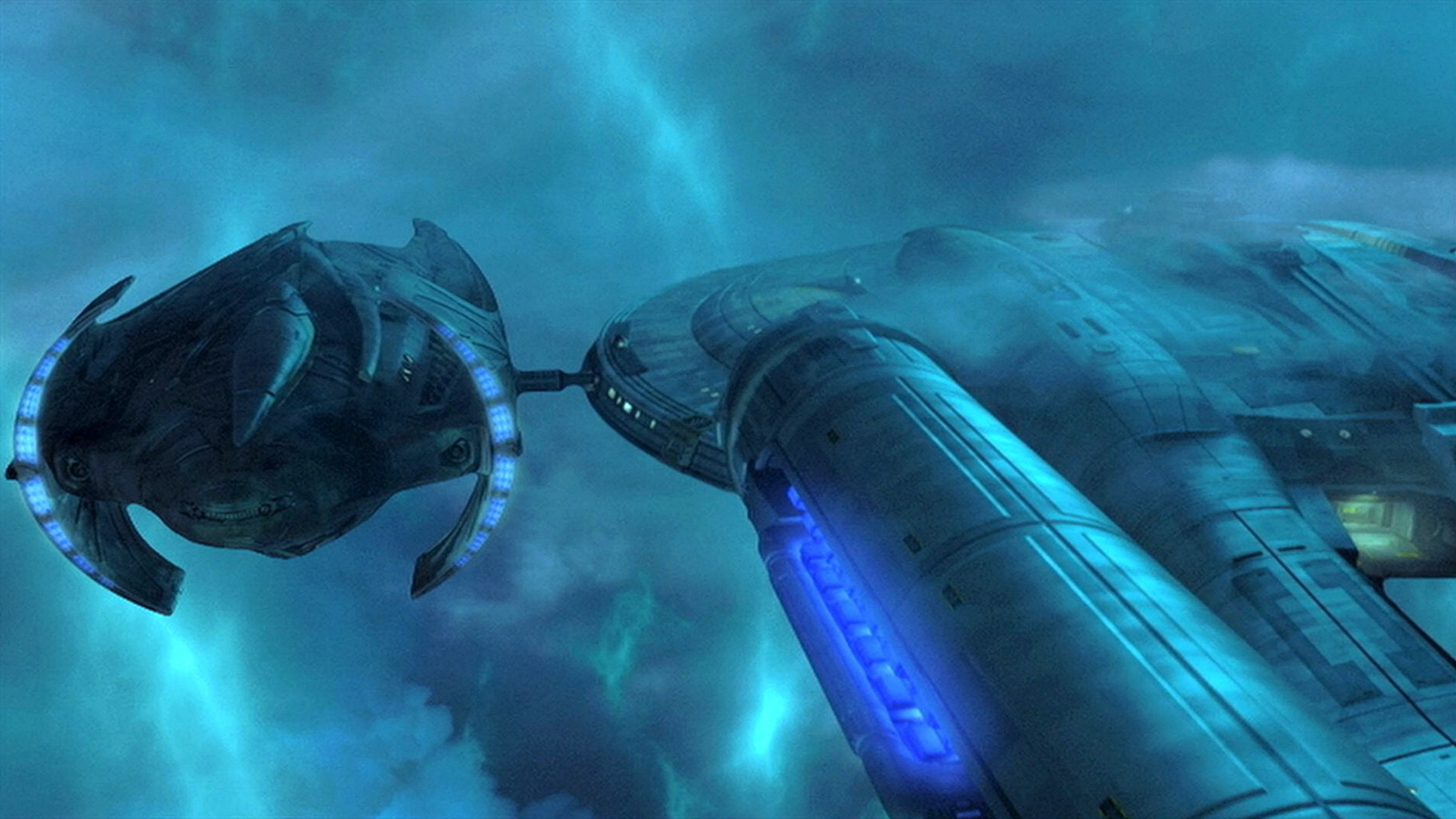
Date not given: While charting the Arachnid Nebula, Enterprise encounters the Vulcan vessel Vahklas, whose crew have abandoned the practice of suppressing their emotions. One of them, Tolaris, develops an interest in T'Pol. He suggests, as an experiment, that she not meditate before going to sleep, after which she has an unsettling dream of living out her emotions in a night club called "Fusion". When Tolaris mind-melds with T'Pol, a technique that is unknown to most Vulcans, she collapses. Archer is upset. He provokes Tolaris to exhibit his violent nature, upon which the Vulcans are told to return to their ship.
Review
Well, the bothersome and pleasant aspects somehow cancel out each other here. Something that is particularly interesting, also with respect to the previous "Evil Vulcan" episodes, is how they are treated here. For once, we have some nice Vulcans, only to learn that they are actually outcasts, something like space hippies with pointed ears, totally untypical of their kind. Eventually, however, it is ironically the old order that prevails. Of all people, it is Archer, who is usually full of prejudices of the Vulcan establishment, who uncovers Tolaris's violent nature, thereby coming to the conclusion that T'Pol's and other Vulcans' mental discipline cannot be that bad after all. Not that they would grow more likable in his view (it might even reinforce his grudge against the species as a whole), but seeing the Vulcans that could have been he might also develop more respect for the way of living most of them have chosen.
On the other hand, this is exactly the problem with the episode too. As we already know since TOS, the Vulcans once had self-destructive tendencies that they learned to overcome. According to "Fusion", Vulcans have to work on themselves, to go through sacrifices and inconveniences to become the peaceful and more or less likable persons as we know them. It is suggested that, without all this, they would be more violent than the wildest Klingon. I don't like at all how this is presented in the manner of one more "dark secret" about them, and how the difference between the "good" and the "evil" Vulcans is exaggerated. In other words, Vulcans are suddenly shown as wolves in the fold. In contrast, humans, although they also behave somewhat differently in Star Trek than they do today, have not needed punishment, exercise, maybe drugs or whatever - they have seemingly achieved peace without any "tricks". Ironically, the whole series so far and even the course of the episode itself contradicts the bottom line of the episode that Tolaris's way must be wrong because it necessarily leads violent tendencies to resurface. Only two episodes ago we could see an aggressive captain, who was obviously a respected person. On the other hand, at least one of Tolaris's comrades, Kov, was a really nice guy (for what we know), whose only flaw were his hard feelings toward his father. This character and his very nice interaction with an often embarrassed Tucker has actually reconciled me with the story as he compensates for the impression created by Tolaris. Still, if Tolaris is only a single case of violence, why is Archer again generalizing things? Finally, why was Archer so sure at all that Tolaris would become violent? If T'Pol has told him what the viewer could witness during the mind meld, it was at most something like harassment, not really a mental rape. It may have been unpleasant to T'Pol and may have caused physical and psychic damage, but it would still have to be proven that this was intentional and because of his violent nature.
The fascinating part of the episode was how T'Pol's struggled with her emotions which was shown as something both enjoyable and unsettling. I found Jolene Blalock very convincing since the very first day, a real surprise even among the very good cast, but this episode is definitely a highlight and deserves extra praise for acting. For once, the recent tendency to show her in all kinds of weird situations for the pleasure of especially many male viewers was appropriate, even the first unmistakable sex scene in Star Trek (even if it was only a dream). It is only sad that the whole issue couldn't be resolved without stigmatizing her seducer as a diabolic villain who only misused her for his sadistic games (for which a proof is missing). Aside from its impact on the Vulcans' reputation, we have seen something very similar already in TNG when Deanna suffered in TNG: "Violations".
Annotations
- Continuity: Something remarkable with regard to continuity is that T'Pol doesn't know mind melds. If only dissenters have continued to perform this practice for centuries, it is no wonder why it will be still fairly unknown until the 23rd century when humans obviously first witness a mind meld in TOS: "Dagger of the Mind". Maybe Spock was some sort of a rebel too that he propagated mind melds for all of his life, and he may even have contributed to make them popular again. Only Voyager's Doctor was still skeptical in the 24th century. This is not completely satisfactory, but an intelligent trick to show us a mind meld in Enterprise. If the authors don't want to strain continuity too much, it should be the first and last one, though. Another, possibly minor point is that Tolaris rejects T'Pol's objections against a life with emotions as "propaganda from 5000 years ago", although Surak's teachings date back only 2000 years. There may have been an earlier movement, maybe one that led a sect to erect the monastery of P'Jem 3000 years ago.
- Remarkable dialogue: "Where'd you hear that?" - "A Vulcan anthropologist told me he'd seen the ritual during an Earth expedition." - "They're not trying to kill the quarterback. They're just trying to keep him from throwing the ball and running with it. It's only a game. Not a... fight to the death." - "I see." (Trip and Kov)
- Remarkable facts:
- Archer has the book Laura Danly - Cosmos A to Z since his eighth birthday. The book lists a diameter of 6.5 billion km for the Arachnid Nebula, but it is actually 8 billion km.
- Nearly a third of Enterprise's crew are female, according to Tucker.
Rating: 5
Rogue Planet
Synopsis

Date not given: On a "rogue planet", a planet that has left its orbit, an Enterprise landing party encounters a group of hunters of the Eska. Archer believes to see a young human woman on the planet, but the hunters tell him that this is only an illusion. The truth, however, is that the Eska are actually hunting shapeshifters, of whom one has made contact with Archer by assuming a female form he has imagined in his childhood. To protect the shapeshifters, Archer has Phlox develop an agent that disturbs the Eska's sensors.
Review
The story is very simple in essence, which alone isn't bad. I only wasn't fond of how it was again spiced up with the mystery factor, massively supported by the darkness of the planet. Enterprise heavily relies on this fashionable surrogate for real suspense, more so than any other Trek series so far. On the other hand, the romantic touch to it was nice this time, as Archer was enchanted by the woman, not as a simple sexual fantasy but as a subconscious childhood memory. Nevertheless, I see "Rogue Planet" rather as a below-average episode in the tradition of "Strange New World", "Terra Nova" or "Civilization", which all had rather tedious passages in which the plot progressed at a snail's pace.
The Hirogen vs. the Founders. The parallel was so obvious that I found it frustrating. Instead of the mere citation of clichés I would have liked to learn more especially of the Eska and what may make them different from the Hirogen. Their motivation was explained to some extent, but they remained very unremarkable. In the end, the Eska were eluded with ease, and they were not given the opportunity to make their point, and if only to utter some threats. On the other hand, for once there was a really peaceful solution, even if it was contrived (Janeway wouldn't have mastered this situation without using three or four photon torpedoes ;-)).
Annotations
- Continuity: Continuity is impaired once again, as we see yet another different species of shapeshifters. In Star Trek it was never a problem that shapeshifters were always shown as something totally unknown, but predating the whole phenomenon by 100 years does everything but make shapeshifter appearances (or better, humanoids' reactions to them) since TOS more credible. This is exactly the kind of "soft continuity errors" I have been criticizing ever since the very first announcement of Enterprise, and which will become a "hard error" in their accumulation. Speaking of errors, I wonder if the authors have ever heard of *photo*synthesis without which no plant life could exist. Although the jungle looks almost exactly as on Earth, we are supposed to believe that biology is completely different here, in that trees have leaves just for fun and grow away from their geothermic energy source in the soil. Considering that it was not necessary for the story to take place on a "rogue planet" (except for giving the episode its title), this error could have been avoided.
- Remarkable dialogues:
- Archer: "Do Vulcan captains have their portraits hanging at the High Command?" - T'Pol: "Vulcans are revered for their accomplishments, not for the way they look." - Tucker: "Except for the really important ones - who get mummified."
- Reed: "Follow me." - Archer: "Why don't you let me play Captain for a while, Malcolm?"
- Remarkable behind-the-scenes fact: The mysterious woman was played by Stephanie Niznik. She also appeared as a Trill named Kell Perim aboard the Enterprise-E in "Insurrection".
- Remarkable prop: Tucker is using a digital camera, which doesn't look any more advanced than the ones we have today.
Rating: 2
Acquisition
Synopsis

Date not given: A group of Ferengi plunder the ship after they have rendered the crew unconscious - with the exception of Trip, who has been in the decon chamber. While Archer is talking the lowest-ranking Ferengi, Krem, into mistrusting his comrades, Trip and T'Pol are preparing a trap. In the ship's alleged "vault" where the Ferengi expect large amounts of gold they can finally be overpowered. After taking the stolen goods back to Enterprise, Archer leaves Krem in command, warning him never to come too close to a Vulcan or an Earth ship.
Review
"Vulcan Love Slave" - how it all began! So this episode preserves continuity only because the word "Ferengi" is never uttered? Bullsh*t! It is a ludicrous theory that the Ferengi should be identified as late as 213 years later when the Enterprise-D has the first official encounter with them. Even if their whole civilization had heeded Archer's threat for a full two centuries, this wouldn't have prevented Starfleet from finding out about them. It may have been a bit more acceptable, still very contrived, if the Ferengi of this episode had said, in a side note, that they were a long way from their home planet. On the other hand, only a few weeks ago in "Dear Doctor", they have already been explicitly mentioned to be in contact with the Valakians. Although it was probably supposed to be one and the same ship in both episodes, it would suggest that Ferengi are already notorious within the (rather narrow) range of Enterprise. Moreover, one of the other Ferengi mentions a "Bolian female" to Krem in the end. So they already know the Bolians, but the Bolians won't report about them when they join the Federation? Finally, the fact that the Enterprise crew prevails and would be able to scan their databanks gives the death blow to all awkward attempts to excuse the continuity breach, because this should reveal everything important about them (at the very least what they are called). "Admiral, you need to warn all Starfleet ships of these, err, guys with big ears whose race name I neglected to find out."
<rant> Must I be grateful now because they at least attempted to preserve continuity by avoiding the "F" word? B&B don't bother to stick to their own series premise, and after giving us a taste of their interpretation of continuity with the look of the Akiraprise design and her 24th century technology, the K't'inga, the holodeck or the shapeshifters they now open a door to allow just everything. But who among the writer staff (especially now that external script submissions are not possible any longer) would still care for a different premise in a different time if it is so convenient to exploit all the common Trek clichés? The Trek Universe is about to become a static universe as the series fails to show us a development. Always the same stories, the same adversaries, the same technology. Whom will we see next along these lines? Definitely the Romulans, but perhaps also the Borg, Q or maybe James T. Kirk? I wonder how much credibility TPTB will still throw overboard, only for the sake of easy writing, and to please a few fanboys.</rant>
There was a good deal of fun in the episode, but it was once again annoying how the Ferengi were depicted (which is not a particular fault of Enterprise, of course). I may still understand why they could be interested in the dedication plaque as a trophy, but what in the world could they want with the helm seat? Or the food? Considering how gullible they were when Archer told them of the gold or Tucker led them in circles around the ship, the only thing I missed was someone telling them about the "firomactal drive". Honestly, I have no idea how the Ferengi could have ever come so far if the ones we know (of whom only very few were as clever as Quark and his family) are like the Ferengi stereotype perpetuated here. The only scene I really liked was when Archer and Tucker got into an argument about the value of a wife. ;-) The rest of the story (which may have been intentionally reminiscent of TNG: "Rascals") was a bit too contrived. How could only one probe with the gas contaminate the air in the whole big ship? How could the four Ferengi find and empty all fourteen weapons lockers so quickly? Why was exactly one dose of hypospray left for T'Pol (and why didn't Trip try to wake Dr. Phlox instead?). I also didn't like how unhurriedly, almost reluctantly the crew attempted to regain control of the ship. Especially when Tucker first opened Archer's handcuffs and then tightened them again, they accomplished almost nothing. Tucker only learned that there was a hypospray in engineering.
I liked a couple of scenes because they were a bit ironic. For instance, when Krem tried to open the door with two boxes in his hands, he demonstrated how impractical the door openers are. On a funny note, we may regard T'Pol's encounter with him as the foundation of "Vulcan Love Slave, Part I". These little tidbits, like the Vulcan nerve pinch, the Ferengi whip and some other good ideas too, are the reason for my still gracious rating.
Annotations
- Remarkable quotes:
- "What's a wife worth? Five bars of gold, maybe six? Let them take Hoshi and I'll give you ten." (Archer, to Tucker)
- "If you come within a light year of any one of our ships, you won't know what hit you." (Archer)
- Rules of Acquisition:
- "Never allow family to stand in the way of profit." (#6)
- "Nothing is more important than your health - except for your money." (#23)
- "Expand or die." (#46)
- "A man is only worth the sum of his possessions." (no number given). There are only 173 rules altogether at the time.
Rating: 2
Oasis
Synopsis

Date not given: A landing party discovers a group of survivors on a ship that was allegedly attacked and crashed on a planet three years ago. While Tucker is spending a lot of time with the young Liana, Reed's investigation of the ship yields several inconsistencies - there was no attack and the ship is on the planet for over 20 years. Upon their return, Tucker and T'Pol are taken hostage by the survivors and forced to repair the computer system. Liana finally reveals the truth to Tucker. She and her father, Ezral, were the only survivors when the ship depressurized. Ezral created holographic images of the dead crew for her. Archer can eventually convince him to get the ship running again and head back to their homeworld.
Review
"Oasis" may not have been quite the worst, but was the least remarkable episode so far, as it is the most blatant case of plot recycling, much more so than "Terra Nova" or last week's "Acquisition". The extent of originality in the episode amounts to zero. Nearly every aspect of the story, every piece of dialogue and every facet of the guest characters is something that we have seen several times before. In addition, the plot is being developed extremely slowly. Nothing of any significance happens in the first ten minutes when the landing party is running through dark corridors (like almost every week) until the airponics bay is discovered. The next twenty minutes are a bit more eventful, but the destiny of the survivors and Tucker's interest in Kes aka Liana (isn't there an old movie like "Liana, the Girl from the Jungle"?) fail to catch my interest.
The final fifteen minutes are just appalling. Not only couldn't the authors resist featuring the *defining* technology of the 24th century for the second time in the season, even with a perfection Starfleet holograms will still not have 220 years later (I'll spare you of my rant this time). Even the conclusion is exactly the same as in DS9: "Shadowplay" where Rurigan created a holographic village with the same motivation. The little bit of suspense that has been created in the middle of the episode is blown away in an instant when the holographic crew members vanish one after another, maybe already when Trip examines the optronic relays that almost leave no other explanation than a holodeck. I may have expected any resolution of the inconsistencies Reed discovered, but this was easily the least interesting and most frustrating idea they could have come up with (although I admit it is hard to conceive something original because shipwrecked people in Star Trek *always* hide a secret).
Ezral, played by René Auberjonois, who couldn't save the boring story, was the usual stereotypical stubborn old character, like Rurigan or Mullibok in DS9: "Progress" for instance. Liana, on the other hand, reminded me so much of Kes (not only because of her haircut and the fact that she worked in the airponics bay) that I thought I was watching Voyager at times. Well, plot-wise the parallel to Vina of the "The Cage" is obvious too. As for the Enterprise characters, it may at least have been an opportunity to give some of them (most of all I had hope for Mayweather) something to do again. However, it turned out as yet another Archer-Tucker show.
There was only one scene I liked in the whole 45 minutes. Characteristically of the episode, this was not a serious contribution to the story, even if it may have been intended so, but only a funny side note. When T'Pol notices that Tucker holds Liana in high regard, she can't resist to remind him of his "affair" on the Xyrillian ship: "I'm simply noting that last time you found someone this competent you wound up carrying her child." Liana walks in and asks, "Am I interrupting?" T'Pol: "Not at all. Commander Tucker and I were just discussing his previous repair experience." Last week Archer still claimed T'Pol had no sense of humor. ;-)
Annotations
- Remarkable ship: The crashed ship is the good old "hammerhead" freighter that appeared several times in TNG, very often as a Bajoran ship in DS9 and also in the Delta Quadrant. Now there seems to be even a CGI model of it and we will probably "enjoy" it several more times in Enterprise too.
Rating: 1
Detained
Synopsis

Date not given: Archer and Mayweather find themselves arrested in a detainment camp of the Tandarans, together with a number of Suliban. Archer soon finds out that obviously none of the Suliban imprisoned there is genetically altered or guilty of any crime. Colonel Grat justifies their imprisonment in that it would be for the Suliban's own security, to avoid them being made soldiers in the Temporal Cold War. Archer, however, decides to free the prisoners. With help from Enterprise, the Suliban escape to their ships.
Review
Although "Detained" does not really put an end to the recent lack of innovation and inspiration in Enterprise, it is an overall positive surprise because it proves that even cookie-cutter plots may be turned into something special. With yet another hostage-taking and yet another interference into internal affairs of a planet, the episode is somewhat reminiscent of "The Andorian Incident" and "Shadows of P'Jem"; still the course of the story is quite different this time. "Detained" creates suspense through acting instead of action and spares us of endless beatings and shootings until the culmination in the last five minutes. I like how the episode critically comments on Earth's own history, namely the repression and imprisonment of people only because of their racial or national descent. In this resgard it also shows the Suliban in a different light and, moreover, tells us a great deal about them. Archer needs to change his mind about them, and unlike it was with his previous premature actions, I think he now makes the right decision. It may seem exaggerated to attempt to free all the Suliban with force, as many may have been killed. But I think that the "wiser" Starfleet captains of later centuries would have supported the prisoners likewise in one way or another. What I like too is that the authors have finally used the opportunity to concede Travis Mayweather a few decent lines after he had been window dressing for most of the season.
The Tandarans (yet another T-Race...), however, were rather uninspiring. Their military was depicted too stereotypical - as just the willing helpers of a racist regime. In an effort to render them as familiar as possible, they were only given Bajoran-like noses and Romulan-like uniforms. "Al" Dean Stockwell as Colonel Grat didn't impress me very much either, although it's not his fault. I appreciated that he was shown as sinister instead of openly hostile, but the writer made his motivation and the justification of his actions too vague to turn him into a formidable opponent. He and Archer didn't really have any business.
Annotations
- Nitpicking:
- I was surprised to see that the shuttle is suddenly armed with what appears to be a phase cannon, judging from its continuous beam.
- The oddity of the week, however, is that the Tandarans obviously have a racist slogan with a rhyme even in the English translation. ;-)
- Remarkable fact: The Suliban homeworld became uninhabitable 300 years ago.
Rating: 5
Vox Sola
Synopsis

Date not given: After a cultural misunderstanding, the insulted Kreetassans leave the ship in a haste. Unnoticed by the crew, a creature with tentacles slips through the airlock and hides aboard Enterprise. When crewmen investigate malfunctions aboard the ship, they are caught by the creature and spun into a web. With Archer, Tucker and three more crewmen trapped like this, the rest of the crew attempt to free them with force, but they would endanger their crewmates' lives by that. Finally, Reed devises a forcefield to get close to the creature without danger, while T'Pol and Hoshi develop a method to communicate with it. The lifeform, actually part of a huge organism, has taken the crew members as a surrogate for the lost contact with its own kind. It agrees to release the crew in exchange for being transferred to its home planet.
Review
"Archer to Lieutenant Ripley. We could use your help down here." Not only in the "Alien" series, but also in Star Trek itself, we have already seen plenty of stories with non-humanoid creatures that endanger the crew, most notably in TOS: "Devil in the Dark" or TOS: "Operation: Annihilate". Considering that I expected almost nothing from watching yet another episode like that, "Vox Sola" ("single/solitary/lonely voice") turned out a positive surprise. It presented a Trek-like variant of the "Alien" theme in that the alien lifeform was not killed but released after communication had been established. It was also extraordinary that the first choice would have been to kill the creature indeed, something that for once successfully distinguishes Enterprise from the three Star Trek series set in the 24th century. Another interesting aspect is that the creature didn't suck out the lives of its victims as we have seen it so often in science fiction, but was actually lonely and seeking for company. Although I was prepared to see the most trivial scary effects so far, they were surprisingly reduced to a minimum here. Instead of that, the episode had a great deal of character interaction, and everyone of the crew played an important part. Especially the conflicts between T'Pol and Hoshi and between Reed and Phlox worked out well. Even Mayweather had a part in the story again when it was up to him to negotiate with the Kreetassans, which he did with palpable stage-fright.
Annotations
- Nitpicking:
- It is bothersome that Reed casually invents the forcefield and therefore introduces yet another technology that better should not exist for another one hundred years or at least a couple of decades. As with the transporter too, the remark that the improvised device still needs refinement does not excuse that it is already indistinguishable from the advanced routine technology used 200 years later.
- Something that I don't understand is that the creature is said to be "highly photosensitive" on one hand, but the concentrated light pulse of a phase pistol does not have any effect on it.
- Finally, I am surprised that suddenly a phase rifle shows up (with the same visual effect as the phase pistol) that has never been mentioned before and probably didn't exist so far, as especially "Blow-it-up" Reed should have preferred this more powerful weapon over the pulse rifle.
- Remarkable dialogue: "Why don't you stay for the movie tonight?" - "What's playing?" - "Uh... 'Wages of Fear'. Classic foreign film." - "Hmm." - "You'll like it. Things blow up." - "Hmm. Sounds fun." (Travis and Malcolm)
- Remarkable fact: The Kreetassans don't eat in the presence of others which they consider equally indecent as mating in the public. This was the actual reason why they took offense when they came to Archer's usual captain's dinner. This cultural peculiarity may also explain why their words for "eat" and "mate" are similar, as Hoshi found out.
Rating: 6
Fallen Hero
Synopsis

February 9th, 2152: Enterprise is ordered to take the noted Vulcan diplomat V'Lar, currently ambassador to Mazar, to a rendezvous with a Vulcan vessel. On Mazar, V'Lar has been accused of several crimes, but she refuses to make a statement about the charges against her. At T'Pol's request, Archer agrees to carry on with his mission, although Mazarite ships demand the extradition of V'Lar. With Mazarite ships attacking Enterprise, Archer has to buy himself time until the arrival of the Vulcan ship. Finally, the Mazarites can be defeated, and V'Lar may be transferred safely to the Vulcan ship. Her actual mission was to uncover corruption in the Mazarite government, but she did not reveal it because of her lacking trust in humans.
Review
The old spirit is back in this episode, which reconciles me to some extent with the overall negligence and the many conscious errors that were made before in the series, in particular the questionable pleasure of frequently seeing Vulcans with evil hidden agenda or aggressive behavior. 89 years after "First Contact", it is actually the first time in the series at all that there is a positive development of the human-Vulcan relations - in general as well as between Archer and T'Pol. This alone makes the episode a pleasure to view. V'Lar's little speech in the end may be a bit too solemn, but with regard to continuity, it is finally a step into the right direction. Aside from that, the story is quite exciting. Only that I would have wished to see something more elaborate than Enterprise running away from the Mazarite ships all the time.
The dermal regeneration that Phlox mentions to the Mazarites is definitely a ruse, since we know the tomography unit may not be used for that purpose. I hope the authors will remember that too. As for the mention of Risa in the episode, I always thought that it was a fairly unknown place at the time when Riker recommended it to Picard in TNG: "Captain's Holiday". On the other hand, Picard may be the type who just doesn't care where ordinary people go on vacation just to relax and/or have sex.
Annotations
- Remarkable quote: "I sense a great bond between you. A bond of... trust and respect. But also... a bond of friendship. I think it bodes well for the future relations of our two people." (V'Lar)
- Remarkable facts:
- The Vulcan ship Sh'Ran has a top speed of Warp 7.
- Enterprise, on the other hand, reaches Warp 5 for the first time.
Rating: 7
Desert Crossing
Synopsis

February 12th, 2152: After the successful repair of his shuttle, Archer and Tucker are invited by Zobral to visit him in his desert camp. Enterprise is warned by the planet government that Zobral is a terrorist and that the two officers are regarded as his helpers. Meanwhile on the planet, Zobral tries to persuade Archer and Tucker in vain to join his cause. When the camp is attacked, the Starfleet officers escape to the open desert. After a long walk, they are finally rescued by a shuttle, after T'Pol has convinced Zobral to support them because he was responsible to get them into trouble in the first place.
Review
"The galaxy could use more people like you." This is what Zobral thinks of Archer and Tucker. This statement gains a completely new significance when he attempts to recruit the two officers for his cause, not knowing that Archer is not a great leader but just a Starfleet captain who strives to do the right thing (or what he thinks is right). The intra-series continuity in the episode is great, as it shows the consequences of Archer's actions in "Detained". His reputation proceeds him, and this is only plausible in a region of space which is smaller than at the time of TOS or even TNG. As for the plot itself, Enterprise is caught in the middle of a civil war yet another time, and we have seen similar struggles for survival several times before in Star Trek.
The episode may have been intended as a way to cope with the present-day phenomenon of terrorism. But as such, it doesn't work out quite well. Like several times before in Enterprise, the conflict parties fail to make their points and their motivations remain rather vague. In this respect, "Desert Crossing" reminds me a lot of "Shadows of P'Jem" where shooting, beating and bondage games were a poor surrogate for the lack of a real plot. Fortunately, there is a tad more development in "Desert Crossing" besides the mere action, and the open-air desert scenes are definitely a highlight, also because they make Archer's and Tucker's desperate situation palpable.
Annotations
- Nitpicking:
- Concerning the technology, I wonder if someone made up their mind about the shuttle's weapon. After it (erroneously?) had a phase weapon in "Detained", it is now equipped with what looks like a pulse cannon.
- But the question of the week is what happened to the shuttlepod that Archer and Tucker abandoned. Even more so than on Voyager, it should be hard to replace shuttles, and Enterprise allegedly has only two of them.
- I also wonder why they went into the desert in the first place when they could have used the shuttle to escape. It obviously had not been hit in the long artillery bombardment, and I think they would have had a good chance to outrun the slow projectiles.
Rating: 3
Two Days and Two Nights
Synopsis
February 18th, 2152: Part of the crew finally take their deserved vacation - two days and two nights on a pleasure planet called Risa. Trip and Malcolm are seeking company in a bar, but the two attractive girls turn out to be thieves. Hoshi meets an alien man, and they soon find more interesting activities than only learning each other's languages. Travis engages in rock climbing and breaks his leg, and Dr. Phlox has to be interrupted in his hibernation to tend to an allergic reaction due to a medication on Risa. Captain Archer, finally, meets a woman, but he eventually finds out that she is a surgically altered Tandaran spy who tries to find out where the Suliban helixes are located.
Review
Th synopsis of "Two Days and Two Nights" reads like a "Love Boat" episode - and that's what it is. The setting is only slightly different. The way of storytelling, with multiple light-hearted plot threads about the adventures and problems of the guests, is much the same.
It is a fun episode overall, something for the viewer to relax, quite as the characters intended to do. Irony is in the plot itself, and in many single lines. All our brave crew wants is relaxation but what they get is excitement and/or trouble. Hoshi is a bit miffed about Trip's and Malcolm's apparent intentions to meet aliens of the opposite sex, but in the end it is her who ends up in bed with an alien - whereas Trip and Malcolm are robbed. Travis is overly confident about how he can climb rocks with ever changing steepness, which conjures up his accident. Archer just wants to take a break from interstellar politics for two days, but has to realize that spies would not respect his wish to relax. Even Phlox is interruped in his hibernation because of adverse circumstances.
Since nothing with serious consequences happens in "Two Days and Two Nights", nothing should be taken too seriously. Nevertheless, the episode with its countless references to previous heroic deeds or mishaps may have the best intra-series continuity. Unfortunately, this applies to the plot vehicles likewise. Even though it has an ironic undertone here, seeing that everyone of the crew is being knocked out in one way or another adds to the overall awkward and naive impression that has been created of them over the first season. The fact that that Malcolm and Trip are once again fettered and in their underwear is just the icing on the cake. As much as I enjoyed it, it has become hard to take the crew seriously as characters any longer because the same already happened in serious stories. In other words, the potential that may have been in a one-time comical look at the crew's misfortunes has already been wasted throughout the season. By now, it is rather a self-ironic look at the series as a whole.
Another issue is that, except for Hoshi's long conversations in alien languages (I don't remember any sub-titled scenes that long in Star Trek), Risa is not very alien. Well, there are (at least) two moons and Horgahn-shaped door buttons, but that's it for the specifically Risan setting. Looking back, it would have been more interesting to see the crew getting into trouble because of the special customs, laws or environmental conditions or anything else intrinsic to the planet. Only Travis's allergic reaction to the treatment on Risa falls into this category but remains a side note. The way the story unfolds, the episode could have taken place in Florida as well.
Speaking of Florida, who else thought that especially the bar scene with Trip and Malcolm borrowed a lot from the 1980s? The synth-pop music, colorful hairstyles and finally Trip's and Malcolm's Crockett & Tubbs outfits.
Annotations
- Nitpicking: Archer mentions a couple from "Vega Reticuli". This star designation makes no sense. He may have meant Zeta Reticuli.
- Remarkable scene: When Cutler and T'Pol wake up Phlox, I can fully understand his disorientation. I feel like that every morning!
- Remarkable dialogues:
- Reed: "Well, supposedly Risa is very cosmopolitan. There are species visiting from all over." - Tucker: "Malcolm and I, uh, plan to broaden our cultural horizons." - Hoshi: "Is that all you two think about?" - Tucker: "Well, how we choose to relax is our own business."
- Tucker: "I saved the captain's life." - Alien "women": "I thought you were the captain." - Tucker: "We rotate." (pointing at Reed) "He's captain next week."
- Mayweather, to T'Pol: "Have you ever been to an alien hospital?" - T'Pol: "Yes. In San Francisco."
- Remarkable quote: "As a matter of fact, I learned several new conjugations." (Hoshi, on her "language studies")
- Quote of the week: "Malcolm, bearing 1-8-0." (Tucker, when he spots the two women behind him)
- Remarkable facts:
- Dr. Phlox usually hibernates six days per year, but two should suffice.
- Hoshi had learned 38 languages before she left Earth.
- Earth is 90ly from Risa. This is the farthest any human being has ever gone, according to Archer.
Rating: 5
Shockwave I/II
Synopsis

Date not given: An Enterprise shuttle seemingly causes the ignition of gases in an atmosphere, costing thousands of lives on the planet below. Admiral Forrest has no choice but to cancel the mission and call Enterprise back to Earth. Daniels, the time traveler from the 31st century, however, knows that the Suliban are responsible for the disaster by planting a device on the shuttle's hull. He sends Archer on a mission to track down a Suliban stealth cruiser, disable it and steal the evidence. But on the way back Enterprise is surrounded by Suliban vessels. In an attempt to correct history once again, Archer is transferred to the 31st century, but his absence triggers a development in which Earth is being devastated. Without any time travel equipment, Archer and Daniels are trapped in the 31st century, while Enterprise is facing a battle against a fleet of Suliban ships... Daniels and Archer find out that the Federation never existed in the current version of the 31st century, and that it must have to do with Archer's disappearance from the 22nd century. Searching for Archer, the Suliban have boarded Enterprise and confined the crew to their quarters. Archer and Daniels manage to send back a message through time to the Enterprise crew. Reed finds a time travel device in Daniels's former room, but Silik takes it, and Archer is returned from the 31st century to the Suliban Helix. In the meantime, having faked a warp core breach, Enterprise breaks free from the Helix. Archer manages to take Silik hostage and get back to Enterprise. The mission is allowed to continue.
Review
"And now the confusion...". I usually don't review two-parters separately, but this one would receive 8 points for part one and only 3 for part two. The first part of "Shockwave" makes several promises the conclusion doesn't keep. While the cliffhanger leaves several options as to how the temporal mess may be explained and fixed later on, the second part absolutely fails in doing either of that. The time travel aspects are discussed on a separate page, but they are not the principal problem. Among many weak points about the logic I am especially annoyed that there is no other interpretation possible except that Daniels must have abducted Archer against better knowledge that this would necessarily change history and might lead to exactly the disaster that happened. How stupid of him! The successful attempt to fix the whole situation by creating a temporal transmitter with a few extremely simple modifications to Archer's communicator and scanner is another major annoyance. The device suddenly even has a holographic imager! As if it would only take a good 21st century engineer to turn a 19th century telegraph into a modern cell phone. This is the most ludicrous engineering nonsense in Star Trek in a long time! Without any change to the plot, Daniels could have taken one of his own advanced devices or modified parts of his protection suit to send the message, which may have already been difficult enough.
There are several more errors and plot holes, which show up massively in the second part. Was it part of the plan that Silik would take away Daniels's device from Reed and that Archer would be trapped on the Helix upon his return? It almost seems so since no one backed Reed while he broke into Daniels's quarters. And did Silik really think he had any chance to contact Future Guy with a device he had not the slightest idea how to operate? Silly Silik! Why is Silik so awfully important that his soldiers stop the attack when he is taken hostage? Why didn't Archer simply keep Silik as a prisoner? And finally, since when can Enterprise fire phase cannons at warp?
The second part also compares badly to the first one in that some of the tasteless Enterprise clichés show up again. T'Pol tortured in underwear, Hoshi losing her shirt, Reed beaten until he bleeds by Silik. Braga and Berman should finally start thinking about which kind of audience they are aiming at. But what I actually like least about the second part is that everything said about Archer's mission in particular and human-Vulcan relationships in general exactly echoes what has been stated so many times before. Especially the final five minutes with the stereotypical statements by Archer, Tucker, Forrest, Soval and T'Pol are perfectly interchangeable with "Broken Bow", "The Andorian Incident" or "Shadows of P'Jem". Of all people involved, only T'Pol may have changed her mind, but this became apparent as soon as in "Broken Bow". I really wonder when the whole human-Vulcan story arc will finally see an advancement. While it is certainly realistic that such things don't fundamentally change in the course of only one year (I would be the last person to contest this), I simply expect more from a story arc than hearing the same statements and discussions all over again.
There are certainly a number of things I really like in both parts of the episode. First of all, the disillusion of the crew in the first part is quite credible. The failure of Archer's mission in one case may have endangered the whole space program and the future of the human race. Once again, Enterprise establishes a palpable difference to the saturated and secure 24th century. The crew's efforts to regain control of the ship are quite witty, including Tucker's modification of the comm system (which was a lot more credible than what Daniels did with Archer's communicator) and the faked warp core breach. What an improvement compared to the half-hearted actions in "Acquisition"! The special effects, like the explosion in the planet's atmosphere or the battle between Enterprise and the Suliban, are outstanding.
One interesting observation (thanks, Martin!) is that, while the future was in ruins, Silik had no possibility to contact the guy from the future. This may be taken as a hint that this guy is actually human, or that his future was affected as well, so he either didn't exist or had no interest in waging a "Temporal Cold War".
Annotations
- Remarkable quote: "As I told you, the Vulcan Science Directory has concluded that time travel is impossible." (T'Pol)
- Remarkable dialogue: Archer, looking at a book in the shelf of the derelict library: "The Romulan Star Empire? - What's that?" - Daniels: "Maybe you shouldn't be reading that."
- Remarkable fact: Archer reads "Romulan Star Empire" on a book. This may be a predestination paradox, in that he may give the Romulans their name based on that. We'll have to wait and see.
Rating: 6