


Weapons
PhasersPhoton TorpedoesOther WeaponsShields & Cloaking Tactics
Phasers
Phaser beams
There is only one definite fact about phasers, that they release stored energy and need to be recharged at latest after some shots, as opposed to lasers whose energy output is continuous. A phaser beam probably doesn't consist of charged particles (ions) either, because the beam would quickly disperse due to the mutual repulsion of equally charged ions and because it would be rather easy to shield a ship against them with a static electromagnetic field. The shields in Star Trek, however, are always high-frequency fields. And according to the TNGTM they are not electromagnetic, but of gravitational nature.
It is even more nebulous of what exactly the beams of phasers consist since VOY: "Scorpion" when the weapons were suddenly capable of firing macroscopic objects in the form of nanoprobes. No matter how hard I try, I can't imagine how they could survive in there, unless the phaser worked similar to a transporter, meaning that some sort of annular confinement beam can be added or is intrinsically available, just as the transporter beam that keeps macroscopic objects in one piece.
Phasers at warp
We have occasionally seen phasers being fired at warp, like in VOY: "Message in a Bottle" or DS9: "Treachery, Faith and the Great River" and even the purportedly primitive phase cannons in ENT: "Shockwave" and "Future Tense". The concept of firing at warp dates back to the days of TOS when this was done repeatedly, like in TOS: "The Corbomite Maneuver", "The Ultimate Computer" or "Elaan of Troyius", although it seems to have been silently revised by the time of TNG since when it seemed possible only occasionally. Certainly we wouldn't assume that the Federation somehow lost or gave up this immense tactical advantage.
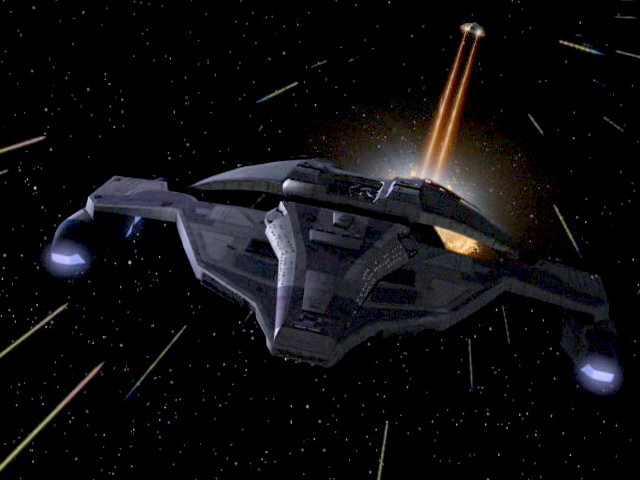
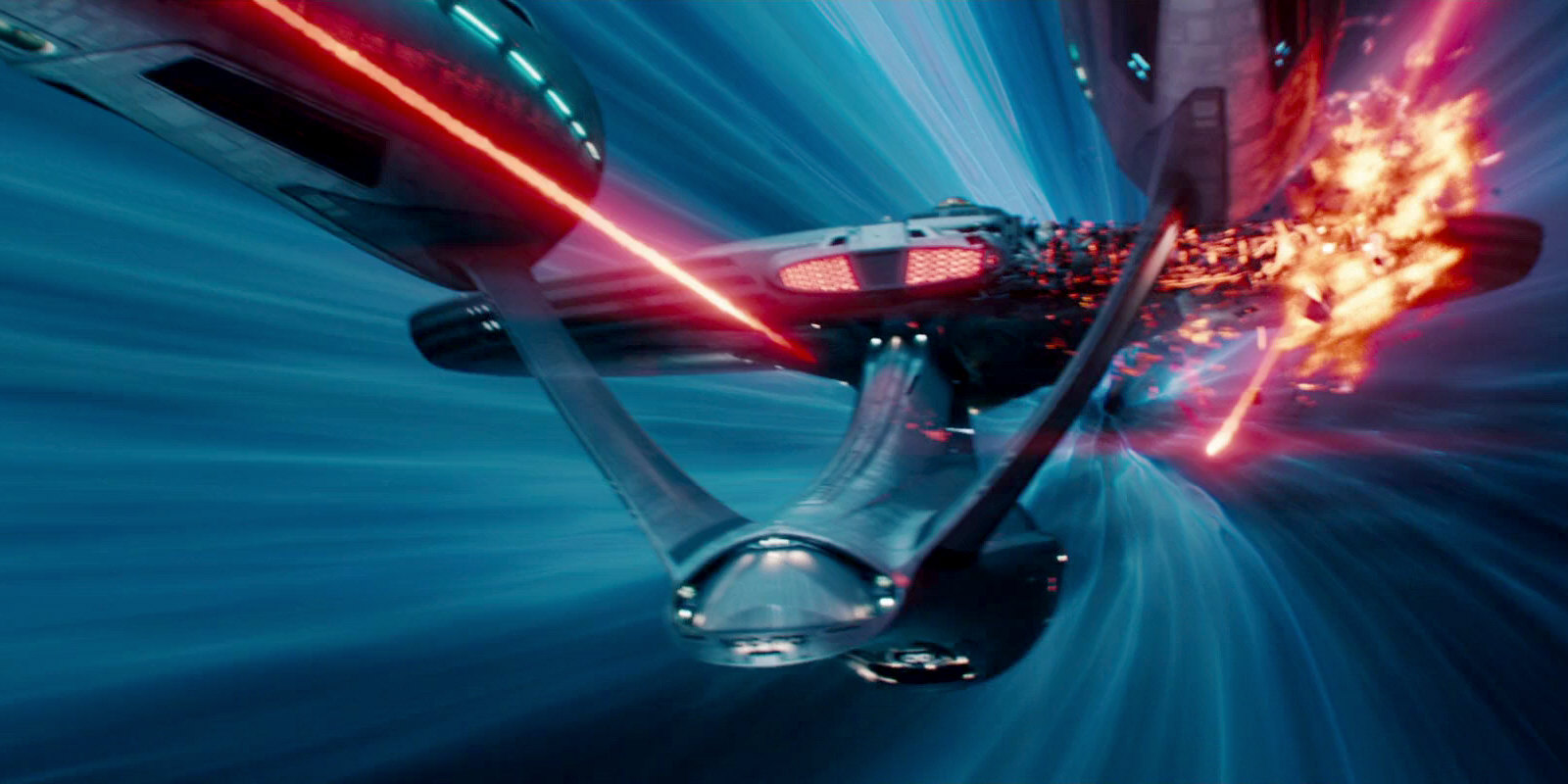
If the phaser is anything like a laser in that it releases photons, it has to be restricted to exactly the speed of light. A particle beam consisting of ions, on the other hand, could reach any desired speed well below c. A confinement beam, like already mentioned above, could be the solution to this problem too. If this beam extends the warp bubble around the phaser beam, the beam itself would be able to travel at FTL speed. A similar technology is used for FTL processing in 24th century computer cores, according to the TNGTM, and the warp sustainer engine of a photon torpedo (see further below) may work like this too in that it "grabs" the warp field from a starship. The problem is that this kind of confinement would have to be still another one than the confinement beam that would allow objects like nanoprobes to "ride" on a phaser beam like in VOY: "Scorpion".
Probably in response to previous inconsistencies, the DS9TM explicitly mentions the possibility of firing phasers at warp, thanks to the recent development of an "ACB-jacketed beam device". This certainly doesn't explain the problems of phasers at warp in TOS or even the phase cannons at warp in Enterprise, or would the freshly developed weapon at a previously unachievable speed of Warp 5 already have this obviously advanced feature? Only on a few occasions like TOS: "The Corbomite Maneuver", when the target (the alien buoy) was so close to the ship that they may have been in a common warp bubble, we can argue that this would be much like firing phasers at rest.
Mark Temple suggests about phasers at warp: "Warp fields around a ship alter space around the ship. Within the warp field, the local reference frame is still sublight, explaining how the ship and crew can still operate normally. Firing a light speed limited weapon outside of such a field would be pointless. Once it leaves the area of altered space, it would drop back down to normal speeds, and the ship would overtake the energy as it travels along. But within the warp field, it would behave normally.
This means that if two ships were to get close enough to overlap their warp fields, they'd share the same reference frames and thus could fire light speed weapons at one another normally. The visuals of ships fighting at warp usually depict such close quarters combat, with ships closing to within one or two ship lengths of each other, effectively point blank range compared to most depictions of non-warp combat. Overlapping warp fields would be possible as early as ENT, and in the 2200's warp combat appears to occur at even closer distances between ships than in later eras.
The relative rarity of employing phasers at warp in TNG, compared to their use in ENT, TOS, DS9, and VOY could represent a tactical doctrine issue, not a technological limitation. Since closing to overlap your warp field requires you to get so close to the enemy, it places you in a poor tactical position. Any advantage your vessel has as the result of superior targeting ability or superior effective weapons range is lost in such a close range battle. And it places you within weapons range of the opposing vessel. Warp battles in TNG apparently rely more on photon torpedoes more than phasers. Weapons that are capable of sustaining a warp field of their own, giving not only greater effective range, but requiring less precise navigation on the part of the firing vessel. The return to the use of phasers at warp could represent another tactical change, either from a technological advancement (such as the "annular confinement beam") or just a switch to a more aggressive combat doctrine.
 In "Star Trek Into Darkness" the Enterprise runs from the Vengeance. Khan says, "If you think you're safe at warp, you're wrong." A bit later Admiral Marcus attacks the Enterprise. This insinuates that weapons are generally considered useless at warp, and that the Vengeance is an exception.
 In LOW: "The Stars at Night" the drone ships of the Texas class fire at the Cerritos at warp. We can't tell whether this is considered unusual.
Photon Torpedoes
Glow of photon torpedoes
In The Original Series photon torpedoes only appeared as light pulses, fired from the Enterprise's sensor dome on the ventral side of the saucer. Based only on this visual effect we could presume that photon torpedoes were meant to be just packets of light at the time, without a clear shape and possibly without any kind of a solid projectile involved. The first time we could see a photon torpedo before it was launched was in "Star Trek II: The Wrath of Khan". Here the torpedo is a solid object, and one that is completely dark and opaque. It doesn't look like it could emit light when it is fired. Yet, the red light effect of the photon torpedo in space remained essentially consistent with the one of TOS throughout the movies and the three series set in the 24th century, the only real variation being that sometimes there was a trail (a bit as if the light effect were due to air friction) and sometimes not. On the other hand, we could see the dark and solid torpedoes on several occasions. The same applies to quantum torpedoes, only that the light effect is white/blue.
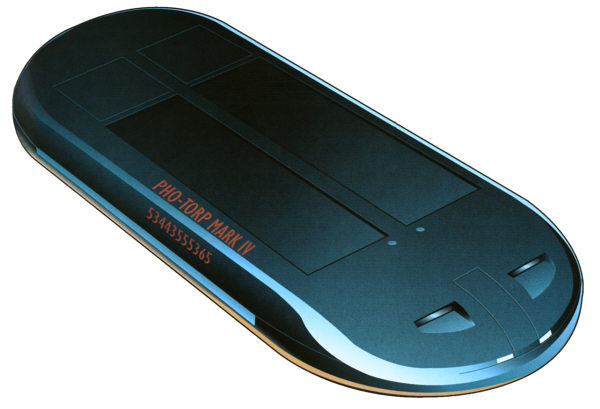

It is obvious that the solid torpedo was introduced in "Star Trek II" in the first place to serve as a coffin for Mr. Spock, and perhaps that purpose was even the reason why torpedoes (with the exception of those from the 22nd century) are still black. Since the torpedoes are accelerated in the launcher, the red glow may hint at excess plasma that surrounds the torpedo after the launch. But we can often see the torpedoes for several seconds, and we would expect such a kind of plasma glow to vanish sooner. Alternatively, we could imagine that the warp sustainer engine in the torpedo (according to the TNGTM) is responsible for the light. The probe in TNG: "The Emissary" that carried K'Ehleyr at warp and that is a design very similar to a photo torpedo (in fact, it's the same prop) does not emit any light though when it comes into sight, still at warp. So it remains somewhat of a mystery why the photon torpedoes are so bright. This is especially odd if we accept that at usual combat distances they need a couple of seconds to impact, and the glow would only make it easier for the enemy to target them.
Speeds of photon torpedoes
The TNGTM suggests that, when the ship is at warp itself, the warp sustainer engine of photon torpedoes may keep the torpedo at warp (as seen, for instance, in TNG: "Best of Both Worlds"). When the ship is not at warp, the torpedoes would be fired at speeds slower than light too. Still, we may assume that the driver coils of the torpedo tube accelerate the projectile to a very high speed, probably a considerable fraction of the speed of light.
Note The TNGTM states that the sustainer engine gives a torpedo another boost after it has been launched, but figures for the acceleration accomplished with the driver coils inside the ship are not given at all. According to the book, the formula vmax = vl+0.75vl/c applies for a torpedo fired at low sublight speeds, where vl is the launch velocity (probably of the torpedo itself and not of the ship!) and vmax the final cruise speed of the torpedo. This formula is wrong because the dimension of the term 0.75vl/c is not a speed, but a speed ratio. It seems as if the sustainer engine could accelerate the torpedo to 1.75vl (I have simply removed the faulty 1/c factor) which is also stated in the text. However, we are not told to what speed vl the launcher may accelerate the torpedo in the first place.
As it looks on screen, most notably in "Star Trek: The Undiscovered Country", the photon torpedoes always need several seconds from the launch to the impact. If the target is several kilometers away, their speed would be only a few thousand kilometers per hour, not faster than a present-day missile. Well, we have to take into account the "dramaturgic" close distance of the fighting ships too (see further below). Still, the time of several seconds to the impact remains, enough in my opinion to target the approaching torpedo with the phasers and destroy it. It seems we have to accept both the facts that the target is usually shown closer than it actually is and, in addition, photon torpedoes are slower than they should be.


Torpedo yields
Each standard photon torpedo carries an explosive antimatter charge of at least 1.5kg, according to the TNGTM. The simple formula E = mc2 gives us an explosive energy of as much as 270*1015 joules (that's 270 petajoules for prefix fetishists ;-)) for 1.5kg matter and 1.5kg antimatter. This equals 64.41 megatons TNT, but is only the theoretical maximum energy. Actually, a large amount will be lost because the mutual annihilation is only direct in the case of the electrons and positrons, whose collision produces gamma radiation. The much heavier nucleons undergo a more complicated process, involving a large amount of neutrinos which are lost without contributing to the explosive force. Finally, the torpedo casing, no matter of which material, will be quickly vaporized, and part of the temporary reaction products will be hurled away from the target and not contribute to the explosion either. Thus, a photon torpedo must be a "dirty" weapon with limited efficiency. In a realistic assumption, 16% of the theoretical maximum energy may be achieved. Since the explosion is omnidirectional, at most 8% would act upon the hull or shields of an enemy ship, 21.6 petajoules. This is obviously still a lot. After a development of almost two centuries, we may expect that the yield may have approached this figure, and whenever it is not considered, there would no reason not to charge a torpedo with a few kilograms more.
The usual shields of starships, on the other hand, have a power output of at most several gigawatts. I think it is futile to attempt an exact calculation about what effect a torpedo explosion should have on the shields, a very coarse estimation should do. If we assume that the energy of the photon torpedo takes as long as one second to be completely released, we still have a power impact of a few petawatts, a millionfold compared to the shields. I think that, no matter how exactly the shields work, they wouldn't survive a single nearby torpedo explosion, much less would the ship itself.
Nevertheless, we frequently see shields that can withstand whole volleys of photon torpedoes, and much worse, sometimes the ship even survives photon torpedo explosions with the shields down (such as the Enterprise-A in "Star Trek: The Final Frontier" or the Enterprise-D in "Star Trek: Generations"). Although, as I stated above, there would be no reason to arm the torpedoes with less antimatter if one really wants to destroy the enemy, it seems that the real charges must be a lot lower than shown on screen. In this respect it was good that, since Voyager, the dialogue usually referred to "isotons" instead of real masses - if only isotons had been used consistently and not the figures been increased (like those of the quads too) every few episodes.
Tricobalt torpedoes
Tricobalt torpedoes were first mentioned in TOS: "A Taste of Armageddon", and the appeared as rather crude, maybe old-fashioned weapons. Yet, over 100 years later, in VOY: "The Caretaker", tricobalt torpedoes belonged to Voyager's inventory and were used to destroy the Caretaker Array. We may explain this problem in that tricobalt devices have a high yield and are simple to handle, but only against targets with no or with limited defense.
A more severe problem may be that tricobalt torpedoes, according to VOY: "The Voyager Conspiracy", have a yield of "20,000 teracochranes". Since the cochrane is a unit for subspace distortion, are these torpedoes actually subspace weapons? And wouldn't they be banned under intergalactic laws ("Star Trek: Insurrection")? Maybe the Second Khitomer Accords mentioned in "Insurrection" only apply specifically to the isolytic weapons of the Son'a, but that doesn't seem to make much sense - in particular since a distortion of 20,000 teracochranes would be *a lot*, something like a black hole in subspace, something that would almost definitely destroy its structure. On the other hand, the figure is not only extremely high, but also its dimension is obviously erroneous. The cochrane figure doesn't give anything about the extent of the distortion which may be taken as a measure for the yield.
Other Weapons
Holographic weapons
We see fully operational holographic weapons in VOY: "Night" and "Star Trek: First Contact", for instance. With the safety protocols of the holodeck offline, the holographic beam weapon in "Night" works just like a real phaser (or rather a "Captain Proton ray gun" in this case), and Picard's holographic machine gun behaves like a gun with real bullets which may even be used to kill Borg (see below). This suggests that the holodeck doesn't only reproduce the look, sound, smell and feel of objects, but synthesizes their functions in their entirety - a perfect simulation in every respect, including that a lethal beam or bullet is created that would be indistinguishable from the real thing.
I don't think it is very plausible that the holodeck may create fully functional weapons for entertainment purposes in the first place, and only a safety protocol prevents them from being dangerous or lethal. While we know that there are other fully operational holographic devices too (like the generator in TNG: "A Matter of Perspective" and the interface Barclay built in TNG: "The Nth Degree"), I wouldn't think that the same applies to possibly lethal weapons. I would much rather expect that normally the holodeck only simulates the effect a weapon or any other action has on a holographic target, but not on anyone or anything physical that is taken inside the holodeck. For a battle simulation it would be useful to see these effects without doing any real damage, but no one in Starfleet would ever seriously consider to severely hurt or kill someone in a holodeck. Least of all, I would expect the holodeck to simulate a fictional weapon like the "Captain Proton ray gun" which is supposed to be only a prop in Star Trek, just like Star Trek phasers are in the real world. The same should apply to Picard's machine gun, or did he ever plan to use them against real targets?
If we assume that the sometimes, with the safety protocols off, holographic weapons are fully functional according to some set of parameters though, it basically would not matter if they were perfect simulations or the real thing - a replicated weapon that would work outside the holodeck too. Replicated weapons would face one serious problem though: The holodeck is a lot smaller than the distance between the weapon and the target may appear to be, and maybe it is not even physically directed towards the target. There would have to be some sort of forcefield or transporter involved to carry the bullet or whatever is fired to the location of a real target within the simulation, just like the "treadmill effect" for people inside the holodeck.
Bullets against Borg
The Borg have shields that can adapt to any kind of beam weapon in a matter of a few shots - the drones that are killed before the adaptation are obviously considered expendable. But why is it so easy to fight against the Borg with physical weapons? We may still easily explain how Data can strangle a Borg in "First Contact". After all he is exceptionally strong and the Borg usually shouldn't expect such kind of resistance from their victims. However, it seems a bit strange that neither their shields nor their body armor protect the Borg against Worf's mek'leth in "First Contact", for instance, or the virtual bat'leths in VOY: "Unimatrix Zero".

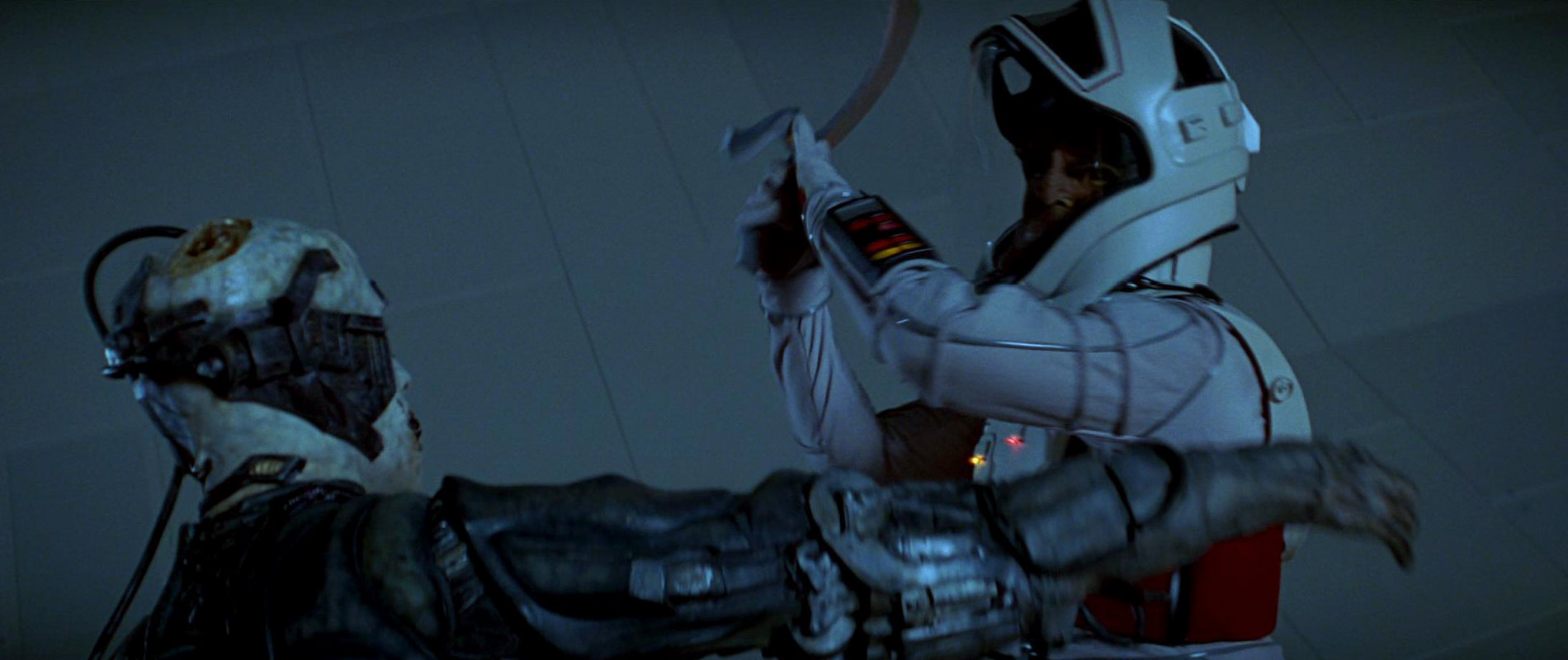
Picard manages to kill the Borg with a holographic machine gun. Even if we accept that, without the safety protocols, the bullets behave exactly like real ones, shouldn't they simply be reflected by the Borg shields or get stuck in the body armor? It still takes a few volleys until the Borg are finally dead, but wouldn't we expect their thick armor to offer significantly better protection than bullet-proof vests of our days? Again, we may argue that this is not the kind of resistance the Borg would expect to encounter, after all they are after advanced civilizations that don't use projectile weapons any longer. On the other hand, if it is so easy to kill them, why don't the enemies of the Borg, most of all the Federation, always use old-fashioned guns and swords against them? The Enterprise-E should have stored a load of machine guns. At latest when it was clear that the Borg were aboard, the crew should have replicated some guns.
In light of the working principle of Borg shields, as it is conjectured further down, we may explain why they block energy weapons, but not bullets. The shields obviously create a field that is designed to interfere with the weapon's frequency, as opposed to an energy barrier. We can assume that an energy barrier is impervious to anything with less energy, be it solid matter, a matter wave or energy. An adaptive field that is made to cancel out one specific (beam) weapon type could not accomplish that.
Yet, in every encounter so far it took the Borg a couple of dead drones until they could adapt their shields when they were hit with beam weapons of rotating frequencies. Unless we presuppose the phasers were upgraded prior to each Borg attack, the Borg may not be able to access the existing countermeasures immediately. Perhaps the structure of the collective consciousness is sluggish in this respect. If we go with this explanation, we don't really notice differences in their reactions to weapons.
Finally, we don't know for sure whether the Borg really can't withstand an attack with projectile or blade weapons, as opposed to one with phasers. Attacking them with physical force is always just the second option, after using the phasers. Perhaps the Borg can adapt their shields to these physical weapons just as well and we only didn't witness a fight that lasted long enough for this to happen.
Shields & Cloaking
Shapes of shields
Since TNG we are accustomed to the typical "shield bubbles" around a ship. It doesn't seem to be realistic in the first place to have a sharp border between the shields' inside and outside, if shields have anything in common with real forcefields, whose potential always decays with the reciprocal first power (r-1), and its field strength with the reciprocal second power (r-2) of its radius. This applies to electric fields, as well as to gravitational fields, the latter of which are supposed to be the basis of a Federation ship's shields, according to the TNGTM (see also "shields and cloaking" further down). The typical shield bubble since TNG was an ellipsoid, as it would be created by shield emitters sufficiently far away. Such a bubble can be seen in various TNG episodes and very clearly in "First Contact", when the Borg lock on the Enterprise-E. The shape however has changed recently, as we have seen the Enterprise-E with separate shields in "Insurrection" (that lit up only in a particular region when hit), and finally with almost "skin tight" shields in "Nemesis". It doesn't seem like an improvement (well, it looks rather like an improvement of visual effects), if incoming fire is deflected or dispersed as late as it has almost reached the hull. Also, the tight or partial shield would not have the homogeneity of the bubble, therefore exhibiting weak spots, even if crucial areas may be better protected. It is questionable whether the Federation would change its technology so considerably.
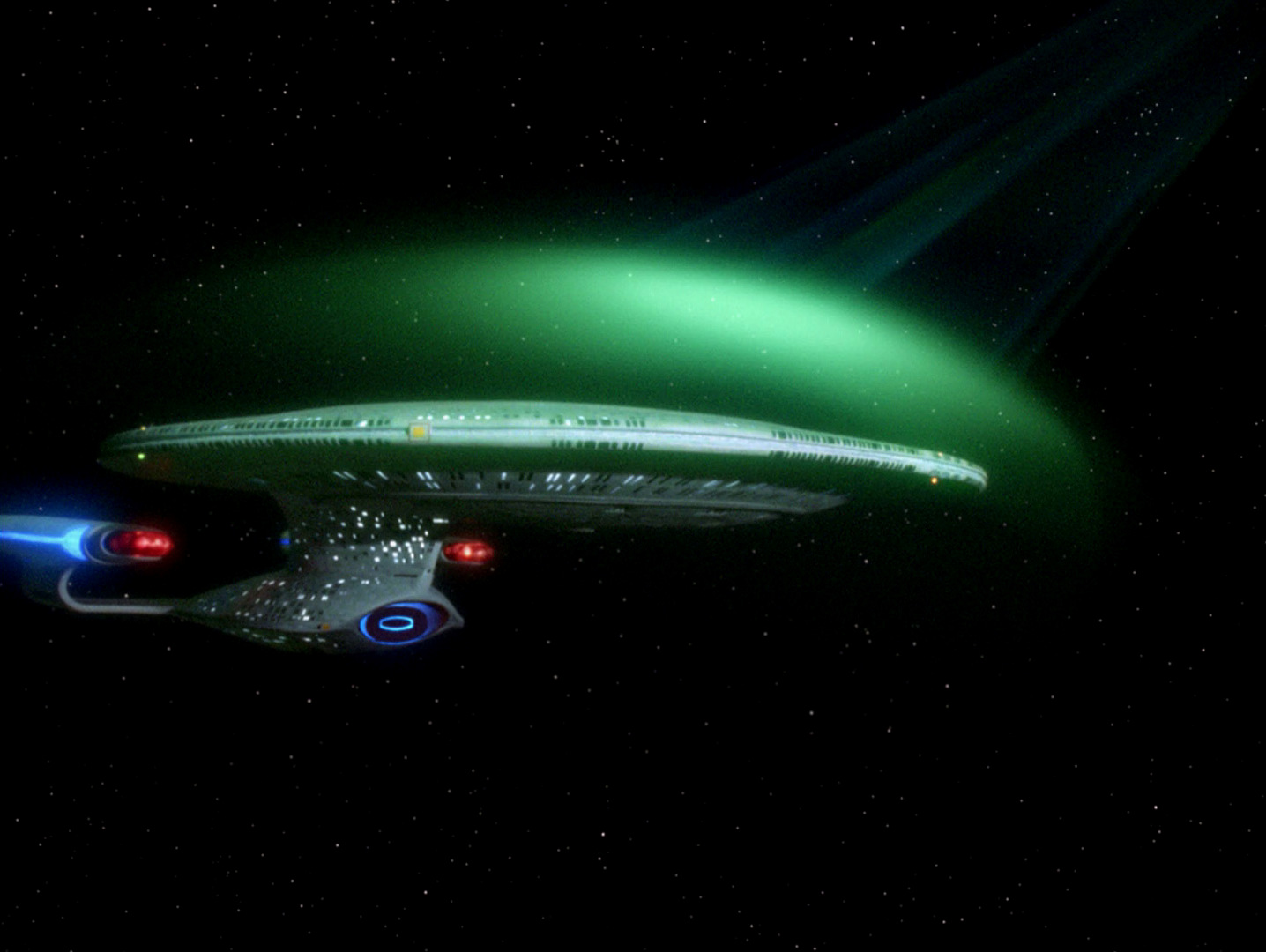
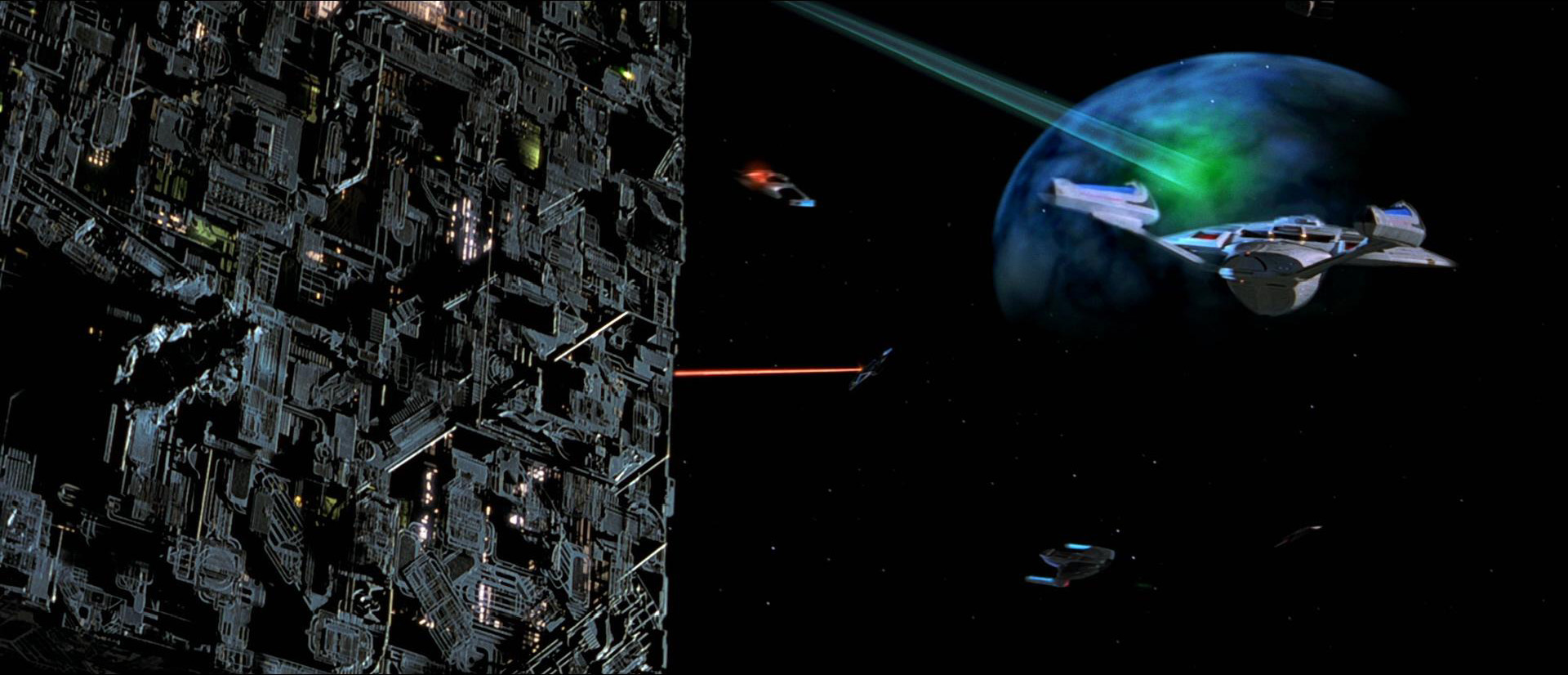
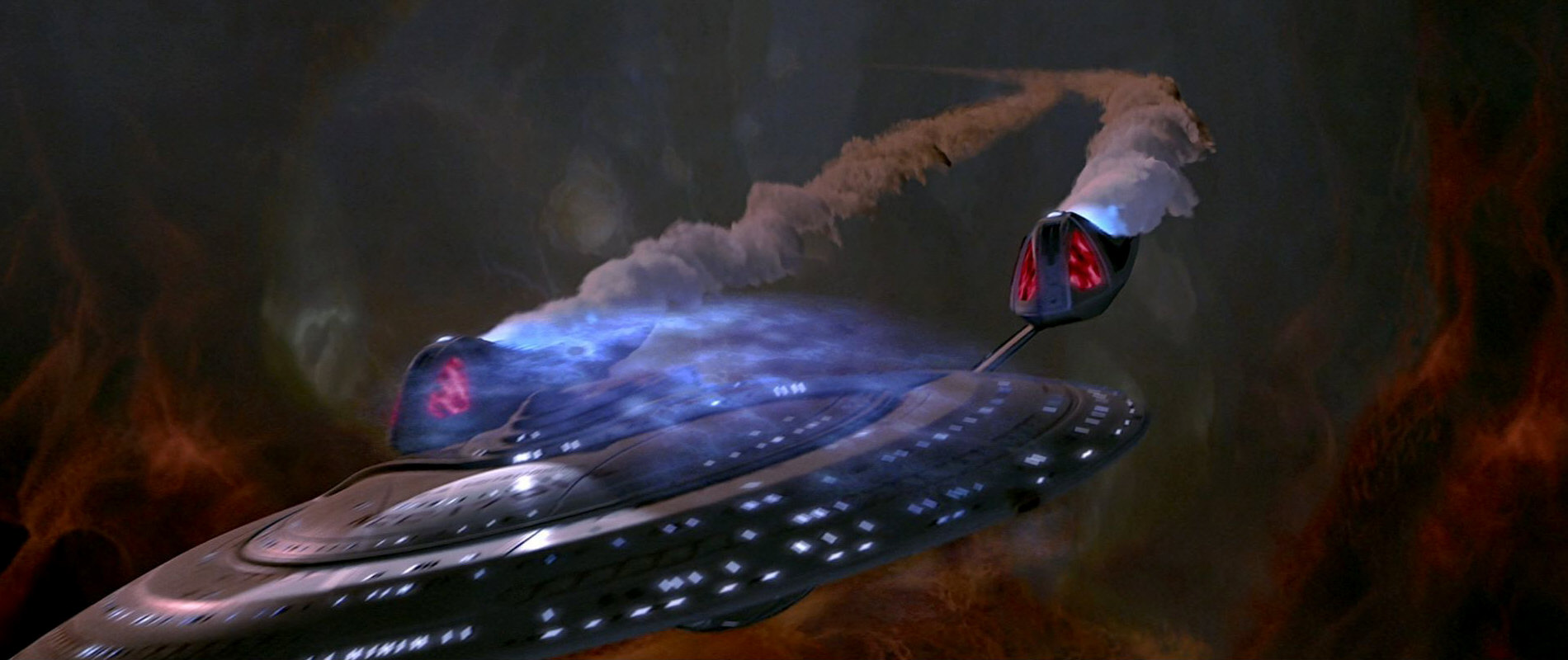
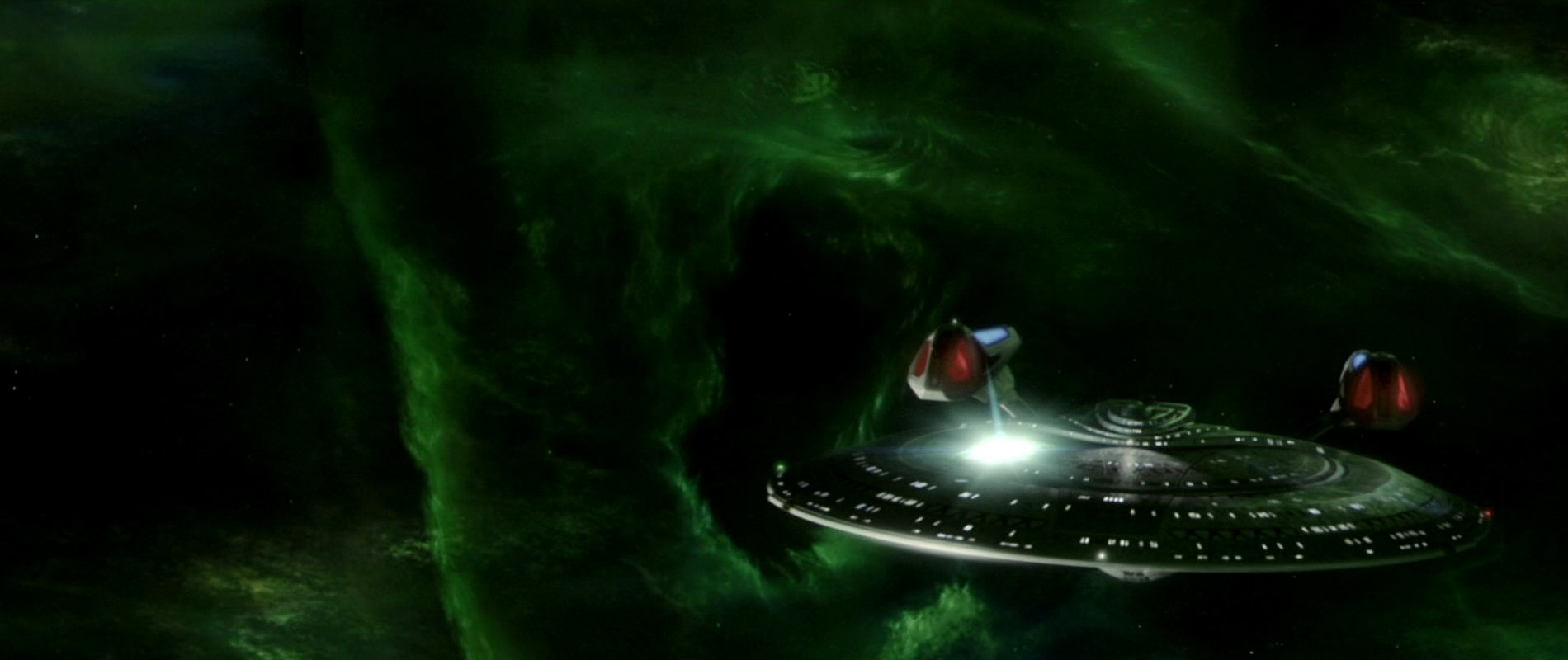
One possible reason for tight shields is that this way the shields are not unnecessarily weakened, by shots that would have narrowly missed the hull. I'd figure that the skin-tight shields would need more power to be maintained in the first place than a single bubble around the ship. But who knows if this wouldn't pay after one or two times the elliptical shields would have been hit.
Shields may be generally layered, as visible in TNG: "Datalore" and a few more episodes. Mike Okuda tells us about the visual effect: "Sternbach and I envisioned multiple shield layers, and 'Datalore' reflects this concept. The problem with this is that it required more time to create the visual effect, and in some shots, multiple layers would make it less clear as to what was happening (usually, an enemy energy beam hitting the shield bubble). As a result, in some episodes, the visual effects supervisors elected to go with a single layer. I attribute it to subspace compression." The skin-tight shields may be generated from different generators than the large bubbles of the TNG era. The skin-tight shields may serve as the last line of defense, in a similar fashion as the hull armor of the Defiant. This still doesn't comply with the observations especially from "Nemesis", where the ship seems to have only these tight shields. There would be no reason to have shields so close to the hull that not just the shields but the hull itself could take damage on impact - unless this type of shields only worked in the immediate vicinity of the hull (reactive armor) and for some reason better than the traditional bubbles.
Mark Temple thinks that tight shields may have their advantages: "Since shields are described in the TNG Technical Manual as a reactive system, detecting and blocking incoming attacks, there may be an advantage to a conformal configuration over a bubble configuration. In either configuration the system would detect a beam or torpedo, and if it intersects with the area the system is programmed to protect, block it with a gravity distortion. On a bubble configuration, the area programmed in would be large, with large areas of relatively empty space protected as the result of wrapping an effectively irregular shape with an ovoid. Such a configuration would end up activating to block attacks that would otherwise have passed through those empty areas without hitting the ship. Thus wasting energy and reducing the integrity of the shields. A conformal configuration would represent programming to cover a smaller area, against attacks which would actually have impacted the ship. While this would likely result in more complex programming, there would be an advantage in energy drain and preservation of shield integrity, allowing a ship's shields to stay active longer in battle."
It is still another problem that, in the battles of the Dominion War, many ships of the Federation as well as other factions don't seem to have shields at all. They are completely destroyed with the first volley of torpedoes. But rather than a real inconsistency, this is most of all artistic license. I personally imagine that those ships have taken previous damage.
Shield percentages
What does "shields at 47%" mean? Is the average shield strength down to 47%, or is it rather the angular coverage that is down to 47% of the entire surface? It seems that shields may not be switched on and off instantaneously, they may need to be built up and shut down gradually as seen in "Star Trek II". They may be charged in a similar way as phasers. In this light they are not devices that always operate at 100% (or even more), if only they are provided with enough power. Rather than that, they appear to discharge and thereby to lose their strength upon impact, even if nothing on the ship has taken physical damage. This would corroborate the notion that the whole system of shields, which forms a continuous bubble (see above) loses a certain percentage of its overall strength, no matter where it is hit.
If, on the other hand, the shield percentage were to refer to a coverage, this would imply that the shield emitters in certain areas failed completely, which would make no sense if there were no considerable other physical damage. One of the few arguments in favor of shield coverage is that power may be diverted to the shields. This suggests that, with a part of all shield emitters gone, it may be possible to increase the protection again by powering up the rest to more than 100% (there is always a safety margin in engineering). But this doesn't seem to be the case, as we have always witnessed shields continuously losing their strength. It seems that the additional power would be spent rather to recharge the shields than to gain immediate strength through more power. If a percentage of 50%, for instance, stood for a coverage, it would mean that half of the hull surface were totally unprotected. In other words, the ship would make quite a target and would take disastrous damage with the very next hit, which usually doesn't happen either. Instead of that, the percentage keeps further decreasing, while the ship remains intact (with the exceptions discussed in "damage despite shields" below).
There seem to be better arguments that shields lose overall strength. But the increasingly frequent mentions of particular areas like "aft shields down to..." seem to contradict this theory. In this light, maybe the shield strength should indeed take into account weakened areas as well as its overall strength. It is possible that the percentages are a combination of both the shield strength and coverage, calculated with a rather complicated algorithm. Only in case that there are particularly weakened areas that the captain would need to protect, the tactical officer would refer to something like "aft shields" in addition to the total figure.
Damage despite shields
Ships in Star Trek seem to take considerable damage already when the shields are still up. First of all, the ship rocks every time it is hit, although the shields can't be supposed to form a rigid framework around the ship that would be mechanically coupled to the hull. On the other hand, since the shield around the ship is changing its geometry (or is "pushed aside") when hit by weapon fire while the shield emitter power remains the same, this could indeed result in a force on the hull. Even simpler, the shaking could arise from a smaller amount of weapon power that is able to pass through and reach the hull.
The usual effects of weapons that penetrate the shields are scorches on the hull (most obviously in "Star Trek VI"), but very often even exploding plasma conduits inside the ship (as about every time when the Defiant or Voyager is attacked). It is yet another issue why high-power conduits are unwisely routed through bridge consoles, as there may be all sorts of security concerns, not only in a battle. Moreover, the most exposed location of the whole ship doesn't seem to be the right place for the bridge. Anyway, the question arises why and how exactly this specific kind of damage frequently occurs. Still assuming that "holding" shields keep away most of the weapon's energy, we should assume that, if at all, only the hull would be affected, and that the metal should shield the interior like Faraday's cage. Therefore it is not evident why most of the damage seems to occur inside the ship. Maybe the metallic hull plates actually have no effect in blocking weapon energy which we may explain with some quantum physics and technobabble. At least, it wouldn't matter in such a case where the bridge was located.
In "Star Trek (2009)" the Kelvin takes hull damage from the Narada's weapons while the shields are still in place, in a similar fashion as the Enterprise-A in "Star Trek VI". Likewise, the shields do not protect the Enterprise at Vulcan the way we may expect. This may be attributed in part to the fact that the 24th century weapons of the Narada are superior.
Simultaneous shields and cloaking
There is no generally valid answer to the question if a ship can be cloaked and shielded simultaneously. Romulan and Klingon cloaking devices seem to work similarly, although the ones of the Romulans are generally considered to be more advanced - also because, at the time of TNG, the Federation knows a bit about Klingon technology, but almost nothing about that of the Romulans. In TNG: "Redemption" we saw cloaked Romulan ships being fired on, and the weapons fire was dispersed, which indicates that they did have the shields up. In TNG: "Face of the Enemy", however, the Romulan Warbird couldn't be cloaked and shielded at the same time. The same applies to the Defiant in DS9: "The Search". The Klingon D-12 Bird-of-Prey in "Star Trek: Generations" could not keep the shields and cloaking up simultaneously either, and Worf used exactly this weakness to get the shields down and the cloaking up to be able to destroy the ship. At least the Klingon ship may easily be explained in that it was explicitly called outdated anyway, but the question about the capabilities of Romulan ships remains.
There is a more general problem about cloaking and shields if we take into account their working principles. The shields of Federation starships, according to the TNGTM, are made up of a graviton field and not, as one might have expected, of an electromagnetic field. This way, the shields would be based on the same technology as the cloaking that employs a graviton field to "bend" light rays around the ship, and both fields would possibly obstruct or even cancel out each other. On the other hand, we don't have to believe everything in the TNGTM if not explicitly stated in screen, and even if it is correct for Federation starships, the Romulans or Klingons may easily use a different shield technology that doesn't interfere with their cloaking. Maybe the similarity between shields and cloaking is even the explanation for what we have seen in "Redemption", as the apparent shield bubble could have actually been the bubble of the cloaking device.
Sight from inside a cloaked ship
For all we know a cloaking device, for instance one of Romulan/Klingon flavor, renders a vessel invisible by bending any light around its hull. The effect is that neither active nor passive sensors would receive anything from the direction of the cloaked vessel, except for the star background (which we must assume is not distorted, because otherwise it would readily give away the ship's position, like hinted at in "Star Trek III"). But what about the sight from inside the ship? If it is surrounded by a perfectly opaque cloaking bubble, then the ship would not only be invisible but also blind. This is definitely not the case, as on all occasions without exception we could witness or assumed that the crew was able to observe the space around their cloaked ship.
A cloaked vessel could use specially modulated light to penetrate the cloaking, but then a scan across the spectrum could reveal its location, especially since this light would need to be emitted in all directions. Maybe some light from outside still reaches the hull in spite of the raised cloak, enough to be amplified to half-way clear images. However, such a "light trap" must be assumed to re-emit some radiation (most likely in the infrared range). An alternative and rather effortless explanation is that a tiny probe, which would not be visible on enemy scanners, is kept outside the cloaked region. Maybe this is the true reason for the periscope on the Klingon Bird-of-Prey in "Star Trek V" (although we definitely wouldn't expect a pipe to protrude from the hull of the vessel)?
Beaming with shields up
It is an important concept, also for story-telling, that beaming is only possible when the shields are down. Entering the shield bubble with a shuttle isn't possible either, as we learned in "Star Trek V". In some episodes like TNG: "The Wounded" and TNG: "Relics", however, the transporter is definitely used while the shields are in place. In "The Wounded", O'Brien used a scan "window" in the shields of the USS Phoenix to beam over to the ship. In "Relics" we may assume that Scotty and Geordi, who were on the Jenolan to keep the door to the Dyson sphere open with the ship's shields, transmitted the shield frequency to the Enterprise. On the Enterprise, the frequency of the transporter carrier wave could be matched to that of the Jenolan shields. In a similar fashion the Duras sisters managed to penetrate the shields of the Enterprise-D in "Star Trek: Generations", after they had seen the frequency through Geordi's modified VISOR. It seems that, under normal circumstances without knowledge of the shield parameters, only friendly transporter activities are possible, if any. Otherwise enemies would succeed in beaming over boarding parties more often during a battle. But in DS9: "The Way of the Warrior", for instance, the Klingons can use only a short time during which the shields of the station are explicitly failing in certain areas.
Matching phaser and shield frequencies
In order to obstruct adaptation, the frequencies of ship and hand phasers are rotated in almost all of Starfleet's encounters with the Borg since TNG: "Best of Both Worlds". We may assume that the Borg analyze phaser shots and would be able to adjust their shields to block exactly the phaser frequency if this were not rotated. In other words, a Borg shield of a certain frequency would block or rather cancel out incoming fire of the same frequency through interference. In "Star Trek: Generations", however, quite the opposite happens. Here the Klingons, having found out the Enterprise's shield frequency through Geordi's VISOR, adjust their weapons to exactly this frequency to penetrate the shields. It seems that only Borg shields use the principle of interference, whereas Federation shields are designed rather to deflect, reflect or disperse incoming beams. Moreover, only waves of the same type would be able to interfere with each other. Considering that a phaser or disruptor is a matter wave, while the shields may be an electromagnetic field, a gravitational field (as the TNGTM states) or a subspace field, they should work on a different basis than interference. Maybe the shields are least efficient for some other reason at exactly the weapon's frequency.
There is one more problem. In "Generations" the Klingons match their phaser frequency with the Enterprise-D shields in order to penetrate them. But in order to fire through their own shields they would need to adapt these accordingly. In other words, they would open a window that may have allowed the Enterprise-D weapons to hit them likewise, but returning fire obviously failed while the Klingon disruptors were still firing. Either the different operation principle gives disruptors an advantage in mutual shield penetration, or shields work differently than we thought.


In a comprehensive (and somewhat speculative) concept to explain shield build-up and frequencies, it is possible that the shield bubble that forms just after the command "shields up" is not exactly the protective shield, but just a detection field. As postulated earlier, the shields or rather their storage units have to be "loaded". When the detection field is impinged on or distorted, the batteries are then rapidly drained of enough energy to neutralize the thrust with the exact counter-frequency, canceling it out. This would have the effect of a measurable thrust on the hull (accounting for the characteristic hull rock as the ship takes hits) as the counterthrust leaves the ship in question. Also, it may be possible to distinguish incoming and outgoing fire. This also accounts for why shields can be penetrated if the frequency is known - the detector field will not react to itself, naturally. By the time the surge of power can be detected it is already at the hull - far too late for an effective counterthrust. In "Generations" the permanent shield rotation may have been offline for some unknown reason, and even if this seems to be an idiotic negligence it allowed the Klingons several hits with their accordingly adjusted disruptors.
Protection suits
Why do Starfleet away teams always beam down to dangerous planets with no passive protection at all? Agreed, it is a tradition since TOS, and actors without heavy armors simply look better (and decidedly peaceful) on screen. Anyway, at least in episodes with ground troops like in DS9: "Nor the Battle to the Strong" or "The Siege of AR-558" I would have expected to see much more than standard issue lycra suits. I think that, even if it doesn't sustain a heavy phaser blast (after all even a hand phaser can be used to blow holes into solid rock or solid metal doors), a light armor and helmet would be useful to avoid secondary wounds from explosion fragments, for instance. Since aliens like the Klingons or the Jem'Hadar have protection suits (at least they look as if they are protective), this should considerably increase the chances of Starfleet troops to stay alive.
Tactics
Battle distances
 It is plausible that ships come very close to each other in a peaceful encounter, but the same seems to apply to battles. Although the distances in dialogues are usually hundreds or thousands of kilometers, their distance on screen is usually at most one kilometer. The real-world reason is obvious, as it is possible to shoot two ship miniatures at once if they are close to each other. Also for the drama it may be regarded useful if the enemies see each other almost "face to face" at point-blank range and not only on the viewscreen. It is controversial whether the definite statements or the definite visual evidence should be taken as true. I think that usually it would make no sense to come very close to a (possible) enemy, unless it was a suicide attack. The reaction times are simply too short, and the phaser yields can be considered still higher at short distances. Only for a small ship that is going to fight a large one, the close attack would be a useful tactic, as the large ship could make use only of a part of its weapons at once, and the small ship would be hard to hit at a short distance, like we have seen it in DS9: "Shattered Mirror" or DS9: "Valiant".
Mark Temple mentions a reason why point-blank combat could make sense: "One possible reason why many battles occur at relatively short distances was detailed in the TNG episode: "A Matter of Honor". Riker, having become an officer on a Klingon ship, suggested closing to a very close distance from the Enterprise-D before attacking, "to reduce reaction time". At such shot distance not only would both sides only have a few instants to decide what to do, but their ships would be able to enter and leave the weapons arcs of the enemy much more quickly. At a distance of several hundred thousand kilometers (as we see in TNG: "The Wounded"), it would take some time for a ship to pass through the weapons arcs, since it is a relatively slow moving target at that distance, and the area of the sky the weapons cover is much wider. Targeting such a distant target would be somewhat simpler, and more time could be spent refining the shot before firing without losing the target. At close range, the target would be changing its relative position much more rapidly, and finding a firing solution in the short period of time the target is within the firing arc of the weapon becomes more difficult."
Credits
Some screen caps from TrekCore. Thanks to Mark Temple for various suggestions, to Fernando for the hint about the light effect of torpedoes, to Carsten for the suggestion to care about the "Bullets against Borg" issue, to David Blalock for a correction about bullet-proof vests, to DAS for the tricobalt torpedoes and various considerations about shields, to Denaal Sovek for notes about holographic weapons, to Slosh for suggesting that Borg shields are based on interference, to DungeonMaster for pointing out the shields & cloaking problem, to Mimi Billewicz for bringing up "blind cloaked ships", to Rainer Semmelmann for thoughts about mutual shield penetration, to James Burke for more ideas about skin-tight shields, to Gregory Price for the mentions of phasers at warp in TOS and to Erwin Grootes for the quote about the ACB-jacketed beam devices. Special thanks to Chris for the information about yields of matter-antimatter reactions and to johndmes for the theory on shield formation and frequencies.


