


Abramsverse Inconsistencies
Star Trek (2009)Star Trek Into DarknessStar Trek Beyond
 The three "Abramsverse" films, starting with "Star Trek (2009)", take place in a new continuity, the Kelvin Timeline, which is interpreted differently by some fans though. Anyway, from the moment that the USS Kelvin runs into the Narada, galactic history, personal histories and technical developments diverge from what we know of the TOS era. There is no problem with young Kirk knowing how to drive a stick shift car, which Spock had to show Captain Kirk in TOS: "A Piece of the Action". Several altered basic principles of the Star Trek Universe and real-world facts, as well as the plot holes of the movies constitute inconsistencies though. A few of the problems particularly of "Star Trek (2009)" are explained in the Countdown comic or in deleted scenes, but they do not make sense in the film itself.
Star Trek (2009)
- The Kelvin's registry is NCC-0514. While we don't know for sure how ships were numbered thirty years before TOS, it is still an oddity. If anything, I would expect a leading "0" to be added after the introduction of 4-digit registries, rather than removed from older ships such as the USS Grissom NCC-638.
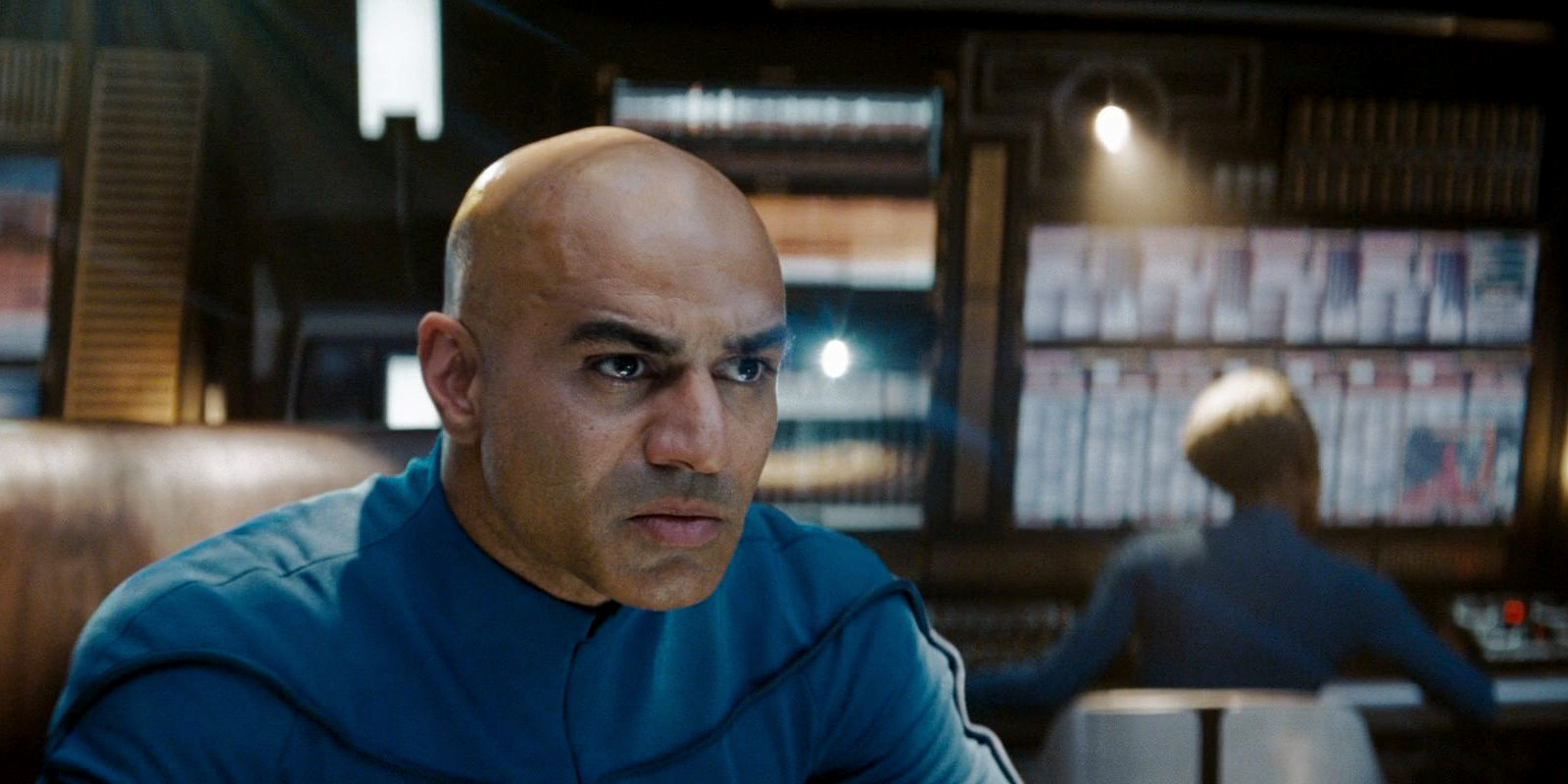
- Why is Captain Robau wearing a blue instead of a golden uniform? This implies that there must have been not just a uniform switch (to the "The Cage" uniforms) but also another so far unknown department color permutation some time later in the Prime Universe.
- There is a window on the Kelvin bridge instead of a solid wall with a viewscreen as on all other Starfleet vessels of the future or past that were ever shown. This is not a one-off phenomenon, considering that the alternate Enterprise has such a window too. So there is something different about the parallel universe designs, only that the Kelvin predates this universe.
- Robau orders red alert, which implies that the shields are raised. The Kelvin's shields, however, are totally useless. All missiles from the Narada impact without meeting any resistance. Later in the movie the shields (that Pike raises before entering the orbit of Vulcan at Kirk's request) won't be much protection for the Enterprise either. 130 years more advanced or not, Nero's mining ship has marvelous weapons that penetrate shields so easily.
- After the first missiles have impacted, engineering reports that the weapons are offline. Yet, only a few seconds later the Kelvin fires phasers.
- Captain Robau's turbolift is going down when it arrives in the shuttlebay, but the shuttlebay is located in the upper pod.
- The struts in the engineering section of the Kelvin are riveted, a construction technique that became obsolete in the late 20th century (and that can't be found anywhere on Enterprise NX-01, for instance).
- Why is the appearance of the Romulan Nero not a total surprise to the crew of the Kelvin? At this time, humans have never seen Romulans face to face (at least no one has survived to report of it), as clearly evidenced in TOS: "Balance of Terror". Why doesn't anyone surmise that he has to be a Vulcan because that is how he must have looked to them?
- The Romulans in this movie do not look like any other Romulans of the 24th century though. They have lost the V-shaped forehead bones that all members of their race had since TNG. The real-world reason is that the flat variant looked best in make-up tests.
- Why is it that Nero and all of his crew are bald and tattooed? Is that a common fashion among miners or did they all quickly change their look after learning of the demise of their planet? And while they were at it, did they swear eternal loyalty till death to their leader, in any century? It is hard to believe that Nero had everyone that perfectly under control for 25 years. In Countdown, shaving and painting the head is a Romulan mourning ritual. Because of their insurmountable pain the crew of the Narada keep this look permanently.
- Nero? Did our Rom(ul)an baddie captain quickly make this name up to impress his human opponents with his knowledge of Earth's history? It is contrived. Or is it some more profound in-joke, as the full name of the Roman Emperor Tiberius was indeed Tiberius Claudius Nero?
- The stardate system has never been consistent, but for what it's worth in the new movie they gain a whole new meaning. Now the full decimals simply denote the (Earth) year! Jim Kirk is born in the year 2233 on Stardate 2233.04.
- Is the Kelvin always carrying families of officers, or why is Winona Kirk on the ship in the first place, in her ninth month? Well, the Kelvin reportedly has a crew of 800, which is twice as many as on a Constitution class 30 years later in the Prime Universe, but the Kelvin is only a survey ship. So why the families and/or the big crew?
- For a survey vessel the Kelvin's armament is formidable, at least she withstands the attack from the Narada much longer than the whole (albeit totally unprepared) fleet at Vulcan 25 years later.
- Why doesn't the Narada attempt to steer clear when George Kirk sets a collision course? The impact of the Kelvin obviously inflicts quite some damage.
- The movie plot is built on a chain of coincidences that was constructed to get the seven main characters of TOS and essentially only these characters together on the Enterprise in some fashion, to link their destinies as if it has to happen again in the parallel timeline, under totally different circumstances. The first link in the chain is when Nero arrives in the past. It is almost the exact place and time where Winona Kirk is heavily pregnant with her son, who would be the best friend of Nero's archnemesis (or so he believes), Spock.
- The region of the real Riverside, Iowa, is not as flat as in the movie, or largely bereft of vegetation. The crevice that becomes the grave of the classic Corvette is definitely man-made. But the topology of the wide plains does not look like it could have been flattened.
- Since when is the sky of Vulcan blue? While it used to vary between red and yellow shades from TOS to ENT, we never saw a blue sky so far. Orci and Kurtzman explain the blue sky as "seasonal" and T'Pol mentions an "occasional" blue sky to Archer in ENT: "Strange New World". Still it is an oddity that only in this movie we can see the blue sky even on two different occasions.
- We do not know when and how Kirk's Starfleet career started in the Prime Universe. But Pike makes a point that Kirk has been hanging around for years instead of doing something useful with his life, which he would have done under different circumstances. So in the Prime Universe, Kirk would not go to that bar as a twenty-something years old man and meet Uhura, who would later serve on his ship. He also wouldn't get acquainted with McCoy on a shuttle, who would later serve on his ship. These are two further totally unlikely coincidences.
- On a further note about the bar, what are several Academy cadets doing there, in the middle of nowhere in Iowa? The Academy is in San Francisco. Pike's presence, on the other hand, may make sense, considering that at this time he may already be meant to take command of the Enterprise that is being built in the Riverside shipyards. Well, perhaps the cadets are taking a tour of the shipyards.
- How old is Captain Pike? In TOS: "The Menagerie" Commodore Mendez states that Pike is about Kirk's age. But in "Star Trek (2009)" Pike is Kirk's fatherly friend, at least 25 years older! Well, the problem dates back to the time of TOS. Jeffrey Hunter, who played Captain Pike, was 38 at the time "The Cage" was produced (1964). William Shatner was 36 when he was in "Menagerie" (2267). Here Kirk meets the disabled Pike, now played by another actor whose age in his role is hard to estimate because of the make-up. But that supposedly takes place 13 years after "The Cage". So Pike is definitely older than Kirk. Not just because of the visible age, but also because he commanded a starship a decade prior to Kirk - unless Pike was promoted straight from Cadet to Captain. Anyway, Commodore Mendez still claims that the two are the same age. Perhaps because he himself is much older? Not really. Malachi Throne, who portrayed José Mendez, is barely three years older than Shatner. So the error was already with "The Menagerie", although "Star Trek (2009)" arguably worsened it.
- So starships are being built on the ground in this alternate timeline (assuming that the Enterprise is not a one-off exception). It contradicts the overwhelming evidence of starships that are assembled in drydocks, as previously seen around a dozen times, most notably in VOY: "Relativity" and in ENT: "The Expanse". It also makes very little sense, one reason being that starships are just not built for being operated in an atmosphere and gravity, and that the ship would have to be specially reinforced just for the ascent.
- In the Prime Universe the Enterprise is almost definitely built in space, and Kirk rises up the ranks until he can eventually take command of the ship. In the new timeline, the alternate version of the ship (at least one with the same name and purpose) is being built on the ground, conveniently only a few miles away from his home.
- In the alternate reality the Academy is located on the shore of the Presidio, not far away from the southern end of the Golden Gate Bridge. We can spot the present-day Transamerica Pyramid, perhaps 1 or 2 kilometers away from the Academy, amidst many much taller buildings. The direction of the building is roughly correct, but the real Transamerica Pyramid should be located some 4km away. Moreover, in order to be able to see the building from there the way it is possible in the movie, it would require to lower Russian Hill, one of the most prominent parts of San Francisco, almost to sea level!
- In the new universe, Spock, Kirk's closest friend in the Prime Universe is A) the one who programmed the Kobayashi Maru scenario that Kirk cheated, B) the second in command on the ship that Kirk's friend Bones gets assigned to, C) the boy-friend of his Orion love affair's roommate Uhura. Moreover, Spock's Prime Universe counterpart is D) the target of Nero's insane crusade in the course of which Kirk's father was killed in the first place. One coincidence would have sufficed to bring them together but for some reason it had to be four. Well, the fact that Spock programmed it would at least nicely explain why he never took the Kobayashi Maru scenario, as stated in "Star Trek II". This could be the same in the Prime Universe and the Kelvin Timeline.
- The Klingon ships mentioned in this movie are called "Warbirds". Even the often scorned Brannon Braga admitted that the "Klingon Warbirds" in ENT: "Broken Bow" were an error, so why is it repeated here?
- On a general note, where do all the new aliens suddenly come from and when will they be extinguished (or leave the Federation for good)? Actually, as far as I could see, every single alien aside from the Vulcans, Romulans and the Orion has to be classified as a new species: Alnschloss K'Bentayr on the Kelvin bridge, the female doctor with the big eyes who helps Winona Kirk deliver her baby, the long-faced guy sitting in the bar between Uhura and Kirk, the dark-skinned alien with a big head on the Enterprise bridge and Scotty's little friend Keenser, to name only the most obvious ones. Well, we've had many otherwise unseen aliens in "Star Trek I" and in "Star Trek IV" as well, and at least the many alien cadets may be there as part of a cultural exchange program. Still, it is an oddity that almost all aliens we see at any time are new, and a missed opportunity to create stronger consistency with old Trek by showing familiar aliens (Andorians, Tellarites, Denobulans, Bolians, etc.).
- The distress call from Vulcan makes Starfleet think that the planet is struck by a natural disaster or a space anomaly. Doesn't have Vulcan any satellites, orbital stations etc. that could have quickly identified the trouble as man-made, as the attack that it was? Heck, Amanda could see the drilling beam from her home! But Starfleet is unaware of the attack until a whole fleet drops into orbit, with their shields down, and falls prey to the Narada. Well, just like it didn't allow the use of the transporter, the Narada has probably jammed all comm frequencies.
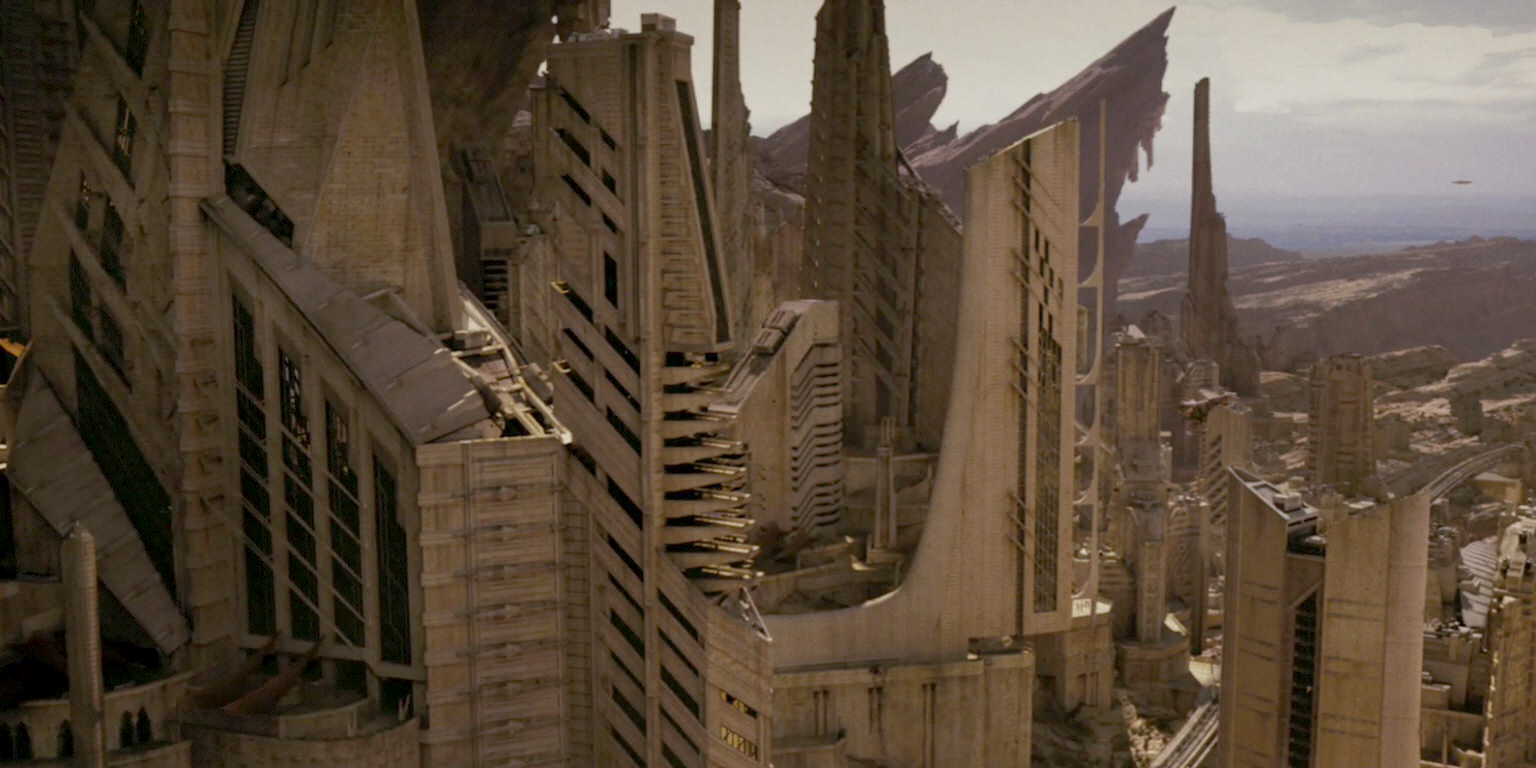
- Since when is San Francisco composed of irregularly shaped gray mile-high buildings? Sure, the future city looked somewhat different in any series or movie so far, but always had skyscrapers of moderate size and shape.
- Much has been written on the new look of the Enterprise (and most of it as it seems by me). In the alternate universe setting it is okay for the ship to look different (and to be launched later). But why does the Enterprise have a saucer section much like in TMP? It would have been more plausible if Spock had brought some plans from the 24th century, which could readily explain why the ship and pretty much every technology is different. But Spock arrives in the past after the ship has already been built, so this is a missed opportunity of explaining why its saucer looks like on the TMP Enterprise, some 12 years ahead of time. It is not really inconsistent, but this tip of the hat could have made more sense, just as every other technology that works differently and may be more advanced than it should be.
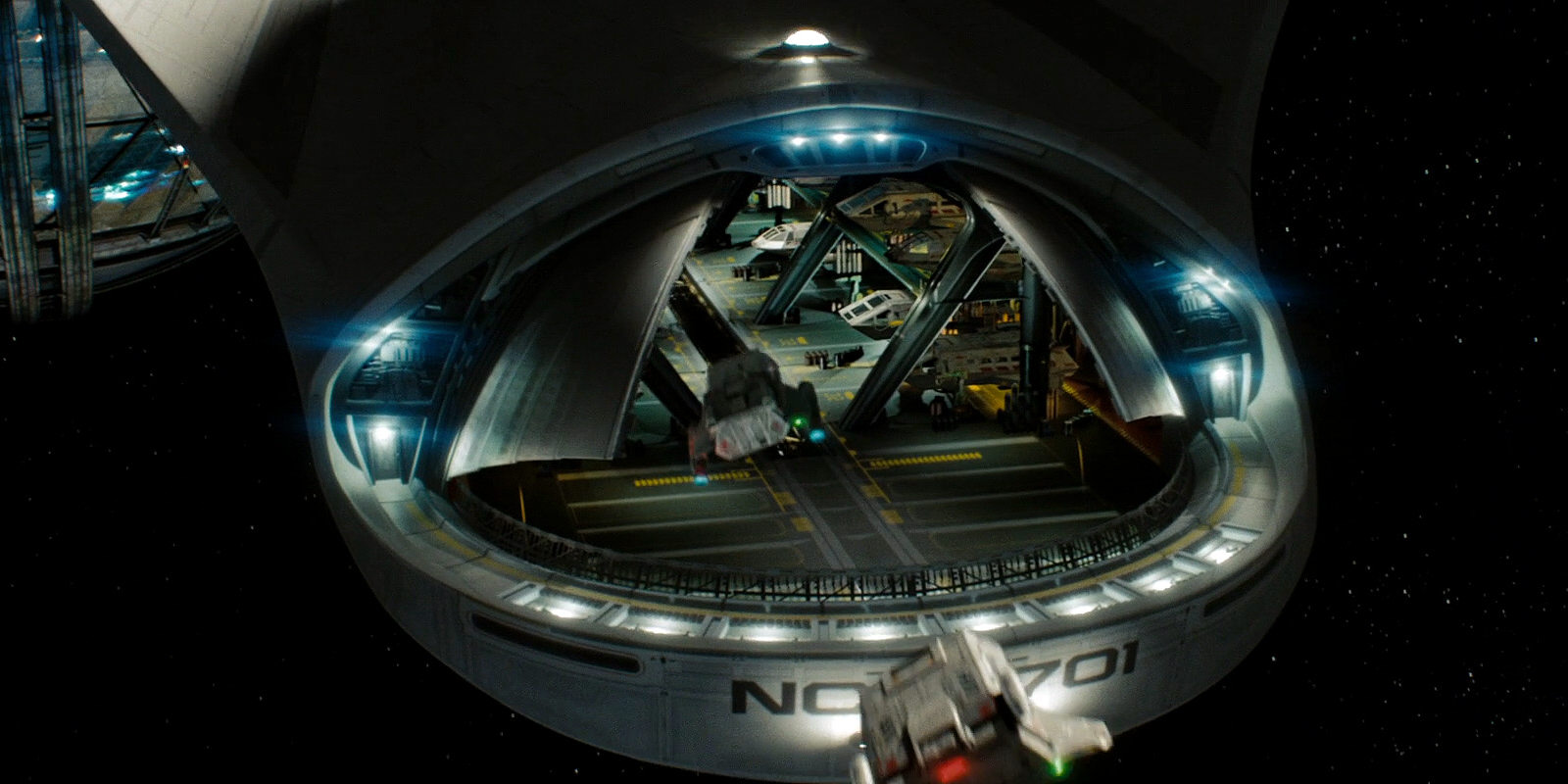
- When the shuttles from the Academy arrive at the Enterprise, we can see that about a dozen of them are stacked on two levels on either side of the shuttlebay. The shuttlebay has to be some 40m across to accommodate the 10m+ shuttles in the shown fashion. This would translate to a length of the Enterprise of over 700m meters! Such a monster ship would be bigger than a Galaxy class, and its volume would be 16 times(!) that of the Prime Universe original Enterprise. Still, the visible deck structure indicates that a size of 366m as originally designed is more likely, no matter what the people in charge of the VFX keep saying. What remains is just a purposeful mis-scaling that has to be ignored for anything else about the ship design to make sense.
- In the Prime Universe, the familiar crew of the Enterprise was not complete until 2265/66 (depending on what we make of Chekov). The date of the new movie is 2258, however. Chekov is still a teenage prodigy, and for everyone else it must be earlier in their career as well, most obviously for Cadet Kirk. While Kirk is sneaked aboard by Bones, everyone else is already a part of the crew of exactly that vessel, however. How slim is that chance?
- Chekov Prime was born in 2245 (TOS: "Who Mourns for Adonais?"). The new Chekov, on the other hand, is 17 years old as of 2258, placing his birth in the year 2241. Is it possible that, for some reason, Chekov's parents decided to have children earlier? It is debatable whether under slightly different circumstances children could be genetically identical. But if we choose not to ignore the problem and if the new timeline serves as an explanation for this continuity issue, the "Star Trek (2009)" Chekov has to be a genetically different person, something like the non-existent older brother of Chekov Prime (Perhaps he should have been named Pyotr?). This would at least explain his curly hair, while the new Chekov at least has the accent in common with his almost-counterpart in the Prime Universe.
- How can a 17-year-old be a fully fledged Starfleet officer (unlike "Honorary Ensign" Wesley)? I doubt that the Academy would accept a 13-year-old boy, prodigy or not. And even if Chekov has needed only two years to pass his final exam, it is still a bit of a stretch, just because Starfleet may not consider him mature enough for the job.
- Since when is an access code necessary for someone to make a shipwide announcement? Sure, access must be restricted, but even if Chekov isn't generally authorized, wouldn't the 23rd century computer software be smart enough to recognize that he was ordered to do so by Captain Pike? Or couldn't the software compensate for his accent?
- When he is listening to Uhura under Gaila's bed, Kirk picks up something the destruction of 47 Klingon ships in the same night. The next day on the Enterprise, when Chekov briefs the crew about the situation on Vulcan, he says: "At 22:00 hours telemetry detected an anomaly in the Neutral Zone, what appeared to be a 'lightning storm in space'. Soon after Starfleet received a distress signal from the Vulcan High Command, that their planet was experiencing seismic activity". It may be the Romulan Neutral Zone but, considering the involvement of 47 Klingon ships, just as well the Klingon one that may have existed at this time in the 23rd century. The described "lightning storm" near the Neutral Zone is clearly meant to be Spock's arrival in the 23rd century. The problem with this sequence of events is the coincidental proximity of Vulcan to the Neutral Zone. Just before or after defeating a whole fleet of Klingons, Nero on the Narada must have captured Spock and the "Red Matter". He set a course to "Delta Vega" and then to Vulcan. And all of this happened in less than a day! The galaxy has to be quite small if Spock emerges from the Neutral Zone (whichever it is) at most a few light years from Vulcan (and from "Delta Vega" which, in this case, definitely has to be in the same star system).
- We don't know how long exactly the "mild sedative" knocks Kirk out, but surely not more than 30 minutes. Everything else is shown in real time after the Enterprise has left for Vulcan, and when Chekov makes his announcement after Kirk is awake again, he explicitly says that it would still take three minutes until the arrival. So let us assume the journey takes 30 minutes. This would correspond to warp factor 65! If you don't believe me, the distance between Earth and Vulcan is 16 light years (ENT: "Home"), and the warp factor (TOS scale) is the third root of the ratio of ship speed vs. light speed.
- When Chekov speaks of a "lightning storm in space", Kirk remembers that the circumstances under which the Kelvin was destroyed were similar. He only needs the confirmation from Uhura that it was the Romulans. I find it hard to believe that Uhura would previously tell Gaila of the 47 destroyed Klingon ships but without mentioning that it was a huge *Romulan* vessel. The question whether or not Uhura reported the incident to her superiors remains unclear. Pike neither explicitly confirms nor denies his knowledge of the incident. He just says, "And you know of this Klingon attack how?". If he was informed, it may be through the report that Uhura compiled in the first place. But that still leaves two other equally probable possibilities, that Pike didn't know it because neither Uhura nor anyone else reported it, or that he did know it from someone else because Uhura just didn't mind reporting it.
- When Kirk races to the Enterprise bridge to warn Pike about the Romulan threat, we can see him run through a corridor that is directly attached to the bridge. This may be another sign that the ship is as long as 725m, because in this case the base of the bridge module would measure as much as 45m in diameter. While this corridor doesn't make as much sense on a bridge module of just 22m diameter on a 366m ship, such a deck layout is not impossible though.
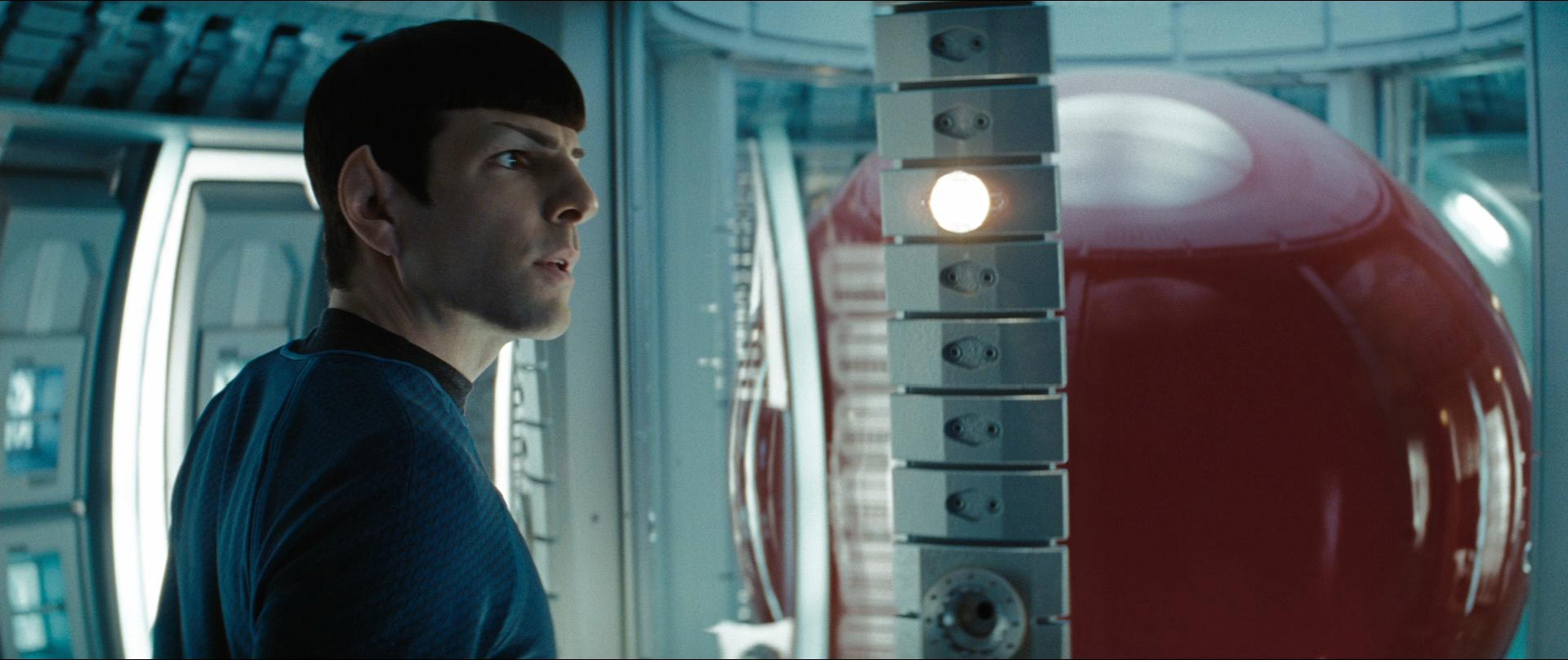
- A huge amount of "Red Matter", a ball of more than a meter across, is stored aboard Spock's ship. To destroy Vulcan, only a tiny drop of less than 1cm in diameter is sufficient. We may surmise that much more Red Matter was needed to create the black hole to eliminate the Hobus supernova. On the other hand, it can't have been a lot more than what is still stored on Spock's ship, considering that the confinement cylinder is only a bit wider than the remaining Red Matter. Actually, we see the original amount of Red Matter in Spock's flashback at a later time. So what was all the excess Red Matter deemed useful for in the first place?
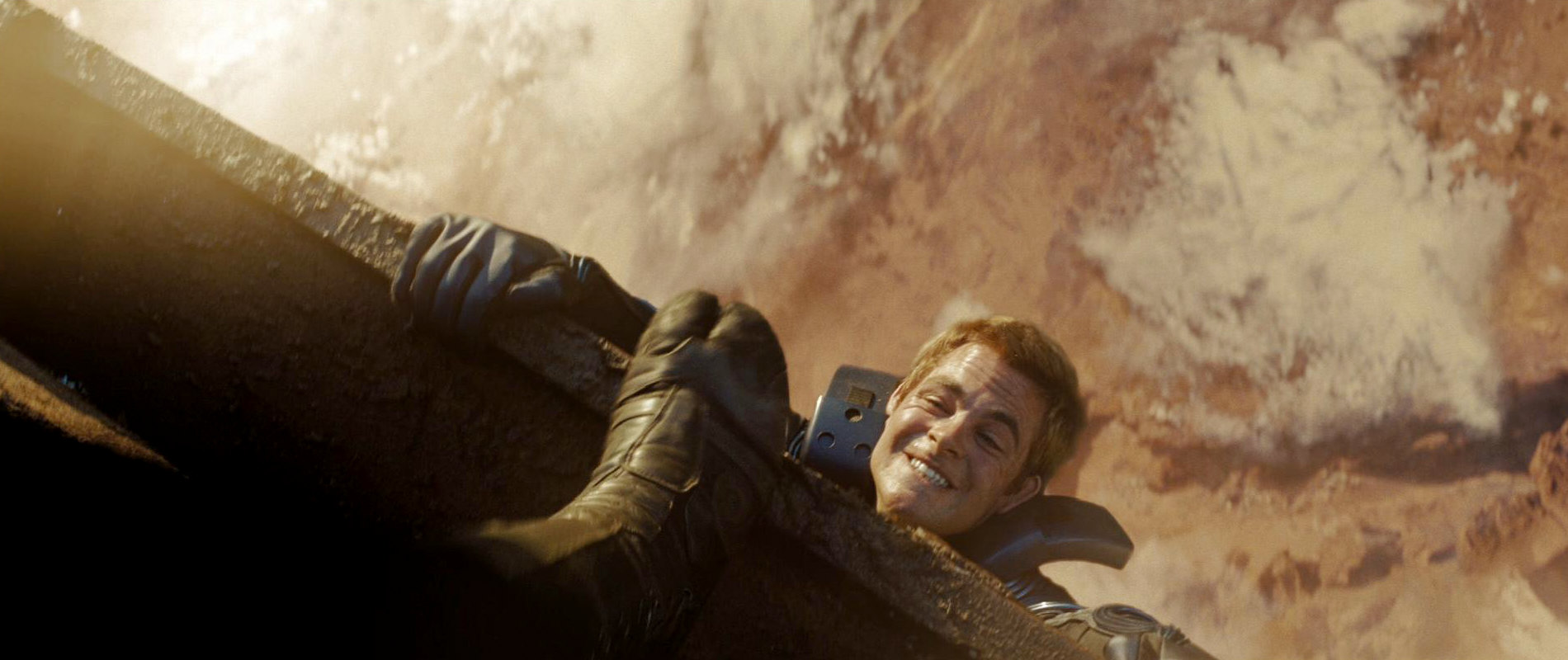
- The view down from Nero's drilling rig insinuates that it must be at least a hundred kilometers above the ground, comparing this with satellite photos of Earth. On the other hand, Kirk, Sulu and Olson use parachutes, and at least the first two have no major trouble breathing the air. So unless the Vulcan atmosphere is much thicker or for some reason the pressure is not exponentially decreasing with the height above the ground, there is something wrong.
- Moreover, in order to drill a hole in the first place, which takes at least as long as the flight from Earth to Vulcan, the Narada has to maintain the position above the drill hole. In stationary orbit? Hardly, because that would to be tens of thousands of kilometers above the surface if Vulcan is an Earth-like planet. So the Narada most likely uses the engines to maintain the position not far above the platform. But then why is there a drill platform and a tether at all? Why is the drill beam not generated on the Narada, where all the energy must come from anyway? Why bother to transfer it to the platform?
- Why is only redshirt Olsen carrying the charges that are required to blow up the drilling platform? Wouldn't it have been a lot wiser to equip Kirk and Sulu with explosives too?
- The Narada jams all comm frequencies, but communication with the skydivers is possible.
- All phasers of the alternate universe, beginning with the ship phasers of the Kelvin, seem to fire bolts instead of continuous beams, unlike any phasers of TOS or TNG or the phase pistols of Enterprise. The only comparable phaser beams could be seen in "Star Trek II". Yet, it seems as if the "Star Trek (2009)" universe has either switched back to pulse weapons, or they have pulse phasers such as on the Defiant everywhere.
- The warp drive, the phasers and even the transporters all make some sort of shooting noise when they are activated. There used to be a "bang" at times when the warp drive was activated (most memorably in TNG), but there is supposed to be no sound in space anyway. The traditionally sizzling transporter noise is in the new movie, but there is also the bang. And the previously just hissing (pulse?) phasers and the Romulan disruptors suddenly sound a bit like the machine ray guns of Battlestar Galactica (reboot).
- This timeline seems to have the slowest and overall least capable transporters of 200 years of Starfleet history. It was no wise idea that in Star Trek Enterprise transporters were almost as powerful as they would be in the 24th century. But making them more primitive in "Star Trek (2009)" doesn't exactly help (even though we may attribute the slow speed to additional features such as biofilters).
- Nero creates a black hole inside Vulcan using small doses of a mysterious "Red Matter". Uhm, well... But we need to wonder why it is necessary to drill a hole down to a planet's core to completely destroy it. As we can see in the end, it is absolutely sufficient to create a nearby singularity that sucks in everything in its vicinity. Maybe not so nicely symmetrically though.
- Only 10,000 Vulcans survive according to Spock's estimate. So virtually no one was evacuated in time, and there are apparently hardly any Vulcans in any colonies, or on vacation on other planets. I find that hard to believe. Roberto Orci told the fans in a Q&A session that this number may not include off-worlders.
- Nero attacks a major planet of the Federation without meeting any serious resistance. He destroys a whole fleet of Starfleet ships and heavily damages the Enterprise. He was so close to his goal of destroying Vulcan. Why does he still need Captain Pike's defense codes? Why would he waste time for that? On the other hand, he may have found someone in Pike whom he may blame for the destruction of Earth, just as he did with Spock and Vulcan.
- Why is there water on the floor on the Narada? Well, the ship is so big that rain might form inside it, still it is silly.
- Why does Spock have to jettison Kirk on an escape pod? Doesn't the Enterprise have a brig? Or is this just an overly emotional reaction that questions Spock's ability to lead a crew? One that would not even have required Kirk to provoke Spock once again, to take over command.
- The escape pod is launched from what looks like a normal docking port. The pod could have been internally transferred to this port like a turbolift car. But would that be practical in case of an emergency? All other starships used to have pods behind individual hatches or break-away plates, or escape shuttles. It is doubtful that all pods could be launched in a serial fashion when explosions are rocking the ship. Well, unless there are just one or two in this location. Rather than in the neck or engineering hull, we would expect escape pods in the saucer section. But no docking ports are visible there, so these must be behind some more or less invisible hatches. But why is this different in the neck? What is the pod doing behind the hatch?
- I doubt that Kirk would have survived a vertical impact in the escape pod that creates a hole that is several meters deep.
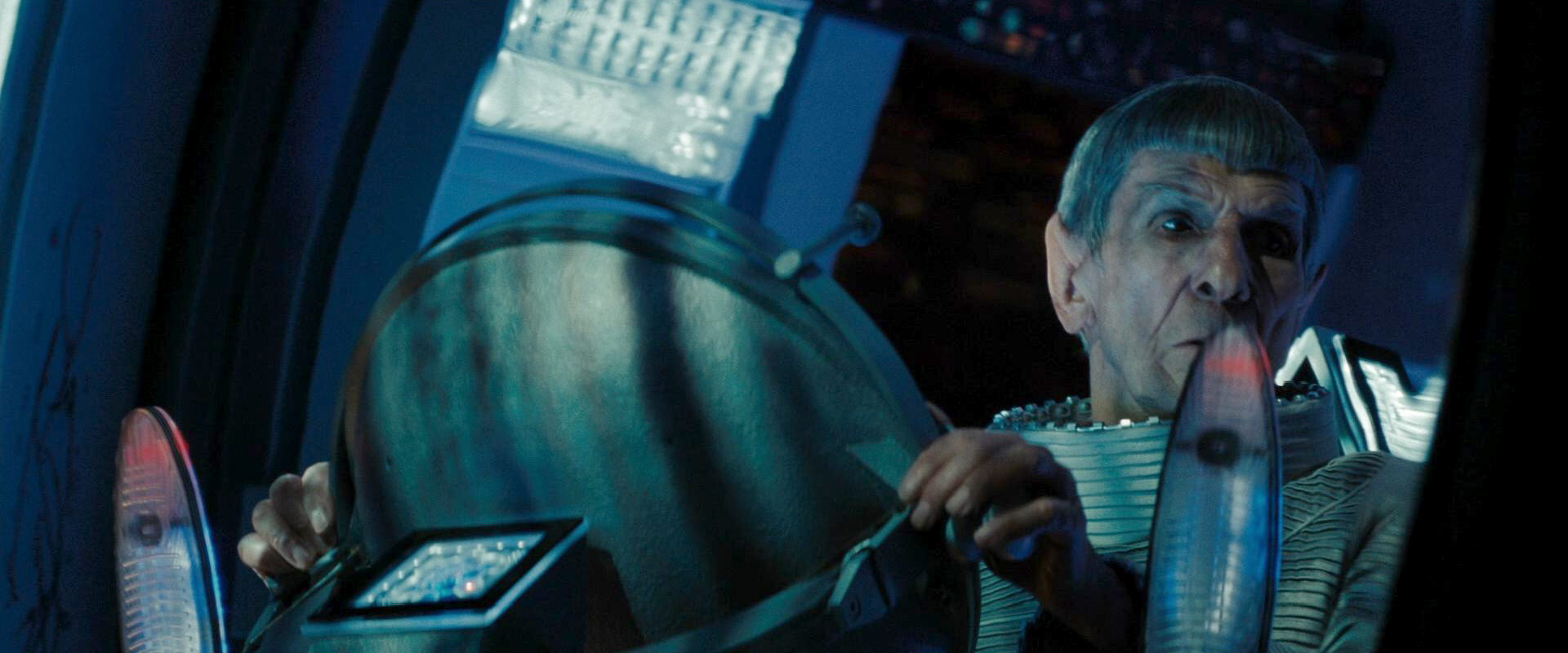
- The Vulcan Science Academy sends Spock to aid the Romulans. His ship, the Jellyfish (name from Countdown), may be the fastest and/or most capable ship for this mission. And Spock is one of the most renowned scientists on Vulcan. But why would Spock, at the age of over 150, be all alone on a mission of utmost importance? Without a backup crew or a backup plan?
- The star that goes supernova is obviously not the central star of the star system that Romulus is located in. So this supernova definitely wouldn't threaten a planet many light years away with total destruction (but only with a sizable radiation overdose). And even if it posed a danger to Romulus, there would have been years to plan the evacuation or countermeasures. There is nothing in a supernova such as a "subspace shock wave" as in "Star Trek VI" that would propagate at superluminal speeds. If the movie refers to real science in order to avoid technobabble, it should be consistent.
- How can Spock still stop the supernova after it has already destroyed Romulus and has expanded to a diameter of billions of kilometers? We would have to twist physics to an extent that supernovae expand at superluminal speeds and a black hole may just revert the effect.
- Nero has no time to arm his vessel before he begins his crusade in 2387. He must have intercepted Spock very soon after the destruction of Romulus, and immediately after Spock has created the black hole into which both ships are pulled. So why does a mining vessel have a large complement of torpedoes and all kinds of other weapons that can take down a whole armada of several Starfleet ships or 47 Klingon vessels? Sure, the vessel may be so equipped to blow up asteroids, but fighting against ships would be a whole new ballgame. Suppose the weapons really originally belonged to the Narada, Nero may have eventually run out of ammunition after the attack on the Kelvin and he would have had 25 years to rearm the Narada. On the other hand, he had to stay out of history's way all the time. In the Countdown comic, the Narada is upgraded with Borg technology and grows in size!
- Just as Nero had no time to arm his vessel in the 24th century, there was no chance for him to learn about Red Matter. Yet, when he intercepts Spock in the 23rd century, he has a plan how to use that Red Matter to destroy Vulcan, which he accomplishes in a matter of less than one day.
- A black hole crushes and swallows a supernova, the planet Vulcan and (presumably) the Narada in the end. But how do both the Narada and Spock's ship survive the black hole that Spock created to eliminate the supernova? And since when do black holes enable time travel? There is one precedence though. In TOS: "Tomorrow is Yesterday" the Enterprise is thrown back in time by a "black star" which, at that time, was meant to be a black hole.
- So Nero was able to await Spock at the exact place and time that he would emerge in the 23rd century. As Spock tells Kirk, this was possible because Spock ran into the anomaly a bit later and hence had to show up later in the 23rd century. Well, in some fashion minutes in the 24th century may translate to years in the 23rd century. This is still plausible. But how could Nero possibly calculate the date and time? A crew of miners are not exactly experts in astrophysics. And even if they had kidnapped an expert and had let him made calculations for 25 years, it still wouldn't have been possible with the sensor data they had collected. The simple reason is that Spock entered after them, so his final trajectory must have been unknown.
- Considering that Spock entered the black hole a bit later than Nero, it seems well possible that he managed to evade the anomaly, and Nero would have waited 25 years in vain. Could he know for sure that Spock would arrive at all?
- Nero's motivation is totally beyond comprehension. He has been waiting for 25 years in the past just to take revenge on the man who attempted in vain to save his planet. Couldn't he and his crew have done something much more useful, such as going back to the 24th century, a few years before the disaster would happen, and warn their people in time? He and his men could have had a good time, regardless which version of the 24th century they returned to, but instead of that they waste 25 years.
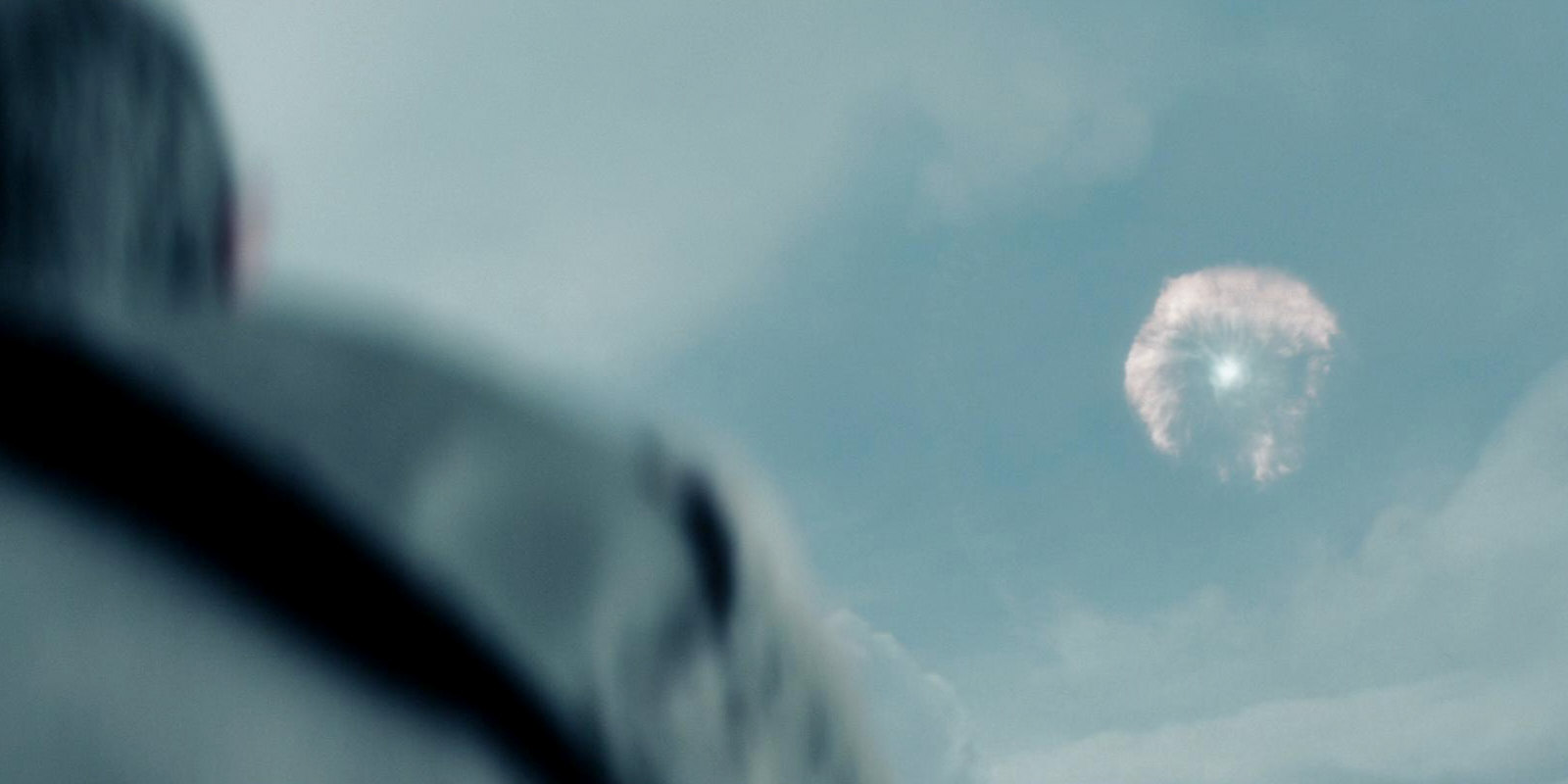
- Spock Prime can see the destruction of Vulcan in the day sky of "Delta Vega", a Class-M planet according to the dialogue where Nero has dropped him for this very purpose. Vulcan appears in the sky at daylight, and we can clearly see how the planet is being devoured. This is only possible if "Delta Vega" is a sister planet of Vulcan, perhaps the one that appeared in the original version of "Star Trek. The Motion Picture". But then "Delta Vega" would have to be either considerably larger than Vulcan itself, or the distance of the two planets would have to vary considerably as they are revolving around one another. In a Q&A session with fans, Orci said: "...we like to think of that sequence as impressionistic for a general audience. In other words, Nero could've beamed Spock prime down to Delta Vega with a telescope or some other type of measuring device to allow Spock to experience the pain of perceiving the destruction of his home world, but that simply isn't very cinematic."
- "Delta Vega" shares only the name with the remote colony from TOS: "Where No Man Has Gone Before", in a totally failed attempt at a homage. And even without the existence of the other Delta Vega the name would make no sense. Why? "Delta Vega" is a clearly human name which, in the Bayer naming system, would correspond to the fourth star in a constellation named Vega. Well, Vega itself is a star and not a constellation, and it would have to be "Delta Vegae" if anything. But it makes even less sense to use this name for a single planet in the Vulcan star system.
- Since this "Delta Vega" is located in the same star system as Vulcan for all we know, it would be swallowed by the black hole eventually. Nero may have taken that into account when he left old Spock on the doomed planet. But what about young Spock, who dropped Kirk on "Delta Vega"? I'd call that attempted murder. Even if it takes long enough by Spocks's calculation to go back and rescue Kirk (as well as Scotty and Keenser) from "Delta Vega", setting the escape pod to impact on this hostile ice planet with deadly creatures is highly irresponsible.
- On "Delta Vega", Kirk meets Ambassador Spock and later Scotty for the first time. All three have been exiled to this planet (Scotty allegedly because he misused Archer's beagle as a transporter test subject, old Spock by Nero to see the destruction of Vulcan, Kirk by young Spock who wanted to get rid of the troublemaker). They all meet within a range of a few kilometers on the surface!
- Montgomery Scott doesn't have the slightest idea of the destruction of Vulcan. Doesn't his outpost have any working sensors or communication? Even if "Delta Vega" is not in the immediate vicinity of Vulcan, he should have picked up that something terrible is going on.
- Transwarp transport? That sounds a lot like transwarp drive, although it is not related to a propulsion system faster than warp but means to beam on a ship that is at warp. Not really inconsistent, but not a wise choice either. I have read a couple of reviews where fans confused the two concepts.
- Even though it makes sense that it could be possible to extend the transporter range to beam from one planet to another, transwarp transport must be just as delicate as Scott explained it by comparing it with "trying to hit a bullet with a smaller bullet while wearing a blindfold, riding a horse." Spock Prime gives Scotty a formula for transwarp beaming. And after that Scotty needs no new hardware, no new software, only the formula to succeed. While the Enterprise is many hours away at warp. In a couple of minutes. Yeah right.
- So Scott develops that formula at some later time in his life. It is apparently not the very same procedure used in TNG: "Best of Both Worlds", where just the speed of two vessels at warp has to be matched ("Delta Vega" is obviously not at warp). So why does no one ever do transwarp beaming in the 24th century? Well, unless old Scotty develops that formula in the years between "Nemesis" (2379) and the year of Spock's disappearance (2387).
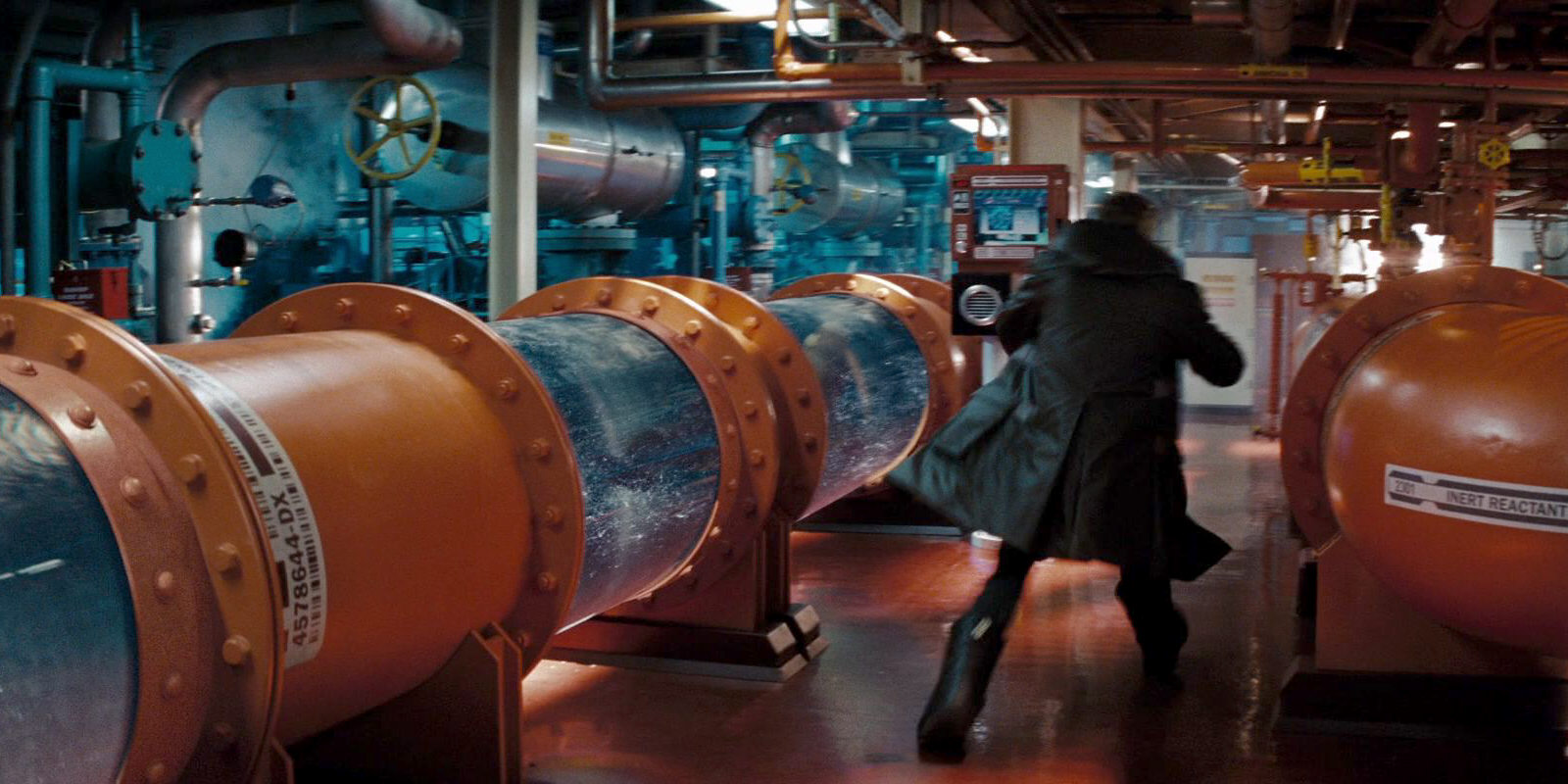
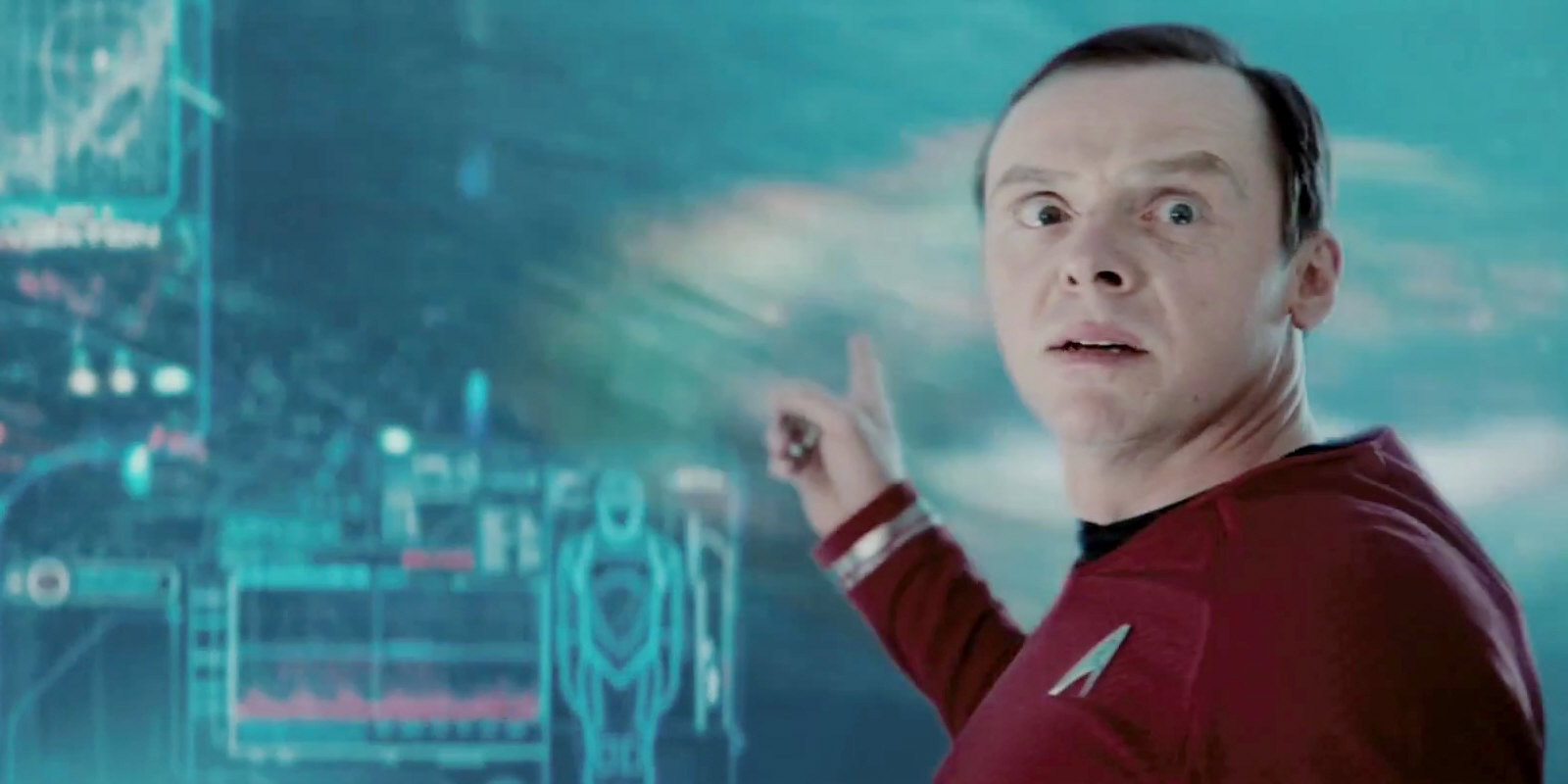
- The interior of the engineering hull of the Enterprise is nothing like anything we have seen on any Starfleet vessel so far. There is no centralized engine room, there is nothing identifiable as power transfer conduits. There is no visible deck structure. It looks like most of this section is comprised of a maze of water pipes. Pipes with rivets. This part of the movie was filmed in an actual brewery. This would explain the look, but definitely not excuse it. Overall, the set also seems too large for the secondary hull of the ship, which was designed to be overall just 366m long.
- Furthermore, considering that the Enterprise is a new ship, why do the big tanks and other equipment look like they have been in use for years and could need a new paint job?
- Spock resigns his command due to his emotional imbalance after Kirk has provoked an irate reaction from him. By Kirk's logic, Kirk becomes the new captain, because Pike made his first officer. But didn't Spock previously relieve him of duty? Realistically someone should quote the regulations and challenge Kirk's claim.
- The Enterprise has taken a detour of many hours, considering that Kirk has been on "Delta Vega" some time, and it takes some more time to turn the ship round for a course to Earth. When they arrive, the Narada is just starting to drill. What has Nero been doing all the time, considering that it does not appear to take more than an hour from Vulcan to Earth? He may have run into a battle, but even this wouldn't have lasted long, seeing what has happened at Vulcan in a matter of minutes.
- We can see Nero's drilling in San Francisco Bay from the same Starfleet building that previously appeared in the movie, as the staircase and the railing is identical. Yet, it must be from a location a few hundred meters to the east, as indicated by the distance and the viewing angle of the bridge.
- Why is it that huge ships (such as the Narada here) and other installations in science fiction movies customarily have multi-leveled staggered bridges without railings? Just so someone, during a fight, can easily jump or fall down to the next lower level?
- Like Vulcan, Earth has no defenses. Only Spock's ship eventually destroys the platform.
- By the film's logic, wouldn't the remaining huge amount of Red Matter aboard Spock's ship generate a black hole that is a million times bigger than the one that destroyed Vulcan? One that could possibly suck in not just the ships but the whole Federation? And even if this is not the case, considering that it took two minutes to devour Vulcan, shouldn't the Narada be gone in a few seconds?
- In the end, Kirk (unlike Spock) is generous and offers Nero to assist him, which he declines. He then orders to fire on the ship. Why? The Narada was quite obviously being crushed. Wouldn't it have been the wiser (and logical) decision to warp away from the forming singularity like hell? After the totally pointless barrage the Enterprise can barely escape herself.
- Scotty explicitly ejects the (one) "warp core" in order to be able to escape from the forming singularity. But what we see is eight pods that are jettisoned, rather than a single warp core. So does the ship have multiple small warp cores, somewhere hidden in the maze of water pipes? It is actually possible that the multiple pods are not the warp cores, but the antimatter pods, as they supposedly exist on other ships such as the Galaxy class as well.
- Wouldn't the explosion of the (multiple?!) warp cores rather toast the Enterprise than push her away from the black hole?
- Cadet Kirk is promoted to Captain. Yeah right. If I were Commander Spock, I would be genuinely pissed to have to serve under the alternate Captain Kirk.
- The decision not to save Vulcan is fatalistic and highly unethical, considering that the science and technology to go back further than 2233 and stop the Narada would be readily available. At least Spock Prime should be familiar with half a dozen of time travel methods such as the slingshot effect, yet he chooses not to "cheat". The needs of the many, however, outweigh the needs of the few, and the few people whose lives may not be as great in the original history as after the incursion definitely don't justify the sacrifice of the lives of six billion Vulcans, a complete species that was never meant to die. Notwithstanding the possible existence of a timeline in which everything is still fine, anyone else from Archer to Janeway would have done anything in their power to save the Vulcans.
Star Trek Into Darkness
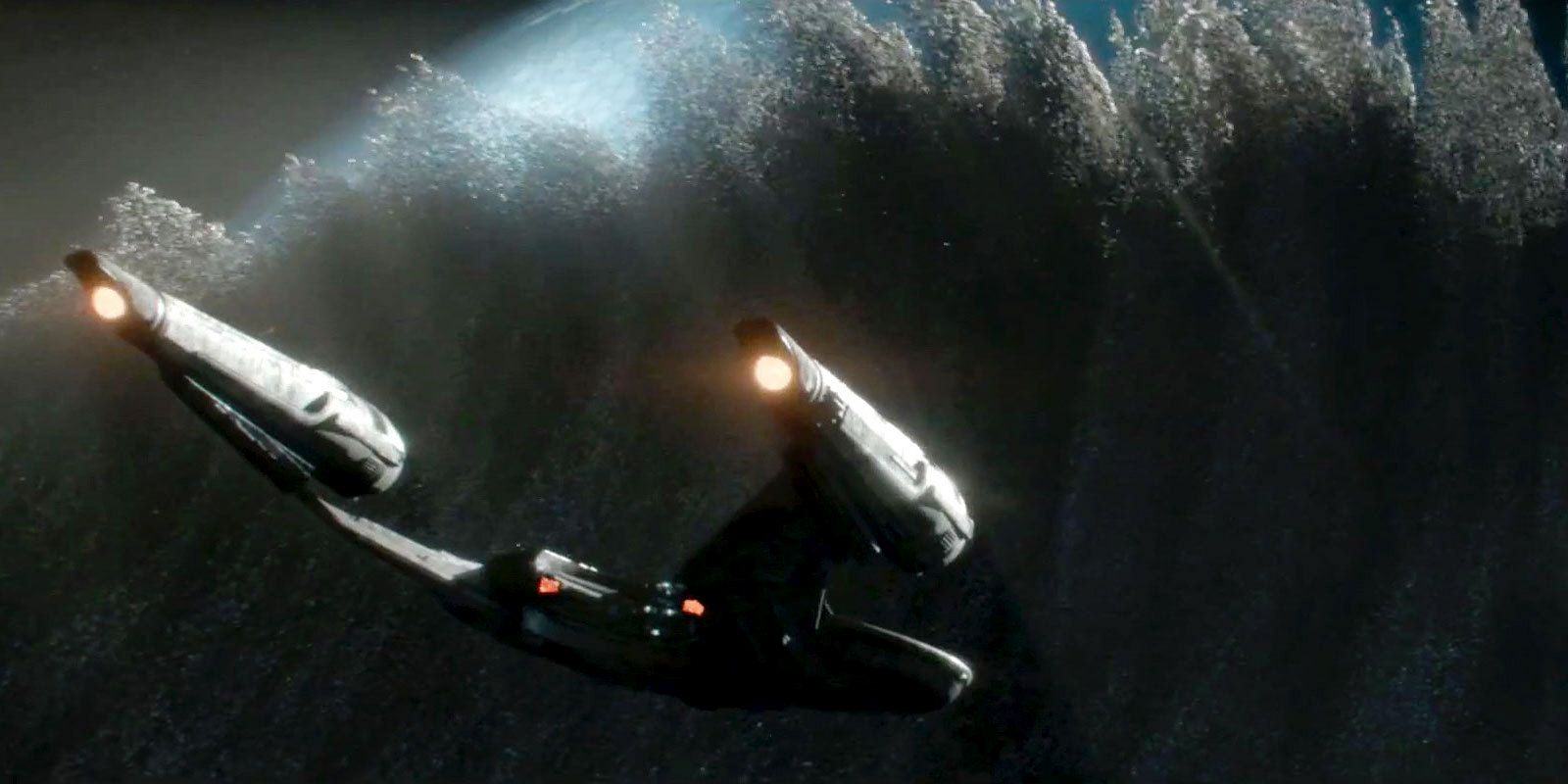
- So the Enterprise may also serve as a submarine. If we believe in the published size figures for a moment, the ship is some 170m tall. This means that to be useful as a submarine it would require a corresponding water depth to start with, and the bottom of the engineering hull would have to withstand as much as 17atm. Sure, there is nothing that enhanced forcefields couldn't accomplish in the world of Star Trek. But that's only one of several additional features that would have to go into the design of the ship, others being a suited propulsion system (impulse engine under water - bad idea!) and special sensors such as sonar. There is a good reason for spaceships and submarines being radically different designs in real engineering.
- Why was the Enterprise hiding under water anyway? The story provides absolutely no reason to expose the hull to corrosive salt water against Scotty's advice. Well, Scotty may have exaggerated the corrosive effect on the hull. And it may not have been possible to beam out Spock from high orbit due to the planet's magnetic field. Still, hiding in an ocean from where the ship cannot simply emerge and from where the use of the transporter and the shuttles is limited is the worst possible option just in case something goes wrong either with Spock's or with Kirk and McCoy's part of the mission.
- Even without saving Spock, Kirk would have broken the Prime Directive, because it would have been necessary to expose the ship to the native population before it becomes engulfed in solidifying lava. Only that the natives would have died, which would have nullified the detrimental influence on their culture. As already in TNG: "Homeward", this is an outrageously cynical interpretation of the Prime Directive.
- Thomas Harewood carries out the bombing in London, killing himself and his colleagues, after Harrison has already saved his daughter. Why does he still have to do that? Well, Harrison could have threatened to kill his family, but he could have done the same just as well without previously healing the girl.
- Wouldn't the leading officers of Starfleet hold a crisis meeting in a secure location that is protected by walls, forcefields, security guards, air patrols and other accouterments of security?
- Harrison transports himself to Qo'noS after the attack on the conference room, using Scotty's "transwarp transport" formula. This was already utterly incredible in "Star Trek (2009)", but instead of admitting it was a bad plot device and abandoning it, the writers repeat and thereby corroborate their mistake. If it is that easy to beam people across many light years, starships effectively become obsolete.
- Why does Harrison hide on Qo'noS of all places in the universe? We will learn later in the movie that Marcus's goal is to incite a war with the Klingons. So why would Harrison give the admiral a reason to attack Qo'noS, unless he too wanted a war with the Klingons, with whom Harrison should have absolutely no business?
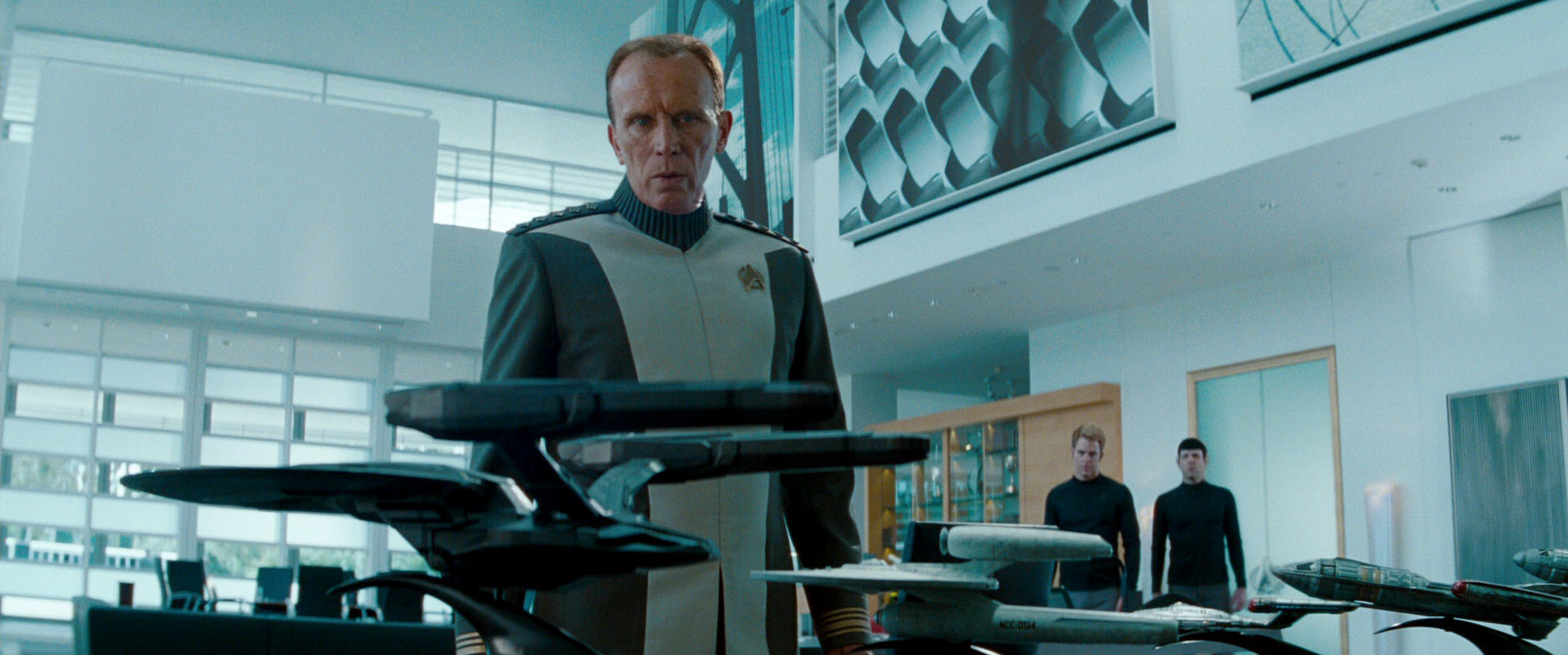
- Admiral Marcus has a starship design lineage on display in his office, which includes the Vengeance as the latest model. He has a top secret starship openly on display?
- Why does Admiral Marcus casually reveal that the target of the terrorist bombing was not an information archive but a Section 31 facility to Kirk and Spock who really would have no knowledge about the organization, as evidenced in DS9 and Enterprise? Why would he cast doubt over his good story, that a Starfleet member is running amuck for unknown reasons, by revealing that he himself is involved in mysterious secret Starfleet operations that Harrison knows of?
- Why does Admiral Marcus send the Enterprise on the mission to kill Harrison at all? He has the torpedoes, he has the Vengeance ready for launch, and he plans to launch the Vengeance anyway. Why would he bother to involve a crew that may not be perfectly loyal to him and that may jeopardize his plan? And a ship whose warp drive he apparently has to sabotage for some other unknown reason (see below)? Just because of a feeling that Kirk, who has a strong motivation to kill Harrison, is a useful idiot?
- Torpedo mystery #1: Admiral Marcus orders Kirk to use the 72 torpedoes, and only these torpedoes, and apparently all of them, to eliminate Harrison. Why? Does he suspect that Khan's crew is hiding in the torpedoes, so he could conveniently get rid of all of them? Later in the movie, he will claim he knew about them. In this case he should have had doubts whether the torpedoes were fully functional, because the space for fuel and/or explosives may have been occupied by those cryotubes. Or does he simply want to make sure that Khan gets killed? In the latter case Marcus may want to keep a few of the torpedoes instead of firing all of them. Well, there may be still prototypes besides this first batch of exactly 72 series torpedoes, but after Khan's death and with some of the records possibly destroyed it may be hard to build more of them. The fact that Khan shielded the devices, however, raises still another question no matter if Marcus knew about what was actually inside. Khan escaped and now commits acts of terrorism. It would be absolutely possible that he programmed the devices to explode immediately as they are being launched, or to go off course once they have been launched. Realistically Admiral Marcus would never order the use of the torpedoes before he has found a way to open and examine them and make sure they behave as intended.
- There is no good reason why Kirk should promote Chekov to chief engineer after he has relieved Scotty of duty, and not one of the engineers. Well, at least it complies with how gratuitously everyone was promoted in the first movie.
- The effect of the ship going to warp is different than in "Star Trek (2009)" (and different than in the Prime Universe anyway). It looks like the ship leaves behind some sort of wake.
- The Enterprise needs less than a day to travel to Qo'noS (not "Kronos!"), almost rivaling the transwarp transporter. As stated in the movie, it would have been a journey of just 20 minutes from the edge of Klingon space, where the ship drops out of warp, to Qo'noS. The journey back to Earth, when the Enterprise is pursued by the Vengeance, seems to be even faster. The speed of the ship in this movie seems to be well above Warp 30. "Four days there - four days back" from ENT: "Broken Bow" is an unfortunate yardstick. Still, the warp speeds and travel times ought to have been more realistic here - especially since there was already such an issue (to Vulcan in at most a few hours) in "Star Trek (2009)".
- The K'normian ship does not leave the Enterprise through the big shuttlebay door, but through some never seen before lateral hatch.
- We can see a half destroyed celestial body in or on the edge of the Klingon territory. This is quite obviously a homage to "Star Trek VI". Could this be Praxis? Well, in the new timeline the moon would have exploded a lot sooner. And while "Star Trek VI" creates the impression that Praxis was orbiting Qo'noS (which is why the evacuation of the planet was being discussed), realistically Praxis should be in a different star system, because otherwise the explosion would have killed all life on the planet, and not just polluted the atmosphere. Under these two conditions the moon could be Praxis indeed. Of course, it could still be any other moon or planetoid that has broken up for any other reason.
- The Klingon who takes off his mask in "Star Trek Into Darkness" has forehead ridges. Although we couldn't expect otherwise, this look does not comply with the one of TOS and with the facts established in ENT: "Divergence", that the antivirus that was created from human Augment genes would genetically alter generations of Klingons to look like humans. This one Klingon may be an exception, but there wasn't a single exception among dozens of Klingons we could see in TOS.
- The Klingons do nothing after their patrol ships have been destroyed by Khan. They neither shoot down the K'normian vessel when it is leaving Qo'noS, nor do they pursue it and find the Enterprise that would be an easy target with the disabled warp drive. The Klingons as depicted in this movie hardly pose a threat to the Federation!
- Torpedo mystery #2: On Qo'noS, when he learns that the Enterprise is carrying special torpedoes and that there are exactly 72 of them, Harrison/Khan surrenders immediately. It was clearly a surprise to him that the torpedoes were aboard, and he now sees a chance to save his crew. In other words, until this point he must have been under the impression that his crew has been found and eliminated, for reasons that are not explained. But why does Khan assume that his people are alive, just because the torpedoes number 72? They could have just as well been discovered and removed prior to transferring the torpedoes to the Enterprise. Well, Khan cares a lot for his people so the possibility they could have survived was sufficient reason for him.
- Harrison has existed for just one year, as Kirk finds out in Starfleet's records. So Admiral Marcus took all the efforts to force Khan to work for him, to change his appearance, to build a massive ship and all kinds of weapons, and he didn't provide the key figure of this plot with a credible bio that predates the time when Khan was found?
- Torpedo mystery #3: Finding out whether his people are still inside may be one reason why Khan urges Kirk to open one of the torpedoes, which could solve mystery #2. But Khan does not bother telling the crew how to circumvent the lock mechanisms. The torpedo that McCoy and Carol Marcus open almost goes off, in which case it would kill the Augment inside. Seeing how much he cares for his crew, would he take this high risk?
- Torpedo mystery #4: In order to get Khan to support him, Marcus was apparently holding Khan's 72 crew members hostages. They were in cryostasis all the time and could have been eliminated easily. So far, so good. Khan somehow managed to hide them in the torpedoes. And no one noticed that they were missing in the place where they were previously stored? Well, perhaps that was exactly the reason why Khan had to escape. Khan implies that Marcus may know about his secret, but it should have been explained or shown in some fashion.
- Torpedo mystery #5: If Khan managed to sneak 72 cryotubes into the torpedoes, why didn't he wake up his people while he was at it? There may be a reason why he was still waiting for something, and why he had to run away prematurely, leaving his followers behind, but this does not become plausible.
- Torpedo mystery #6: So Khan built those torpedoes, and he managed to keep the interior a total secret? How would he explain the empty space that he designed just large enough to hold the cryonic chambers? Agreed, he probably claimed it was for extra fuel or extra explosive charges, but it seems extremely unlikely that he could really keep the secret.
- Torpedo mystery #7: Khan has 72 followers in cryotubes, and exactly 72 of the torpedoes were built. Wouldn't that raise suspicion? Why didn't Khan simply build a few more of them, let's say 80?
- Marcus's original plan was to have the Enterprise eliminate Khan on Qo'noS, whether he knew about the contents of the torpedoes or not. But why would he want to destroy the Enterprise after a successful mission, which is what he sabotaged the ship's warp engines for? He says a war with the Klingons is unavoidable, whether the torpedoes were used on Qo'noS or not. But since Starfleet's rearmament has just begun, is it a good time to start a war? And to destroy another Starfleet ship that could go to battle against the Klingons? Is it just because he feels that Kirk and his crew would discover his criminal activities sooner or later even if they killed Khan for him?
- Marcus has a big goal: to rearm Starfleet and go to war against the Klingons, which is what he built the Vengeance for. And he has an acute problem: to get rid of Harrison/Khan. Marcus subordinates the first to the latter in an extremely lackadaisical way, as if any time and any accidental trigger were fine. By triggering the war himself, he wastes the chance to blame it on the Klingons, which might have got him the support of the Federation Council.
- The Vengeance drops out of warp with a "bang" (as it is customary in this universe) and stops almost immediately, and this at most a few hundred meters in front of the Enterprise! Sure, this is artistic license just like all starships were always much closer together than they should be actually be, but it looks extremely unrealistic.
- If the Enterprise really measures 725m, then the Vengeance is one mile long. Unfortunately there is no one in the staff of the new Trek movies who puts an end to the exponential growth of starships.
- It took just one year since the destruction of Vulcan for the following to happen: Khan's ship is found adrift in space. Marcus enlists Khan's superior intellect to develop the by far biggest starship ever, along with all kinds of superweapons. The starship is built and launched. This is absolutely ridiculous. Especially considering that Section 31 is a secret organization that so far never constructed ships (if they did, they wouldn't remain secret) and that would need the necessary logistics and people first of all. And keep everything secret above all, with probably a thousand people working on the project.
- You don't build your secret ship in a place near Jupiter where there's a lot of space traffic and everyone could find your huge ship yards any time.
- Is injecting blood into a dead Tribble a customary medical analysis in the 23rd century? What does McCoy want to accomplish with that? It would make sense if after a thorough genetic analysis McCoy had the idea that it may revive the Tribble. But the way it is shown, it is much like "Oh, I've got that dead Tribble on my desk. Let's inject the blood into it and see what happens." The resurrection of the Tribble will be a big surprise for him, and not an expected result.
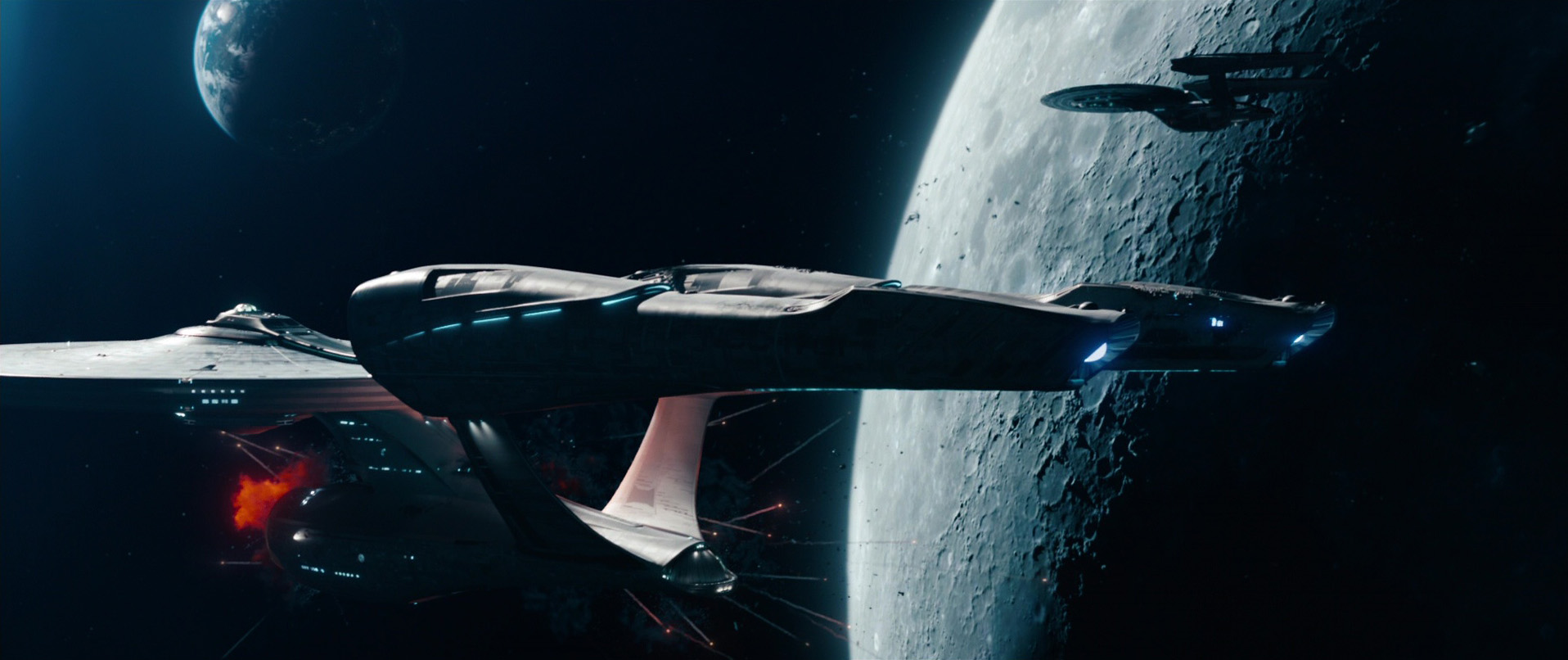
- On the way from the Klingon border back to Earth, the Enterprise is attacked by the Vengeance at warp and suddenly drops out of warp. This happens 20,000 kilometers from the Moon's surface. The chance for that is about one in a billion! Also, the plotted course would lead the Enterprise through the gap between Earth and Moon at warp? Ridiculous. If that was not the plan (the explicit order was "a course for Earth"), the Enterprise would have had to disengage the warp drive sooner than it happened because of the attack, in order not to overshoot the destination (and I'm not even talking about generally not staying at warp in a solar system). It would have made sense if Khan had attacked the same instant that Kirk was about to give the command to slow down to impulse in the Sol system, but the impression is that the attack occurs some time in mid-flight. Considering that the Vengeance would be able to follow the Enterprise almost immediately and is three times as fast, it would be even logical to assume that he decided to attack the Enterprise much sooner instead of waiting many hours (or realistically, a few days) at warp.
- Why does young Spock contact old Spock, assuming that Khan is known in the Prime Universe too, other than because of a feeling that he himself is living in a second-rate universe in which events repeat in some fashion? Old Spock only corroborates this notion by speaking of young Spock's destiny once again.
- Shouldn't Spock rather have contacted Starfleet, reporting Marcus's treason and his attack on the Enterprise? Maybe he did report it but the movie makes it look like talking to old Spock was on top of his priority list.
- And speaking of Starfleet, even if there is no other ship in the sector (as usual in the movies) someone must have monitored that Admiral Marcus was firing on a crippled ship between Earth and Moon. Even as Head of Starfleet, that is something he could never explain.
- The movie creates the impression that Scotty could simply walk aboard the Vengeance. Isn't it a top secret ship that should have all kinds of security provisions?
- Scotty says something about the people on the Vengeance being "private security". While I could imagine that hand-picked officers may join Marcus on his illegal quest, it is hard to believe that Admiral Marcus has mercenaries and minions like a James Bond villain. Well, they may have been regular Section 31 or even Starfleet members, only that we'd expect there is a point in Scotty's statement.
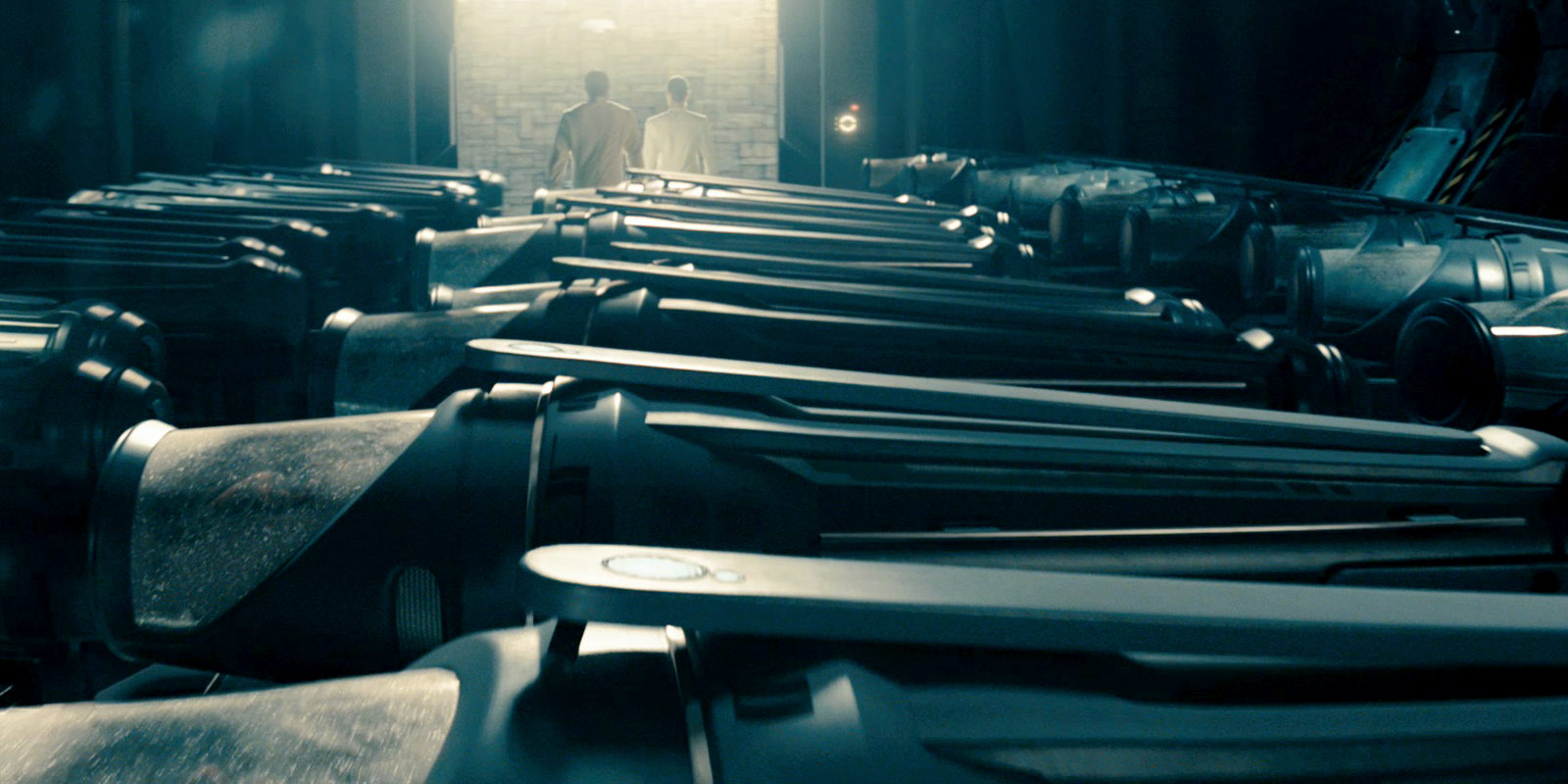
- Many, if not all of the 72 torpedoes are apparently stored aboard the Enterprise behind individual hatches from where they can be launched. What happened to photon torpedo tubes with a conveyor belt? Why the regress to "cannon decks" like on the HMS Victory? Also, this weapons bay apparently flanks main engineering on the Enterprise, which is a poor design choice, considering that the engines and the weapons should better be separated.
- Khan says: "Your crew requires oxygen to survive, mine does not. I will target your life support systems located behind the aft nacelle and after every single person aboard your ship suffocates, I will walk over your cold corpses to recover my people. Now... shall we begin?" The Enterprise has two nacelles, and nothing like an "aft nacelle". And there is definitely nothing but open space behind the nacelles. Moreover, the nacelles would be a very bad place for the life support systems of the whole ship that Khan is obviously talking about. We can only imagine that Khan said something different instead of "nacelle".
- Why doesn't Khan, with his superior intellect, smell a rat when Kirk allows him to beam over the torpedoes, which have been activated in the meantime? He himself told Kirk to open a torpedo, which is also the key to activating them!
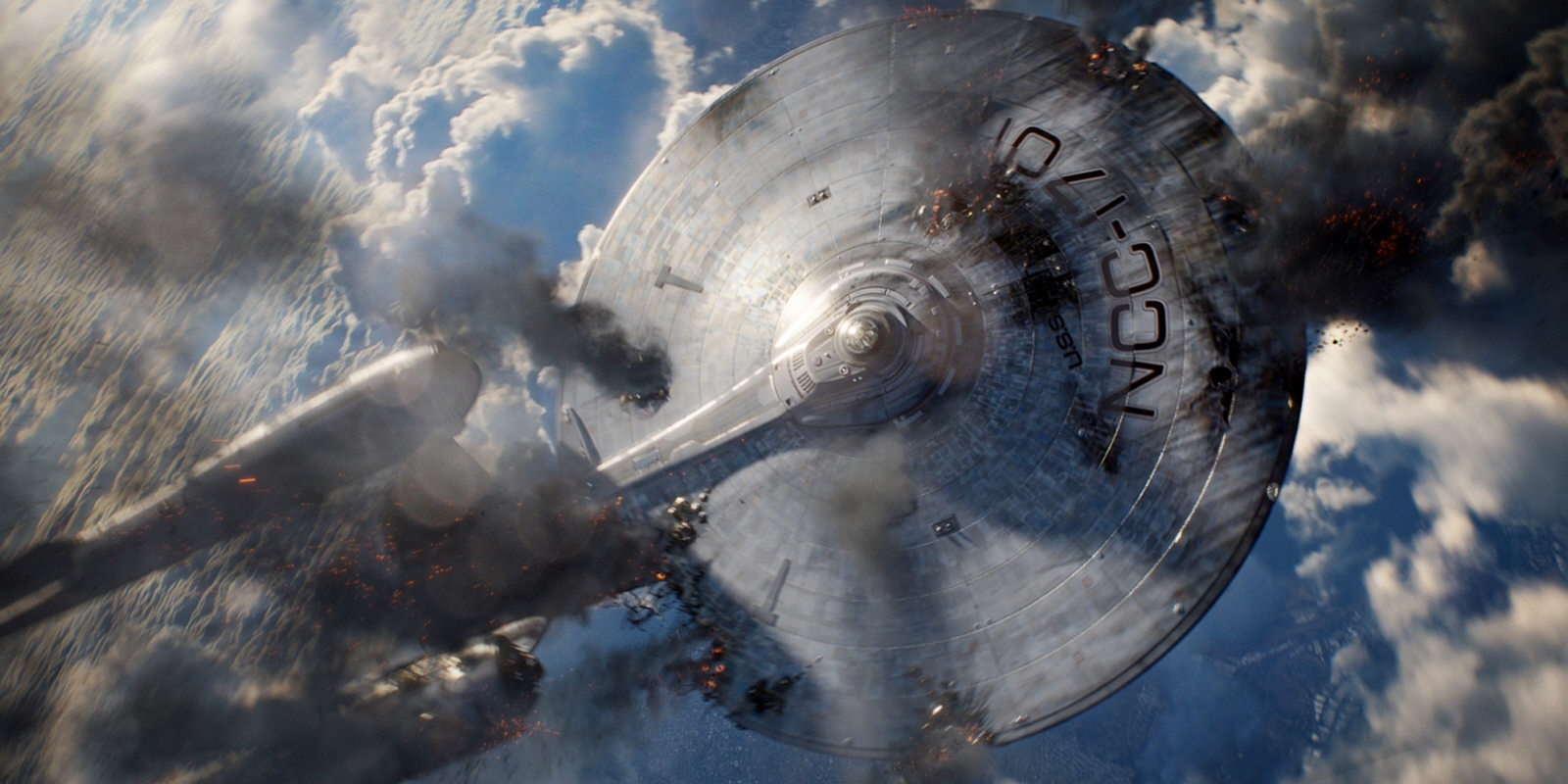
- How did the two ships, which were stuck between Earth and Moon, but much closer to the Moon, end up falling into Earth's atmosphere? It would have taken an eternity for them to drift all the way to Earth. While Khan's intention was to crash the ship, Kirk would have avoided Earth, had there been a minimum of power left.
- In a free falling ship, the crew can have gravity only if the gravity generators are still working, and its direction does not depend on the orientation of the ship relative to Earth's surface. But what kind of malfunction would cause the direction of "down" to change from the floor to the walls, the way it happens temporarily? Well, the generators may have failed for some reason, and for some other reason a still working thruster could have pushed the ship to the side or could have made it spin, thereby providing some effect of gravity.
- Is there no way to rescue the Enterprise crew as it falls towards Earth? We see some shuttles get wrecked, but what about onboard lifeboats and beaming off by transporters on Earth or other ships?
- Scotty is a pleasant exception among all the crew members with superpowers when he loses his grip of the railing while the Enterprise is tumbling. But Kirk catches his fall, which is physically impossible. And if this were not yet unrealistic enough, Super-Chekov comes and grabs Kirk's hand when he is falling together with Scotty!
- The industrial look of the huge warp core is quite realistic from the outside as well as the inside, but it has nothing in common with anything we have seen in Star Trek so far.
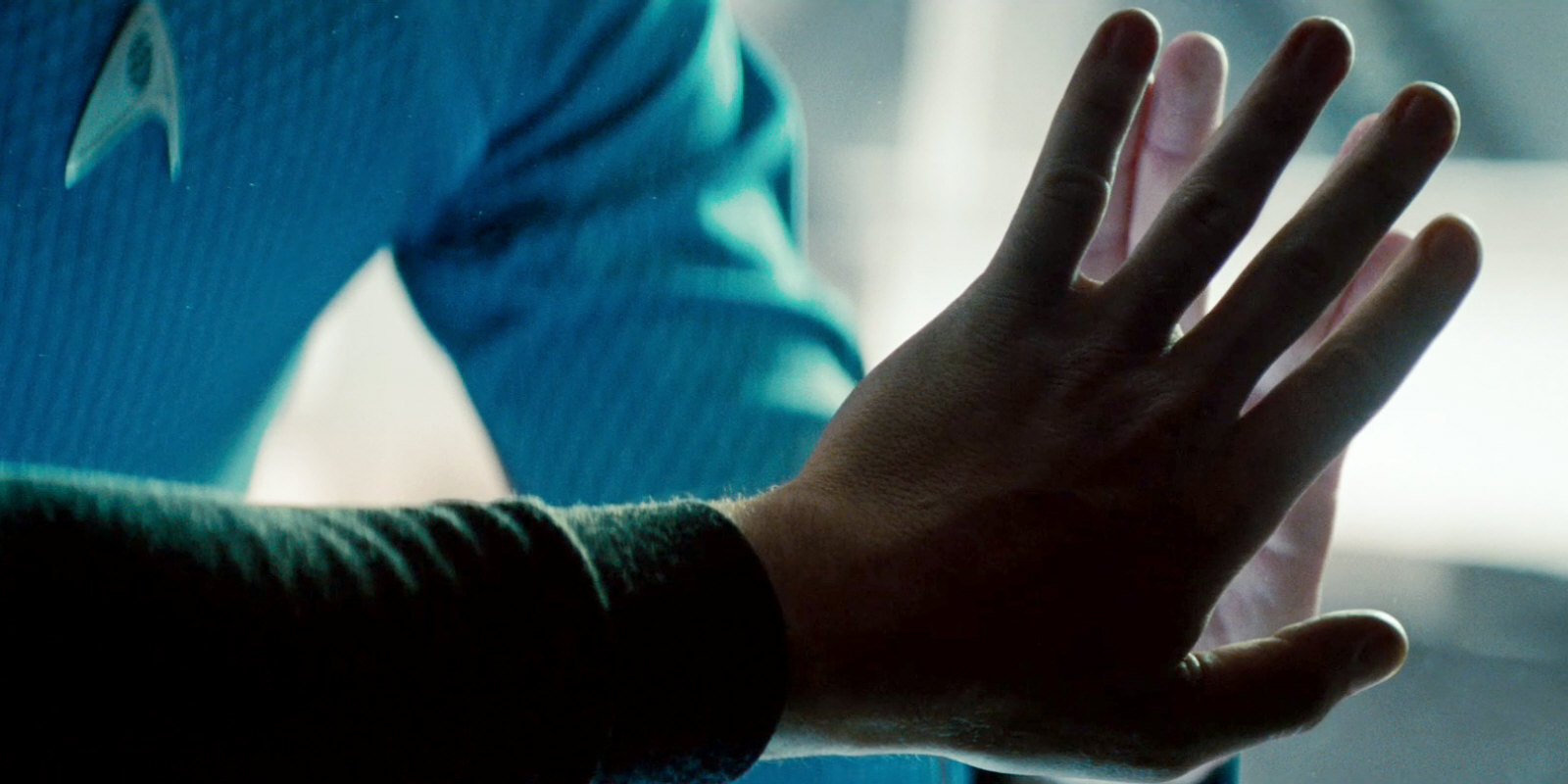
- The sequence of events and the dialogues, everything that happens after Kirk has fixed the warp core is exactly as in "Star Trek II", only with switched roles. Aside from being a tribute that winds up as a parody, it insinuates that there is something wrong with the universe, in a way that events are the same as in the original (even if they happen some 25 years too early).
- As always in all Star Trek movies, Earth has absolutely no defenses and the barely operational Enterprise is the only ship in the sector.
- In the showdown in San Francisco Spock develops seemingly the same superhuman forces as Khan when they jump around on and between the shuttles. Khan even backs off although realistically Spock couldn't hurt him.
- What happened to beaming people while they are moving? Spock and Khan are fighting on top of the shuttle and Chekov somehow forgets what he knew in the previous movie and what Admiral Marcus did in this movie when he beamed aboard his daughter. Their movement is explicitly mentioned as the reason why it's not possible, rather than the fact that the damaged transporter may not allow it.
- Thinking of 9/11, the whole city should be engulfed in smoke and dust after the crash of the Vengeance, unless the 23rd century has completely different building materials.
- Why does McCoy need Khan's blood to cure Kirk? Couldn't he simply revive one of Khan's people, who likely have a suited blood composition too, especially considering that he needs one of their cryogenic chambers for Kirk anyway? And even if only Khan's blood could provide the cure, wouldn't the cells stay intact for a short time after his death?
- Many aspects of Kirk's resurrection are doubtful. First of all, Kirk was already dead for a while and no one cares to keep his brain from depolarizing until McCoy sees that the Tribble is alive again. Kirk should have retained brain damage. Furthermore, McCoy says he is going to create a serum that would be more effective than the mere blood. But how would this serum trigger all kinds of different healing processes in the bones, the skin, other organs? Would the serum decontaminate the body too? Would it also resuscitate Kirk, like it did with the Tribble? Wouldn't the super-blood fight Kirk's immune system, at least once he was alive again, up to a point that Kirk becomes a semi-Augment?
- It looks like McCoy saves only Kirk's life using Khan's superblood. What about all the other people who were fatally injured during the attacks? Is it the captain's prerogative? Where could he possibly draw a line anyway, considering that Khan is a blood bank that could be tapped for the benefit of humanity? The apparently unlimited healing capabilities of Khan's blood pose similar problems as already the omnipotence of the Nexus in "Star Trek Generations" and the fountain of youth in "Star Trek: Insurrection".
- Considering that the crew otherwise discover their conscience when we would least expect it, isn't it against medical ethics to extract the blood against Khan's will to save Kirk (thinking about Worf's refusal to save the Romulan in TNG: "The Enemy")?
- The new Khan is nothing like his Prime Universe counterpart. Benedict Cumberbatch doesn't look at all like Ricardo Montalban. This may be explained as a surgical alteration as part of his new identity as a British Starfleet officer. But what about the mental and physical abilities? Khan 1.0 was capable of learning very quickly, he was stronger than an average human being, and he was power hungry. Khan 2.0, in contrast, is a fighting machine, rather than a leader. He is nearly invulnerable, and his blood has the miraculous capacity of healing everything. We have to keep in mind that in the Kelvin Timeline Khan is still meant to be a creation from the 20th century!
- Was Khan sentenced to be put back into a cryonic chamber by a criminal court of the Federation? Is cryonic imprisonment a legal punishment in the 23rd century?
- After the extreme structural damage, the Enterprise is definitely only fit for scrap. Well, maybe it is actually a new ship in the end, but the impression is created it is still the same Enterprise (only with some modifications such as to the impulse engines).
- The Klingons were attacked by humans on their own homeworld. What could possibly have appeased the Klingons after this incident, which was much like a declaration of war?
Star Trek Beyond
- There are new uniforms yet again in this movie, standard ship uniforms as well as field uniforms. Overall, the Abramsverse movies have a large number of uniform variations at a time, and frequent uniform changes. This is not inconsistent per se, but more constancy would add realism to the Abramsverse.
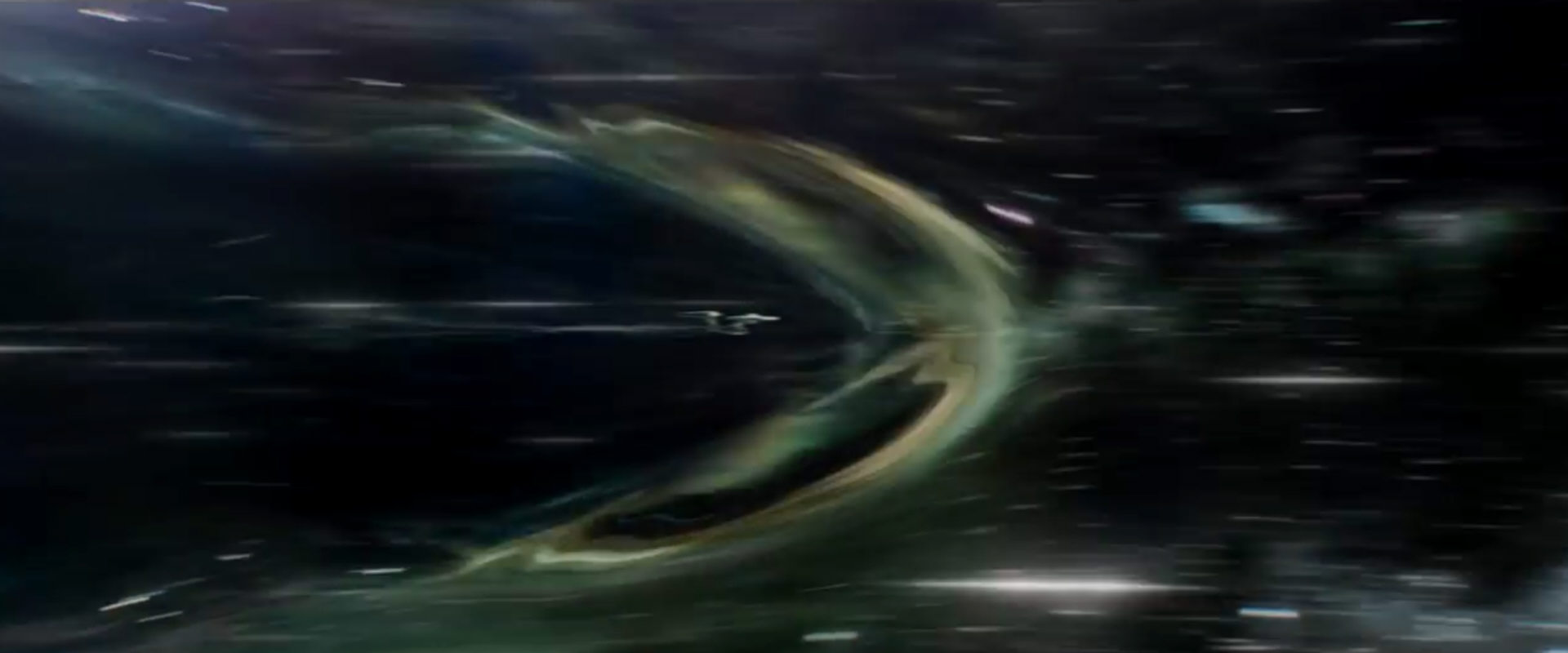
- I don't care for the new "bullet effect" for warp speed. It may seem just a question of style. And we could already see many variations such as straight star streaks or the "warp wake" from the last movie, so there is no real consistency anyway. But the "bullet effect" is so much different than anything shown so far, and without a good reason. The explanation that in real life, a bullet in the water would behave like that, is not a fitting analogy. So far the warp field was always considered to be something very stable in shape, not at all like the heavy turbulences that a bullet would cause and that can be seen in "Beyond". Moreover, the actual warp field could never be seen so far but only its side effects in normal space.
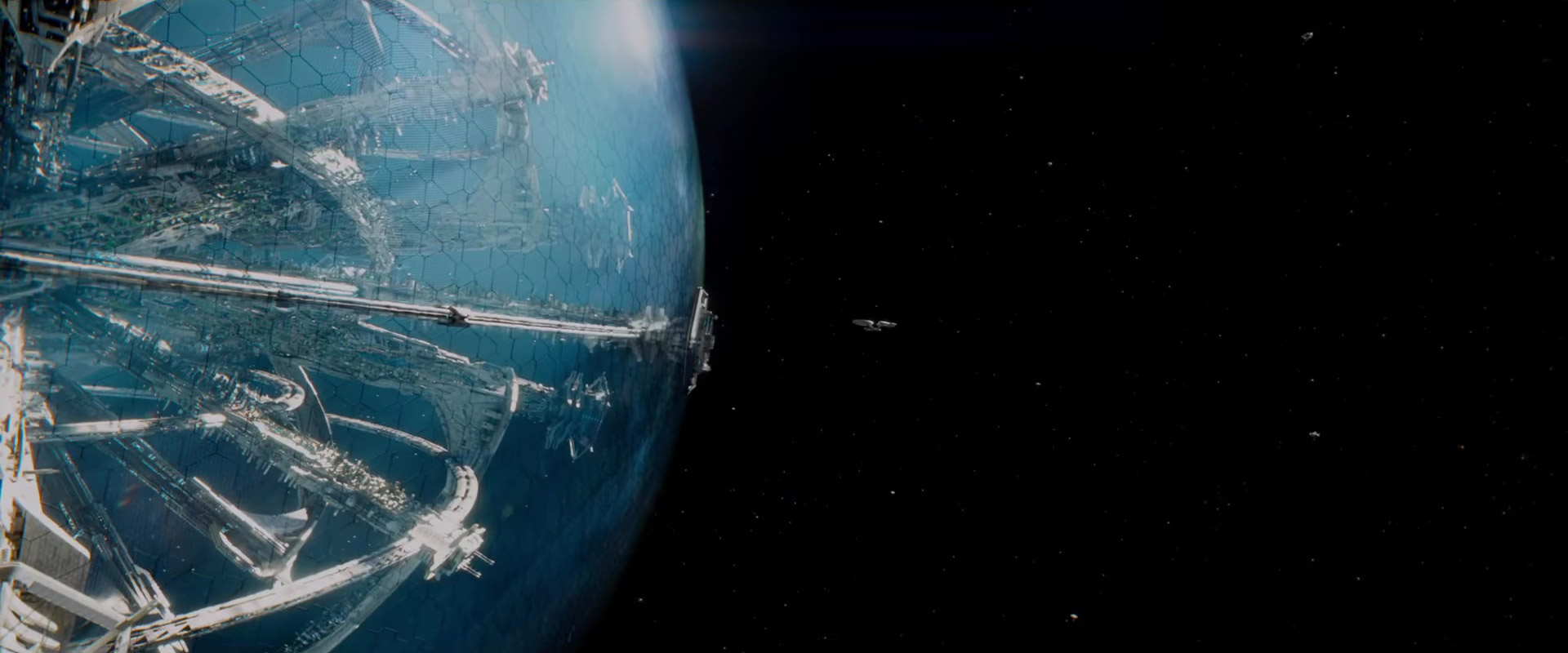
- The size of the Yorktown starbase, which is many kilometers across and which has millions of inhabitants, is incredible. Even if you should have the resources in outer space, you don't build a major city there, close to a nebula that is totally unexplored and from where a huge fleet can attack any time. Which is exactly what happens.
- Would the Federation name a space station "Yorktown"? It is inappropriately Americentric for a multicultural station and more like a name for a ship anyway.
- The "nebula" that the Enterprise has to pass is rather an asteroid belt, and the big rocks are unrealistically close to each other and to the Enterprise. It seems like a miracle that the Enterprise doesn't collide with one. (I know, that's a general problem with all asteroid belts in all science fiction films where big rocks collide all the time.)
- Scotty first miraculously survives the hard impact of his torpedo and then stops his fall grabbing a tiny protruding piece of rock with one hand. His superhuman forces are ironical because in the last movie Scotty was the one to lose his grip and had to be saved by Super-Chekov.
- Ancient technology such as the Abronath just needs to be assembled, and it works immediately and exactly as desired.
- Chekov and Kirk ignite the thrusters on the underside of the crashed saucer of the Enterprise. They destroy the bridge window and slide down the saucer. When they are at the bottom, the saucer is upright and begins to tip over. Three or four seconds later, the saucer crashes onto the ground and buries Kalara. In these few seconds, Kirk and Chekov must have run at least 300 meters (well, 150m if we don't believe in the huge size) through the woods, in order to be safe.
- The USS Franklin is said to be the first Warp 4 ship, but Enterprise NX-01 looks more modern and was built for Warp 5 around the same time as it seems. On the other hand, it is well possible that the Franklin is older, and was kept in service after 2161 because the young Federation urgently needed ships after the Romulan War. The Franklin may be a sui generis design, so it seems plausible that the ship got an NX registry (now standing for "experimental" and not for "NX class") although it was already outdated at the time.
- The fact that the otherwise awesome Franklin has a bridge window (as it is typical only on Abramsverse ships) disconnects the design from the Prime Universe. Designer Sean Hargreaves says this was done to be able to see the crew from the outside, but no such shot made it into the film.
- Krall doesn't seem to miss his old ship, which Jaylah hides with a holographic cloaking device. Well, he may not have a reason to still care about the old rust bucket.
- The Franklin was abandoned one hundred years ago but was not vandalized in any fashion by the survivors. All systems are still in place, there is medical equipment and even the motorbike is still on board, fueled up and ready for use.
- The motorbike with Kirk and Jaylah is at full speed when it materializes on the rocky road. Sure Chekov, did some tricks to compensate for motion in "Star Trek (2009)", but that was with a much more advanced transporter. Even if it was possible to speed up the motorbike somewhere near the Franklin and target it with the transporter, it would have been a lot less trouble to simply beam it away while it was standing still.
- It is unrealistic enough that all systems of the Franklin could be powered up after as long as a hundred years. But why is half the ship, to increase the difficulties, buried and still everyone seems to expect it to lift off? Why does the Franklin survive the collisions with the mountains (the ship doesn't only scratch them) and remains spaceworthy? This is all such a stretch and could have been shown in a more realistic way without changing anything about the story.
- The Franklin conveniently sits on a cliff that is a few kilometers high and may serve as a "launch pad". The cliff, however, could hardly have been a preferred landing site, and we may doubt that Jaylah was able to move the ship there.
- What is the point of the Franklin's jump start stunt anyway? It would be useful if the ship had some sort of jet engines (which they likely aren't as the ship was built for space), or if some of the systems functioned better without gravity (which isn't the case because it was built to operate with artificial gravity all over the ship).
- It doesn't make sense that a simple radio transmission has an extremely short range so the Franklin has to be amidst the swarm, while there are no range concerns regarding the transporter.
- Considering how easy it was for Scotty to beam McCoy and Spock onto the Swarm ship (not to mention the other unlikely transporter stunts of this film), why isn't it possible to beam them back?
- Krall's ship is one of just three in thousands that survives the "Sabotage" attack. Why is it that science fiction villains are always so much better pilots than anyone else? It is true that probably all other ships were manned by drones. Still, as all other ships collide with each other, how could Krall escape the inferno? Perhaps he was well ahead of the Swarm?
- The Franklin is said to be less advanced, having been built in space and for space. Yet, the ship can operate in the atmosphere and even under water just like the Enterprise submarine in "Star Trek Into Darkness".
- Where are the transporters of Yorktown when Kirk tries to stop Edison/Krall? Where are the fighters? Where are the rescue shuttles? Kirk is "the only ship in the sector" here for no obvious reason.
- Why does Kirk try to apprehend Edison/Krall, who has his finger on the trigger of the Abronath? The due action should have been to kill him immediately.
- The Abronath is underwhelming as a superweapon. Even if it was not possible for some reason to destroy it or simply beam it into space, there would have been several more options for countermeasures against this quite obviously slow weapon. Killing people and leaving the infrastructure intact (which is what Krall may have wanted) works a lot better with gas or with radiation. In any case, the Abronath definitely wasn't worth all the efforts for Krall, whose swarm ships are a lot more formidable.
- So after Edison/Krall was stranded on Altamid, he spent all those years making ships crash and sucking out the lives of their crews? Hoping he would get his hands on that superweapon? To destroy the Federation. Or to save it? Although he could have gone anywhere he liked? Whatever his plan was, it doesn't make sense.
- Old ships such as the USS Franklin were built in space and for space, according to Scotty. That makes the construction of the Enterprise NCC-1701 in Iowa in the Kelvin Timeline more advanced by definition, although the construction site in "Star Trek (2009)" looked like a 20th century factory. There may be reasons (at least in this timeline) to build ships on the surface of a planet if they are "advanced" and meant to perform lift-offs and landings. Yet, at the end of "Star Trek Beyond" we can see how the Enterprise NCC-1701-A is being assembled at Starbase Yorktown. The technology of this facility isn't only much more advanced than the shipyards in Iowa, it also combines the best of both worlds: gravity and/or air just as it is needed. The question is why Starfleet would bother to build starships the hard way on the surface of their principal planet if everything could be so much easier, and why this new shipbuilding technology is eventually used in a remote space station of all places.
- There's no problem with Sulu being gay. But why it was deemed necessary to give Sulu a daughter in the Kelvin Timeline, other than insinuating it could be the "same" Demora as in the Prime Universe (which is what some viewers believed)? The Prime Universe Demora was definitely much younger than 34 ("I was never that young.") when she appeared in "Generations", set in the year 2293.
Commentary
When I first published this page in 2009, I earned hundreds of comments that were spiteful or insulting, coming from people that claimed to be fellow fans. My alleged offense was that I listed the possible and actual inconsistencies of "Star Trek (2009)", using the same criteria, the same level of detail, the same format and the same tone as I had done with all previous Star Trek movies. It is not my fault that there are many more problems in the Abramsverse (with the notable exception of "Beyond") than in classic Trek. It is not my fault that some explanations can only be found in non-canon comics or in deleted scenes, and are hence disregarded here. And while I admit that many of my findings are just small nitpicks, so are many of the things that I took note of in classic films and episodes - without being put on a witch trial for it. The fandom has changed for the worse since self-righteous fans shout down any criticism of the new Trek. And this was only the prelude to what happened regarding Discovery.
Credits
Some screen caps from TrekCore. Thanks to DITL for the Chekov quote and to Andrew Probert, Ben Rowe, Ben Parker, Lee Sherman, Harald Hofmeier, Thomas Owens, Shawn Boles, Tim Maher, IJD, Greg Tyler, Michael Minnick, Jared, Gustavo, chris, Hakan, Jeff, Pizza the Hutt, Drew (doubleofive) Stewart, Robert Heckadon, Steeko, Judah, TheCrudMan, Frank Turturici, Josh Wilder, Colin, Micah Haber, Dan Carlson, Andrew Gilbertson, Ben Dickson, Jake Barrett and Masao Okazaki, who gave me some additional ideas.
See Also
Dealing with Continuity Issues of the Abramsverse - general thoughts and the policy at EAS


