Deep Space Nine (DS9) Season 5 Reviews
Season 1Season 2Season 3Season 4Season 5Season 6Season 7
Apocalypse RisingThe ShipLooking for par'Mach in All the Wrong PlacesNor the Battle to the Strong
The Assignment
Trials and Tribble-ationsLet He Who is Without SinThings PastThe Ascent
RaptureThe Darkness and the Light
The BegottenFor the UniformIn Purgatory's Shadow / By Inferno's Light
Dr. Bashir, I PresumeA Simple InvestigationBusiness as Usual
Ties of Blood and WaterFerengi Love Songs
Soldiers of the EmpireChildren of TimeBlaze of GloryEmpok NorIn the CardsCall to Arms
Apocalypse Rising
Synopsis

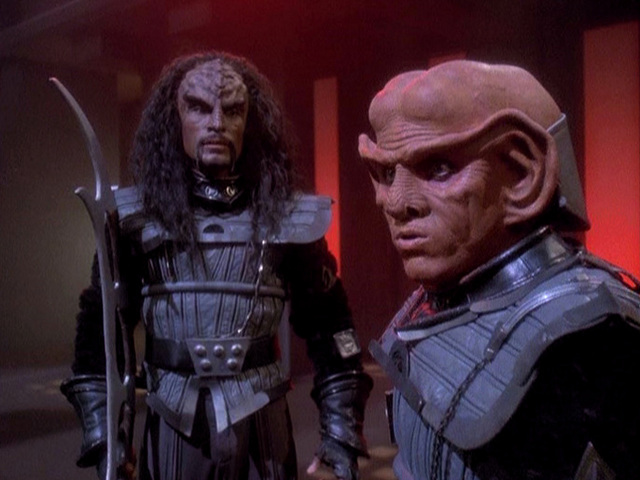
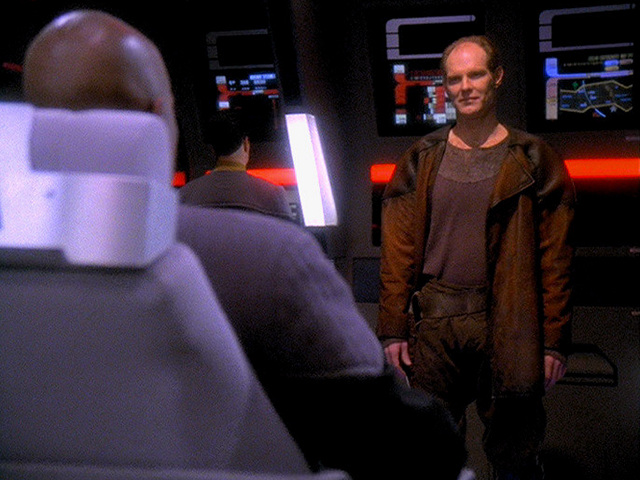
Stardate not given: Sisko, Odo, O'Brien and Worf are surgically altered to infiltrate the Klingon Empire and expose Chancellor Gowron who is a Changeling as Odo suspects. Dukat provides a safe transfer on his Bird-of-Prey and drops them at the Hall of Warriors at Ty'Gokor where they are left to themselves. While installing polaron emitters that would force a Changeling to return to the fluid state, the four officers have to fend off drunk Klingons. Sisko is just about to activate the emitters when his Klingon name is called up to become members of the Order of the Bat'leth. But Martok recognizes Sisko and has him, Odo, O'Brien and Worf arrested. Saying that he had the same suspicion, Martok later leads the four back into the hall where they are supposed to complete their mission and exterminate Gowron. But Odo notices that Gowron, as opposed to Martok, has the honor to challenge Worf to a fight. He exposes Martok as the true Changeling. It was the Founders' intention to deceive Odo in order to seize control of the Klingon Empire. In the wake of these events Gowron agrees to a cease-fire with the Federation, however fragile it would be.
Review
Although I rate DS9's season 4 as the one with the greatest single episodes, it wound up as a bit unbalanced, even undecided. At long last the season finale "Broken Link" managed to join the dangling threads of the Klingon and Dominion conflicts. Odo was made human, the Klingons canceled the peace treaty, and the ending was the most exciting cliffhanger since TNG: "The Best of Both Worlds". So Gowron is a Changeling, as Odo believes. I was just as excited as everyone else to see the conclusion, and it did not leave me disappointed.
The first half of the season opener "Apocalypse Rising" thrives on its character interaction. Sisko motivates a lethargic Odo, who is struggling with his new existence as a human being and who takes an odd pleasure in watching the bubbles in a glass of beer. Kira welcomes Dukat, her former arch nemesis, who has become an odd kind of friend since the two found his daughter Ziyal. She surprises him with the pregnancy and the statement that O'Brien is the father of her child. Later Kira jokingly blames Bashir for her condition, because it was him who transplanted the O'Brien's baby (who would be named Kirayoshi) into her womb. This is a hilarious tongue-in-cheek reference because in real life Alexander Siddig is the father of Nana Visitor's baby, Django. Also, it is great how the two attempt to cheer up one another while Sisko and the three other officers are on what seems to be a suicide mission. Likewise, Bashir talks to Jake, who is hanging around on the promenade deck after the departure of his father. I would have appreciated to see Jake one or two more times in the episode though. He maintains a too low profile here.
In its second half the episode gradually builds up tension in a very skillful way. I just loved how Worf gave his fellow crew members a crash course in Klingon manners aboard Dukat's Bird-of-Prey, although it was on the verge of becoming childish. We could expect that, rather than Sisko, the restrained O'Brien and Odo would have trouble behaving like real Klingons. Especially Odo, who is a now Changeling caught in a human body disguised as a Klingon! But even Sisko makes a serious mistake, when he strikes Worf with the back of his hand, which is a challenge to a fight to the death. In other words, the right misbehavior must be learned. When the visual communication with another Klingon ship fails, Dukat does not hesitate long and blows it up. This comes as a shock, although it was foreseeable. Quite evidently Dukat's intentions and methods are not like those of the four Starfleet officers, whose mission is only to expose Gowron, not to kill anyone (although it would be legitimate as they are at war with the Klingons). It is not very surprising either that Dukat decides to leave the scene just after beaming down the infiltration team. So the four are left to themselves, a failure of their mission meaning certain death.
Once they have arrived in the Hall of Warriors, everything initially flows more smoothly than expected. Even when Sisko assaults the Klingon warrior who boasts about killing a Benzite captain whom Sisko happened to know from the Academy, the situation remains under control. (The Klingon says something like "Benzonite" but it must be a Benzite as he explicitly mentions the breathing apparatus.) O'Brien reacts exactly the right way when Martok finds his face familiar, explaining that they probably met in battle. Likewise, Odo keeps his nerve when a Klingon discovers the polaron emitter he is installing. Worf explains in his inimitable fashion that it is actually a Vulcan toy - just as he always used to give lectures on Klingon rituals to his fellow Starfleet officers, he now kind of parodies himself.
However, when Sisko has just received the award from Gowron's hands, Martok knocks him down with the bat'leth. This doesn't come unexpected. When Martok concedes that he suspected Gowron to be a Changeling himself, he is able to give reasons, because it was Gowron who acted not very Klingon-like when he called off the battle in "The Way of the Warrior" but later pressed the Klingons into a war with the Federation when the Federation was already prepared. I admit Martok deceived me just like he did with the infiltration team, although in retrospect such an obvious outcome would have been too easy. The twist was overdue, but when Odo discovered the truth, it wound up as a bit less spectacular than it could have been. Well, exposing Martok as the actual Changeling was "morally" up to Odo because he caused the whole trouble in the first place.
The episode has two nice TNG tie-ins. The first is the tachyon detection grid, a technology that has obviously been adopted by the Klingons since TNG: "Unification" as a defense against cloaked vessels. The second is rather a déjà-vu, as the travel on a disguised Cardassian BoP to Klingon space is somewhat reminiscent of Picard's and Data's journey on a Klingon BoP to Romulus in TNG: "Unification", only that the political situation has changed.
Annotations
- Nitpicking: Well, we don't know how exactly the Dominion plan was supposed to work and which options were available, but it seems a bit too convoluted to get Federation officers to kill a wrong Changeling deep inside the Klingon Empire. I also wonder whether the Starfleet officers spoke Klingon all the time. That's barely possible. Perhaps the universal translator works much better in the 24th century than still in "Star Trek: The Undiscovered Country" (and is hard to detect too).
- Remarkable quotes:
- "He is upstairs at his usual table. Just follow the black cloud." (Quark, to Sisko, about Odo)
- "As for you — You should have killed me when you had the chance. I promise you won't get another." (Gowron, who wouldn't keep the promise, to Worf)
- "I could do without the ridges, but I kind of miss the fangs." (Sisko, after the restoration of his human appearance)
- Remarkable dialogue: Dukat: "Captain, I insist we make a holographic record of the four of you. Consider it payment in full for the use of my vessel." - O'Brien: "Maybe after the mission." - Damar: "After the mission you will be dead."
Rating: 8
The Ship
Synopsis

Stardate 50049.3: A small survey team is on a runabout in the Gamma Quadrant when they discover a crashed Jem'Hadar vessel. While Sisko, Dax, Worf, O'Brien, T'Lor and Muniz are investigating the ship, which is fairly intact but whose crew is dead, another Jem'Hadar ship appears and destroys the runabout. T'Lor and the runabout crew are killed, Muniz is wounded. A female Vorta named Kilana demands that Sisko relinquish the ship, but he refuses. After an assault by a Jem'Hadar secretly beamed into the vessel fails, Kilana lowers her demands and requests just an unspecified item that is aboard, but Sisko doesn't trust her. Muniz dies in an unsuccessful attempt to lift off. It turns out that the valuable item Kilana wanted to have was a Founder, and that his critical condition was the reason for the Jem'Hadar not to openly attack the away team. Now the Founder is dead, and the Jem'Hadar commit mass suicide for their failure. The Defiant arrives to salvage the crashed vessel.
Review
One key issue raised in this episode is how a lack of trust between Kilana and Sisko kills five Starfleet crew members, the Founder and eventually the Jem'Hadar. But realistically, is there any chance that all of them could survive the incident? For all we know the Dominion always takes everything by force and does not give a damn on the lives of their own soldiers, much less of their enemies. They recklessly destroy the runabout and attack the away team. It is an exceptional situation that the Jem'Hadar do not immediately board the crashed ship and kill everyone, which buys the remaining Starfleet crew some time. Still, there is just no reason for Sisko to trust the Vorta, because once she has the valuable asset she wants, couldn't the Jem'Hadar do anything they want with the Starfleet officers? Sisko may have considered agreeing to Kilana's lowered demands though, when she proposed leaving the ship to him.
Well, Sisko makes it clear to Kilana that he doesn't trust her and that there is nothing to trade already at their first meeting. But then why does he go out with Worf in the first place? Doesn't he take into consideration that the Jem'Hadar could easily capture or kill them, leaving two less people to defend the ship? Or beam in a Jem'Hadar while they are talking, which is exactly what happens? Sisko may have intended to buy the rest of his crew some time to the arrival of the Defiant, but realistically the risk was much too high.
Kilana, on the other hand, has two options: take the Founder by force, or come to any kind of agreement with Sisko. I wonder why the injured Founder is able to maintain the shape for so long but not able to escape somehow. Anyway, if Kilana has to assume that the Founder is severely hurt and may die without medical aid, why doesn't she order the soldiers to simply take the ship? The chances that the Founder is hit would be slim, and expending a few Jem'Hadar shouldn't be an issue anyway. Well, Sisko might blow up the ship or, as Kilana herself said, he might have discovered the Founder and taken him hostage. Regarding Kilana's appearance and nature, she may not appear as the most credible Vorta, and actually she is like none of her species that we see on other occasions. But I think it was just the right choice to let her appear in the best light outwardly and inwardly, because it still does not help to come to a peaceful solution. A mischievous Vorta along the lines of Weyoun would not have worked here.
It is the point of the episode that Kilana and Sisko have discussions to absolutely no end because they don't trust one another. But exactly this is what makes the episode a bit dissatisfactory. There is no real progress, it never gets really exciting. On the other hand, I like how the focus remains on the enclosed crew and particularly on Muniz all the time, rather than on cold negotiations. Even though and just because he dies slowly, painfully and perhaps unnecessarily, he receives the highest esteem in the story. He gives his fellow crew members who die in this and other episodes a face and a voice to be remembered, possibly the most touching death of a "redshirt" ever shown.
I cherish how Captain Sisko deals with the situation at every point, doing the negotiations, never losing sight of the goal to salvage the ship and continuously motivating his crew. Still, he always shows a great deal of compassion and remorse about the crew members who have died — for the needs of the many? Sisko summarizes it himself: "Five people have died on this mission. I want to be able to tell their families why." But most of all I like the interaction between O'Brien and Worf. They have a violent argument about Muniz's chances of survival, with O'Brien insisting on the human(e) position that any slim chance to survive must be embraced, while the fatalistic Worf would rather kill Muniz than let him die in such a miserable fashion. It is a great consoling ending in the best tradition of Star Trek when the two join at Muniz's coffin in the end.
The episode takes advantage from extensive filming on location. Unfortunately the crashed Jem'Hadar ship, which is buried in rock and soil for the most part, does not look realistic, especially since we are meant to believe that it is essentially still in one piece. Well, the set decorators could hardly build a 100m long and 20m tall ship for one episode, and it was before the time of CGI wizardry. The interior of the ship, on the other hand, looks quite realistic as usual, and eerie because it is all upside down.
Annotations
- Remarkable dialogues:
- O'Brien (having a rest on a rock): "Me out of breath? I was climbing mountains in Ireland before you were born." - Muniz: "You mean hills, don't you? They've gently sloping hills in Ireland. No mountains. — But, what do I know, after all you're the mountain man. An old mountain man." - O'Brien: "You know something, Muniz? You're due for a transfer. How does waste extraction sound?"
- Sisko: "The Vorta doesn't want the ship. She wants something aboard it." - O'Brien: "Any idea what?" - Sisko: "Could be anything. Encoding device, guidance system,..." - Dax: "Maybe she lost an earring."
Rating: 6
Looking for par'Mach in All the Wrong Places
Synopsis
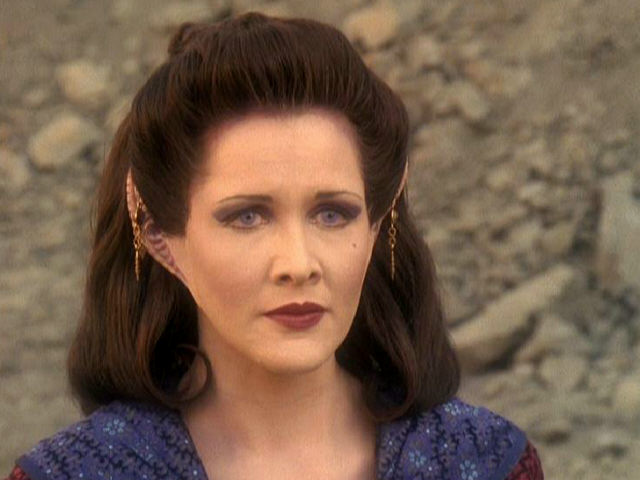
Stardate not given: Worf is captivated by the sight of Grillka, but is angry to learn that she is Quark's ex-wife. Nonetheless he and Dax help the Ferengi with Klingon practices in romantic relationships. Quark is successful, but when Grillka's guard, Thopok, sees the two together, he challenges the Ferengi to a bat'leth duel. Doomed to lose either Grillka or his life, Quark receives Worf's help yet again. Jadzia attaches remote control devices to Quark's body so Worf would be able to effectively fight for him. During the fight the devices fail, and while Worf and Dax are hurrying to repair the system, Quark delivers a lengthy speech about his beloved. With the remote control working again, Quark wins the fight. Worf has him hand out the bat'leth to Grillka, which would retain Thopok's honor. Suddenly recognizing that the fitting woman has been next to him all along, Worf becomes intimate with Jadzia.
Review
Knowing that par'Mach means something like the Klingon equivalent of love, the title of the episode is obvious in retrospect. But even though more sex was shown, or rather implied, than in any Trek installment in the preceding 30 years, the episode came out as mostly boring. It took until the final 15 minutes that anything of consequence happened, when Thopok challenged Quark, something that was overdue at this time. The course of the story was also quite predictable. We could anticipate that Quark, the self-declared womanizer, would fall in love with Grillka again, and so does Worf too. They both declared, "She's glorious". It was just too understandable that the Klingons wouldn't tolerate that. Also because Quark already got himself into trouble on Qo'noS in "The House of Quark". It was foreseeable that Quark would wind up in another duel, and that, just for a change, this time he wouldn't simply fall on his knees, begging for his life. When Jadzia devised the rather silly remote control for Quark's bat'leth fight, we knew that it would fail at some point. Fortunately Quark quickly made up the Ferengi "Right of Proclamation" - not only a trick that saved his life, but also an innuendo to the Klingon fondness of rituals. I found it quite funny.
By any means, Quark has to overcome a good deal of cultural disparities to attain his goal. And he is walking a thin line all the time. He is always like that, and perhaps unlike other Ferengi: no risk, no fun. But after re-enacting the romance of Kahless and Lady Lukara in the holosuite Quark queries, "I'm surrounded by corpses, my shoes are dripping in blood, and you want me too feel romantic?" This illustrates the radically different concepts of love, romance and relationships. So Quark still wants to "enjoy" the sexual intercourse in a Klingon fashion? Well, he is very happy afterwards despite all his contusions and bruises. I can't imagine that Worf prepared him for that in any fashion, but perhaps little dirty Quark always maintained a secret holographic SM dungeon?
I have a bit of a problem understanding Worf in this episode. Grillka's advisor Tumek makes it clear that Lady Grillka would never want to get involved with an outcast. So Worf compensates for this setback by helping Quark, even though he is not exactly a friend of Worf's. Moreover he is a Ferengi who would never deserve Grillka's appreciation in Worf's mindset. Like on many other occasions, it makes Worf proud to heed Klingon traditions and teach them to other people. It may give him satisfaction that Quark would never succeed without his support. But would Worf really go as far as taking part in the dishonorable cheat with the remote-controlled Ferengi against a Klingon warrior? Well, we can see that he enjoys the fight. He not only has the skills and the fortitude that Quark is lacking, he also looks a lot more solemn than Quark when he puts down the bat'leth at Grillka's feet. Anyway, I have the impression that, although Tumek couldn't really know Worf, he is absolutely right with his remark that Worf had no idea of Klingon women — although we know that K'Ehleyr could never be Klingon enough for him. I don't know how to pursue Klingon women either, but even by human standards Worf acts like a lovesick teenage boy all the time. At no point it can have been more than just romantic desire from his part (albeit probably of a Klingon flavor), seeing how suddenly he changes his mind and gets intimate with Jadzia (though not totally unexpected).
There seems to be a second love triangle in the episode in the secondary plot, and not just accidentally. But unlike Quark and Worf the "three O'Briens" have a quite mundane problem, no unfulfilled love, much less a cultural clash (we once again witness that humans and Bajorans are very much alike, not only physically). The three simply don't leave each other enough freedom. They could need a counselor, if Deep Space 9 only had one at this time. I like how Miles and Nerys manage to deal with it in a rather professional way, while Keiko is really a bit too hysterical about everything. I had that impression of her already in TNG. Their best scene is when Keiko insists on O'Brien accompanying Kira to Bajor when the major's true intention is to get away from the overcaring couple for a few days.
What is left to mention is that Sisko has just one brief appearance in the episode, and Odo at least once scene, in which he makes some wonderful snide remarks about Kira and the O'Briens.
Annotations
- Remarkable dialogue: "I thought you said the O'Briens were arguing in there." - "Not Miles and Keiko - the *other* O'Briens, Miles and Kira." (Bashir and Quark, who "accidentally" heard loud voices in the O'Briens' quarters, and then saw Keiko walk in)
- Remarkable quotes:
- "I will apologize for this at a later time. — YOU ARE IN MY SEAT!" (Worf, tossing Morn off his seat to impress Grillka)
- "...and I refrain from making any further disparaging remarks about the chief - I mean, Miles." (Odo, after criticizing that O'Brien cares too much about Kira and vice versa)
- Remarkable fact: We finally hear a sample of genuine Klingon opera the way Worf loves it. I've listened to more outlandish human operas, albeit not very long.
Rating: 3
Nor the Battle to the Strong
Synopsis
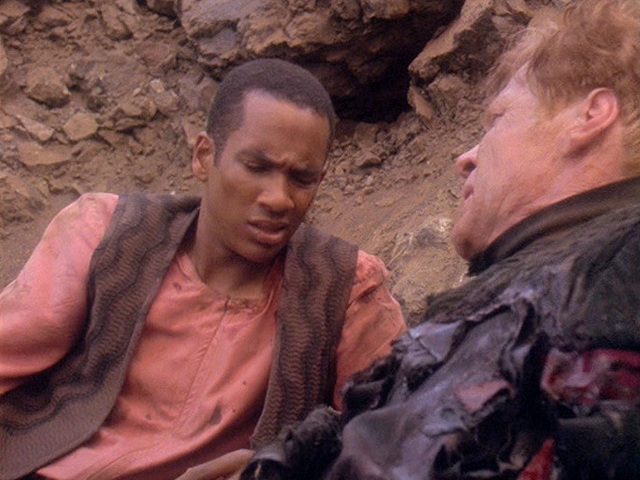
Stardate not given: Jake is traveling with Dr. Bashir on a runabout to write an essay about the physician, when they receive a distress call from a Federation colony under attack by the Klingons. With Jake affirming that he could handle the situation and that it would make a good story, Bashir alters the course to aid the colony. Soon Jake finds himself in a makeshift hospital in a cavern, crowded with seriously injured and dying people. When he and Bashir go out to get an emergency generator from the runabout, they come under attack by the Klingons. Jake panics and runs away. He runs into a dying soldier but can't help him. Some time later he finds his way back to the cavern but doesn't talk about his experience. As the Klingons keep advancing, the hospital has to be evacuated. Jake is hiding when Klingons enter the cavern and shoot the last guard. Jake grabs the rifle in panic, fires erratically and accidentally releases an avalanche that stops the Klingon advance. Instead of writing about Bashir, Jake decides to describe his own behavior in the crisis and the thin line between cowardice and courage.
Review
Jake is given less screen time every season as it seems. The writers often don't really know how to get him involved, since he decided against a career in Starfleet and has nothing to do with the station's operation. But they occasionally come up with stories that concentrate on him. So this is the first of only two installments of season 5 where Jake is allowed to play a major part. I never liked this episode too much though, seeing that Jake just stumbles through it with horror. He comes to rest and reflects about it only in the very end. But while nothing really "important" happens, it still deserves more consideration than other episodes that I give only an average rating.
It is obvious that the writer chose Jake to experience the horror of war first-hand just because he has never been trained for it. The episode shows the full range of human behavior and emotional states in a time of war, and it is perhaps a first time in Star Trek, at least in this intensity. Jake hears of Starfleet people who just ran away out of fear, wondering why they would get scared and run, although they have been in so many battle simulations. He encounters an ensign who shot himself with a phaser in order to be taken away from the battle zone. He stumbles straight into a dead Klingon. He witnesses the death of a Starfleet soldier who stayed behind to allow the hopper to lift off with the rest of his platoon. He finds the grim humor of the nurses appalling, who are discussing their preferred methods of getting killed by the Klingons. But most of all he is scared, all the time and to an extent that he can think of nothing else. Fear determines his thoughts and his actions alike. His notes just reaffirm what we can observe all along: "I wonder if Kirby [the orderly] knew that the whole time we were talking all I could think about was how close the Klingons were. He didn't seem that worried. No one else seems to lose sleep over it. So why is it the only thing I can think about? I have been on the station when it was under attack plenty of times, but somehow the danger never seemed as real as it does here. Maybe it's because I spent all day seeing first hand what the Klingons are capable of. And maybe it's because for the first time in my life my father's not here to protect me."
Jake's fear is justified. He gets into a Klingon barrage twice. While he panics on both occasions, the first time he just runs away, leaving Bashir behind, and is full of self-reproaches later. The second time there is no running away, he grabs a phaser rifle and fires aimlessly, luckily releasing an avalanche that stops the Klingons. So why should he be a coward the first time, and a hero the second time? This is the question that Jake probably keeps asking himself. And his father provides the answer in the end, that the common concept of "cowardice" and "courage" may be flawed. I think Jake is a coward on the battlefield by all means, but that is why he never considered to become a soldier. Whether they have been specially trained or not, there may be many people who wouldn't panic in his place, but only a complete idiot would not be afraid in the face of death. You can be courageous while still being afraid, you are even courageous in the first place just because you put aside your fear for a moment. But Jake's courage rather lies in a different field, and he can be glad to have a father who understands him.
As hard a time Jake has on Ajilon Prime, as easy is the banter on the station and later on the Defiant. Even Odo's little accident that he mentions to Sisko comes out as rather amusing although it must have been quite painful. While pursuing two Yridians who cheated at the dabo table, Odo tried to morph into a Tarkalean condor in mid-air, noticing too late that he has lost this ability.
Annotations
- Remarkable dialogue: Odo: "Jake is eighteen years old. Does your father still worry about you?" - Sisko: "All the time." - Odo: "I never realized how stressful it is to be a parent. I have to say I don't think it's for me." - Sisko: "That's your choice. But you don't know what you're missing."
- Jake's notes:"...The Battle of Ajilon Prime will probably be remembered as a pointless skirmish, but I'll always remember it as something more. As a place I learned that the line between courage cowardice and courage is a lot thinner than most people believe." - Jake, to his father: "I wasn't sure whether to show it to you or not." - Ben: "Anyone who's been in battle would recognize himself in this. Most of us wouldn't care to admit. It takes courage to look inside yourself. And even more courage to write it for other people to see. I'm proud of you, son."
- Remarkable quote: "Solid. I wonder why my people use that term. Humanoid bodies are so fragile." (Odo, after telling Sisko of his accident)
- Remarkable scenes: Aside from his fear, Jake shows a less severe human weakness, aversion to medical science, in two more light-hearted scenes. The first is still on the runabout, when Bashir floods his ears with medical technobabble, not noticing that Jake does not understand anything. The second is when Bashir performs a "surgery" on his plate with noodles, and Jake has to vomit (which I think is not related to his battlefield hospital experience).
- Remarkable facts:
- The Klingons have occupied the Archanis Sector. But Starfleet is regrouping for a counter-offensive, including the Rutledge and the Tecumseh. The Farragut is destroyed by the Klingons in the Lambatta Cluster on her way to Ajilon Prime.
- The episode title is from the Bible, Ecclesiates 9:11: "I returned, and saw under the sun, that the race is not to the swift, nor the battle to the strong, neither yet bread to the wise, nor yet riches to men of understanding, nor yet favor to men of skill; but time and chance happeneth to them all."
Rating: 4
The Assignment
Synopsis

Stardate not given: When Keiko O'Brien returns from Bajor, Miles is shocked to learn that his wife's body is possessed by an alien conscience. The entity demands that O'Brien make some modifications to the station's impulse response filters in the subspace communication emitters. O'Brien decides to seek the captain's advice, but the entity demonstrates its power by dropping Keiko from the upper level of the promenade deck. O'Brien carries on with his sabotage and swears Rom to secrecy about it. After evading Odo the two have almost completed the task when Rom explains that the modifications can be used to kill the wormhole aliens, the Bajoran Prophets, with a chroniton beam. O'Brien recognizes that the Pah-wraiths want to eradicate their ancient adversaries. He takes his wife on the runabout and activates the weapon. But instead of the wormhole the beam hits the runabout, and the Pah-wraith is expelled from her body.
Review
"The Assignment" is a creepy episode that greatly benefits from the performances of Colm Meaney and Rosalind Chao. But overall the execution is too cautious and real highlights are missing. In addition, we have seen the bodies of crew members as hostages before, most notably and more excitingly in the action thriller TNG: "Power Play". Well, "The Assignment" is rather a psycho thriller anyway. I admit that I am still fond of the two most frequent motives of this genre: The hero is either running around with no one believing him that something terrible is going to happen, or he is running around trying to pretend that everything is fine while a beloved person is being held hostage. The episode draws its suspense from the latter, from Miles O'Brien's bizarre and direful situation. It is not enough that he has to pretend that everything is perfectly okay with Keiko. No, he also has to celebrate his birthday with the Pah-wraith Keiko baking the finest pastries ever. And he has to listen how Dax, Sisko and Odo are talking about the saboteur in his presence.
After Miles was already possessed by an alien and threatened Keiko in TNG: "Power Play", they have ironically switched their roles now. However, nobody bothers to refer to their previous experience of alien possession. The only slight cue is when Miles initially thinks that Keiko is kidding when she says that she is possessed by an alien. It is possible that the two have found a humorous way to deal with the events from "Power Play" without the need to explicitly mention it. But while it is clear that their family is the perfect target for an evil alien, I wonder if it really had to be the O'Briens yet again. Of all crew members it is preferably O'Brien anyway who is given a hard time with physical and mental torture, even if Keiko is not involved. Well, it is always a good idea to give Colm Meaney the chance to excel as Chief O'Brien, the perhaps best character of the show to identify oneself with.
Rom's role in the story lies somewhere between a useful idiot and a stalwart sidekick. His awkward attempts of socializing with the people on his shift are somewhere between pitiful and hilarious and there is no real way of telling how Rom feels about it. I didn't like that part very much, but I could never really make much sense of his character anyway. Well, I have met people who were naively overenthusiastic in a similar fashion as Rom, as well as geniuses who could quickly analyze things that I needed to reflect on thoroughly. Only that I cannot really imagine to find both qualities in one person. Maybe rather in an alien than in a human person.
Regarding the Pah-wraiths, their premiere in "The Assignment" turns out creepy enough to call for sequels. So the Pah-wraiths will play an important role in some more episodes. It is satisfying to see that the authors manage to re-use not only plots with non-corporeal aliens that are pulled off thin air each time, but also the aliens themselves. In the end the Pah-wraith is killed as it seems by its own chroniton weapon that left Keiko largely unscathed. Poetic justice of this kind is comparably rare in Star Trek but is another very common motive in psycho thrillers.
Annotations
- Continuity: It is the third time in four episodes that people are talking about waste extraction, this time Quark and Rom. Somehow this is a worrying development...
- Remarkable quotes:
- "Is there something wrong, chief? I can work slower if you want me to." (Rom)
- "Don't worry about me, chief. My lips are sealed. Nobody will get anything out of me. Not even my name." (Rom)
- "For the first 40 minutes it was like pulling teeth even getting him to admit his name." (Odo, after Rom's interrogation)
- Remarkable scene: While working on the modifications, O'Brien discusses with the computer how he can stun Keiko. Although there is not really a big deal about it, I like this typical Trek narrative (as used extensively in TNG: "Remember Me") as the more skillful substitute for the stream of consciousness (as used repeatedly in the preceding episode "Nor the Battle to the Strong").
- Remarkable fact: O'Brien is probably the first one to be very lucky that Odo is not a Changeling any more, otherwise he couldn't knock him out so easily.
Rating: 5
Trials and Tribble-ations
Synopsis
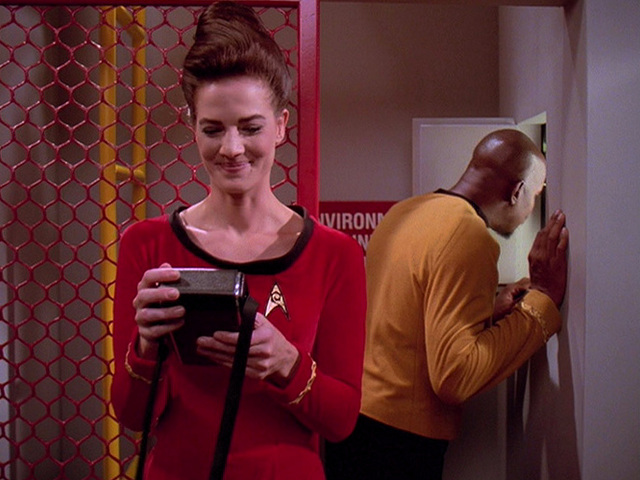
Stardate not given: Sisko receives two unpleasant visitors: Dulmer and Lucsly from Starfleet's Temporal Investigation. They question him about a recent time travel. Flashback: The Defiant is carrying the Bajoran Orb of Time when Arne Darvin, an old Klingon disguised as a human, uses the device to send the ship more than 100 years to the past. More precisely to the time when the USS Enterprise NCC-1701 was orbiting Deep Space K-7, summoned there to protect a cargo of quadrotriticale. Arne Darvin was present aboard the station and was later, with the help of Tribbles who don't like Klingons, exposed as a Klingon spy who had poisoned the grain. Now he strives to alter history. He has planted a bomb on the station to take revenge on James T. Kirk. The Defiant officers are deployed to find the bomb. Sisko and Dax manage to find it attached to one of the Tribbles in the grain storage just above Kirk's head. The bomb is beamed into space and the original timeline is preserved. The Defiant, however, brought some uninvited guests to the 24th century, as Deep Space 9 is swarming with Tribbles.
Review
"Trials and Tribble-ations" perfectly blends the good old TOS episode "The Trouble with Tribbles", a known fan favorite, with a new DS9-based background story. My high opinion of the episode is noteworthy because until then I usually disliked similar installments in any TV series, including the classic re-use of "The Cage" in TOS: "The Menagerie", which I saw as an inept attempt of story recycling. But "Trials and Tribble-ations" benefits greatly from an intelligent script, from its accurate timing, from the fantastic visual effects and from actors who visibly have fun in their roles. It is full of memorable quotes like several normal episodes combined, and the crew's numerous mistakes about 23rd century technology and habits are hilarious without becoming silly. An equally affectionate homage to The Original Series has never been produced before and will never be made again. Among my all-time favorite episodes this may not be the most exciting one, but it will always have a special place.
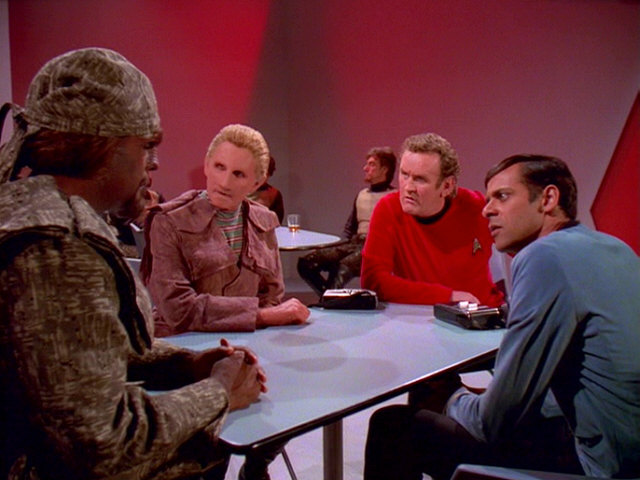
The digital effects were a masterpiece at the time the episode was being made and still are today. The bar brawl does not allow a distinction of old and new shots. In the following interrogation it really looks like O'Brien and Bashir are standing next to Kirk. However, it is remarkable that, in spite of all the efforts to digitally insert new characters into old scenes, "Trials and Tribble-ations" authentically recreates the look of all TOS sets and props without any concessions to 24th century style and to innovations in the real world. Even the obviously primitive tricorder interface that Dax is fond of remains exactly the same as in TOS. The decision not to digitally adapt the Klingon foreheads to the ridged 24th century version was prudent in a stylistic sense, and it paid reverence to the original, although it was Gene Roddenberry's stance that the Klingons always looked like they did since "Star Trek: The Motion Picture". But I wonder why it was necessary to explicitly hint at the flat foreheads. When O'Brien, Bashir and Odo are sitting in the bar, they don't recognize the Klingons at the two neighboring tables. The Klingons of the 23rd century don't seem to smell either. Moreover, what is the deal about Darvin's look having been surgically altered, as Worf and Jadzia insinuate, when in fact many if not pretty much all Klingons of his time used to look like humans? The episode does not offer a solution. On the contrary, it toys with the self-imposed inconsistency when the allegedly surgically altered Klingon Darvin insults his own people and when the disguised Worf takes part in the famous bar brawl - against the Klingons.
Aside from the Klingon foreheads, I have only one minor nitpick. While it is a lucky coincidence that Sisko and Dax get an empty turbolift while the deck is swarming with crewmen, how likely is it that the turbolift can simply be stopped for a couple of minutes while the ship is at red alert?
Annotations
- Remarkable dialogues:
- Darvin (in Worf's presence): "After six months, I was hoping that the Klingons would invade. At least, they know how to make coffee - even if they are foul smelling barbarians... uh... Sorry." (Darvin leaves) - O'Brien: "I wouldn't take it personally, Worf." - Bashir: "I rather like the way you smell." - O'Brien: "Yeah, a sort of earthy, peaty aroma." - Bashir: "With a touch of lilac."
- Bashir (to O'Brien and Sisko in their TOS uniforms): "Wait a minute, aren't you two wearing the wrong color?" - O'Brien: "Don't you know anything about this time period?" - Bashir: "I'm a doctor, not a historian." - Sisko: "In the old days, operations officers wore red, command officers wore gold." - Dax (entering in a miniskirt): "And women wore less." - Bashir: "I think I'm going to like history."
- Worf (about Tribbles): "They were once considered mortal enemies of the Klingon Empire." - Odo: "Huh. This?!" - Tribble: "SQUEAK!" - Odo: "A mortal enemy of the empire..." - Worf: "They were an ecological menace. A plague to be wiped out." - Odo: "Wiped out? What are you saying!" - Worf: "Hundreds of warriors were sent to track them down throughout the galaxy. An armada obliterated the Tribble homeworld. By the end of the 23rd century they had been eradicated." - Odo: "Hm. Another glorious chapter of Klingon history. Tell me, do they still sing songs of the great Tribble hunt? Hmhmhmhm."
- Remarkable quote: "I guess you boys of Temporal Investigation are - always on time." (Dax) - Actually, I was glad that after two minutes of "time" jokes following the arrival of the two temporal agents Sisko took his time to tell his story.
- Remarkable scenes: When the Defiant crew tries to get accustomed to the 23rd century, they make countless funny mistakes. Bashir confuses the uniform colors. O'Brien and Bashir are standing in the turbolift, not knowing how to activate it. O'Brien removes a transtator that he has no idea of, and the lights on the deck go out. Bashir possibly meets his great-grandmother and wonders if he could be his own great-grandfather. Sisko slaps the embroidered patch on his uniform that he thinks is the communicator, but nothing happens. O'Brien mistakenly identifies a lieutenant in the bar as James Kirk. Sisko thinks that Jadzia is speaking of Kirk when she actually adores Spock. Odo, Bashir and O'Brien don't know how Klingons of the 23rd century look like.
- Remarkable facts:
- "Dulmer" and "Lucsly" are anagrams for "Mulder" and "Scully".
- As a homage to Spock, Jadzia arrives at the very same number of Tribbles of 1,771,561, based on the assumption that each Tribble creates 10 offsprings every 12 hours. She comes to that conclusion about one hour earlier than Spock, an hour in which the Tribbles have continued to breed. But since the calculation is based on a quantization of 12 hours, the result is still the same. With 72 hours of reproduction we have six generations and hence 11^6 = 1,771,561 Tribbles. Thanks to Guri Harari for the hint.
Rating: 10
Let He Who Is Without Sin
Synopsis
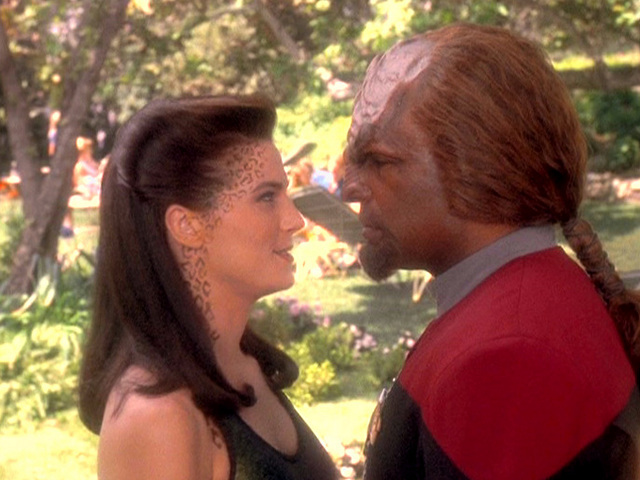
Stardate not given: Worf agrees to join Jadzia on a vacation on Risa. Julian Bashir and Leeta travel with them to "celebrate" the end of their relationship with a Bajoran ritual. On Risa, Worf is annoyed to learn that a woman named Arandis is Curzon Dax's former lover. Out of jealousy he decides to join the rally of the New Essentialists who turn against the complacency of the Federation. In order to demonstrate how vulnerable everyone would be without technology, Worf sabotages Risa's weather grid, with the result that the planet's climate becomes naturally rainy and stormy for a couple of days. He leaves New Essentialists leader Pascal Fullerton in control of a tricorder that taps into Risa's environmental systems. When Dax and Worf have an argument about the matter, he tells her that he once accidentally killed a boy named Mikel during a soccer match on Gault and that he does not want to indulge himself ever since. Suddenly an earthquake strikes the planet. Worf rushes to snatch the tricorder from Fullerton, who went over the top with his demonstration. Now he and Dax can finally enjoy what's left of their vacation.
Review
I didn't care a lot about the episode when I first saw it because it was so full of clichés and not only the setting reminded me a lot of soap operas. But watching it again, I found some new qualities and I noticed how well the single threads were woven together. And in the post-9/11 world some aspects have gained a whole new significance.
Worf's childhood trauma effectively prevents him from having fun. I wonder if he ever talked to a psychiatrist or to Deanna to find that out. But it wouldn't even have needed this all-embracing explanation to see what is going on. I think that Worf's and Jadzia's problem in their relationship boils down to the simple finding that they are quite different in many if not most respects. They both share a passion for martial arts, but aside from that they don't have very much in common, or they have just not yet discovered it. Most of all, Worf's graveness does not go with Dax's joyfulness. He reacts with jealousy on what he sees as escapades, whereupon she punishes him with defiance. This may have been one reason for her to choose Risa for the vacation - a place that Worf definitely wouldn't enjoy.
In a similar fashion as Worf's and Jadzia's disagreements, the austere idea of Fullerton's Essentialist Movement collides with the lax conventions of the pleasure planet. As with many things in life, the truth lies somewhere in the middle. Fullerton wants to create awareness for the dangers of the universe, which certainly isn't a bad thing. Although this is not his principal intention, citizens of the Federation should not turn a blind eye on those who are not so lucky to live in a free and wealthy society. Although no one is required to fight, hunt or work hard in order to be able to survive, the Federation would not function if all of its inhabitants were indulging themselves all the time. And actually it looks like they don't. Unfortunately we never learn about the other guests, but aren't they probably people with jobs who just seek some diversion on Risa, not in any way different than those who prefer vacations on Earth's beaches today? We may disagree about the role of Risa as the Federation's biggest brothel, but not about the fundamental right of the pursuit of happiness. By taking it for granted that the whole Federation is in a state of dangerous self-indulgence, Fullerton makes the fundamental error of all extremists of all times. Like so many before him he is blind for the shades of gray in life.
I don't care for Julian and Leeta and their Bajoran rite of separation, which I find about as silly as Quark does, and which distracts from the more important plot lines of Worf, Jadzia and the Essentialists. Moreover, it turns out much less humorous as probably intended. It is odd anyway that, in spite of the casual environment and the bizarre sight of Worf on a pleasure planet, the episode never gets really funny.
Annotations
- Remarkable dialogue: "Aren't you uncomfortable in that uniform?" - "Starfleet uniforms are designed for comfort, even in the most extreme environments." (Jadzia and Worf, in whose eyes Risa is an extreme environment)
- Remarkable quote: "Do not hug me." (Worf, to Bashir, just after a hug attack by Leeta - the by far best line of the episode)
- Remarkable facts:
- We can see how Morn apparently dates a woman in Starfleet uniform.
- The O'Briens are thinking about naming their child Sean, but in Bajoran something like "Sean" means "swamp". As we know from DS9: "Bar Association", Sean Aloysius O'Brien was one of Miles's forefathers.
- Jadzia went for lunch with a Gallamite captain named Boday. Gallamites have transparent skulls. Worf says that he is Jadzia's ex-lover.
- Jamaharon is the Risan word for sex. And jamaharon is mentioned more often in this episode than "sex" on any other occasion in Star Trek.
- Curzon Dax died during jamaharon on Risa.
- Leeta says that she has fallen in love with Rom because "he's so cute and so sexy."
Rating: 5
Things Past
Synopsis

Stardate not given: Returning from a conference on which a "dispassionate view" of the Cardassian occupation of Bajor was being discussed, Sisko, Odo, Garak and Dax are found lifeless in their runabout. The unconscious crew wake up on Terok Nor, apparently at a time when Odo's Predecessor Thrax was still on duty, more than nine years ago. After Dax has been taken to Gul Dukat's office, the three men discover that, in this reality, they are three Bajorans named Ishan Chaye, Jillur Gueta and Timor Landi. Odo recalls that these three were falsely accused of attempting to assassinate Gul Dukat and were executed - but this happened at a time when Odo was already the station's head of security. Thrax morphs into a changeling, and Odo is eager to not let it happen again. But in the end the three prisoners are lined up for execution in the presence of Dukat and another Odo, just as it happened seven years ago. The four wake up on Deep Space 9. Dr. Bashir finds out that during a plasma storm Odo's morphogenic enzymes created something like a miniature version of the Great Link with his crewmates, and they relived the event from the past that he still feels guilt about.
Review
DS9 has a predilection for subjecting characters to illusions induced by some mysterious force or by their own conscience, rather than trapping them on the holodeck, in a parallel space or in the past. This episode with its eerie atmosphere is reminiscent of Bashir's "Distant Voices" and O'Brien's "Hard Time". But most of all it harks back to "Necessary Evil", the other episode partially taking place in Odo's past on Terok Nor. I actually confused the two episodes more than once. This may also have to do with the fact that on both occasions the chemist's shop next to Quark's Bar plays a role, albeit this time it is merely mentioned as the place where the terrorists supposedly stole the chemicals for their bomb. Nice continuity here!
The episode is full of inconsistencies that are quite deliberate and a part of the story. For instance, the four characters only see each other as Bajorans. Thrax is the chief of security at a time when it should be Odo's job. Dax is apparently hurt in the blast in Dukat's place, as Sisko's perceives it. Finally, the escapees that have already reached the docking hatch suddenly find themselves in the cell again. Also, would the actual Thrax discuss his investigation with a convicted Bajoran criminal like he does with "Timor Landi", Odo in Bajoran disguise? I like how initially the four characters discuss several typical Trek scenarios that could have taken them to Terok Nor, but gradually dismiss all of them because they would make no sense. Their considerations are quite logical and well-written. In some respects the repeated nonsensical leaps from one place to another remind me of TNG: "Frame of Mind", but the DS9 episode is not by far as impressive. Some of the inconsistencies will make sense in the following, such as the wrong statements of the Cardassian guards that Odo mentions as one reason for the false accusations and that explain why Sisko believes to see that Dax has been injured, thereby raising unnecessary suspicion.
Still, everything is simply too constructed. It is clear that the whole dilemma is somehow taking place in Odo's mind, out of guilt for allowing three innocent people to be executed. As a matter of fact, it becomes clear to everyone after 21 minutes that Odo must be responsible for their deaths when Garak checks his files and states that the time is seven years ago when Odo was already there. However, Odo needs 20 more minutes to understand what is going on. This may be justified by a tendency in his mind to deny what happened, but effectively it takes away the tension from the story. I was a bit annoyed by the rather cheap fashion in which Odo was uncovered and released, only to watch how the three terrorists (now Sisko, Garak and Dax) are executed, with Dukat and Thrax in the roles of his conscience. Finally, Julian's twisted technobabble may be a satisfying in-universe explanation, but it is only one more deficit in a story that too quickly becomes exhausted.
One thing that I am fond of and that is indispensable is Odo's and Kira's scene at the very end when she asks him whether there were more innocent Bajorans killed when Odo was on Terok Nor. Odo truthfully answers that he doesn't know but hopes there were none. I am also delighted to finally see Garak again, after not appearing in the previous episodes of the season.
Annotations
- Remarkable quotes:
- "How much damage would it do to the timeline if Quark were to suffer a mysterious accident?" (Odo)
- "I never knew we were such messy conquerors." (Garak)
- Remarkable fact: When Dukat asks Jadzia, who appears to be a Bajoran woman, for her name, she calls herself "Leeta".
Rating: 4
The Ascent
Synopsis

Stardate not given: Quark and Odo are on their way to a hearing, when Quark notices a whistling sound in the floor of the runabout. It is a bomb, obviously planted by the Orion Syndicate. They manage to contain the explosion in a transporter beam. Still, the small vessel crash lands on a desolate and cold Class-L planetoid. Quark suggests that they carry the emergency emitter to the top of a high mountain in order to increase its range. The two are already completely exhausted when they discover that the mountain is still days away. Moreover, Odo breaks his leg when the two slide down into a valley. Odo insists that Quark leave him behind. He is prepared to die when the Defiant arrives and beams him up.
Review
This episode follows a well-known recipe: Isolate two opponents or otherwise contrary characters in a dangerous situation that requires them to collaborate in order to survive. In the end they may learn a lesson and gain some more mutual respect while still maintaining their conflict. Quark and Odo run the gamut from mutual mistrust to mutual accusations, mutual malice and finally some sort of solidarity. Armin Shimerman and René Auberjonois give great performances. Especially the latter gets to play out emotions that Odo always used to restrain when he was still a Changeling - although his typical condescending attitude towards Quark has never been different and dominates parts of this episode too while we may have expected to see a bit more of a change. Anyway, not only physically he is a weak human being in this episode — and a strong character nonetheless. On the other hand, this benefit doesn't prevent "The Ascent" from being plain boring. It is a conventional and rather contrived plot about marooned people without any particular highlights. With the Orion Syndicate it introduces an unnecessary new conflict to the mix that will have hardly a chance to become bigger in the following. The only interesting outcome is that Odo is not even aware if and why Quark is being persecuted when he is ordered to take the Ferengi to the interrogation. Odo apparently feigns knowledge to get Quark to talk.
Jake's and Nog's problems in their cozy quarters mirror those of Odo and Quark on the Class-L planet in a light-hearted fashion. I like that part of the episode better than the main plot. It is life as we probably all know it, and still it is nice watching.
It happens quite a few times, and especially in DS9, that an inhabitable planet is incidentally very close whenever an accident happens on a ship. Well, the runabout may have been still traveling at warp for a couple of minutes, and Odo explicitly says that the long-range sensors have found the Class-L planet. Still, it is a huge coincidence to have such a planet a few minutes away. It is also contrived that the explosion selectively destroys the comm system, most of the emergency rations and all protection suits but one. On a different note, as much as I like filming on location, the Sierra Nevada scenery is too pleasant a place to insinuate that Odo and Quark almost starve and freeze to death. There are supposedly meant to be no animals, at least no "beetles, slugs, worms or snails" that Quark would have loved to eat (In "The Jem'Hadar" he still loathed anything but Ferengi beetles, but it is obvious that he can't be that picky here). Still, about 38 minutes into the episode, when Quark is lying on the soil, we can see some small insects buzzing around his head.
Annotations
- Remarkable dialogues: "We're going to clean every day?" - "No, Jake, just the odd- and even-numbered ones." (Jake and Nog),"...It looks like he saved both of your lives." - "I was afraid you'd say that." (Jadzia and Odo, about Quark)
- Remarkable quote: "Try not to break the other leg while I'm gone." (Quark)
- Remarkable facts:
- Rom takes a blood sample from Nog because he thinks his son could be a Changeling. He became suspicious because Nog is so different after returning from the Academy.
- When he discovers that Odo is reading a romantic or erotic story, Quarks offers him a first edition of "Vulcan Love Slave".
- Jake writes a story named Past Prologue (that Nog feels urged to "correct"). "Past Prologue" is also a first-season DS9 episode.
Rating: 2
Rapture
Synopsis

Stardate not given: The Cardassians return an old painting depicting the ancient Bajoran city of B'hala. Sisko is eager to find the site. While he is working in a holosuite to reconstruct an obelisk that could reveal the city's location, he is struck by a discharge from a console. From now on his senses are enhanced, and he manages to finish his work and find B'hala. But he continues to be plagued by headaches and, against Jake's and Kasidy's advice, refuses to be treated. When Bajor's admission to the Federation is going to be signed, Sisko storms into the conference room and demands that it be halted, otherwise Bajor would be destroyed. The captain then collapses, and Jake decides that Dr. Bashir needs to operate his father so he can survive. Bajor abstains from joining the Federation for the time being.
Review
Since the beginning of the series Benjamin Sisko has gone through quite a development from a mundane Starfleet commander to a revered Bajoran religious icon. In "Emissary" his actions were governed by rationality. The Bajoran Prophets appeared to be just "wormhole aliens" in his view. In the beginning Sisko's visions of the Prophets surely impressed him but were not essentially different to him than were the frequent encounters with non-corporeal aliens to Spock or Data. This changed a bit in the following. However, by the time of "Destiny" in the third season Sisko still preferred the scientific explanation of the surprising outcome of the wormhole relay experiment over the Bajoran interpretation of it being the fulfillment of a prophecy. In "Accession" in the fourth season Sisko was willing to hand over his duties as Emissary to Akorem Laan but was lucky in the end when Akorem returned to his own time. Once again a prophecy was fulfilled, and this time it left the captain thinking.
In "Rapture" Sisko takes a further step, and it is a huge one this time. He is hit by a lightning that comes out literally as an enlightenment, rather than as the mundane malfunction of an ill-maintained console that it would have been in any other episode. After this incident Sisko openly confesses that something has happened to him that he cannot explain and may not even want to explain. Sisko's former role as the skeptical Starfleet officer who demands discipline and dispassion is now up to Admiral Whatley who has a small yet important role. Sisko is plagued by visions all the time, to an extent that he may suffer permanent and possibly lethal damage. But he doesn't care. He puts his new-gained faith in the Prophets and his dedication to serve the Bajoran people above everything. Well, he is not totally obsessive all the time and he attempts to limit the damage to the relationships with his son and with Kasidy. I like how charmingly he manages to combine pleasure and duty when he invites Kasidy to a trip to Bajor where he is determined to excavate the ancient city of B'hala — but that works only because Kasidy is more than keen on continuing their relationship.
Other things he does and says rather sound like he is out of his mind. It looks like Sisko wants to be Jesus Christ II, ready to suffer and die for the welfare of the Bajoran people, if this should be the plan of the Prophets. Statements such as "The baby that I'm holding in my arms right now is the universe itself. And I need time to study its face." are either indicative of a mental illness, or he has really become superhuman. But the latter still wouldn't excuse him talking such a grandiose trash. I admit that, as much as I appreciated him in this season so far, I don't like Avery Brooks's performance in this episode. Sure, the script is to blame for Sisko's frequent piercing headaches, his fainting and his trembling on the floor like he were drunk as hell. The script as well as the acting should have been toned down, it becomes importunate after a while. When he storms into the conference room, barely capable of saying that Bajor is not ready yet for the Federation, the episode hits its low. I found it unintentionally funny.
Looking at the other characters, the discussion of the religious issue in the ops in the obvious constellation Dax/O'Brien (secular) vs. Kira/Worf (spiritual) resonates with me. Although it is essentially composed of phrases, it echoes the debate in the real world. In the end it is neither Starfleet nor the Bajorans, but it is up to Jake as the closest relative to decide whether Bashir can perform a probably life-saving surgery against Sisko express orders or not. In the best scene of the episode Jake makes the obvious decision to save Ben's life. Only Kira is apparently against the operation, but she shows a good deal of loyalty when she later defends it against Kai Winn's criticism. Other than that, it is noteworthy that Kai Winn's role has shifted from an opponent to Kira's new trustee in spiritual matters.
"Rapture" comes at a time when VOY: "Sacred Ground" has already laid the ground for a new kind of Trek episodes that turn the tables on Trek's rationality and technophilia. Scientific findings lose their relevance, and intuition may be just as valid or even better than thorough consideration of a problem. Not everything can be rationalized, and some things better remain unexplained. Many things in the Star Trek Universe always remained mysterious, but never before so clearly as an essential part of a story. Particularly in the DS9 episodes another trend is that technology is involved in the fulfillment of ancient prophecies, like in "Destiny" and once again in "Rapture" (where Sisko finds B'hala only with the help of the holodeck). Technology serves spiritual purposes, further blurring the former contrast.
Annotations
- Remarkable mishap: When Quark celebrates Bajor's expected entry into the Federation, his employees uncoil the Klingon flag.
- Remarkable fact: This is the first DS9 episode with the new uniforms from "Star Trek: First Contact".
Rating: 3
The Darkness and the Light
Synopsis
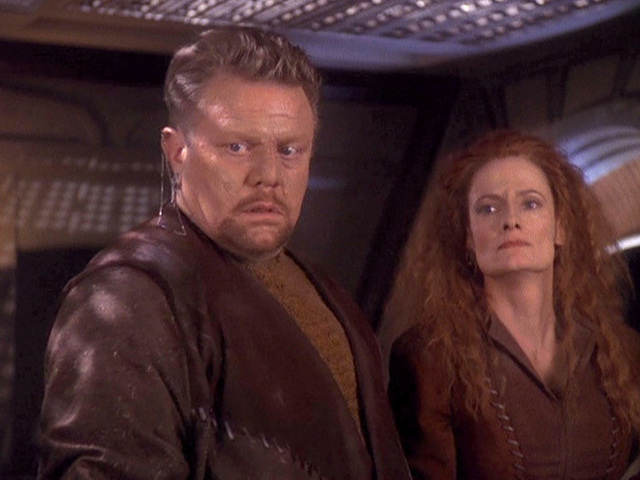
Stardate 50416.2: Three members of Kira's Shakaar resistance cell have been assassinated, each time followed by a message from the culprit to Kira. Her former comrades Lupaza and Furel arrive at the station to aid her. But the two are killed in an explosion. Odo compiles a list of suspects, refusing to give it to the pregnant Kira. However, Kira takes the list and comes to the conclusion that it has to be Silaran Prin. Without anyone's knowledge she takes a runabout to Prin's home but is instantaneously confined in a forcefield upon her arrival. Prin was disfigured in a resistance bombing and now seeks revenge. When Prin thinks she has been sedated, Kira manages to overwhelm and kill him.
Review
"The Darkness and the Light" is one of those episodes that I can find nothing wrong with, still it is rather uninspiring. The episode is well-written but it is a routine job devoid of real highlights. Clearly Nana Visitor's performance is great, and her character finds a worthy opponent in Silaran Prin. Prin continues a long tradition of Cardassian characters whose stances and actions appear confounding, even despicable to Bajorans and to humans alike. However, oddly enough, of all DS9 characters it was most often Kira Nerys who became emotionally attached to single Cardassians, such as Marritza in "Duet", Ghemor in "Second Skin" and eventually even Dukat in "Indiscretion" and "Return to Grace". Silaran Prin sort of "corrects" her view of Cardassians. His dispute with Kira about what is allowed in a war and what not is something we have had before, but is is still the most interesting part of the episode. Prin is much of an antithesis to Marritza, the low-ranking Cardassian executive who thought that his sacrifice could help in the redemption the Cardassian people. Prin's intention is quite the contrary, but in achieving their goals the two share their determination, their passion and their attention to detail.
The other characters hardly play a role. Particularly Kira's friends from her resistance cell fail to contribute much to the plot because they are all assassinated after their first appearance or only show up on computer screens anyway. On the other hand, killing off these characters is not such a great loss, as the focus of the series has shifted since the first three seasons and the idea of episode is a bit anachronistic anyway. Seeing how irresponsibly the pregnant Kira acted, I would have expected the O'Briens to be accordingly infuriated. But that opportunity was wasted.
There a few nifty details in the episode, like the fact that Prin uses Kira's voice to relay his messages (which Nog with his "lobes" finds out), or the herbs that Kira takes and that later block the effect of Prin's sedative.
Annotations
- Remarkable dialogues:
- "You've been smirking ever since we left the starbase." - "I do not smirk. But if I did, this would be a good opportunity." - "How was I supposed to know that Captain Ramirez was a three-time tongo champion." - [Worf is still smirking] "You may have asked, before mocking him and then allowing him to up the stakes to a no-limit game." - "I didn't lose that much." - "Two bars of latinum. I hope you have it." - "I have it - most of it... Worf -" - "No." - "Fine. I'll borrow it from Quark. He likes me." - [Beep] "Major Kira's friend is ready for transport... Quark may lend you the money. But remember Rule of Acquisition No. 111: 'Treat people in your debt like family. Exploit them.'" - "You know the Rules of Acquisition?" - "I graduated at Starfleet Academy. I know many things." (Jadzia and Worf)
- "None of us liked killing. We were fighting for our freedom, against..." - "You vaporized the entire east wing! Twelve Cardassians were killed, including Gul Pirak's entire family. Twenty-three others were crippled. Don't you feel guilty, don't you feel ashamed of what you did?" - "None of you belonged on Bajor. It wasn't your world. For fifty years you raped our planet, and you killed our people. You lived on our land and you took the food out of our mouth, and I don't care whether you held a phaser in your hand or you ironed shirts for your living. You were all guilty, and you were all legitimate targets." - "And that's what makes you a murderer. Indiscriminate killing... No sense of morality... No thought given to the consequences of your action. That's what makes us different." (Kira and Prin)
- Remarkable fact: 15 million Bajorans were killed during the occupation, according to Major Kira.
Rating: 3
The Begotten
Synopsis

Stardate not given: While Kira is about to deliver the O'Briens' baby, Odo has adopted a child of his own - an infant Changeling. Dr. Mora Pol, who once worked wit Odo, arrives from Bajor to assist him. But even though he is ordered by Starfleet Command to establish communication with the Changeling as soon as possible, Odo detests Mora's methods of using mild force to teach the shapeshifter. The two finally settle their conflict when their concerted efforts succeeds. However, the celebration doesn't last for long as the young Changeling is dying. As a final gift the Changeling merges with Odo and transforms him back into one of his kind.
Review
Although his being human was not explored too much except in "The Ascent", an episode that I simply didn't like, it was an interesting twist to have Odo transformed into what must appear as a primitive lifeform to him. Still Odo as a Changeling is a more versatile and a more valuable character, also because this way he can literally maintain unique ties with his people. So it is good to have this old Odo back. And although it happens in a quite miraculous fashion, there is something poetic about the dying infant's last gift to Odo.
All parents of all species probably want their children to have a better childhood than they had themselves. Odo is determined to let the infant Changeling, his child, experience loving care, something that he thinks he never received from Dr. Mora. The two met before in the series, in DS9: "The Alternate", but didn't get the chance to talk things out. When Odo talks about him and with him in "The Begotten", it almost sounds like Dr. Mora must have been a ruthless stepfather who misused Odo as a lab rat. But it becomes clear very soon that Mora is not like that. "You never want to give anything away, even though it is right there in your face." is one of the first things that Mora says to Odo, and this sounds like it comes from a caring father. Odo's beef with Mora is also reminiscent of inexperienced parents who think that they instinctively know what is best for their child and who wouldn't take a lesson from a professional nanny or from their own parents.
Mora Pel appears to Odo as a self-righteous person who believes that he always did the only right thing in the given circumstances. But at latest when Starfleet demands fast results from Odo in a similar way as the Cardassians put Mora under pressure, Odo begins to understand him. In many ways the situation echoes that of TNG: "The Offspring", when an admiral came to monitor Data's progress in the development of Lal, threatening to take away his daughter from him - with a sad outcome. But most of all it becomes clear that Mora is right that a Changeling needs stimulation and needs motivation to explore his world, just as a human child should not spend all day in front of the TV screen.
The secondary plot of Kira's Bajoran birth ceremony was quite exasperating, but that was probably exactly the intention. Miles's and Shakaar's adolescent quibbling really wasn't necessary to beef up the story though. I bet the next time Kira would want the baby to be simply beamed out.
Annotations
- Remarkable quotes:
- "And it's always nice to have someone around to change the diapers." (Sisko, advising Odo to accept help in raising the Changeling)
- "Constable. Why are you talking to your beverage?" (Worf)
- Remarkable dialogues:
- "Arghh. I'll be in pain for the rest of my life." - "Odo. You have a pinched nerve." - "Really." - "It comes from bad posture." - "Me? Ridiculous. I haven't seen anyone sit so straight." - "Exactly. You carry yourself too rigidly." (Odo and Bashir)
- "I'm measuring its volume. It's been here a week, and it's only grown 17%. After three days in my lab, you were twice that size." - "Maybe I was anxious to grow up, so I could get out of there." (Mora and Odo)
Rating: 6
For the Uniform
Synopsis
Stardate 50485.2: Sisko is going to retrieve information about the former Commander Eddington, who defected to the Maquis, when his contact turns out to be none other than Eddington himself. Eddington sabotages the Defiant with a cascade virus and escapes. Using a compound that is harmless to humans but hazardous to Cardassians, Eddington begins to poison Cardassian colonies. The Defiant now receives support from the USS Malinche, but the Maquis attack and disable the Starfleet ship. When his ship arrives too late to stop another attack on a Cardassian planet, Sisko decides to turn the tables and contaminate a Maquis planet with a chemical that is harmful to humans but not to Cardassians. While the two sides have to switch planets, Eddington turns himself over to the Federation authorities in order to avert a further escalation.
Review
It is an exciting episode and one that I enjoyed a lot. Still, I have a huge problem with it. A problem with Sisko's decision to poison the Maquis planet. He does not just overstep his authority by far, but the act is plain criminal. Very easily Sisko could have become a mass murderer, if the Maquis had not accidentally had enough transport ships to evacuate the whole planet, or if the bioweapon had taken effect too rapidly. Eddington says that Sisko is betraying his uniform, without even noticing it, and he is damn right about that. Sisko betrays his superiors by weakening Starfleet's position in the Neutral Zone, he betrays the principles of peace and justice that the Federation and Starfleet stand for and he betrays the human settlers of the Neutral Zone who would have deserved neutrality from his part at the very least, and not help for the Cardassian oppressors. Sisko does all this only to hunt down one man. Ironically, when Sisko met with Eddington at the beginning of the episode, the captain still accused the Maquis of misusing the colonists for their purposes. Now Sisko does the very same, he may even kill many of them. My particular gripe is not only that Sisko does commit this crime in the first place, but that it has no consequences for him. No charges from Starfleet Command, no open criticism from his crew. On the contrary, the episode closes with an inappropriate comment from Dax who says that she is glad that this time the bad guy wins. The sad thing is that Sisko really is the bad guy here, and nobody really cares. The manufactured poetic justice that the expelled Maquis settlers may take over the former Cardassian planets and vice versa does not really alleviate Sisko's (or Eddington's) guilt either. But Eddington eventually surrenders for a higher cause, while Sisko would not have abstained from his hunt to avoid incommensurate damage. So in a strange fashion it is Eddington who prevails in the end. The moral victory is with him.
A key question of the episode is whether Sisko takes the task of apprehending Eddington too personally. It is quite obvious in all of his statements and actions that he does. It may be the main reason why Starfleet takes away the task of apprehending Eddington from him. Since the events of "For the Cause" Sisko has been deceived and repeatedly humbled by the former fellow officer. It is not even the fact that Eddington commits clear war crimes when he poisons whole planets and attacks defenseless refugee transports that makes Sisko furious. On the contrary, Sisko does exactly the same in the end, just to capture Eddington. But it usually takes two for a vendetta. So what about Eddington? The Maquis leader initially comes across as magnanimous. He says that he just does what he has to do, and that he has no harsh feelings towards Sisko. But Eddington's position is much more comfortable anyway. He has not been betrayed by a fellow officer. No one has ordered him to go after the Starfleet captain. So why should he make it a personal matter? Still, we cannot really believe him. At latest when Eddington sends over Les Misérables to the Defiant, it becomes evident that there is more about it than just fighting for a cause. In his mindset Eddington is the bread thief Valjean who is chased by Inspector Javert, Sisko's character, for the rest of his life. Eddington should know that this interpretation of his connection to Sisko is simply not true. He did not commit a minor offense like Valjean. He may not take it quite as personally as Sisko does, but Eddington's transfigured perception of the situation is just as dangerous for everyone involved.
Annotations
- Nitpicking:
- I wonder why the Defiant's bridge was not simply moved down to engineering, as long as most systems, even including the helm, could be operated only from there. And even if it made sense to give remote commands, why didn't everyone on the bridge wear a communicator like Nog, instead of having Nog repeat everything from and to engineering?
- Trilithium already has a history of being used inconsistently. In TNG: "Starship Mine" it was a highly volatile by-product of the warp core. In "Star Trek Generations", trilithium resin was an unknown explosive. In DS9: "For the Uniform", trilithium resin is suddenly familiar but not an explosive any longer, but rather a bioweapon.
- Remarkable dialogues:
- "Tell me captain. What is it that bothers you more? The fact that I left Starfleet to fight for a higher cause, or the fact that it happened during on your watch?" - "You didn't leave Starfleet. If you had, I wouldn't be here. You betrayed Starfleet." (Eddington and Sisko)
- "You betrayed your uniform!" - "And you're betraying yours, right now! The sad part is, you don't even realize it." (Sisko and Eddington)
- Remarkable quotes:
- "You know what I see out there, Mr. Eddington. I see victims. But not of Cardassia or the Federation. Victims of you, the Maquis. You sold these people on the dream that one day they could go back to those farms and schools and homes. But you know they never can. And the longer you keep that hope alive, the longer these people will suffer." (Sisko)
- "You know what your problem is, captain. You made this personal. It didn't have to be, it wasn't with me. I have no animosity, no harsh feelings towards you." (Eddington)
- "I think it is time for me to become the villain." (Sisko)
- "Sometimes I like it when the bad guy wins." (Dax)
- Remarkable fact: This episode repeatedly makes use of the new holo-communicator, a device that will reappear in only one more episode and then vanish without a trace.
Rating: 7
In Purgatory's Shadow / By Inferno's Light
Synopsis

Stardate 50564.2: Worf and Garak follow a mysterious message that Garak's mentor Enabran Tain seems to have sent from the Gamma Quadrant. On the far side of the wormhole they run into a Dominion fleet, are captured by the Jem'Hadar and taken to a prisoner camp. In the camp they meet Tain and General Martok, as well as another prisoner: Dr. Bashir, who was kidnapped on his way to a conference and replaced with a Changeling a month ago. Tain is about to die when he finally acknowledges Garak, who promises to escape, as his son. Meanwhile on Deep Space 9, the crew, together with the Bashir Changeling, is working on a plan to seal the wormhole. When the Dominion fleet enters the Alpha Quadrant through the wormhole, the ships surprisingly turn about and head for Cardassia. Gul Dukat follows the fleet and announces that Cardassia is now a part of the Dominion, with he himself being their leader. Gowron reinstates the Klingon-Federation treaty against the new common enemy. In the internment camp, Worf almost ceaselessly fights against the Jem'Hadar for the guards' enjoyment, while Garak and Bashir are working for their escape. Although Garak suffers from claustrophobia, he continues to modify the communication system in a narrow crawlspace and beams out Worf from the arena before he is executed. The doctor sends a message to Deep Space 9, warning the crew of the shapeshifter. But the fake Bashir has already taken a runabout, heading straight for the Bajoran sun with an explosive that would cause it to go nova. Dax and Kira take the Defiant and tow away the runabout in the nick of time.
Review
This is the best thriller of the series since DS9: "Way of the Warrior". Most notably the double feature bears as many surprises as hardly any other Trek installment: Tain's and Martok's survival in the prisoner camp, the fact that Tain is Garak's father, Dukat's ploy to join the Dominion. Still nothing of all this comes across as contrived. It all ties in nicely, and makes a lot of sense. Clearly this double episode, written by Ira Steven Behr and Robert Hewitt Wolfe, has not been pulled out of thin air but has been carefully prepared over the course of several months. The definitely biggest surprise, however, is that for several episodes (at latest since "Rapture" when we first saw the uniforms) we have not seen the real Bashir but a Changeling in disguise. A Changeling who did such a thorough job that no one noticed the difference. Regarding Martok, he says he has been in the prisoner camp for two years and he also doesn't know Worf, so the Martok from "The Way of the Warrior" must already have been the Changeling.
An all-out war with the Dominion is due at the time of the episode, and yet it is adjourned once again, which leaves me a little bit disappointed. If the prior acts of aggressions were not yet sufficient to prove that the Dominion is evil, the almost successful attempt to detonate the Bajoran sun in order to destroy the combined Federation, Klingon and Romulan forces is so devilish that it should defy all diplomacy. Gul Dukat apparently doesn't notice that he is selling Cardassia to a ruthless superpower that would sooner or later destroy his people, and just to play the head of a pathetic puppet government.
I am delighted to see Tora Ziyal again after a longer absence from the screen (though she is yet again played by a different actress, Melanie Smith, and with a somewhat different make-up as I think). It is no surprise that her little romance with Garak would infuriate her father. Still, Cardassian family ties remain incomprehensible. At one time Gul Dukat truly wants his child to die (DS9: "Indiscretion"), on other occasions he would kill anyone who just talks to her. But when he leaves the station, Dukat gives up his daughter rather effortlessly, knowing that she will die together with everyone else. Elim Garak's relationship to his father is similarly ambivalent. He has been denied and exiled by his father Enabran Tain. We never learn what disunited the two though.
Annotations
- Nitpicking: Prisons in Star Trek "traditionally" have lax security. The Jem'Hadar internment camp is no exception. Crawlways with important systems are rather easy to access, there are no weapon fire detectors and there is no audio or video surveillance.
- Remarkable dialogues:
- [Garak talks Worf into supporting his application for Starfleet Academy] "Frankly, I think I could be quite an asset to Starfleet. With my extensive experience, I could skip the lower ranks entirely, and begin my career as a commander. Maybe you could suggest that in your letter. Tell them you'd be honored to serve under me." - "Do not play games with me. - You have no desire to join Starfleet, do you?" - "No. I'm afraid I don't." - "Then why all of this deception?" - "Because lying is a skill like any other, and if you want to maintain a level of excellence, you have to practice constantly." - "Practice on someone else." - "Mr. Worf, you're no fun at all." (Garak and Worf)
- "The Jem'Hadar don't eat, don't drink and they don't have sex. And if that wasn't bad enough, the Founders don't eat, and don't drink and don't have sex either... which, between you and me, makes my financial future less than promising." - "It might not be so bad. For all you know, the Vorta could be gluttonous, alcoholic sex maniacs." (Quark and Ziyal)
- Remarkable quotes:
- "Romance is for solids." (Odo)
- "At the first sign of betrayal, I will kill him, but - I promise to return the body intact." (Worf, before departing with Garak)
- "I should have killed your mother before you were born. You have always been a weakness I can't afford." (Enabran Tain, to Garak)
- Remarkable character: The Breen prisoner is sitting there all the time, never talking, until he attacks the Jem'Hadar guard. The Romulans have a proverb, "Never turn your back on a Breen", although I doubt that the Romulans may know the mysterious Breen so well.
Rating: 8
Dr. Bashir, I Presume
Synopsis
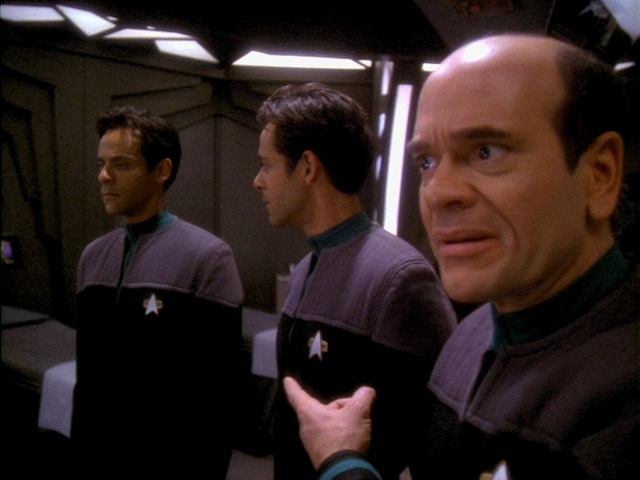
Stardate not given: Dr. Bashir has been chosen to be the model for Starfleet's latest holographic doctor. Dr. Lewis Zimmerman comes to the station for extensive field studies. Dr. Bashir is uncomfortable when his parents Richard and Amsha Bashir arrive - invited by Zimmerman who is going to examine Bashir's childhood as well. Julian is particularly concerned that the two could reveal a childhood secret that would cost him his career - that he has been genetically enhanced. This is illegal in the Federation. The two later tell their son that they won't let that happen. But they are actually talking to the holographic version, with Zimmerman and O'Brien witnessing the revelation. Dr. Bashir decides to resign before the fateful report is filed. But Sisko arranges an alternative solution to the dilemma. Richard Bashir accepts a two-year sentence, while his son is allowed to remain in service, albeit with a stain on his record.
Review
As the dust of the almost successful Dominion attack has settled, DS9 carries on with a light-hearted episode - at least this is what "Dr. Bashir, I Presume?" appears to be in the beginning. It is the second time after VOY: "The Swarm" that Robert Picardo appears as Dr. Zimmerman. And once again it is a lot of fun to watch. Zimmerman is not just outwardly the exact prototype of the EMH. The only thing the latter obviously hasn't inherited is Zimmerman's insatiable libido. We may speculate if there are any characteristics of Julian that Zimmerman may have decided to abandon when creating the new long-term EMH.
While we could not anticipate that Bashir has a good reason for his parents not to be interviewed because they are hiding a secret, it was obvious that Zimmerman would ignore the doctor's explicit wish. When Amsha and Richard Bashir arrive on the station, the atmosphere is still humorous in its awkwardness, a lot like in TNG: "Family" where Worf is similarly enthusiastic when his adoptive parents come aboard the Enterprise. Probably everyone knows what it is like when your parents come to visit the place you live or work at, and then keep telling your colleagues or friends all sorts of embarrassing things about your childhood. Especially when they find attentive listeners among them, like Jadzia in this case.
Richard Bashir is a real windbag, an anachronistic kind of human character that we rarely see on Star Trek. He has not accomplished anything noteworthy in his life, but he can talk about his great achievements and his plans for hours. Or give Julian advice in fields he has not the slightest idea of. Julian, on the other hand, is hostile towards his parents and especially towards his father from the very beginning. My impression is that he is not only afraid that Richard Bashir may talk a bit too much to Lewis Zimmerman. Julian wouldn't want to speak with his father anyway, knowing that it is rather fruitless. Of course, the revelation that the Bashirs have altered Julian's DNA in a way that he would have a better life and overall better chances gives their conflict a new dimension. Yet, the problem between Julian and his parents may have been essentially the same if he had wound up as a genius despite his natural genetic heritage.
As much as his anger about his father's method to circumvent problems instead of facing them is understandable, Julian is being unfair to him. Unfair because he himself has been profiting from his enhanced abilities more than anyone else, and because he would never want to give up that part of his personality (for instance, by having the treatment reverted in some fashion). Even if it was morally questionable and illegal, the genetic enhancement works. Julian is not a freak. He is not the fraud that he is afraid to be. He is not a victim either. Perhaps we can compare his viewpoint to that of an overprotected child of overcaring parents who looks back and would have preferred to struggle for acceptance instead of gaining it effortlessly. When Julian and his father are spouting mutual accusations, the time for his mother to speak up for the first time has come. Amsha Bashir's account gives the whole dilemma a human dimension again. We may want to believe her that it was not their overbearing desire to have a perfect child but rather the sincere worry that Julian's life as a possible mentally handicapped person in the complicated 24th century would have been miserable in spite of all the social progress.
In retrospect, it should have been easy to anticipate that the Bashirs would accidentally reveal their secret to the Bashir hologram. I noticed that after a couple of seconds, when "Julian" was still standing there, mostly motionless. His own parents didn't recognize the fake son... The outcome that Julian would be able to keep his commission in spite of his being a fraud makes sense. Especially since his abilities do anything but disqualify him to be an officer. In addition, if genetic engineering is not tolerated because it is "fraudulent", wouldn't the same apply to artificial lifeforms or cybernetic enhancements? Wouldn't Data or Picard have to resign as well? It is a nice twist that, for once, Richard Bashir has to face the consequences of his deeds and is sentenced to prison. It only leaves a bad taste how Starfleet is apparently authorized to decide about a punishment for a civilian person...
Regarding the thread about Leeta and Rom, there is one rule in the universe that is invariable (perhaps except Quark's stance that "females are trouble"). Even if all humanoid species may basically feel attracted to the opposite sex of other races, the cheerleader would still never date the inhibited pimpled spectacle wearer from the chess club. So inhibited (rather than slow on the uptake) that he even doesn't even react to the many clear cues that Leeta gives him when she makes him jealous by going out with Zimmerman and later asks Rom whether he could tell her a reason to stay on the station. It is TV, not real life, that she returns his affection.
Annotations
- Remarkable quotes:
- "Wow. Think of it, Julian. If this thing works, you'll be able to irritate hundreds of people you've never even met." (O'Brien)
- "No, there's no stigma attached to success, chief. After the treatments, I never looked back. But the truth is, I'm a fraud." (Julian Bashir)
- Remarkable scenes:
- Dr. Zimmerman's interview is carried over seamlessly from one person to another. This is a narrative technique that I remember from just one other episode, DS9: "Visionary". Morn was involved on both occasions.
- At the end of the episode Julian demonstrates his "new" powers by hitting three bullseyes in the darts match with O'Brien. This is the beginning of a running joke through several more episodes in which everyone expects the doctor to show superhuman abilities.
- Remarkable facts:
- Amsha Bashir calls her son "Jules".
- Quark offers his brother a copy of "Vulcan Love Slave, part II".
- Admiral Bennett says that the Eugenics Wars happened 200 years ago, putting them well into the 22nd century.
- We learn something about Rom's former wife and Nog's mother, Prinadora. Her father swindled Rom out of his money, and then she left him for a richer man.
Rating: 7
A Simple Investigation
Synopsis

Stardate not given: Odo encounters the attractive Arissa. She tells him that she is about to meet with Tauvid Rem who is going to provide information about a daughter she gave up fifteen years earlier. But when the two enter his quarters, Tauvid has been killed. Arissa admits that she is working as a computer hacker for Draim of the notorious Orion Syndicate but wants to leave the criminal organization. All she still needs is the information stored on Tauvid's data crystal to buy her own life. After spending a night with Arissa, Odo is informed by an Idanian agent that she is actually one of his people who was surgically altered to infiltrate the organization. All memories of her former life were erased and stored on the data crystal. The Idanian and Odo save Arissa when Draim is going to kill her, but he has to let her return to her married life.
Review
This is a simple and an unusually boring episode. There is nothing really wrong with it, but I nearly fell asleep watching it for the first time, and once again when I re-watched it. Overall, there are just two noteworthy aspects about the episode. The first one is that Odo gets intimate with a humanoid woman for the first time. It almost seems like it is still the human Odo, before his state was reverted in DS9: "The Begotten". His liquefying hand while he is holding Arissa's is the only time that Odo's nature as a Changeling plays a role here. Fortunately, while the episode insinuates more clearly than usual that the two are having sex, their relationship overall remains romantic. However, it is simply little interesting to watch, because there is nothing special about a man having a romantic relationship with a woman that does not encounter real obstacles except for initial aloofness.
The second interesting aspect is that Arissa is not aware of her own true identity. We have seen similar things on Star Trek before. I'm thinking of the intriguing episode DS9: "Second Skin", in which Kira was close to believing that she was actually a covertly operating Cardassian agent. That was clearly a much more interesting context than some previously unknown woman working for some previously unseen aliens and pursued by yet another unimportant species. The spy story is very lame, and the plot twist essentially just emphasizes Odo's letdown and, at the same time alleviates it. In some odd fashion, Arissa or whatever is her real name beats Odo in terms of not knowing what she really is and what she really wants. Still, the way it happened, neither of the two must be sorry about anything.
Annotations
- Remarkable dialogues:
- "Falcon? Again? I'm tired of being the bad guy." - "But you do it so well." (O'Brien and Jadzia, talking about Julian's holographic characters)
- "You are not talking, you're gossiping. And besides, Odo is quite capable of taking care of himself." - "Don't shout across the room. If you want to 'gossip' with us, then come down here." (Worf and Jadzia, who has just been chatting with Kira about Odo)
Rating: 1
Business as Usual
Synopsis
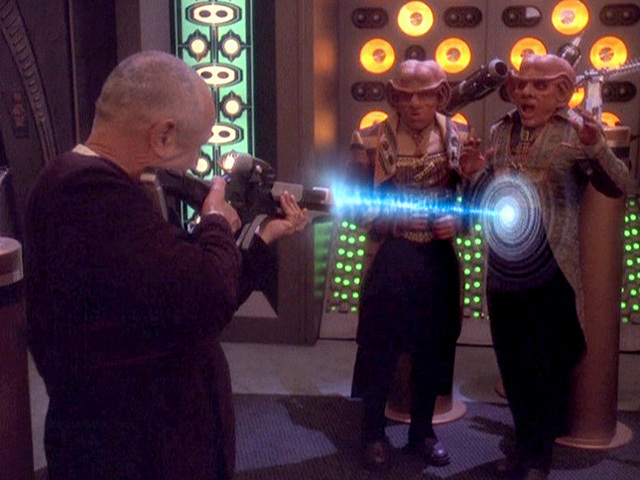
Stardate not given: Quark has just realized that he is practically bankrupt when his cousin Gaila proposes him a tempting deal. Quark is supposed to provide his holosuites for weapon demonstrations of the unscrupulous arms dealer Hagath. Quark witnesses how Hagath fires his associate Farrakk and later learns that Hagath killed the man. The deals having become an open secret on the station although the Bajoran Government allows them because Hagath once supplied the Resistance, all his friends turn their backs on Quark. When Hagath is going to sell weapons to the Regent of Palamar, which will result in the death of millions, Quark decides that the deal must not take place. He invites Nassuc to the station to "accidentally" encounter his enemy, the Regent of Palamar. While the regent is killed, Hagath and Gaila escape with Nassuc on their heels. Quark, however, has paid off his dues and regained his friends.
Review
It is no surprise to see that Quark is insolvent yet again, and that he is engaged in a dubious business yet again. Overall the idea of this episode includes only few new aspects, most obviously that this time Quark crosses the line to being utterly immoral and criminal. Speaking of criminals, Gaila, Quark's shady cousin that has been mentioned before appears for the first time. At one point, in DS9: "Little Green Men", Gaila even attempted to kill Quark, but so did Rom in DS9: "The Nagus". The family has anything but a clean record, and so far Quark appeared to be among its more decent members.
Now Quark follows the rules of the unscrupulous Hagath as readily as Hagath is willing to trust Quark. The desire to make a fortune unites the two men. Actually, there is even one thing I like about Hagath, that he is not giving the earned money directly to Quark until all debts are paid. I wish everyone who wastes money has a supervisor like that. ;-) Anyway, other than their quest for money the two don't have much in common. Quark still has a conscience, although it needs as many as 28 million prospective victims to finally convince him that his dealings are wrong. Quark's nightmare of "dead" crew members accusing him of murdering them is the turning point. It has been done in similar fashions quite often in the series, and I'm usually not fond of such tricks to visualize emotions. But this time, with the dabo table indicating that Quark loses, it works out well. Especially since Quark has no one he could actually talk to, not even Jadzia.
It leaves a bit of a bad taste how easily Quark apparently copes with Farrakk's death or that of the Regent, although they were both bad guys. I am not convinced that in the end everything is really as fine as it seems and I also don't think that Quark's friends should so readily forgive him. On the other hand, we have to take into account the legal situation, that the Bajoran Government insists that Hagath may continue selling weapons on the station because he supplied the Bajoran Resistance. I have to concede that this is a clever twist devised by the writers that allows Quark to carry on legally but scorned by everyone on the station. It also wouldn't give him many options to end his business relationship than with the trap he sets up.
I am not really fond of the secondary plot involving Miles O'Brien and his fruitless attempts to get his son Kirayoshi to stop crying. It is just too trivial, although it may have been meant to constitute a light-hearted antithesis to Quark's grave situation. At least the ironical outcome that either technology (the maintenance pit on the ops) or a Klingon warrior are the best surrogate fathers is funny.
Finally, while regular characters other than Quark appear only casually anyway, it is strange, even a bit irritating, that neither Rom nor Nog are in the episode.
Annotations
- Remarkable quotes:
- "28 million dead? Can't we just wound some of them?" (Quark)
- "Look out there. Millions and millions of stars. Millions upon millions of worlds. And right now, half of them are fanatically dedicated to destroying the other half. Now, do you think, if one of those twinkling lights suddenly went out, anybody would notice? — Suppose I offered you ten million bars of gold-pressed latinum to help turn out one of those lights. Would you really tell me to keep my money?" (Gaila)
- Remarkable fact: Curiously, the episode credits list Siddig El Fadil as the director, although, as an actor, he changed his name to Alexander Siddig with the beginning of the fourth season.
Rating: 4
Ties of Blood and Water
Synopsis
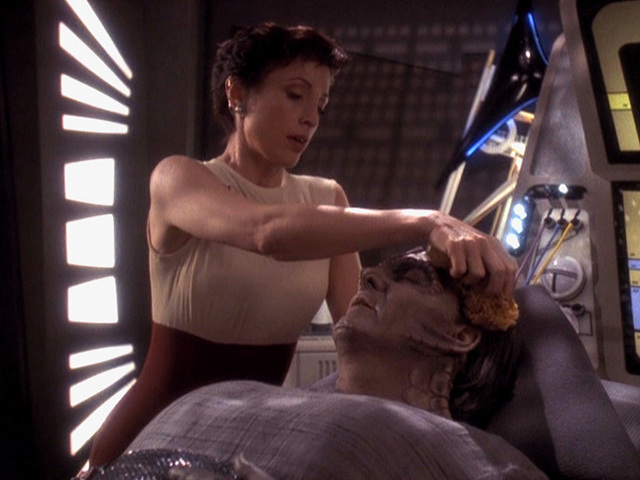
Stardate 50715.5: Tekeny Ghemor, the high-ranking Cardassian who once thought that Kira was his long-missing daughter, appears at the station. He is going to die soon, but not before revealing to his family the secrets he holds. As Ghemor doesn't seem to have any living relatives, he has elected his "daughter" Kira. She grudgingly agrees, seeing the opportunity to learn something to be used against the abhorred Cardassian-Dominion alliance. But then Gul Dukat appears and demands Ghemor to be turned over to him. He provides Kira with a military record stating that Ghemor, as a young man, took part in a massacre on Bajor. Kira turns away from Ghemor in disgust, but then remembers how she left her father to die when he needed her most. She joins the Cardassian in his last moments and buries him next to her father.
Review
This episode nicely wraps up the story that began in "Second Skin" in the third season when Kira was presented to Tekeny Ghemor as his long-lost daughter, who had infiltrated the Bajoran Resistance. Kira Nerys has a talent to decide quickly whether something is right or wrong, or whether someone is a friend or a foe. This is probably a holdover from her time in the Resistance. Now she is willing to move on and to give her former enemies, the Cardassians, a chance to redeem themselves in her eyes. Yet, she makes this exception only for Cardassian dissidents (formerly including Dukat) who support the Bajoran cause. Dukat's recent ploy of joining the Dominion facilitates her distinction of "good" and "bad" Cardassians even more.
Unfortunately for Kira her Cardassian "father" Ghemor has not always been the friend of the Bajorans she has imagined him to be. That she turns her back on him after learning of his participation in a massacre is certainly an emotional response. She could continue to talk to him because it is her duty and her cause, but ultimately it is another emotional response, her role as his "daughter", that reconciles them. Kira's flashbacks about her father nicely illustrate what she feels for Ghemor. I think the parallels between the two men are a bit factitious nonetheless. Yet, they bring forth the superb closing scene in which Kira buries Ghemor beside her father.
Something I find interesting but also worrying is how close Kira and Dukat still are despite his despicable treason. As he says himself, they have a perverse pleasure talking to one another. Why are Dukat and Weyoun, as clear enemies and without diplomatic immunity (because neither the Federation nor the Bajorans recognize their government) allowed to walk about the station anyway? It would be understandable if the Bajorans lynched them.
Annotations
- Remarkable dialogue: "Major Kira... friends with a Cardassian... seems wrong." - "You should have known her five years ago. Back then, I never thought she would be friends with anyone." (Worf and Jadzia)
- Remarkable quotes:
- "He doesn't seem to like you very much. We're going to have to do something about your public image. *grin*" (Weyoun, about Ghemor, to Dukat)
- "Vorta are immune to most forms of poison. Comes in handy when you're a diplomat. *giggle*" (Weyoun, after drinking a glass of the poison delivered to Ghemor)
- Remarkable facts:
- Shri-tal is the Cardassian tradition that a dying person tells secrets to a family member, to be used against their enemies.
- This is the first appearance of Weyoun 5. We learn that the Vorta are cloned. The preceding clone, Weyoun 4, was killed by Jem'Hadar Omet'iklan in DS9: "To the Death."
- Remarkable ship: This is the first time we can see the impressive Jem'Hadar battlecruiser up close.
Rating: 6
Ferengi Love Songs
Synopsis
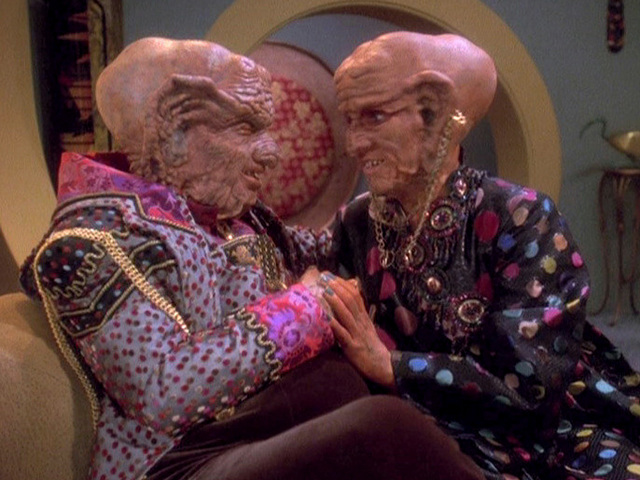
Stardate not given: Quark returns to Ferenginar to his mother's home. But Ishka is uneasy because she is secretly romantically involved with Grand Nagus Zek. When Quark discovers the liaison, he is thrilled but hopes in vain that Zek would restore his trade license, which only the FCA can do. Liquidator Brunt of the FCA proposes that Quark break up the relationship between Zek and Ishka to regain his license in return. The plan succeeds and Zek leaves Ishka, with Quark feigning sympathy. He agrees to become Zek's First Clerk and soon recognizes that the economic decisions of the Grand Nagus are disastrous without Ishka's advice. Quark helps Zek to redeem himself in the eyes of the Ferengi society, and he reunites the couple.
Review
This light-hearted episode shares the problem of most Ferengi-centered outings. It is fun to watch, but relies heavily on comedy clichés. The setting and the way the story takes reminds me a lot of soap operas. But I have to concede that "Ferengi Love Songs" remains on track where an overdose of silliness could easily derail it. I'm speaking of the moment when Quark finds the Nagus and his servant Mai'hardu hiding in his closet, and some time later Brunt. Yes, it is funny. Yet, I am glad that most other jokes in the episode wind up as more decent and still quite nifty, like the "Marauder Mo" figures that Moogie has been keeping for Quark. Most of all the pleasant characters save the episode, which becomes sort of a tragicomedy in its second half. It is touching to see Ishka cry when the Nagus has left her, or the Nagus who suffers from senility and doesn't want to admit it. In spite of everything it comes across that they are not simple caricatures but characters with feelings and desires, although the Ferengi appear a bit too human in everything they're doing. Well, Quark admits that he has been hanging around with "hew-mons" too long and has been "brainwashed" with their ethical values. But Ishka, Zek and Brunt represent human behavior and misbehavior just as well, even though they do it in an alien setting.
I also like Rom in this episode, because this time he gets himself into a real dilemma when he urges Leeta to sign an unfair Ferengi marriage treaty - based on his education and his bad experience with his ex-wife. Only that I doubt that his eventual solution, to donate all his money to a Bajoran orphan fund, will make anyone happier - except for the orphans, of course. Anyway, he has grown to more than just the clown who is always the last to notice anything.
Annotations
- Remarkable dialogues:
- "I know, I know. This is just a temporary setback. The bar will open again, and I'll get back to my life." - "I'm going to realize that." - "The trouble is, I hate my life." (Quark and Jadzia)
- "My Marauder Mo action figures. I thought you'd thrown these out." - "All these years I've been keeping them in storage for you. I figured you wanted to take them back to Deep Space 9 with you." - "I sure do. Do you have any idea how much these are worth?" - "Not as much as if you had kept them in the original packaging, which is what I told you at the time." (Quark and Ishka)
- Remarkable oddity: Rom quotes Horan's seventh prophecy as "He will come to the palace, carrying a chalice, bearing no malice, overflowing with sweet spring wine." Did he twist the translation to produce a rhyme?
Rating: 4
Soldiers of the Empire
Synopsis
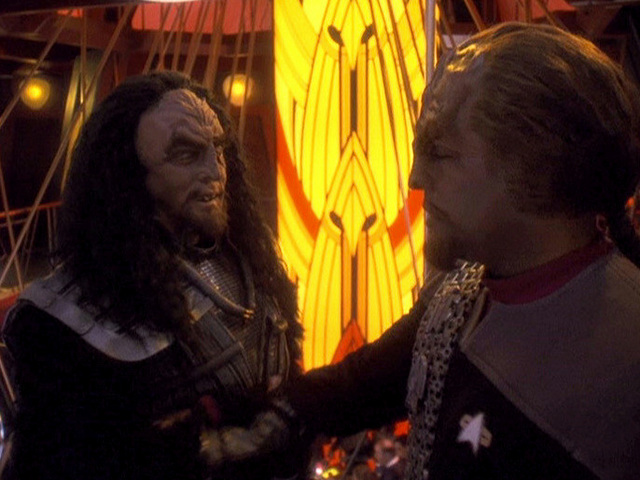
Stardate not given: General Martok assumes command of the Bird-of-Prey Rotarran. He takes Worf and Jadzia on a mission to search and rescue a missing Klingon ship, the B'Moth. But the crew of the Rotarran is war-weary, and Martok's attitude to evade confrontations with the Jem'Hadar only aggravates the depressive mood aboard the Rotarran. When they locate the B'Moth, Martok refuses to enter Cardassian space to save the survivors. Worf challenges Martok to a fight. He allows Martok to defeat him just when he notices that the crew's warrior spirit has been reawakened and a Jem'Hadar vessel is approaching. The Rotarran destroys the enemy ship and rescues 35 crew members from the B'Moth. Martok, grateful for what the son of Mogh has done for him, accepts Worf's entry into the house of Martok.
Review
"Soldiers of the Empire" will be remembered for showing the other side of the Klingon warrior spirit. Not every Klingon can always win or can die a glorious death in battle. There have to be single warriors or warships that barely survive a skirmish by withdrawing in time, which is lucky by human standards but ill-fated in a Klingon interpretation. The events on the Rotarran correct the image of Klingons to something more realistic, and more likable in its diversity. Still, her crew is not depicted as a bunch of overly "humanized" Klingons. They all still heed the principles of their culture or strive to do so. They only struggle over the right way to prove their worthiness. They are lacking a common goal and they are lacking leadership. And this is what makes them dangerously unstable as a crew, as Jadzia correctly recognizes.
Dax's sudden decision to join the Rotarran crew befits her capricious character, still it does not really make sense. As she has to concede herself, it is an occasion to be with Worf and to have some fun (or what she considers fun besides vacations on Risa). I wonder what the "old man" did off-screen to persuade Sisko to let her go. Overall, her being on the ship is a bit fabricated despite the importance of her role.
Surprisingly, when the rescue mission begins, it is not the frustrated Rotarran crew, but General Martok is the one who is overly cautious. Leskit suspects that Martok fears the Jem'Hadar because they broke him. The old Klingon may be correct, because Martok was in the Dominion prisoner camp, he has been practicing all along, he of all warriors should be prepared to enter a battle even with a second-rate crew on his side. However, the general may be actually afraid that his subordinates could fail again, possibly even giving credence to the alleged curse on the Rotarran. Based on the Rotarran's records Martok's apprehension may be justified, but in the eyes of the crew that desperately awaits a battle he must appear as a coward. The true reasons for his lack of motivation remain nebulous.
Out of loyalty and discipline Worf initially grudgingly supports Martok's orders although in his heart he feels more like everyone else aboard. Jadzia's ties to the crew are even much closer, which has to do with Worf being an outcast and the higher-ranking officer on this mission. But overall it is ironical that the only non-Klingon on the ship apparently knows best what the crew needs, followed by the Klingon without a house. In contrast, Martok's caution and the crew's unrest are the two positions that simply don't fit together and need to be corrected.
The inevitable fight would have to take place either between the crew and Worf or between Worf and Martok, as only the first officer is allowed to challenge the captain. By human standards the duel is certainly the least preferable option and a total waste especially if the two opponents are much rather expected to fight side by side. But remembering everything we have seen about the Klingons so far it makes sense as it re-awakens their spirit no matter who wins the challenge. The Rotarran crew are just waiting for something to happen. And as Worf proves, it does not have to be a fight to the death. This looks like a concession to human ethics in an episode that is overall dominated by Klingon philosophy.
Annotations
- Inconsistency: Worf apologizes to Martok for causing too much damage in the battle simulation, and the old Klingon bridge officer apologizes to Martok for his disrespect. Both are very polite. What happened to the Klingon ban on apologies, which was corroborated in the lesson Worf gave to his fellow officers in "Apocalypse Rising"?
- Remarkable quotes:
- "The Klingons are as diverse a people as any. Some of them are strong, and some of them are weak." (Jadzia)
- "Getting away is something we've become very good at. The Rotarran can run away from battle faster than any ship in the quadrant." (Leskit)
Rating: 6
Children of Time
Synopsis
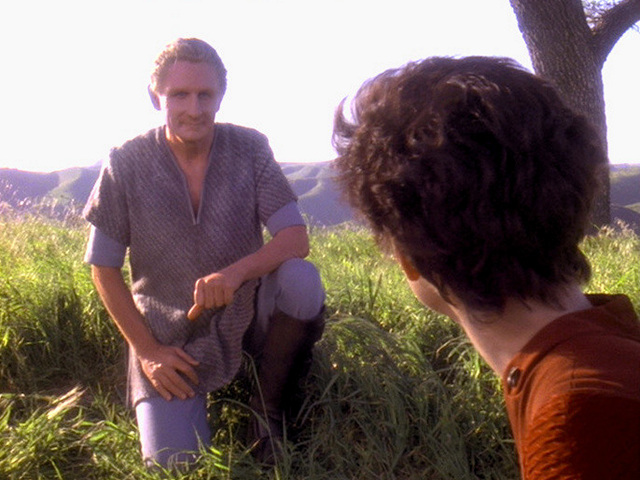
Stardate not given: While the Defiant is investigating an energy barrier around a planet in the Gamma Quadrant, Kira is struck by a plasma discharge. The crew discover a colony on the planet, led by a certain Miranda O'Brien and entirely populated by descendants of the Defiant crew. This is possible because upon their departure from the planet, the Defiant would enter the energy barrier again, would be hurled 200 years to the past and crash land. Trapped on the planet named Gaia, the crew would have to begin a new life and have several generations of children. Yedrin, the current Dax host on Gaia, claims to be working on a plan to duplicate the Defiant of which one would crash and one would make it through the barrier. But he has no hope that it could work, and his actual plan is to let the crash happen in order for his colony to continue to exist. Although Sisko's initial decision was to escape in order to save his first officer and to allow everyone to return to their families, he changes his mind after spending some time with the people on Gaia. He ultimately rules in their favor, with the approval of most of his crew. But the Odo of Gaia, who is still alive and still in love with Kira, changes the ship's course in a way that it would be able to cross the energy barrier unscathed. The people on Gaia cease to exist.
Review
"Children of Time" clearly stands out among the more recent time travel episodes because of its novel premise. Having the crew encounter their own descendants from a time anomaly is something never seen before. The idea of the quantum duplicate, like in TNG: "Parallels", that Yedrin puts forth is an additional clever twist. It is only a ruse here, and hence it ironically comments on the cases where similar theories were successfully put to work. Overall, it is a well-rounded story as it is possible only on the ground that Star Trek has been preparing all along, rather than any other science fiction series.
The probably biggest surprise of the episode, however, is Odo - the one who has been on Gaia all the time and who has learned to maintain his shape despite the anomaly. In some way it is the human Odo of the first half of the season, but the Odo from Gaia is also a lot more accessible and self-confident than the one we know. This Odo, the future version of the one who confessed his love to a fake Kira in DS9: "Heart of Stone" but never to the real one, has been waiting for his beloved to return for 200 years! Wow. It was a brilliant idea to bring in this second Odo in the course of the story, without the need to resort to another contrived trick. It is almost like the whole time travel plot is built around him, even rather than around the idea of the crew meeting their own descendants. Yet, this doesn't mean that the rest of the setting of Gaia, such as the "Sons of Mogh" (the young people following Worf's example), doesn't impress me just as well. I only think that Worf should have kept his promise to kill them in the face of their pending disappearance. Anyway, it is remarkable, for a change, to see Jadzia with pangs of remorse, and Yedrin Dax mirroring this sentiment.
The other characters, especially Sisko and O'Brien, are rather problematic. I have already given my more than two cents on the time travel and the ethical concerns about the outcome elsewhere. So the only thing I would like to repeat is that I find annoying how cutesiness beats true affection, how fatalism beats logic and how herd instinct beats sense of duty here. I still like the scene in which Sisko consults his senior staff, and Kira's and Worf's fatalism clashes with O'Brien's down-to-earth attitude. It is the last honest thing that happens in the episode. O'Brien and everyone else change their minds in spite of everything, while doing romanticized kibbuz work with even the "Sons of Mogh" participating and looking into all the cute children's faces that would be doomed to disappear forever. It seems to make sense, but actually it is a fabricated impression that the script imposes on us against all reason. It is kind of a setback in a so far fantastic episode, also because it is lucid anyway that the crew would eventually escape their "destiny" on Gaia. The way it happens, future Odo plays the scapegoat as he sabotages the Defiant. Fortunately no one but Kira explicitly blames him, but the crew comes out a bit hypocritical because they let someone else do what everyone would eventually be glad about. It may have been better (and more consistent) if in the end nobody remembered Gaia, the colony that was never meant to exist.
Annotations
- Nitpicking: What reconnaissance mission could be so vital that DS9 may be unshepherded with the complete senior crew gone for weeks, while the Dominion could attack any time? The station is not shown once in this whole episode, by the way.
- Remarkable dialogue: "All right. We'll make a quick survey. But if all we detect is some fungus, we're not beaming down." - "What if it's smart fungus?" (Sisko and Jadzia)
- Remarkable quotes:
- "It's something I want you to know, something I want to tell you for 200 years - I love you, Nerys. I always loved you." (Odo)
- "Ceasing to exist because my parents were never born - that is not a death worthy of Sto-vo-kor." (Brota)
- Remarkable fact: In the beginning, Kira mentions her break-up with Shakaar in Odo's presence.
Rating: 8
Blaze of Glory
Synopsis

Stardate not given: The Jem'Hadar have almost completely wiped out the Maquis who were fighting against the Cardassians. Yet, Sisko receives a message that the Maquis have launched a series of missiles against the Cardassians as a final retaliation. In order to stop the missiles, Sisko takes the reluctant Michael Eddington into the war zone where they have to evade two Jem'Hadar vessels. Eddington final gives in to Sisko's demand and leads the captain to Athos IV. After fending off two Jem'Hadar soldiers they don't find any weapons but a few Maquis survivors among many corpses. Eddington introduces Sisko to his wife Rebecca. The message about the missiles was a trick by Rebecca to let her husband know that she has safely arrived on Athos. But when the Jem'Hadar advance toward the hiding place, Eddington is wounded. He stays behind to provide coverage and is killed while valiantly battling the attackers.
Review
It is definitely a worthy swan song for Eddington and for the Maquis as a whole. Yet, the episode never gets quite as interesting as the teaser promises, in which Martok hands out to Sisko the intercepted recording about the missiles. It is clear from the start that Eddington is playing a game with Sisko besides his already well-known role as the victim of the obsessive Starfleet captain. It still comes as a little surprise that the missiles never existed. Given his record in the Maquis so far, we wouldn't put it past him that he may actually launch a retaliatory attack against Cardassia that may kill millions. On the other hand, he is still too much Starfleet to ever consider such a cruel act of revenge, and Sisko knows that. While Sisko and Eddington generally continue their petty struggle from "For the Uniform", it is good to see that they do manage to behave like normal people at times. And Eddington's eventual self-sacrifice out of love and loyalty gives the episode a nice twist. He dies the romantic way he has probably always envisioned for himself. Although he announced it to Sisko, I doubt anyway that he really had the intention to kill the captain. No, Eddington is too much concerned with always doing the right thing. He would have found a perfect excuse not to kill Sisko, like he did for everything else.
While eating a replicator meal, Eddington talks to Sisko about his new-gained appreciation of real food, "grown with my own hands", which does not fall on deaf ears. Their common interest in fresh food essentially serves to bring the two not so dissimilar characters closer together again for a moment, just before they fall back to their old debate. However, it should be noted that DS9 has always been a proponent of simple lifestyles. This is in contrast to TNG, where such an idea was often regarded as backward, and to Voyager, where it was usually shown as a necessity rather than a deliberate choice. After "Let He Who Is Without Sin" and "Children of Time" Eddington's way is one more recent example of technology criticism in DS9.
I sort of like the B-plot in this episode, in which Nog tries hard to gain the respect of the Klingons. Although Klingons and Ferengi don't mix like few other things in the Trek Universe, it never becomes silly.
Annotations
- Remarkable off-screen facts:
- Cal Hudson was killed in a skirmish with the Cardassians, as Eddington says.
- When Quark mentioned to Morn that the Dominion may attack the station and kill everyone, Morn hit Quark with a bar stool, ran out onto the promenade deck, screaming, "We're all doomed!"
- Remarkable dialogues:
- "You are either very brave, or very stupid, Ferengi!" - "Probably a little of both." - [Laughing] "Indeed. Courage comes in all sizes. But don't tempt fate." (Martok and Nog)
- "What would you have done if I hadn't forced you to come with me?" - "I would've volunteered." (Sisko and Eddington)
Rating: 6
Empok Nor
Synopsis

Stardate not given: A team of engineers with O'Brien, Garak and Nog take a runabout to the abandoned Cardassian station Empok Nor to salvage spare parts needed for repairs on Deep Space 9. On Empok Nor they discover two stasis tubes that have recently been activated. Two Cardassian soldiers, apparently under the influence of a psychotropic compound, are on the loose. They destroy the runabout and kill two of O'Brien's team. Garak tracks down one of the soldiers and kills him, acting increasingly erratically. The other one attacks two team members before Garak eliminates him too. But then the Cardassian tailor, who has been exposed to the drug as well, turns against the surviving crew member. Garak has captured Nog when O'Brien challenges him to a duel. But O'Brien detonates a phaser he has prepared, which knocks Garak unconscious without killing him, much to O'Brien's relief. The remainder of the team returns to Deep Space 9 with the spare parts.
Review
While it is superficially an action thriller, "Empok Nor" bears an underlying controversy. In a surprising twist Garak is affected by a psychotropic drug. He eventually turns against the Starfleet crew and even kills one of them. And he desecrates the bodies of the four dead crew members, for what it's worth. Although the drug may excuse his actions to some extent as Bashir explains, it is still essentially the same person who commits the crime, not something like an alien parasite in Garak. Star Trek usually doesn't go that far with characters that are slated to stay more or less likable. But DS9 crosses that line. This is not to the disadvantage of the episode, which may have wound up somewhat hypocritical if Garak's victim had survived. But just like Bashir, even O'Brien forgives him too readily in the end. I don't think that it should be as easy as blaming a "dark side" in a person for criminal conduct. A drug that "amplifies xenophobic tendencies" is a quite worrying idea anyway. The way it is described, it sounds like xenophobia is an inherent trait, rather than something that arises from education, experiences and social factors.
Garak's unsettling metamorphosis is especially noteworthy in the light of his latent conflict with O'Brien. It is already remarkable that the two are in the same away team in the first place. We know of the chief's involvement in the Cardassian War and particularly the Setlik Massacre since TNG: "The Wounded". While he doesn't have too much business with Cardassians on DS9 anyway, he always avoids them. And unlike his friend Bashir, he never talks more with the only resident Cardassian than the absolutely necessary minimum. They are the two most estranged regular characters of the show, just because they avoid contact instead of engaging in semi-humorous quibbles such as Quark and Odo. Well, Garak would enjoy an occasional little debate with the chief though. He provokes him several times in his uniquely polite fashion, also mentioning Setlik III — after all an event that caused a trauma in O'Brien. While O'Brien is the most skeptical mind among the station's staff anyway, Colm Meaney gives his character that inimitable "don't tread on me" expression whenever he is worried or annoyed. And Garak is an extreme annoyance to him, even without psychotropic drugs. The two don't mix at all because of their histories and because of their personalities, with O'Brien being very human and Garak very Cardassian.
Aside from that, "Empok Nor" benefits from a credible premise and a convincing execution. Empok Nor is particularly creepy because this dark and messy place otherwise looks just like Deep Space 9. The low-ranking crew members are more than just cannon fodder, although not a single one of them escapes the usual fate of redshirts. The Bolian strikes me as overly anxious for a member of Starfleet though. On a humorous note, the episode has another waste extraction reference. There are quite a few of them in this season, considering that this topic is normally never talked about.
Annotations
- Remarkable quotes:
- "Really. It's just that lately I noticed that everyone seems to trust me. It's quite unnerving, I'm still trying to get used to it. Next thing I know is people are inviting me to their homes for dinner." (Garak, to O'Brien)
- "It's a shame. And the worst part of it is, this isn't a coil spanner. [Stabbing the crewman] It's a flux coupler." (Garak)
- Remarkable station: Empok Nor has the same design as Terok Nor. It is rather odd though that the abandoned station is always shown as tilted (as a means to distinguish the to stations), although there is evidently no up and down in space.
Rating: 7
In the Cards
Synopsis

Stardate 50929.4: Jake decides to cheer up his dad who is depressed in the face of the bad news about the ever worse warmongering of the Dominion. In an auction at Quark's he and Nog bid on an ancient baseball card, but a man named Dr. Giger outbids them. When they approach Giger, he tells Jake and Nog that he would trade the card for a variety of supplies that he needs for his cellular regeneration chamber. After collecting the requested items, Jake and Nog are surprised that Giger's quarters are empty and that he allegedly never dwelt there. In a paranoid move Jake suspects that Kai Winn, who is on the station negotiating a non-aggression pact with the Dominion, has something to do with Giger's disappearance and confronts the Bajoran religious leader. Sisko is infuriated, but still with the intention to get that baseball card as a surprise, Jake doesn't tell the truth. On the way to their quarters Jake and Nog are suddenly beamed to Vorta Weyoun's ship where Giger is held captive too. When Weyoun doesn't buy the story about the baseball card, Jake conceives a conspiracy theory so absurd that Weyoun allows them to leave with the baseball card.
Review
Even though it has some entertaining merit, I think this is the crappiest episode of the season. Basing the story on the baseball card that Jake wants to get for his father at any cost is ridiculous to start with. It is the first of many contrived coincidences that Jake is just thinking of something to cheer up his dad when Nog spots the baseball card in his uncle's auction listing. And realistically, would Nog be ready to spend all his savings just to buy one pathetic gift? I also don't like the involvement of the senior staff. Their only purpose is to procure supplies to Jake and Nog in exchange for little favors, like stealing Kukalaka, the teddy bear, from Leeta's quarters for Bashir. The way everyone is bartering with everyone else in this episode is wacky.
I admit that Giger's character is out of the ordinary because we can never really make sense of him. Unlike other obsessed scientists that we have seen on Star Trek, his research is so odd that even the laymen Nog and Jake think he is crazy. And his weird idea of being pursued by the "soulless minions of orthodoxy", the 24th century equivalent of the "black helicopters", doesn't exactly make him more credible. Giger's disappearance may have been worked into a mystery story. I remember I was hoping for such a twist the first time I watched, when Nog and Jake try to convince Odo that Giger indeed exists. But rather than that the two plot threads are woven together in an awkward fashion. In my view it simply doesn't work to embed the Dominion into a humorous premise.
Aside from that the episode certainly does its job of foreshadowing the Dominion War and saving Bajor through the proposed Bajoran-Dominion treaty. It thereby corroborates Sisko's vision in "Rapture" that with Bajor as a member the Federation the planet would be doomed. Unlike the baseball card affair the political and military considerations absolutely make sense. And they make curious how the pact with the devil will turn out for Bajor.
Annotations
- Remarkable dialogue: "I'm concerned. The Dominion is notorious for its political intrigue." - "Oh, I have some experience in that area as well." (Sisko and Kai Winn)
- Remarkable quote: "We need that card. The entire future of the galaxy may depend on us tracking down Willy Mace and stopping him." (Jake, to Weyoun)
- Remarkable scene: Weyoun tells Kai Winn that he thinks they are much alike. Winn then grabs his ear, stating, "No, we're nothing alike." But while Weyoun is smiling after she has left, Winn's facial expression is very uncertain.
Rating: 2
Call to Arms
Synopsis
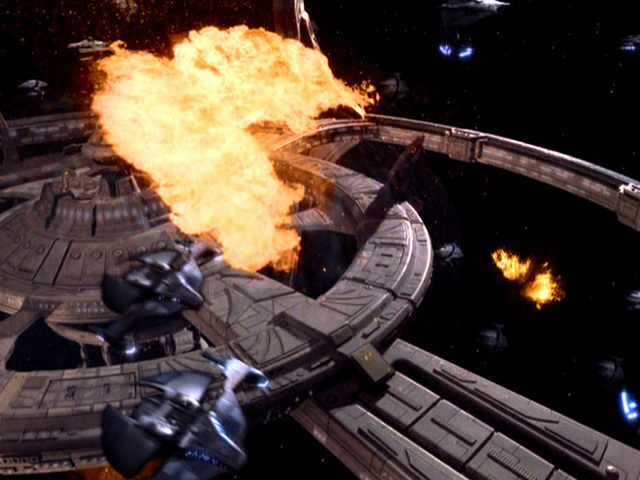
Stardate not given: The crew of Deep Space 9 discuss ways to protect the Alpha Quadrant against Dominion reinforcements from the Gamma Quadrant, when Rom comes up with the idea to deploy self-replicating mines at the wormhole entrance. Using the Defiant, Dax and O'Brien begin to drop the mines. Rom hurriedly marries Leeta. With no further support to be expected from Starfleet and with a Dominion fleet arriving from Cardassia to seize the station, Sisko orders Deep Space 9 to be evacuated. The Dominion attack begins while the Defiant is still building the minefield, protected only by Martok's Rotarran. As soon as the minefield is completed, all Starfleet personnel withdraws, leaving only the Bajoran crew who "welcomes" their Dominion "guests" led by Weyoun and Dukat under the terms of the non-aggression treaty - but not before Kira has disabled most of the station's systems. While the Dominion was distracted at Deep Space 9, Starfleet has taken the opportunity to destroy a Dominion shipyard. Sisko promises to return, joining a fleet of the Federation. He is furious, however, when he learns that Jake has chosen to stay behind and report on the ensuing war.
Review
"Call to Arms" does a terrific job in making the political and strategic matters transparent without going too much into details that may appear unrealistic. Everything fits together in this episode, and it is exciting to watch as well. I wondered why it comes as such a surprise that Sisko supports Bajor's non-aggression treaty with the Dominion. He was not really opposed to it when he talked to Kai Winn. But his official refusal makes sense, as it may buy Bajor and DS9 some time (well, unless the Dominion decided breach its promise not to attack Bajor...).
It is amazing how great a deal of private issues were packed into the 45 minutes of the episode. Naturally all of them have something to do with the impending war. Miles O'Brien mentions that his family has left for Earth. Ben Sisko is surprised that his son publishes first-hand stories about the preparations for the war. Leeta and Rom are eager to get married before the war breaks out. Quark and Rom reaffirm their family ties. Kira needs to talk with Jadzia and later with Odo himself about Odo's feelings; they decide to keep their relationship on a professional level. Ziyal and Garak have to separate for the time being, as Garak would not exactly be welcome on Bajor. Jadzia and Worf vow to get married. Quark orders yarmok sauce for the Cardassians, just the supplies he was glad to get rid of in DS9: "Progress", when Jake and Nog traded them for self-sealing stembolts. These unusually quick changes of the focus intensify the impression that something troublesome is in the air. Well, this is a bit like in disaster movies of the 70s, but hey, I liked a couple of them.
We always knew that straightforward thinking is not exactly one of Rom's strengths. He can be a genius with his out-of-the-box ideas, but he may just as well be a jerk who doesn't even get everyday tasks managed. And now he jumps forth and back between the two roles when he proposes the self-replicating mines, only to worry about details of his marriage a split second later and then hurry to the waste extraction. I used to have a few problems with Rom until this episode, but as unrealistic as his erratic trains of thought seem at times, his unique character has grown to a valuable asset of the series.
Nitpicking: The destruction of the ship yards may have been deemed a top priority. Yet, it is inconclusive why Starfleet couldn't spare at least one or two ships to protect the station until the minefield is up. The Defiant and the Rotarran barely manage to fend off the attack, and if they failed, the cause to seal off the Alpha Quadrant would be lost. Moreover, doesn't it make the Dominion suspicious if there are no additional ships at DS9?
I also wonder how the Dominion could have possibly agreed to a cease-fire of several minutes, long enough for all Starfleet personnel being able to leave the station and even for Sisko to hold a speech. Would Weyoun and Dukat really forego the opportunity to kill them all or to get prominent prisoners?
Annotations
- Remarkable dialogue: "Captain, as a major in the Bajoran militia, I must officially protest Starfleet's refusal to turn over this station to my government." - "Your protest is duly noted." - "Good. Now that's over with. Kira Nerys reporting for duty." (Sisko and Kira)
- Remarkable quote: "Well, that was the most pathetic excuse for a wedding ceremony I have ever seen. No bridal auction, no latinum dances, and the bride - the bride was severely overdressed." (Quark)
Rating: 8